SUBSCRIBE TO OUR FREE NEWSLETTER
Daily news & progressive opinion—funded by the people, not the corporations—delivered straight to your inbox.
5
#000000
#FFFFFF
To donate by check, phone, or other method, see our More Ways to Give page.
Daily news & progressive opinion—funded by the people, not the corporations—delivered straight to your inbox.
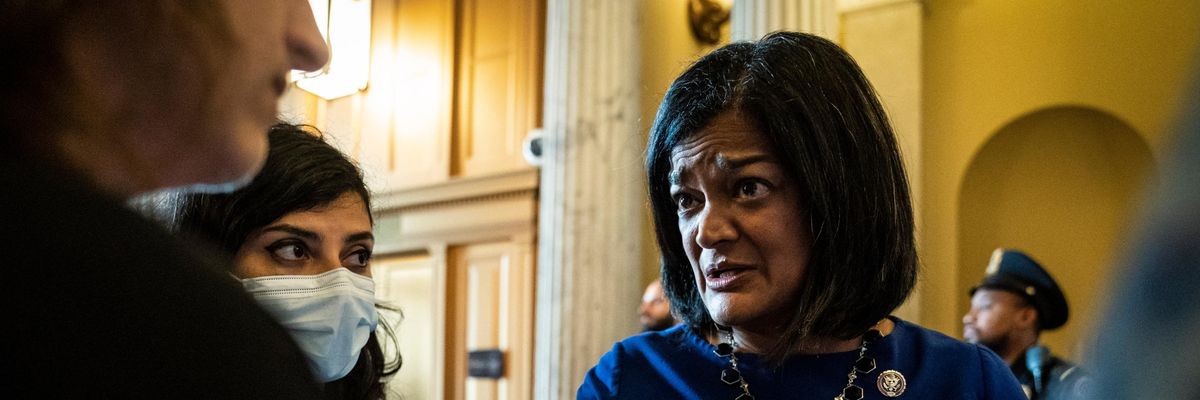
Rep. Pramila Jayapal (D-Wash.) speaks with reporters after a vote on Capitol Hill on Thursday, July 28, 2022 in Washington, D.C. (Photo: Jabin Botsford/The Washington Post via Getty Images)
Rep. Pramila Jayapal on Monday said Democratic leaders had made it impossible to bring a bill banning stock trading by federal lawmakers up for a vote last month by holding discussions about the legislation behind closed doors--a process that she suggested sabotaged an opportunity to pass a bill with broad public support ahead of the midterms.
The Congressional Progressive Caucus chair said in a press call that House Speaker Nancy Pelosi's (D-Calif.) decision to direct the House Administration Committee to draft a proposal left members unaware of "what was happening with the bill," which was released just before they were scheduled to go on recess.
"A lot of folks are calling the release of any text a step forward. But it's not a genuine step forward."
The Washington Democrat told reporters that she couldn't "speak to people's intentions" regarding why lawmakers were given so little time to review the legislation, but noted that House Majority Leader Steny Hoyer (D-Md.) made it clear last week that he would not support reforms to the STOCK Act in order to restrict trading by members and avoid conflicts of interest.
"We weren't really brought into the process," Jayapal said. "The way in which it was released, and the timing of it, and the fact that it never even got to come to a vote, and the fact that some members--even of leadership--were not supportive of it, was very difficult for us."
As The Intercept reported last week, the version that was released by the committee did not take into account Jayapal's proposal for a ban, which she co-authored with Rep. Matt Rosendale (R-Mont.). Jayapal is one of the five Democrats who have recently sponsored legislation to ban stock trading on Capitol Hill.
"This should have been a no-brainer in terms of being able to craft it in a way that kept our Republican support--that some of us had already managed to get on our bills--and gotten enough Democratic support to pass the House," Jayapal said.
Several members said discrepancies between the bill that the House Administration Committee negotiated and the bipartisan proposals that had previously been proposed left them unwilling to vote on the package before the recess. The Intercept reported that "non-starters" included "issues around the structure of qualified blind trusts, the inclusion of dependent children in the ban, and a measure expanding the ethics rules to members of the judiciary--sticking points that negotiators addressed in bipartisan reforms hashed out earlier this year."
"We have bills that were bicameral and bipartisan, and none of us involved with those were consulted, and now we have a bill that can't move," a Democratic staffer told The Intercept last week. "A lot of folks are calling the release of any text a step forward. But it's not a genuine step forward."
Economic justice group Patriotic Millionaires said Tuesday that Democratic leaders' decision-making regarding the legislative process amounted to "suspicious activity."
"There are too many careless actions here to be a genuine mistake," said the group.
Before finally allowing the party to negotiate a package, Pelosi expressed opposition to a ban on stock trading by members late last year, even after a report showed dozens of conflicts of interest by lawmakers who own stock in the healthcare sector and other industries that they are tasked with regulating.
Last month, as the package was being written, a New York Times investigation revealed that nearly 100 members of Congress owned stocks in companies influenced by their congressional committees.
A poll published last week by Stand Up America and Data for Progress, a day after the text of the package was released, showed that nearly 80% of Americans support banning stock trading for their representatives in Washington.
In a conversation on Twitter Spaces Tuesday with Rep. Raja Krishnanmoorthi (D-Ill.), who has also sponsored stock trading ban legislation, Citizens for Responsibility and Ethics in Washington (CREW) expressed hope that legislation can be passed after the midterms.
"Close the trust loophole, and apply the bill to only Congress, and then pass a bill on congressional stock trading," tweeted CREW. "It's time to get this done."
Dear Common Dreams reader, It’s been nearly 30 years since I co-founded Common Dreams with my late wife, Lina Newhouser. We had the radical notion that journalism should serve the public good, not corporate profits. It was clear to us from the outset what it would take to build such a project. No paid advertisements. No corporate sponsors. No millionaire publisher telling us what to think or do. Many people said we wouldn't last a year, but we proved those doubters wrong. Together with a tremendous team of journalists and dedicated staff, we built an independent media outlet free from the constraints of profits and corporate control. Our mission has always been simple: To inform. To inspire. To ignite change for the common good. Building Common Dreams was not easy. Our survival was never guaranteed. When you take on the most powerful forces—Wall Street greed, fossil fuel industry destruction, Big Tech lobbyists, and uber-rich oligarchs who have spent billions upon billions rigging the economy and democracy in their favor—the only bulwark you have is supporters who believe in your work. But here’s the urgent message from me today. It's never been this bad out there. And it's never been this hard to keep us going. At the very moment Common Dreams is most needed, the threats we face are intensifying. We need your support now more than ever. We don't accept corporate advertising and never will. We don't have a paywall because we don't think people should be blocked from critical news based on their ability to pay. Everything we do is funded by the donations of readers like you. When everyone does the little they can afford, we are strong. But if that support retreats or dries up, so do we. Will you donate now to make sure Common Dreams not only survives but thrives? —Craig Brown, Co-founder |
Rep. Pramila Jayapal on Monday said Democratic leaders had made it impossible to bring a bill banning stock trading by federal lawmakers up for a vote last month by holding discussions about the legislation behind closed doors--a process that she suggested sabotaged an opportunity to pass a bill with broad public support ahead of the midterms.
The Congressional Progressive Caucus chair said in a press call that House Speaker Nancy Pelosi's (D-Calif.) decision to direct the House Administration Committee to draft a proposal left members unaware of "what was happening with the bill," which was released just before they were scheduled to go on recess.
"A lot of folks are calling the release of any text a step forward. But it's not a genuine step forward."
The Washington Democrat told reporters that she couldn't "speak to people's intentions" regarding why lawmakers were given so little time to review the legislation, but noted that House Majority Leader Steny Hoyer (D-Md.) made it clear last week that he would not support reforms to the STOCK Act in order to restrict trading by members and avoid conflicts of interest.
"We weren't really brought into the process," Jayapal said. "The way in which it was released, and the timing of it, and the fact that it never even got to come to a vote, and the fact that some members--even of leadership--were not supportive of it, was very difficult for us."
As The Intercept reported last week, the version that was released by the committee did not take into account Jayapal's proposal for a ban, which she co-authored with Rep. Matt Rosendale (R-Mont.). Jayapal is one of the five Democrats who have recently sponsored legislation to ban stock trading on Capitol Hill.
"This should have been a no-brainer in terms of being able to craft it in a way that kept our Republican support--that some of us had already managed to get on our bills--and gotten enough Democratic support to pass the House," Jayapal said.
Several members said discrepancies between the bill that the House Administration Committee negotiated and the bipartisan proposals that had previously been proposed left them unwilling to vote on the package before the recess. The Intercept reported that "non-starters" included "issues around the structure of qualified blind trusts, the inclusion of dependent children in the ban, and a measure expanding the ethics rules to members of the judiciary--sticking points that negotiators addressed in bipartisan reforms hashed out earlier this year."
"We have bills that were bicameral and bipartisan, and none of us involved with those were consulted, and now we have a bill that can't move," a Democratic staffer told The Intercept last week. "A lot of folks are calling the release of any text a step forward. But it's not a genuine step forward."
Economic justice group Patriotic Millionaires said Tuesday that Democratic leaders' decision-making regarding the legislative process amounted to "suspicious activity."
"There are too many careless actions here to be a genuine mistake," said the group.
Before finally allowing the party to negotiate a package, Pelosi expressed opposition to a ban on stock trading by members late last year, even after a report showed dozens of conflicts of interest by lawmakers who own stock in the healthcare sector and other industries that they are tasked with regulating.
Last month, as the package was being written, a New York Times investigation revealed that nearly 100 members of Congress owned stocks in companies influenced by their congressional committees.
A poll published last week by Stand Up America and Data for Progress, a day after the text of the package was released, showed that nearly 80% of Americans support banning stock trading for their representatives in Washington.
In a conversation on Twitter Spaces Tuesday with Rep. Raja Krishnanmoorthi (D-Ill.), who has also sponsored stock trading ban legislation, Citizens for Responsibility and Ethics in Washington (CREW) expressed hope that legislation can be passed after the midterms.
"Close the trust loophole, and apply the bill to only Congress, and then pass a bill on congressional stock trading," tweeted CREW. "It's time to get this done."
Rep. Pramila Jayapal on Monday said Democratic leaders had made it impossible to bring a bill banning stock trading by federal lawmakers up for a vote last month by holding discussions about the legislation behind closed doors--a process that she suggested sabotaged an opportunity to pass a bill with broad public support ahead of the midterms.
The Congressional Progressive Caucus chair said in a press call that House Speaker Nancy Pelosi's (D-Calif.) decision to direct the House Administration Committee to draft a proposal left members unaware of "what was happening with the bill," which was released just before they were scheduled to go on recess.
"A lot of folks are calling the release of any text a step forward. But it's not a genuine step forward."
The Washington Democrat told reporters that she couldn't "speak to people's intentions" regarding why lawmakers were given so little time to review the legislation, but noted that House Majority Leader Steny Hoyer (D-Md.) made it clear last week that he would not support reforms to the STOCK Act in order to restrict trading by members and avoid conflicts of interest.
"We weren't really brought into the process," Jayapal said. "The way in which it was released, and the timing of it, and the fact that it never even got to come to a vote, and the fact that some members--even of leadership--were not supportive of it, was very difficult for us."
As The Intercept reported last week, the version that was released by the committee did not take into account Jayapal's proposal for a ban, which she co-authored with Rep. Matt Rosendale (R-Mont.). Jayapal is one of the five Democrats who have recently sponsored legislation to ban stock trading on Capitol Hill.
"This should have been a no-brainer in terms of being able to craft it in a way that kept our Republican support--that some of us had already managed to get on our bills--and gotten enough Democratic support to pass the House," Jayapal said.
Several members said discrepancies between the bill that the House Administration Committee negotiated and the bipartisan proposals that had previously been proposed left them unwilling to vote on the package before the recess. The Intercept reported that "non-starters" included "issues around the structure of qualified blind trusts, the inclusion of dependent children in the ban, and a measure expanding the ethics rules to members of the judiciary--sticking points that negotiators addressed in bipartisan reforms hashed out earlier this year."
"We have bills that were bicameral and bipartisan, and none of us involved with those were consulted, and now we have a bill that can't move," a Democratic staffer told The Intercept last week. "A lot of folks are calling the release of any text a step forward. But it's not a genuine step forward."
Economic justice group Patriotic Millionaires said Tuesday that Democratic leaders' decision-making regarding the legislative process amounted to "suspicious activity."
"There are too many careless actions here to be a genuine mistake," said the group.
Before finally allowing the party to negotiate a package, Pelosi expressed opposition to a ban on stock trading by members late last year, even after a report showed dozens of conflicts of interest by lawmakers who own stock in the healthcare sector and other industries that they are tasked with regulating.
Last month, as the package was being written, a New York Times investigation revealed that nearly 100 members of Congress owned stocks in companies influenced by their congressional committees.
A poll published last week by Stand Up America and Data for Progress, a day after the text of the package was released, showed that nearly 80% of Americans support banning stock trading for their representatives in Washington.
In a conversation on Twitter Spaces Tuesday with Rep. Raja Krishnanmoorthi (D-Ill.), who has also sponsored stock trading ban legislation, Citizens for Responsibility and Ethics in Washington (CREW) expressed hope that legislation can be passed after the midterms.
"Close the trust loophole, and apply the bill to only Congress, and then pass a bill on congressional stock trading," tweeted CREW. "It's time to get this done."