SUBSCRIBE TO OUR FREE NEWSLETTER
Daily news & progressive opinion—funded by the people, not the corporations—delivered straight to your inbox.
5
#000000
#FFFFFF
To donate by check, phone, or other method, see our More Ways to Give page.
Daily news & progressive opinion—funded by the people, not the corporations—delivered straight to your inbox.
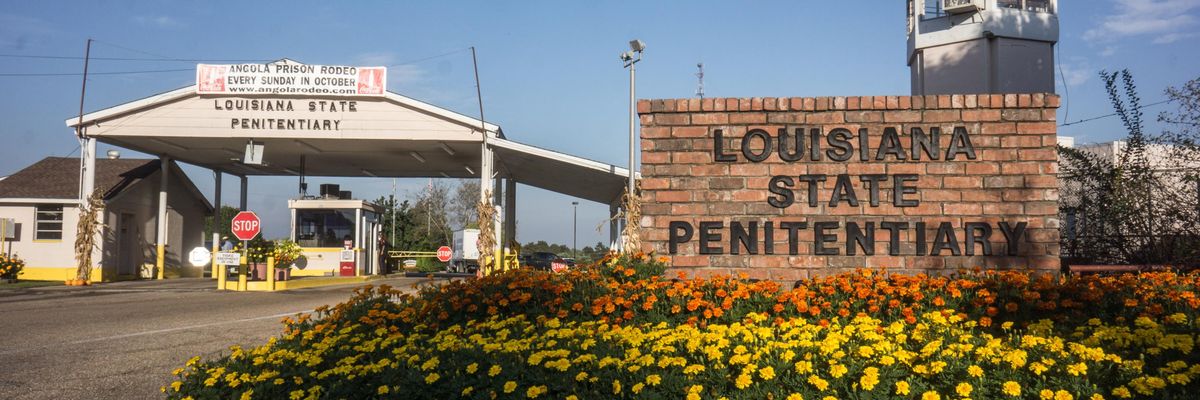
The entrance of the Louisiana State Penitentiary, also known as Angola and nicknamed the "Alcatraz of the South" and "The Farm" is seen on October 14, 2013. (Photo: Giles Clarke/Getty Images)
Critics of mass incarceration are condemning a ruling handed down late Friday by a federal judge in Louisiana, who admitted the state's plan to send teenage inmates at a juvenile detention center to the notorious state penitentiary at Angola was "disturbing" even as she decided the plan could move forward.
Chief U.S. District Judge Shelly Dick ruled that the Office of Juvenile Justice (OJJ) can send two dozen children under the age of 18 from Bridge City Center for Youth, located outside New Orleans, to the Louisiana State Penitentiary, denying a motion brought by several law firms and the ACLU to halt the plan.
The plan was proposed by the OJJ after a series of escapes from the Bridge City Center, which were also used as the reasoning behind subjecting youths in the facility to solitary confinement earlier this year.
Dick said in her ruling that "locking children in cells at night at Angola is untenable" but that the state cannot tolerate "the threat of harm these youngsters present to themselves, and others."
She also noted that some of the youths who may be sent to Angola are "traumatized and emotionally and psychologically disturbed" but suggested that the state prison, the largest maximum security prison in the U.S., can provide a more "secure care environment" for them.
Ahead of the ruling, the ACLU warned on Thursday that the plan is "unprecedented and dangerous."
Plaintiffs in the case have accused the state of failing to take "ample opportunity to enact meaningful reforms that act in the best interest of our young people."
"Instead the state has continued to push forward unjust policies and actions that only further traumatize incarcerated youth, their families, and communities," said Gina Womack, co-founder and executive director of Families and Friends of Louisiana's Incarcerated Children (FFLIC), last month. "The move defies all common sense and best practices, and it will cause irrevocable damage to our youth and families."
According to a court filing by the ACLU, youths transferred to Angola will be held "in windowless cells with floor to ceiling metal bars."
Children at the Bridge City Center have been distraught over the possibility of being sent to Angola, The Appeal reported this week, with one 17-year-old suffering from post-traumatic stress disorder starting to "tear out his hair and to not be able to sleep," according to a statement filed in court by his mother.
"Louisiana is failing to protect youth in [its] juvenile justice system!" said Chelsea Maldonado, an investigative researcher for the podcast "Trapped in Treatment."
It was unclear Saturday when the transfers may take place.
Dear Common Dreams reader, It’s been nearly 30 years since I co-founded Common Dreams with my late wife, Lina Newhouser. We had the radical notion that journalism should serve the public good, not corporate profits. It was clear to us from the outset what it would take to build such a project. No paid advertisements. No corporate sponsors. No millionaire publisher telling us what to think or do. Many people said we wouldn't last a year, but we proved those doubters wrong. Together with a tremendous team of journalists and dedicated staff, we built an independent media outlet free from the constraints of profits and corporate control. Our mission has always been simple: To inform. To inspire. To ignite change for the common good. Building Common Dreams was not easy. Our survival was never guaranteed. When you take on the most powerful forces—Wall Street greed, fossil fuel industry destruction, Big Tech lobbyists, and uber-rich oligarchs who have spent billions upon billions rigging the economy and democracy in their favor—the only bulwark you have is supporters who believe in your work. But here’s the urgent message from me today. It's never been this bad out there. And it's never been this hard to keep us going. At the very moment Common Dreams is most needed, the threats we face are intensifying. We need your support now more than ever. We don't accept corporate advertising and never will. We don't have a paywall because we don't think people should be blocked from critical news based on their ability to pay. Everything we do is funded by the donations of readers like you. When everyone does the little they can afford, we are strong. But if that support retreats or dries up, so do we. Will you donate now to make sure Common Dreams not only survives but thrives? —Craig Brown, Co-founder |
Critics of mass incarceration are condemning a ruling handed down late Friday by a federal judge in Louisiana, who admitted the state's plan to send teenage inmates at a juvenile detention center to the notorious state penitentiary at Angola was "disturbing" even as she decided the plan could move forward.
Chief U.S. District Judge Shelly Dick ruled that the Office of Juvenile Justice (OJJ) can send two dozen children under the age of 18 from Bridge City Center for Youth, located outside New Orleans, to the Louisiana State Penitentiary, denying a motion brought by several law firms and the ACLU to halt the plan.
The plan was proposed by the OJJ after a series of escapes from the Bridge City Center, which were also used as the reasoning behind subjecting youths in the facility to solitary confinement earlier this year.
Dick said in her ruling that "locking children in cells at night at Angola is untenable" but that the state cannot tolerate "the threat of harm these youngsters present to themselves, and others."
She also noted that some of the youths who may be sent to Angola are "traumatized and emotionally and psychologically disturbed" but suggested that the state prison, the largest maximum security prison in the U.S., can provide a more "secure care environment" for them.
Ahead of the ruling, the ACLU warned on Thursday that the plan is "unprecedented and dangerous."
Plaintiffs in the case have accused the state of failing to take "ample opportunity to enact meaningful reforms that act in the best interest of our young people."
"Instead the state has continued to push forward unjust policies and actions that only further traumatize incarcerated youth, their families, and communities," said Gina Womack, co-founder and executive director of Families and Friends of Louisiana's Incarcerated Children (FFLIC), last month. "The move defies all common sense and best practices, and it will cause irrevocable damage to our youth and families."
According to a court filing by the ACLU, youths transferred to Angola will be held "in windowless cells with floor to ceiling metal bars."
Children at the Bridge City Center have been distraught over the possibility of being sent to Angola, The Appeal reported this week, with one 17-year-old suffering from post-traumatic stress disorder starting to "tear out his hair and to not be able to sleep," according to a statement filed in court by his mother.
"Louisiana is failing to protect youth in [its] juvenile justice system!" said Chelsea Maldonado, an investigative researcher for the podcast "Trapped in Treatment."
It was unclear Saturday when the transfers may take place.
Critics of mass incarceration are condemning a ruling handed down late Friday by a federal judge in Louisiana, who admitted the state's plan to send teenage inmates at a juvenile detention center to the notorious state penitentiary at Angola was "disturbing" even as she decided the plan could move forward.
Chief U.S. District Judge Shelly Dick ruled that the Office of Juvenile Justice (OJJ) can send two dozen children under the age of 18 from Bridge City Center for Youth, located outside New Orleans, to the Louisiana State Penitentiary, denying a motion brought by several law firms and the ACLU to halt the plan.
The plan was proposed by the OJJ after a series of escapes from the Bridge City Center, which were also used as the reasoning behind subjecting youths in the facility to solitary confinement earlier this year.
Dick said in her ruling that "locking children in cells at night at Angola is untenable" but that the state cannot tolerate "the threat of harm these youngsters present to themselves, and others."
She also noted that some of the youths who may be sent to Angola are "traumatized and emotionally and psychologically disturbed" but suggested that the state prison, the largest maximum security prison in the U.S., can provide a more "secure care environment" for them.
Ahead of the ruling, the ACLU warned on Thursday that the plan is "unprecedented and dangerous."
Plaintiffs in the case have accused the state of failing to take "ample opportunity to enact meaningful reforms that act in the best interest of our young people."
"Instead the state has continued to push forward unjust policies and actions that only further traumatize incarcerated youth, their families, and communities," said Gina Womack, co-founder and executive director of Families and Friends of Louisiana's Incarcerated Children (FFLIC), last month. "The move defies all common sense and best practices, and it will cause irrevocable damage to our youth and families."
According to a court filing by the ACLU, youths transferred to Angola will be held "in windowless cells with floor to ceiling metal bars."
Children at the Bridge City Center have been distraught over the possibility of being sent to Angola, The Appeal reported this week, with one 17-year-old suffering from post-traumatic stress disorder starting to "tear out his hair and to not be able to sleep," according to a statement filed in court by his mother.
"Louisiana is failing to protect youth in [its] juvenile justice system!" said Chelsea Maldonado, an investigative researcher for the podcast "Trapped in Treatment."
It was unclear Saturday when the transfers may take place.