SUBSCRIBE TO OUR FREE NEWSLETTER
Daily news & progressive opinion—funded by the people, not the corporations—delivered straight to your inbox.
5
#000000
#FFFFFF
To donate by check, phone, or other method, see our More Ways to Give page.
Daily news & progressive opinion—funded by the people, not the corporations—delivered straight to your inbox.
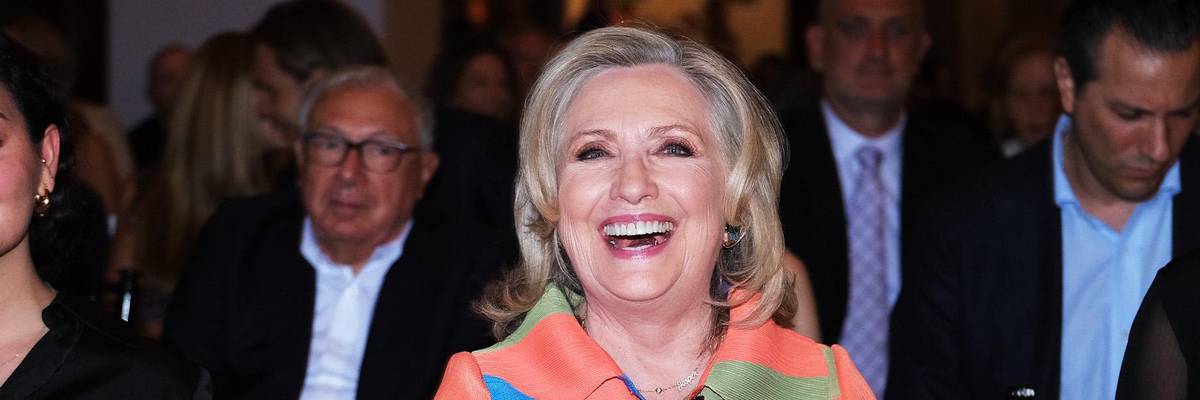
Hillary Rodham Clinton attends the 79th Venice International Film Festival on September 1, 2022 in Venice, Italy. (Photo: Stefano Mazzola/Getty Images)
Hillary Clinton has come under fire for her Thursday comments about the positive implications if Giorgia Meloni becomes Italy's first woman prime minister, with critics warning that the far-right candidate's agenda poses a direct threat to the fight for gender and economic equality.
Italy is scheduled to hold its general election on September 25, and "polls are led by Giorgia Meloni's Fratelli d'Italia, part of a right-wing coalition widely expected to secure a majority of seats," historian David Broder, Jacobin's Europe editor, explained Friday. "With her own party backed by around one-quarter of voters, Meloni looks likely to become prime minister."
Taking time away from the Venice International Film Festival to speak with Italy's leading newspaper, Il Corriere della Sera, Clinton warned of "very powerful" anti-democratic forces around the world, including authoritarian demagogues like former U.S. President Donald Trump.
But when asked about the Italian political scene, Clinton said that "the election of the first woman prime minister in a country always represents a break with the past, and that is certainly a good thing."
To her credit, Clinton went on to say, "as with any leader, woman or man, she must be judged by what she does."
"I never agreed with Margaret Thatcher, but I admired her determination," she added, referring to the former British Prime Minister who played an instrumental role in advancing the neoliberal counter-revolution in the United Kingdom.
Thanks in no small part to Clinton and her husband, former U.S. President Bill Clinton, Thatcher's "free market" ideology and upwardly redistributive policies--such as privatization, pro-corporate trade deals, and deregulation of the financial industry--also took hold in the United States, worsening inequality and aiding the ascent of reactionaries like Trump.
Clinton reiterated her same message in an interview clip to be released by Sky's tg24 on Friday night, saying that a win by Meloni would "open doors" for other women even while acknowledging the far-right candidate would still have to be judged by her policies and performance.
According to Broder:
Prefacing her comments on Meloni saying she "doesn't know much about her," Clinton said, "every time a woman is elected to head of state or government, that is a step forward. Then that woman, like a man, has to be judged, on what she stands for, on what she does." There have to be "two parts to the analysis" for though a woman premier would "open doors, that's not the end of the story."
In all fairness, Clinton probably doesn't know much about Meloni, and chose a diplomatic answer; she also told Il Corriere that women leaders are often backed by right-wing parties because such women "are often the first to support the basic pillars of male power and privilege." It is unclear whether their "determination," like Thatcher's, is itself admirable. But if, as Clinton says, Meloni has to be judged "like a man" on how she governs, it's also important to understand why her election will close doors for women.
Exemplifying the kind of pro-natalist ideology that was central to Nazism and has been key to other expressions of fascist politics, "Meloni's party is obsessed with the idea that women are, more than anything else, mothers, while damning the Left (and what she calls 'LGBT lobbies') for working to destroy this connection," Broder wrote.
"One of the party's main slogans is 'God, Fatherland, Family,' and it routinely insists that one of the main focuses of government should be to drive up birth rates in order to avoid the 'extinction of Italians.'" he continued. "This vision of women's role also has a strong homophobic edge. Last October, in one of a series of rallies where she has been hosted by Spanish far-right party Vox, Meloni spoke of the war on 'natural motherhood,' part of the destruction of Christian civilization."
Italy is already home to the highest jobless rate among women in Europe, and over 25% of Italian women workers make less than $9 per hour.
"Fratelli d'Italia would make the situation for precarious and low-paid women harder," Broder wrote, pointing to the party's opposition to a national minimum wage, efforts to eliminate unemployment insurance, and proposal to restrict welfare benefits to mothers.
When it comes to reproductive freedom, regions already governed by Fratelli d'Italia have gone to great lengths to impede abortion access.
Finally, Fratelli d'Italia, like other far-right parties in Europe, has sought to undermine left-wing feminism through what Broder calls "femonationalism." This refers to the racist portrayal of rape and violence against women as foreign imports brought in by immigrants, especially Black and Muslim men--a lie that Meloni and others on the right tell to suggest that pro-immigrant progressives don't care about Italian women.
Given that most Italian women's lives would be made worse by Meloni's election, Broder argued, Clinton's comments exemplify the inadequacy of claiming that the increased representation of women within the upper echelons of the existing social order is an inherent victory even when nothing is done to ameliorate its exploitative and hierarchical structure.
Attacks on economic security and sexual autonomy, including those launched by right-wing women, are completely at odds with the egalitarian aspirations of working-class women who want equal access to well-remunerated jobs and public goods as well as reproductive rights, stressed Broder.
"Meloni may, indeed, become the first woman prime minister," he added, "but she's prepared to trample on plenty of other women to get there."
Dear Common Dreams reader, It’s been nearly 30 years since I co-founded Common Dreams with my late wife, Lina Newhouser. We had the radical notion that journalism should serve the public good, not corporate profits. It was clear to us from the outset what it would take to build such a project. No paid advertisements. No corporate sponsors. No millionaire publisher telling us what to think or do. Many people said we wouldn't last a year, but we proved those doubters wrong. Together with a tremendous team of journalists and dedicated staff, we built an independent media outlet free from the constraints of profits and corporate control. Our mission has always been simple: To inform. To inspire. To ignite change for the common good. Building Common Dreams was not easy. Our survival was never guaranteed. When you take on the most powerful forces—Wall Street greed, fossil fuel industry destruction, Big Tech lobbyists, and uber-rich oligarchs who have spent billions upon billions rigging the economy and democracy in their favor—the only bulwark you have is supporters who believe in your work. But here’s the urgent message from me today. It's never been this bad out there. And it's never been this hard to keep us going. At the very moment Common Dreams is most needed, the threats we face are intensifying. We need your support now more than ever. We don't accept corporate advertising and never will. We don't have a paywall because we don't think people should be blocked from critical news based on their ability to pay. Everything we do is funded by the donations of readers like you. When everyone does the little they can afford, we are strong. But if that support retreats or dries up, so do we. Will you donate now to make sure Common Dreams not only survives but thrives? —Craig Brown, Co-founder |
Hillary Clinton has come under fire for her Thursday comments about the positive implications if Giorgia Meloni becomes Italy's first woman prime minister, with critics warning that the far-right candidate's agenda poses a direct threat to the fight for gender and economic equality.
Italy is scheduled to hold its general election on September 25, and "polls are led by Giorgia Meloni's Fratelli d'Italia, part of a right-wing coalition widely expected to secure a majority of seats," historian David Broder, Jacobin's Europe editor, explained Friday. "With her own party backed by around one-quarter of voters, Meloni looks likely to become prime minister."
Taking time away from the Venice International Film Festival to speak with Italy's leading newspaper, Il Corriere della Sera, Clinton warned of "very powerful" anti-democratic forces around the world, including authoritarian demagogues like former U.S. President Donald Trump.
But when asked about the Italian political scene, Clinton said that "the election of the first woman prime minister in a country always represents a break with the past, and that is certainly a good thing."
To her credit, Clinton went on to say, "as with any leader, woman or man, she must be judged by what she does."
"I never agreed with Margaret Thatcher, but I admired her determination," she added, referring to the former British Prime Minister who played an instrumental role in advancing the neoliberal counter-revolution in the United Kingdom.
Thanks in no small part to Clinton and her husband, former U.S. President Bill Clinton, Thatcher's "free market" ideology and upwardly redistributive policies--such as privatization, pro-corporate trade deals, and deregulation of the financial industry--also took hold in the United States, worsening inequality and aiding the ascent of reactionaries like Trump.
Clinton reiterated her same message in an interview clip to be released by Sky's tg24 on Friday night, saying that a win by Meloni would "open doors" for other women even while acknowledging the far-right candidate would still have to be judged by her policies and performance.
According to Broder:
Prefacing her comments on Meloni saying she "doesn't know much about her," Clinton said, "every time a woman is elected to head of state or government, that is a step forward. Then that woman, like a man, has to be judged, on what she stands for, on what she does." There have to be "two parts to the analysis" for though a woman premier would "open doors, that's not the end of the story."
In all fairness, Clinton probably doesn't know much about Meloni, and chose a diplomatic answer; she also told Il Corriere that women leaders are often backed by right-wing parties because such women "are often the first to support the basic pillars of male power and privilege." It is unclear whether their "determination," like Thatcher's, is itself admirable. But if, as Clinton says, Meloni has to be judged "like a man" on how she governs, it's also important to understand why her election will close doors for women.
Exemplifying the kind of pro-natalist ideology that was central to Nazism and has been key to other expressions of fascist politics, "Meloni's party is obsessed with the idea that women are, more than anything else, mothers, while damning the Left (and what she calls 'LGBT lobbies') for working to destroy this connection," Broder wrote.
"One of the party's main slogans is 'God, Fatherland, Family,' and it routinely insists that one of the main focuses of government should be to drive up birth rates in order to avoid the 'extinction of Italians.'" he continued. "This vision of women's role also has a strong homophobic edge. Last October, in one of a series of rallies where she has been hosted by Spanish far-right party Vox, Meloni spoke of the war on 'natural motherhood,' part of the destruction of Christian civilization."
Italy is already home to the highest jobless rate among women in Europe, and over 25% of Italian women workers make less than $9 per hour.
"Fratelli d'Italia would make the situation for precarious and low-paid women harder," Broder wrote, pointing to the party's opposition to a national minimum wage, efforts to eliminate unemployment insurance, and proposal to restrict welfare benefits to mothers.
When it comes to reproductive freedom, regions already governed by Fratelli d'Italia have gone to great lengths to impede abortion access.
Finally, Fratelli d'Italia, like other far-right parties in Europe, has sought to undermine left-wing feminism through what Broder calls "femonationalism." This refers to the racist portrayal of rape and violence against women as foreign imports brought in by immigrants, especially Black and Muslim men--a lie that Meloni and others on the right tell to suggest that pro-immigrant progressives don't care about Italian women.
Given that most Italian women's lives would be made worse by Meloni's election, Broder argued, Clinton's comments exemplify the inadequacy of claiming that the increased representation of women within the upper echelons of the existing social order is an inherent victory even when nothing is done to ameliorate its exploitative and hierarchical structure.
Attacks on economic security and sexual autonomy, including those launched by right-wing women, are completely at odds with the egalitarian aspirations of working-class women who want equal access to well-remunerated jobs and public goods as well as reproductive rights, stressed Broder.
"Meloni may, indeed, become the first woman prime minister," he added, "but she's prepared to trample on plenty of other women to get there."
Hillary Clinton has come under fire for her Thursday comments about the positive implications if Giorgia Meloni becomes Italy's first woman prime minister, with critics warning that the far-right candidate's agenda poses a direct threat to the fight for gender and economic equality.
Italy is scheduled to hold its general election on September 25, and "polls are led by Giorgia Meloni's Fratelli d'Italia, part of a right-wing coalition widely expected to secure a majority of seats," historian David Broder, Jacobin's Europe editor, explained Friday. "With her own party backed by around one-quarter of voters, Meloni looks likely to become prime minister."
Taking time away from the Venice International Film Festival to speak with Italy's leading newspaper, Il Corriere della Sera, Clinton warned of "very powerful" anti-democratic forces around the world, including authoritarian demagogues like former U.S. President Donald Trump.
But when asked about the Italian political scene, Clinton said that "the election of the first woman prime minister in a country always represents a break with the past, and that is certainly a good thing."
To her credit, Clinton went on to say, "as with any leader, woman or man, she must be judged by what she does."
"I never agreed with Margaret Thatcher, but I admired her determination," she added, referring to the former British Prime Minister who played an instrumental role in advancing the neoliberal counter-revolution in the United Kingdom.
Thanks in no small part to Clinton and her husband, former U.S. President Bill Clinton, Thatcher's "free market" ideology and upwardly redistributive policies--such as privatization, pro-corporate trade deals, and deregulation of the financial industry--also took hold in the United States, worsening inequality and aiding the ascent of reactionaries like Trump.
Clinton reiterated her same message in an interview clip to be released by Sky's tg24 on Friday night, saying that a win by Meloni would "open doors" for other women even while acknowledging the far-right candidate would still have to be judged by her policies and performance.
According to Broder:
Prefacing her comments on Meloni saying she "doesn't know much about her," Clinton said, "every time a woman is elected to head of state or government, that is a step forward. Then that woman, like a man, has to be judged, on what she stands for, on what she does." There have to be "two parts to the analysis" for though a woman premier would "open doors, that's not the end of the story."
In all fairness, Clinton probably doesn't know much about Meloni, and chose a diplomatic answer; she also told Il Corriere that women leaders are often backed by right-wing parties because such women "are often the first to support the basic pillars of male power and privilege." It is unclear whether their "determination," like Thatcher's, is itself admirable. But if, as Clinton says, Meloni has to be judged "like a man" on how she governs, it's also important to understand why her election will close doors for women.
Exemplifying the kind of pro-natalist ideology that was central to Nazism and has been key to other expressions of fascist politics, "Meloni's party is obsessed with the idea that women are, more than anything else, mothers, while damning the Left (and what she calls 'LGBT lobbies') for working to destroy this connection," Broder wrote.
"One of the party's main slogans is 'God, Fatherland, Family,' and it routinely insists that one of the main focuses of government should be to drive up birth rates in order to avoid the 'extinction of Italians.'" he continued. "This vision of women's role also has a strong homophobic edge. Last October, in one of a series of rallies where she has been hosted by Spanish far-right party Vox, Meloni spoke of the war on 'natural motherhood,' part of the destruction of Christian civilization."
Italy is already home to the highest jobless rate among women in Europe, and over 25% of Italian women workers make less than $9 per hour.
"Fratelli d'Italia would make the situation for precarious and low-paid women harder," Broder wrote, pointing to the party's opposition to a national minimum wage, efforts to eliminate unemployment insurance, and proposal to restrict welfare benefits to mothers.
When it comes to reproductive freedom, regions already governed by Fratelli d'Italia have gone to great lengths to impede abortion access.
Finally, Fratelli d'Italia, like other far-right parties in Europe, has sought to undermine left-wing feminism through what Broder calls "femonationalism." This refers to the racist portrayal of rape and violence against women as foreign imports brought in by immigrants, especially Black and Muslim men--a lie that Meloni and others on the right tell to suggest that pro-immigrant progressives don't care about Italian women.
Given that most Italian women's lives would be made worse by Meloni's election, Broder argued, Clinton's comments exemplify the inadequacy of claiming that the increased representation of women within the upper echelons of the existing social order is an inherent victory even when nothing is done to ameliorate its exploitative and hierarchical structure.
Attacks on economic security and sexual autonomy, including those launched by right-wing women, are completely at odds with the egalitarian aspirations of working-class women who want equal access to well-remunerated jobs and public goods as well as reproductive rights, stressed Broder.
"Meloni may, indeed, become the first woman prime minister," he added, "but she's prepared to trample on plenty of other women to get there."