SUBSCRIBE TO OUR FREE NEWSLETTER
Daily news & progressive opinion—funded by the people, not the corporations—delivered straight to your inbox.
5
#000000
#FFFFFF
To donate by check, phone, or other method, see our More Ways to Give page.
Daily news & progressive opinion—funded by the people, not the corporations—delivered straight to your inbox.
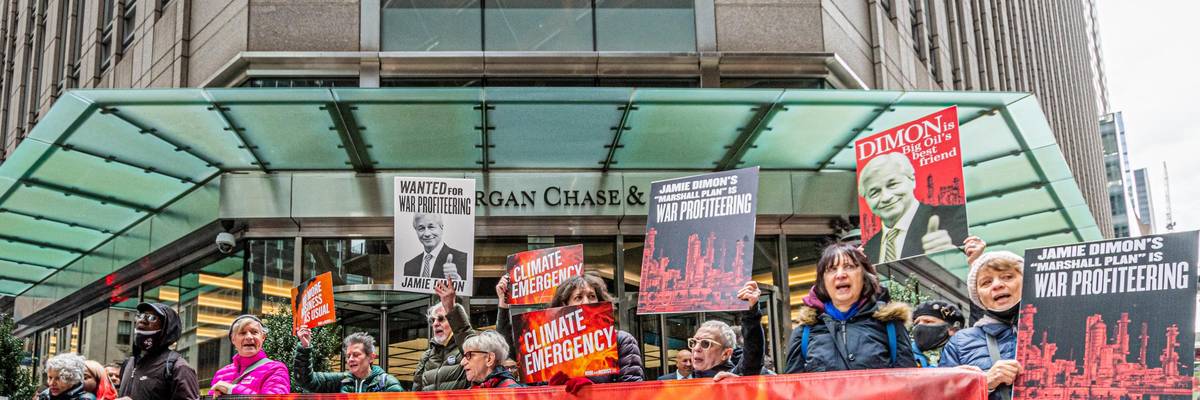
Participants hold a banner outside JPMorgan Chase's headquarters in New York City on April 19, 2022.
New research released Wednesday by a Ukraine-based climate action group reveals that while the U.S. is sending another $3 billion in aid to the country amid Russia's invasion, American banks are among the biggest investors in high-emissions projects which are helping to fund the war as well as pushing the planet toward climate breakdown.
Compiled by the Leave It in the Ground Initiative (LINGO), the new database details the various investors and creditors of Russian "carbon bombs"--extraction projects with the potential to emit at least one billion tonnes of carbon.
Based on its findings, LINGO is calling on major banks including JPMorgan Chase and HSBC to end their funding of such projects by oil and gas companies across Russia.
"We should not be investing in new fossil fuel projects, as the International Energy Agency has confirmed," LINGO Director Kjell Kuhne told The Guardian. "Anybody involved in these projects should be really questioning what they're doing."
More than 400 worldwide firms have provided $130 billion in investment and credit to projects by oil and gas companies including Gazprom, Novatek, and Rosneft in recent years.
"This is criminal behavior leading directly to death, destruction, and the continued devastation of our climate and our world."
Investments make up $52 billion of the funding, and U.S. companies have provided an estimated $23.6 billion of that--approximately half the total.
JPMorgan Chase has provided the largest combination of credit and investment of any U.S. company, pouring $10 billion into projects extracting fossil fuels in the Arctic, Siberia, and other regions.
Qatar's sovereign wealth fund accounted for the second-largest investment in carbon bomb projects, investing more than $15 billion in Rosneft, which began construction last month on an oil terminal in the Arctic. U.K. companies have invested the third-largest amount recorded by LINGO--a total of $2.5 billion.
Two years after JPMorgan released a pledge to "tackle climate change"--one that was met with skepticism by climate campaigners--the company is still engaging in what climate scientist Bill McGuire called "criminal behavior leading directly to death, destruction, and the continued devastation of our climate and our world."
In addition to contributing to the heating of the planet--drilling in a region that scientists recently discovered is heating up four times faster than the planet as a whole due to fossil fuel emissions--the companies identified by LINGO are helping to fund Russian President Vladimir Putin's invasion of Ukraine, which has killed more than 5,500 people and injured more than 7,800 so far.
"This [war] has made really clear that, when you don't care who you're doing business with," Kuhne told The Guardian, "it does translate into human suffering and lives lost."
Dear Common Dreams reader, It’s been nearly 30 years since I co-founded Common Dreams with my late wife, Lina Newhouser. We had the radical notion that journalism should serve the public good, not corporate profits. It was clear to us from the outset what it would take to build such a project. No paid advertisements. No corporate sponsors. No millionaire publisher telling us what to think or do. Many people said we wouldn't last a year, but we proved those doubters wrong. Together with a tremendous team of journalists and dedicated staff, we built an independent media outlet free from the constraints of profits and corporate control. Our mission has always been simple: To inform. To inspire. To ignite change for the common good. Building Common Dreams was not easy. Our survival was never guaranteed. When you take on the most powerful forces—Wall Street greed, fossil fuel industry destruction, Big Tech lobbyists, and uber-rich oligarchs who have spent billions upon billions rigging the economy and democracy in their favor—the only bulwark you have is supporters who believe in your work. But here’s the urgent message from me today. It's never been this bad out there. And it's never been this hard to keep us going. At the very moment Common Dreams is most needed, the threats we face are intensifying. We need your support now more than ever. We don't accept corporate advertising and never will. We don't have a paywall because we don't think people should be blocked from critical news based on their ability to pay. Everything we do is funded by the donations of readers like you. When everyone does the little they can afford, we are strong. But if that support retreats or dries up, so do we. Will you donate now to make sure Common Dreams not only survives but thrives? —Craig Brown, Co-founder |
New research released Wednesday by a Ukraine-based climate action group reveals that while the U.S. is sending another $3 billion in aid to the country amid Russia's invasion, American banks are among the biggest investors in high-emissions projects which are helping to fund the war as well as pushing the planet toward climate breakdown.
Compiled by the Leave It in the Ground Initiative (LINGO), the new database details the various investors and creditors of Russian "carbon bombs"--extraction projects with the potential to emit at least one billion tonnes of carbon.
Based on its findings, LINGO is calling on major banks including JPMorgan Chase and HSBC to end their funding of such projects by oil and gas companies across Russia.
"We should not be investing in new fossil fuel projects, as the International Energy Agency has confirmed," LINGO Director Kjell Kuhne told The Guardian. "Anybody involved in these projects should be really questioning what they're doing."
More than 400 worldwide firms have provided $130 billion in investment and credit to projects by oil and gas companies including Gazprom, Novatek, and Rosneft in recent years.
"This is criminal behavior leading directly to death, destruction, and the continued devastation of our climate and our world."
Investments make up $52 billion of the funding, and U.S. companies have provided an estimated $23.6 billion of that--approximately half the total.
JPMorgan Chase has provided the largest combination of credit and investment of any U.S. company, pouring $10 billion into projects extracting fossil fuels in the Arctic, Siberia, and other regions.
Qatar's sovereign wealth fund accounted for the second-largest investment in carbon bomb projects, investing more than $15 billion in Rosneft, which began construction last month on an oil terminal in the Arctic. U.K. companies have invested the third-largest amount recorded by LINGO--a total of $2.5 billion.
Two years after JPMorgan released a pledge to "tackle climate change"--one that was met with skepticism by climate campaigners--the company is still engaging in what climate scientist Bill McGuire called "criminal behavior leading directly to death, destruction, and the continued devastation of our climate and our world."
In addition to contributing to the heating of the planet--drilling in a region that scientists recently discovered is heating up four times faster than the planet as a whole due to fossil fuel emissions--the companies identified by LINGO are helping to fund Russian President Vladimir Putin's invasion of Ukraine, which has killed more than 5,500 people and injured more than 7,800 so far.
"This [war] has made really clear that, when you don't care who you're doing business with," Kuhne told The Guardian, "it does translate into human suffering and lives lost."
New research released Wednesday by a Ukraine-based climate action group reveals that while the U.S. is sending another $3 billion in aid to the country amid Russia's invasion, American banks are among the biggest investors in high-emissions projects which are helping to fund the war as well as pushing the planet toward climate breakdown.
Compiled by the Leave It in the Ground Initiative (LINGO), the new database details the various investors and creditors of Russian "carbon bombs"--extraction projects with the potential to emit at least one billion tonnes of carbon.
Based on its findings, LINGO is calling on major banks including JPMorgan Chase and HSBC to end their funding of such projects by oil and gas companies across Russia.
"We should not be investing in new fossil fuel projects, as the International Energy Agency has confirmed," LINGO Director Kjell Kuhne told The Guardian. "Anybody involved in these projects should be really questioning what they're doing."
More than 400 worldwide firms have provided $130 billion in investment and credit to projects by oil and gas companies including Gazprom, Novatek, and Rosneft in recent years.
"This is criminal behavior leading directly to death, destruction, and the continued devastation of our climate and our world."
Investments make up $52 billion of the funding, and U.S. companies have provided an estimated $23.6 billion of that--approximately half the total.
JPMorgan Chase has provided the largest combination of credit and investment of any U.S. company, pouring $10 billion into projects extracting fossil fuels in the Arctic, Siberia, and other regions.
Qatar's sovereign wealth fund accounted for the second-largest investment in carbon bomb projects, investing more than $15 billion in Rosneft, which began construction last month on an oil terminal in the Arctic. U.K. companies have invested the third-largest amount recorded by LINGO--a total of $2.5 billion.
Two years after JPMorgan released a pledge to "tackle climate change"--one that was met with skepticism by climate campaigners--the company is still engaging in what climate scientist Bill McGuire called "criminal behavior leading directly to death, destruction, and the continued devastation of our climate and our world."
In addition to contributing to the heating of the planet--drilling in a region that scientists recently discovered is heating up four times faster than the planet as a whole due to fossil fuel emissions--the companies identified by LINGO are helping to fund Russian President Vladimir Putin's invasion of Ukraine, which has killed more than 5,500 people and injured more than 7,800 so far.
"This [war] has made really clear that, when you don't care who you're doing business with," Kuhne told The Guardian, "it does translate into human suffering and lives lost."