SUBSCRIBE TO OUR FREE NEWSLETTER
Daily news & progressive opinion—funded by the people, not the corporations—delivered straight to your inbox.
5
#000000
#FFFFFF
To donate by check, phone, or other method, see our More Ways to Give page.
Daily news & progressive opinion—funded by the people, not the corporations—delivered straight to your inbox.
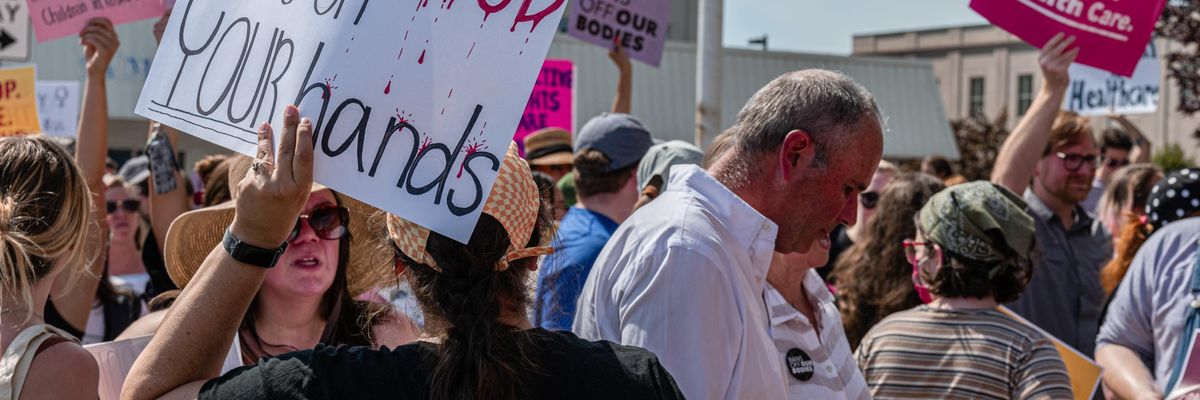
Abortion rights supporters protest the U.S. Supreme Court's Dobbs v. Jackson Women's Health decision at the Gene Snyder U.S. Courthouse in Louisville, Kentucky on June 24, 2022. (Photo: Jon Cherry/Getty Images)
A leading reproductive rights organization on Wednesday reiterated the need for action to protect abortion access at the federal level in anticipation of three more "trigger laws" set to take effect in Idaho, Tennessee, and Texas.
"Vast swaths of the nation, especially in the South and Midwest, will become abortion deserts that, for many, will be impossible to escape."
Since the U.S. Supreme Court reversed Roe v. Wade in June, anti-choice state lawmakers have moved to further restrict reproductive freedom--ramping up the GOP's already "unprecedented" attacks on the right to choose.
"Tomorrow, millions more people will lose abortion access across the nation as bans take effect in Texas, Tennessee, and Idaho," said Nancy Northup, president and CEO of the Center for Reproductive Rights. "Vast swaths of the nation, especially in the South and Midwest, will become abortion deserts that, for many, will be impossible to escape."
Absent judicial intervention, North Dakota's trigger ban is set to take effect Friday--meaning that by the end of the week, abortion could be banned in those states plus Alabama, Arkansas, Kentucky, Louisiana, Mississippi, Missouri, Oklahoma, and South Dakota.
The Washington Post reported Monday that "nearly 21 million--about 1 in 3 girls and women in the United States between the ages of 15 and 44--have lost access to the procedure" in their home states, and "the rapid pace of change has shocked even the closest observers."
"I just thought there would be a little more time to help providers and patients cope with these changes," said Elizabeth Nash, who tracks state-level abortion legislation for the Guttmacher Institute. "It was very clear that that sort of grace period was not going to be provided."
The Post pointed out that on top of outright bans, "Wisconsin has conflicting laws that leave the legality of abortion uncertain, but clinics stopped providing abortions in the state after the Dobbs v. Jackson Women's Health Organization decision, effectively ending abortion within its borders," and other states, such as Georgia and Ohio, ban the procedure around six weeks of pregnancy, before many people even know they are pregnant.
Rewire outlined the looming measures in Texas, Tennessee, and Idaho--and an effort to block the last one--in a series of tweets Wednesday:
"Evidence is already mounting of women being turned away despite needing urgent, and in some cases lifesaving, medical care," Northup noted.
"This unfolding public health crisis will only continue to get worse," she warned. "We will see more and more of these harrowing situations, and once state legislatures reconvene in January, we will see even more states implement abortion bans and novel laws criminalizing abortion providers, pregnant people, and those who help them."
The experience of a Louisiana woman made international headlines this month after she was told that she would have to leave the state to get an abortion or continue her pregnancy. Her fetus had been diagnosed with acrania, a fatal disorder in which a skull does not form in the womb.
"Ms. Nancy Davis was put in a horrifically cruel position by the state of Louisiana, left with only two choices: To carry the fetus until its inevitable death or to travel to another state to end the pregnancy weeks after she made the incredibly painful decision to do so," said her attorney, Ben Crump, in a statement last week.
Other stories of pregnant people faced with difficult decisions regarding if and how to access abortion care across the country have mounted this summer amid constant shifts in state law.
After a federal judge in Texas late Tuesday blocked guidance from the Biden administration requiring doctors to provide abortions in medical emergencies, even if doing so would violate state law, White House Press Secretary Karine Jean-Pierre vowed that President Joe Biden will keep fighting.
"Because of this decision, women in Texas may now be denied this vital care--even for conditions like severe hemorrhaging or life-threatening hypertension," she said. "It's wrong, it's backwards, and women may die as a result. The fight is not over. The president will continue to push to require hospitals to provide lifesaving and health-preserving reproductive care."
Dyana Limon-Mercado, executive director of Planned Parenthood Texas Votes, declared Wednesday that "we must stop playing politics with people's lives. The post-Roe world envisioned by anti-abortion extremists is unfolding before our eyes and has not stopped with banning abortion."
"These anti-abortion lawmakers may be relentless, but so are we," she said, noting that the next general election is just over two months away. "Together, we will be louder than ever, working to elect leaders that will restore abortion access and actually represent the voters of Texas."
As GOP legislators in Texas and other states work to outlaw abortion, some rights activists are pushing for the use of ballot measures to protect reproductive freedom state by state until Congress acts.
In early August, 59% of Kansas voters rejected a ballot measure that would have paved the path to banning abortion in the state. Voter turnout was notably high. Northup said Wednesday that "the vast majority of Americans support access to abortion, as we saw in Kansas."
"Congress must pass the Women's Health Protection Act to protect the right to abortion in every state," she added. "Abortion is not a matter of politics or opinion, it is healthcare that people both want and need."
While House Democrats have approved that proposal to affirm abortion rights nationwide, the bill has been repeatedly blocked in the Senate this year by Republicans and right-wing Democratic Sen. Joe Manchin of West Virginia.
Dear Common Dreams reader, It’s been nearly 30 years since I co-founded Common Dreams with my late wife, Lina Newhouser. We had the radical notion that journalism should serve the public good, not corporate profits. It was clear to us from the outset what it would take to build such a project. No paid advertisements. No corporate sponsors. No millionaire publisher telling us what to think or do. Many people said we wouldn't last a year, but we proved those doubters wrong. Together with a tremendous team of journalists and dedicated staff, we built an independent media outlet free from the constraints of profits and corporate control. Our mission has always been simple: To inform. To inspire. To ignite change for the common good. Building Common Dreams was not easy. Our survival was never guaranteed. When you take on the most powerful forces—Wall Street greed, fossil fuel industry destruction, Big Tech lobbyists, and uber-rich oligarchs who have spent billions upon billions rigging the economy and democracy in their favor—the only bulwark you have is supporters who believe in your work. But here’s the urgent message from me today. It's never been this bad out there. And it's never been this hard to keep us going. At the very moment Common Dreams is most needed, the threats we face are intensifying. We need your support now more than ever. We don't accept corporate advertising and never will. We don't have a paywall because we don't think people should be blocked from critical news based on their ability to pay. Everything we do is funded by the donations of readers like you. When everyone does the little they can afford, we are strong. But if that support retreats or dries up, so do we. Will you donate now to make sure Common Dreams not only survives but thrives? —Craig Brown, Co-founder |
A leading reproductive rights organization on Wednesday reiterated the need for action to protect abortion access at the federal level in anticipation of three more "trigger laws" set to take effect in Idaho, Tennessee, and Texas.
"Vast swaths of the nation, especially in the South and Midwest, will become abortion deserts that, for many, will be impossible to escape."
Since the U.S. Supreme Court reversed Roe v. Wade in June, anti-choice state lawmakers have moved to further restrict reproductive freedom--ramping up the GOP's already "unprecedented" attacks on the right to choose.
"Tomorrow, millions more people will lose abortion access across the nation as bans take effect in Texas, Tennessee, and Idaho," said Nancy Northup, president and CEO of the Center for Reproductive Rights. "Vast swaths of the nation, especially in the South and Midwest, will become abortion deserts that, for many, will be impossible to escape."
Absent judicial intervention, North Dakota's trigger ban is set to take effect Friday--meaning that by the end of the week, abortion could be banned in those states plus Alabama, Arkansas, Kentucky, Louisiana, Mississippi, Missouri, Oklahoma, and South Dakota.
The Washington Post reported Monday that "nearly 21 million--about 1 in 3 girls and women in the United States between the ages of 15 and 44--have lost access to the procedure" in their home states, and "the rapid pace of change has shocked even the closest observers."
"I just thought there would be a little more time to help providers and patients cope with these changes," said Elizabeth Nash, who tracks state-level abortion legislation for the Guttmacher Institute. "It was very clear that that sort of grace period was not going to be provided."
The Post pointed out that on top of outright bans, "Wisconsin has conflicting laws that leave the legality of abortion uncertain, but clinics stopped providing abortions in the state after the Dobbs v. Jackson Women's Health Organization decision, effectively ending abortion within its borders," and other states, such as Georgia and Ohio, ban the procedure around six weeks of pregnancy, before many people even know they are pregnant.
Rewire outlined the looming measures in Texas, Tennessee, and Idaho--and an effort to block the last one--in a series of tweets Wednesday:
"Evidence is already mounting of women being turned away despite needing urgent, and in some cases lifesaving, medical care," Northup noted.
"This unfolding public health crisis will only continue to get worse," she warned. "We will see more and more of these harrowing situations, and once state legislatures reconvene in January, we will see even more states implement abortion bans and novel laws criminalizing abortion providers, pregnant people, and those who help them."
The experience of a Louisiana woman made international headlines this month after she was told that she would have to leave the state to get an abortion or continue her pregnancy. Her fetus had been diagnosed with acrania, a fatal disorder in which a skull does not form in the womb.
"Ms. Nancy Davis was put in a horrifically cruel position by the state of Louisiana, left with only two choices: To carry the fetus until its inevitable death or to travel to another state to end the pregnancy weeks after she made the incredibly painful decision to do so," said her attorney, Ben Crump, in a statement last week.
Other stories of pregnant people faced with difficult decisions regarding if and how to access abortion care across the country have mounted this summer amid constant shifts in state law.
After a federal judge in Texas late Tuesday blocked guidance from the Biden administration requiring doctors to provide abortions in medical emergencies, even if doing so would violate state law, White House Press Secretary Karine Jean-Pierre vowed that President Joe Biden will keep fighting.
"Because of this decision, women in Texas may now be denied this vital care--even for conditions like severe hemorrhaging or life-threatening hypertension," she said. "It's wrong, it's backwards, and women may die as a result. The fight is not over. The president will continue to push to require hospitals to provide lifesaving and health-preserving reproductive care."
Dyana Limon-Mercado, executive director of Planned Parenthood Texas Votes, declared Wednesday that "we must stop playing politics with people's lives. The post-Roe world envisioned by anti-abortion extremists is unfolding before our eyes and has not stopped with banning abortion."
"These anti-abortion lawmakers may be relentless, but so are we," she said, noting that the next general election is just over two months away. "Together, we will be louder than ever, working to elect leaders that will restore abortion access and actually represent the voters of Texas."
As GOP legislators in Texas and other states work to outlaw abortion, some rights activists are pushing for the use of ballot measures to protect reproductive freedom state by state until Congress acts.
In early August, 59% of Kansas voters rejected a ballot measure that would have paved the path to banning abortion in the state. Voter turnout was notably high. Northup said Wednesday that "the vast majority of Americans support access to abortion, as we saw in Kansas."
"Congress must pass the Women's Health Protection Act to protect the right to abortion in every state," she added. "Abortion is not a matter of politics or opinion, it is healthcare that people both want and need."
While House Democrats have approved that proposal to affirm abortion rights nationwide, the bill has been repeatedly blocked in the Senate this year by Republicans and right-wing Democratic Sen. Joe Manchin of West Virginia.
A leading reproductive rights organization on Wednesday reiterated the need for action to protect abortion access at the federal level in anticipation of three more "trigger laws" set to take effect in Idaho, Tennessee, and Texas.
"Vast swaths of the nation, especially in the South and Midwest, will become abortion deserts that, for many, will be impossible to escape."
Since the U.S. Supreme Court reversed Roe v. Wade in June, anti-choice state lawmakers have moved to further restrict reproductive freedom--ramping up the GOP's already "unprecedented" attacks on the right to choose.
"Tomorrow, millions more people will lose abortion access across the nation as bans take effect in Texas, Tennessee, and Idaho," said Nancy Northup, president and CEO of the Center for Reproductive Rights. "Vast swaths of the nation, especially in the South and Midwest, will become abortion deserts that, for many, will be impossible to escape."
Absent judicial intervention, North Dakota's trigger ban is set to take effect Friday--meaning that by the end of the week, abortion could be banned in those states plus Alabama, Arkansas, Kentucky, Louisiana, Mississippi, Missouri, Oklahoma, and South Dakota.
The Washington Post reported Monday that "nearly 21 million--about 1 in 3 girls and women in the United States between the ages of 15 and 44--have lost access to the procedure" in their home states, and "the rapid pace of change has shocked even the closest observers."
"I just thought there would be a little more time to help providers and patients cope with these changes," said Elizabeth Nash, who tracks state-level abortion legislation for the Guttmacher Institute. "It was very clear that that sort of grace period was not going to be provided."
The Post pointed out that on top of outright bans, "Wisconsin has conflicting laws that leave the legality of abortion uncertain, but clinics stopped providing abortions in the state after the Dobbs v. Jackson Women's Health Organization decision, effectively ending abortion within its borders," and other states, such as Georgia and Ohio, ban the procedure around six weeks of pregnancy, before many people even know they are pregnant.
Rewire outlined the looming measures in Texas, Tennessee, and Idaho--and an effort to block the last one--in a series of tweets Wednesday:
"Evidence is already mounting of women being turned away despite needing urgent, and in some cases lifesaving, medical care," Northup noted.
"This unfolding public health crisis will only continue to get worse," she warned. "We will see more and more of these harrowing situations, and once state legislatures reconvene in January, we will see even more states implement abortion bans and novel laws criminalizing abortion providers, pregnant people, and those who help them."
The experience of a Louisiana woman made international headlines this month after she was told that she would have to leave the state to get an abortion or continue her pregnancy. Her fetus had been diagnosed with acrania, a fatal disorder in which a skull does not form in the womb.
"Ms. Nancy Davis was put in a horrifically cruel position by the state of Louisiana, left with only two choices: To carry the fetus until its inevitable death or to travel to another state to end the pregnancy weeks after she made the incredibly painful decision to do so," said her attorney, Ben Crump, in a statement last week.
Other stories of pregnant people faced with difficult decisions regarding if and how to access abortion care across the country have mounted this summer amid constant shifts in state law.
After a federal judge in Texas late Tuesday blocked guidance from the Biden administration requiring doctors to provide abortions in medical emergencies, even if doing so would violate state law, White House Press Secretary Karine Jean-Pierre vowed that President Joe Biden will keep fighting.
"Because of this decision, women in Texas may now be denied this vital care--even for conditions like severe hemorrhaging or life-threatening hypertension," she said. "It's wrong, it's backwards, and women may die as a result. The fight is not over. The president will continue to push to require hospitals to provide lifesaving and health-preserving reproductive care."
Dyana Limon-Mercado, executive director of Planned Parenthood Texas Votes, declared Wednesday that "we must stop playing politics with people's lives. The post-Roe world envisioned by anti-abortion extremists is unfolding before our eyes and has not stopped with banning abortion."
"These anti-abortion lawmakers may be relentless, but so are we," she said, noting that the next general election is just over two months away. "Together, we will be louder than ever, working to elect leaders that will restore abortion access and actually represent the voters of Texas."
As GOP legislators in Texas and other states work to outlaw abortion, some rights activists are pushing for the use of ballot measures to protect reproductive freedom state by state until Congress acts.
In early August, 59% of Kansas voters rejected a ballot measure that would have paved the path to banning abortion in the state. Voter turnout was notably high. Northup said Wednesday that "the vast majority of Americans support access to abortion, as we saw in Kansas."
"Congress must pass the Women's Health Protection Act to protect the right to abortion in every state," she added. "Abortion is not a matter of politics or opinion, it is healthcare that people both want and need."
While House Democrats have approved that proposal to affirm abortion rights nationwide, the bill has been repeatedly blocked in the Senate this year by Republicans and right-wing Democratic Sen. Joe Manchin of West Virginia.