SUBSCRIBE TO OUR FREE NEWSLETTER
Daily news & progressive opinion—funded by the people, not the corporations—delivered straight to your inbox.
5
#000000
#FFFFFF
To donate by check, phone, or other method, see our More Ways to Give page.
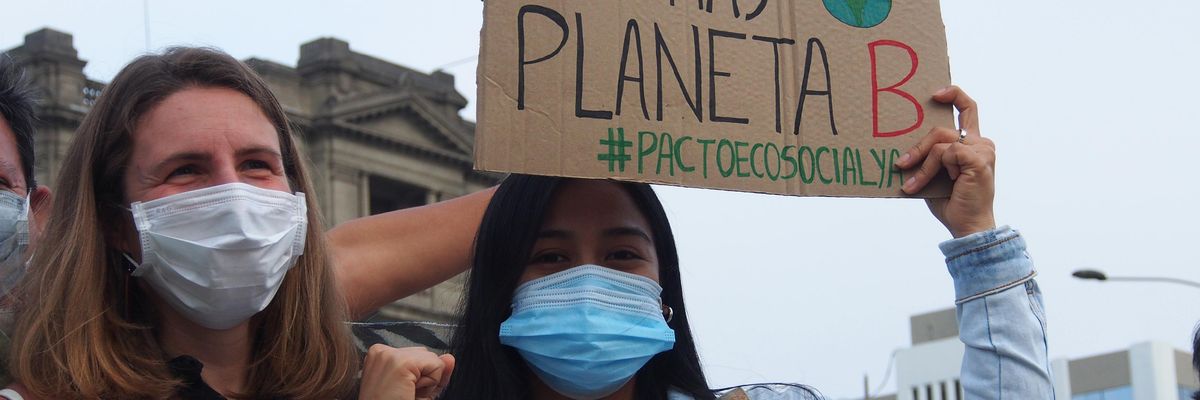
City lawmakers in Lima, Peru on Monday unanimously passed a motion calling for a Fossil Fuel Non-Proliferation Treaty, a proposed global mechanism for tackling the source of most of the greenhouse gas emissions that are fueling the climate emergency.
"It is necessary to take firm action on one of our principal threats, the proliferation of fossil fuels."
Lima councilors voted 39-0 in favor of a FFNPT, making the city the first Latin American capital to endorse the proposed treaty.
Carlo Andre Angeles Manturano, the Lima council member who introduced the motion, said the measure shows his "commitment to continue promoting the necessary actions at the local, national, and international level to combat climate change."
"As we face the climate emergency as a society, the lack of firm commitments to action by our authorities and our governments is what brings us ever closer to irreversible damage," he explained. "It is necessary to take firm action on one of our principal threats, the proliferation of fossil fuels, an industry that is projected to produce 110% more emissions than what is required to limit warming to 1.5degC by 2030."
"That is why," added Angeles, "on behalf of the metropolitan government of Lima, I presented the motion to join this crusade and call for the non-proliferation of fossil fuels in the city of Lima, and requesting the Peruvian national government to replicate this action and endorse the Fossil Fuel Treaty."
Launched in 2020 and backed by hundreds of groups, thousands of scientists, and people around the world from youth to grandparents, the FFNTP is based on three pillars:
Scores of cities and subnational governments have endorsed the FFNTP, including London, Paris, Los Angeles, Sydney, Toronto, and the Hawaiian Legislature. Last month, Vatican City became the world's first nation to back the treaty.
"Enough is enough," said Cardinal Michael Czerny in announcing the Vatican endorsement. "All new exploration and production of coal, oil, and gas must immediately end, and existing production of fossil fuels must be urgently phased out. This must be a just transition for impacted workers into environmentally sound alternatives. The proposed Fossil Fuel Non-Proliferation Treaty holds great promise to complement and enhance the Paris Agreement."
Related Content

In a statement responding to the Lima council's move, FFNTP partnerships coordinator Claudia Campero Arena, said "we are thrilled that Lima has become the first capital in Latin America to endorse the Fossil Fuel Non-Proliferation Treaty."
"Given that Lima is the capital of a diverse country that has suffered the harms of fossil fuel extraction," she added, "this leadership is a welcome push for positive change in Peru and the region to a just energy transition away from fossil fuels."
Coastal communities northwest of Lima are reeling from Peru's worst-ever environmental disaster. An oil spill in February spewed more than 10,000 barrels of crude petroleum into the Pacific Ocean from a tanker at a refinery operated by the Spanish firm Repsol, sending poison black waves washing over 27 miles of coastline.
Peruvian climate campaigner Augusto Duran said the Lima council's motion "has a vindictive character since the coast of Lima and Callao has witnessed the greatest ecological disaster in recent times."
"As such, it will initially put pressure on the executive and the legislature regarding the need for policies that strengthen the climate and environmental struggle," he added. "Although the motion as such is a symbolic element, it strengthens these advocacy processes. That is why we want more cities to be able to make the call to the treaty."
City lawmakers in Lima, Peru on Monday unanimously passed a motion calling for a Fossil Fuel Non-Proliferation Treaty, a proposed global mechanism for tackling the source of most of the greenhouse gas emissions that are fueling the climate emergency.
"It is necessary to take firm action on one of our principal threats, the proliferation of fossil fuels."
Lima councilors voted 39-0 in favor of a FFNPT, making the city the first Latin American capital to endorse the proposed treaty.
Carlo Andre Angeles Manturano, the Lima council member who introduced the motion, said the measure shows his "commitment to continue promoting the necessary actions at the local, national, and international level to combat climate change."
"As we face the climate emergency as a society, the lack of firm commitments to action by our authorities and our governments is what brings us ever closer to irreversible damage," he explained. "It is necessary to take firm action on one of our principal threats, the proliferation of fossil fuels, an industry that is projected to produce 110% more emissions than what is required to limit warming to 1.5degC by 2030."
"That is why," added Angeles, "on behalf of the metropolitan government of Lima, I presented the motion to join this crusade and call for the non-proliferation of fossil fuels in the city of Lima, and requesting the Peruvian national government to replicate this action and endorse the Fossil Fuel Treaty."
Launched in 2020 and backed by hundreds of groups, thousands of scientists, and people around the world from youth to grandparents, the FFNTP is based on three pillars:
Scores of cities and subnational governments have endorsed the FFNTP, including London, Paris, Los Angeles, Sydney, Toronto, and the Hawaiian Legislature. Last month, Vatican City became the world's first nation to back the treaty.
"Enough is enough," said Cardinal Michael Czerny in announcing the Vatican endorsement. "All new exploration and production of coal, oil, and gas must immediately end, and existing production of fossil fuels must be urgently phased out. This must be a just transition for impacted workers into environmentally sound alternatives. The proposed Fossil Fuel Non-Proliferation Treaty holds great promise to complement and enhance the Paris Agreement."
Related Content
In a statement responding to the Lima council's move, FFNTP partnerships coordinator Claudia Campero Arena, said "we are thrilled that Lima has become the first capital in Latin America to endorse the Fossil Fuel Non-Proliferation Treaty."
"Given that Lima is the capital of a diverse country that has suffered the harms of fossil fuel extraction," she added, "this leadership is a welcome push for positive change in Peru and the region to a just energy transition away from fossil fuels."
Coastal communities northwest of Lima are reeling from Peru's worst-ever environmental disaster. An oil spill in February spewed more than 10,000 barrels of crude petroleum into the Pacific Ocean from a tanker at a refinery operated by the Spanish firm Repsol, sending poison black waves washing over 27 miles of coastline.
Peruvian climate campaigner Augusto Duran said the Lima council's motion "has a vindictive character since the coast of Lima and Callao has witnessed the greatest ecological disaster in recent times."
"As such, it will initially put pressure on the executive and the legislature regarding the need for policies that strengthen the climate and environmental struggle," he added. "Although the motion as such is a symbolic element, it strengthens these advocacy processes. That is why we want more cities to be able to make the call to the treaty."
City lawmakers in Lima, Peru on Monday unanimously passed a motion calling for a Fossil Fuel Non-Proliferation Treaty, a proposed global mechanism for tackling the source of most of the greenhouse gas emissions that are fueling the climate emergency.
"It is necessary to take firm action on one of our principal threats, the proliferation of fossil fuels."
Lima councilors voted 39-0 in favor of a FFNPT, making the city the first Latin American capital to endorse the proposed treaty.
Carlo Andre Angeles Manturano, the Lima council member who introduced the motion, said the measure shows his "commitment to continue promoting the necessary actions at the local, national, and international level to combat climate change."
"As we face the climate emergency as a society, the lack of firm commitments to action by our authorities and our governments is what brings us ever closer to irreversible damage," he explained. "It is necessary to take firm action on one of our principal threats, the proliferation of fossil fuels, an industry that is projected to produce 110% more emissions than what is required to limit warming to 1.5degC by 2030."
"That is why," added Angeles, "on behalf of the metropolitan government of Lima, I presented the motion to join this crusade and call for the non-proliferation of fossil fuels in the city of Lima, and requesting the Peruvian national government to replicate this action and endorse the Fossil Fuel Treaty."
Launched in 2020 and backed by hundreds of groups, thousands of scientists, and people around the world from youth to grandparents, the FFNTP is based on three pillars:
Scores of cities and subnational governments have endorsed the FFNTP, including London, Paris, Los Angeles, Sydney, Toronto, and the Hawaiian Legislature. Last month, Vatican City became the world's first nation to back the treaty.
"Enough is enough," said Cardinal Michael Czerny in announcing the Vatican endorsement. "All new exploration and production of coal, oil, and gas must immediately end, and existing production of fossil fuels must be urgently phased out. This must be a just transition for impacted workers into environmentally sound alternatives. The proposed Fossil Fuel Non-Proliferation Treaty holds great promise to complement and enhance the Paris Agreement."
Related Content
In a statement responding to the Lima council's move, FFNTP partnerships coordinator Claudia Campero Arena, said "we are thrilled that Lima has become the first capital in Latin America to endorse the Fossil Fuel Non-Proliferation Treaty."
"Given that Lima is the capital of a diverse country that has suffered the harms of fossil fuel extraction," she added, "this leadership is a welcome push for positive change in Peru and the region to a just energy transition away from fossil fuels."
Coastal communities northwest of Lima are reeling from Peru's worst-ever environmental disaster. An oil spill in February spewed more than 10,000 barrels of crude petroleum into the Pacific Ocean from a tanker at a refinery operated by the Spanish firm Repsol, sending poison black waves washing over 27 miles of coastline.
Peruvian climate campaigner Augusto Duran said the Lima council's motion "has a vindictive character since the coast of Lima and Callao has witnessed the greatest ecological disaster in recent times."
"As such, it will initially put pressure on the executive and the legislature regarding the need for policies that strengthen the climate and environmental struggle," he added. "Although the motion as such is a symbolic element, it strengthens these advocacy processes. That is why we want more cities to be able to make the call to the treaty."