SUBSCRIBE TO OUR FREE NEWSLETTER
Daily news & progressive opinion—funded by the people, not the corporations—delivered straight to your inbox.
5
#000000
#FFFFFF
To donate by check, phone, or other method, see our More Ways to Give page.
Daily news & progressive opinion—funded by the people, not the corporations—delivered straight to your inbox.
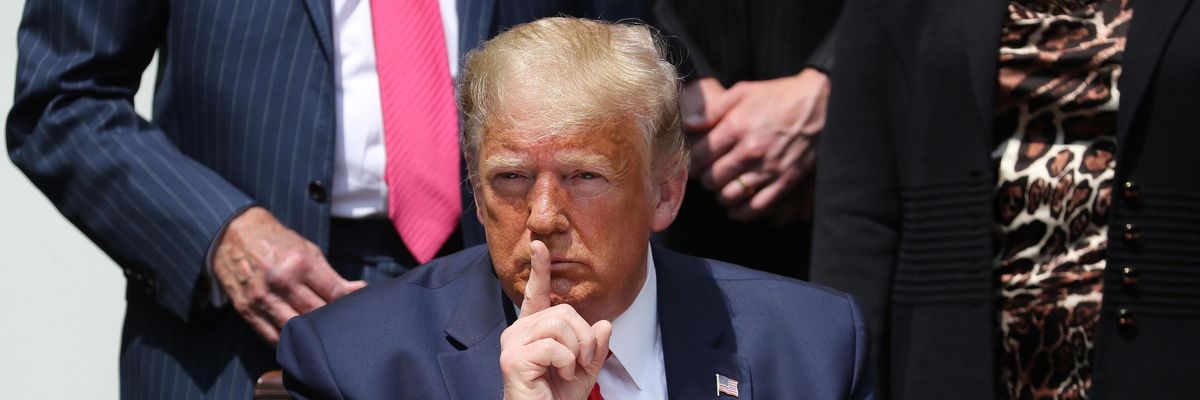
Then-President Donald Trump shushed journalists before signing legislation on June 5, 2020 in Washington, D.C. (Photo: Chip Somodevilla/Getty Images)
Former U.S. President Donald Trump is being investigated for potential violations of the Espionage Act, obstruction of justice, and unlawful removal of government records, according to the warrant authorizing the recent federal search of Mar-a-Lago, which was released Friday.
"This is insane. If you're not fed up, you're not paying enough attention," tweeted the advocacy group Public Citizen in response to the Espionage Act revelation.
Some reports about the warrant and an inventory of what agents with the Federal Bureau of Investigation removed from the Florida residence--including from Breitbart, Fox News, and The Wall Street Journal--came before a federal judge's 3:00 pm ET deadline for Trump's attorneys to respond to a U.S. Department of Justice (DOJ) request to unseal the documents.
Though Trump's legal team had copies of the documents--meaning he could have made them public himself--the ex-president said on social media and to government lawyers that he did not oppose releasing the materials through formal legal channels, which led U.S. attorneys to request that the court do so.
While details of the leaked materials circulated widely Friday afternoon, U.S. Judge Bruce Reinhart--who had signed the warrant on August 5--ordered the official release.
As Charlie Savage at The New York Times summarized:
The search warrant for Trump's residence cited three criminal laws, all from Title 18 of the United States Code. Section 793, better known as the Espionage Act, which covers the unlawful retention of defense-related information that could harm the United States or aid a foreign adversary; Section 1519, which covers destroying or concealing documents to obstruct government investigations or administrative proceedings; and Section 2071, which covers the unlawful removal of government records. Notably, none of those laws turn on whether information was deemed to be unclassified.
The receipt for property shows FBI agents took over 20 boxes of materials from the former president's home. The inventory lists two binders of photos, a handwritten note, information regarding the president of France, "top secret" and other classified documents, and Trump's executive grant of clemency for Roger Stone.
"The FBI seized 11 sets of classified documents, four sets top secret, one of those secure compartmentalized info," noted Noah Bookbinder of the watchdog group Citizens for Responsibility and Ethics in Washington (CREW). "That's an awful lot, and I struggle to think of a good explanation for why all that would be there, particularly after several requests and negotiation."
Trump claimed on his Truth Social platform Friday: "Number one, it was all declassified. Number two, they didn't need to 'seize' anything. They could have had it anytime they wanted without playing politics and breaking into Mar-a-Lago. It was in secured storage, with an additional lock put on as per their request."
Savage explained that even if the former president's declassification claim is true, he could still face legal trouble:
For one thing, two of the laws that a search warrant executed at Mar-a-Lago this week referred to--Sections 1519 and 2071 of Title 18 of the United States Code--make the taking or concealment of government records a crime regardless of whether they had anything to do with national security.
For another, laws against taking or hoarding material with restricted national security information, which generally carry heavier penalties than theft of ordinary documents, do not always line up with whether the files are technically classified.
The third law referenced in the warrant--Section 793, or the Espionage Act--"makes no reference to whether a document has been deemed classified," Savage highlighted. "Instead, it makes it a crime to retain, without authorization, documents related to the national defense that could be used to harm the United States or aid a foreign adversary."
Details of the search warrant and inventory followed reporting by The Washington Post late Thursday that FBI agents were attempting to recover classified nuclear weapons documents from Trump's home on Monday.
The Times' Alan Feuer noted Thursday that the DOJ did not seek the release of the affidavit in support of the warrant, arguably "the most informative--and sensitive--document connected to the search of Mar-a-Lago."
Dear Common Dreams reader, It’s been nearly 30 years since I co-founded Common Dreams with my late wife, Lina Newhouser. We had the radical notion that journalism should serve the public good, not corporate profits. It was clear to us from the outset what it would take to build such a project. No paid advertisements. No corporate sponsors. No millionaire publisher telling us what to think or do. Many people said we wouldn't last a year, but we proved those doubters wrong. Together with a tremendous team of journalists and dedicated staff, we built an independent media outlet free from the constraints of profits and corporate control. Our mission has always been simple: To inform. To inspire. To ignite change for the common good. Building Common Dreams was not easy. Our survival was never guaranteed. When you take on the most powerful forces—Wall Street greed, fossil fuel industry destruction, Big Tech lobbyists, and uber-rich oligarchs who have spent billions upon billions rigging the economy and democracy in their favor—the only bulwark you have is supporters who believe in your work. But here’s the urgent message from me today. It's never been this bad out there. And it's never been this hard to keep us going. At the very moment Common Dreams is most needed, the threats we face are intensifying. We need your support now more than ever. We don't accept corporate advertising and never will. We don't have a paywall because we don't think people should be blocked from critical news based on their ability to pay. Everything we do is funded by the donations of readers like you. When everyone does the little they can afford, we are strong. But if that support retreats or dries up, so do we. Will you donate now to make sure Common Dreams not only survives but thrives? —Craig Brown, Co-founder |
Former U.S. President Donald Trump is being investigated for potential violations of the Espionage Act, obstruction of justice, and unlawful removal of government records, according to the warrant authorizing the recent federal search of Mar-a-Lago, which was released Friday.
"This is insane. If you're not fed up, you're not paying enough attention," tweeted the advocacy group Public Citizen in response to the Espionage Act revelation.
Some reports about the warrant and an inventory of what agents with the Federal Bureau of Investigation removed from the Florida residence--including from Breitbart, Fox News, and The Wall Street Journal--came before a federal judge's 3:00 pm ET deadline for Trump's attorneys to respond to a U.S. Department of Justice (DOJ) request to unseal the documents.
Though Trump's legal team had copies of the documents--meaning he could have made them public himself--the ex-president said on social media and to government lawyers that he did not oppose releasing the materials through formal legal channels, which led U.S. attorneys to request that the court do so.
While details of the leaked materials circulated widely Friday afternoon, U.S. Judge Bruce Reinhart--who had signed the warrant on August 5--ordered the official release.
As Charlie Savage at The New York Times summarized:
The search warrant for Trump's residence cited three criminal laws, all from Title 18 of the United States Code. Section 793, better known as the Espionage Act, which covers the unlawful retention of defense-related information that could harm the United States or aid a foreign adversary; Section 1519, which covers destroying or concealing documents to obstruct government investigations or administrative proceedings; and Section 2071, which covers the unlawful removal of government records. Notably, none of those laws turn on whether information was deemed to be unclassified.
The receipt for property shows FBI agents took over 20 boxes of materials from the former president's home. The inventory lists two binders of photos, a handwritten note, information regarding the president of France, "top secret" and other classified documents, and Trump's executive grant of clemency for Roger Stone.
"The FBI seized 11 sets of classified documents, four sets top secret, one of those secure compartmentalized info," noted Noah Bookbinder of the watchdog group Citizens for Responsibility and Ethics in Washington (CREW). "That's an awful lot, and I struggle to think of a good explanation for why all that would be there, particularly after several requests and negotiation."
Trump claimed on his Truth Social platform Friday: "Number one, it was all declassified. Number two, they didn't need to 'seize' anything. They could have had it anytime they wanted without playing politics and breaking into Mar-a-Lago. It was in secured storage, with an additional lock put on as per their request."
Savage explained that even if the former president's declassification claim is true, he could still face legal trouble:
For one thing, two of the laws that a search warrant executed at Mar-a-Lago this week referred to--Sections 1519 and 2071 of Title 18 of the United States Code--make the taking or concealment of government records a crime regardless of whether they had anything to do with national security.
For another, laws against taking or hoarding material with restricted national security information, which generally carry heavier penalties than theft of ordinary documents, do not always line up with whether the files are technically classified.
The third law referenced in the warrant--Section 793, or the Espionage Act--"makes no reference to whether a document has been deemed classified," Savage highlighted. "Instead, it makes it a crime to retain, without authorization, documents related to the national defense that could be used to harm the United States or aid a foreign adversary."
Details of the search warrant and inventory followed reporting by The Washington Post late Thursday that FBI agents were attempting to recover classified nuclear weapons documents from Trump's home on Monday.
The Times' Alan Feuer noted Thursday that the DOJ did not seek the release of the affidavit in support of the warrant, arguably "the most informative--and sensitive--document connected to the search of Mar-a-Lago."
Former U.S. President Donald Trump is being investigated for potential violations of the Espionage Act, obstruction of justice, and unlawful removal of government records, according to the warrant authorizing the recent federal search of Mar-a-Lago, which was released Friday.
"This is insane. If you're not fed up, you're not paying enough attention," tweeted the advocacy group Public Citizen in response to the Espionage Act revelation.
Some reports about the warrant and an inventory of what agents with the Federal Bureau of Investigation removed from the Florida residence--including from Breitbart, Fox News, and The Wall Street Journal--came before a federal judge's 3:00 pm ET deadline for Trump's attorneys to respond to a U.S. Department of Justice (DOJ) request to unseal the documents.
Though Trump's legal team had copies of the documents--meaning he could have made them public himself--the ex-president said on social media and to government lawyers that he did not oppose releasing the materials through formal legal channels, which led U.S. attorneys to request that the court do so.
While details of the leaked materials circulated widely Friday afternoon, U.S. Judge Bruce Reinhart--who had signed the warrant on August 5--ordered the official release.
As Charlie Savage at The New York Times summarized:
The search warrant for Trump's residence cited three criminal laws, all from Title 18 of the United States Code. Section 793, better known as the Espionage Act, which covers the unlawful retention of defense-related information that could harm the United States or aid a foreign adversary; Section 1519, which covers destroying or concealing documents to obstruct government investigations or administrative proceedings; and Section 2071, which covers the unlawful removal of government records. Notably, none of those laws turn on whether information was deemed to be unclassified.
The receipt for property shows FBI agents took over 20 boxes of materials from the former president's home. The inventory lists two binders of photos, a handwritten note, information regarding the president of France, "top secret" and other classified documents, and Trump's executive grant of clemency for Roger Stone.
"The FBI seized 11 sets of classified documents, four sets top secret, one of those secure compartmentalized info," noted Noah Bookbinder of the watchdog group Citizens for Responsibility and Ethics in Washington (CREW). "That's an awful lot, and I struggle to think of a good explanation for why all that would be there, particularly after several requests and negotiation."
Trump claimed on his Truth Social platform Friday: "Number one, it was all declassified. Number two, they didn't need to 'seize' anything. They could have had it anytime they wanted without playing politics and breaking into Mar-a-Lago. It was in secured storage, with an additional lock put on as per their request."
Savage explained that even if the former president's declassification claim is true, he could still face legal trouble:
For one thing, two of the laws that a search warrant executed at Mar-a-Lago this week referred to--Sections 1519 and 2071 of Title 18 of the United States Code--make the taking or concealment of government records a crime regardless of whether they had anything to do with national security.
For another, laws against taking or hoarding material with restricted national security information, which generally carry heavier penalties than theft of ordinary documents, do not always line up with whether the files are technically classified.
The third law referenced in the warrant--Section 793, or the Espionage Act--"makes no reference to whether a document has been deemed classified," Savage highlighted. "Instead, it makes it a crime to retain, without authorization, documents related to the national defense that could be used to harm the United States or aid a foreign adversary."
Details of the search warrant and inventory followed reporting by The Washington Post late Thursday that FBI agents were attempting to recover classified nuclear weapons documents from Trump's home on Monday.
The Times' Alan Feuer noted Thursday that the DOJ did not seek the release of the affidavit in support of the warrant, arguably "the most informative--and sensitive--document connected to the search of Mar-a-Lago."