SUBSCRIBE TO OUR FREE NEWSLETTER
Daily news & progressive opinion—funded by the people, not the corporations—delivered straight to your inbox.
5
#000000
#FFFFFF
To donate by check, phone, or other method, see our More Ways to Give page.
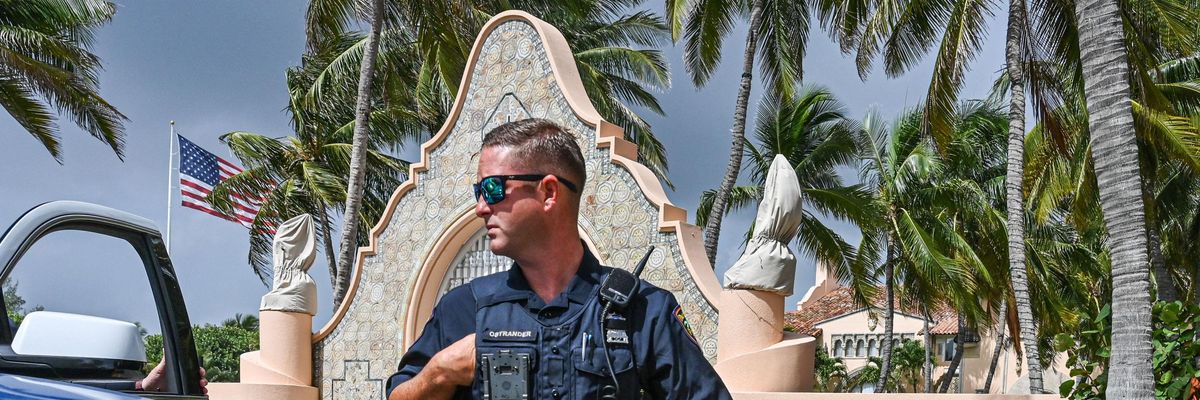
A federal judge in Florida on Thursday ordered the U.S. Department of Justice to release a redacted version of the affidavit used to justify the Federal Bureau of Investigation's August 8 search of former President Donald Trump's Mar-a-Lago residence.
U.S. Magistrate Judge Bruce Reinhart instructed the Justice Department to publish the document by noon ET on Friday. The judge's order came just hours after federal prosecutors gave him a sealed copy of the affidavit with proposed redactions.
The DOJ's warrant to search Trump's Palm Beach mansion was approved by Reinhart earlier this month, and a redacted version was made public in the aftermath of the FBI's search. It revealed that Trump is under investigation for potential violations of the Espionage Act, obstruction of justice, and unlawful removal of government records.
An inventory of seized materials shows that the DOJ, which was seeking to recover classified documents related to nuclear weapons, retrieved 27 boxes of White House records from Mar-a-Lago, including some labeled "top secret."
Related Content

The affidavit, as Reuters explained, "is a sworn statement outlining the evidence that gave the Justice Department probable cause to seek a search warrant."
After Trump and his GOP allies disparaged the FBI's search as a politically motivated "witch hunt"--setting off a firestorm of violent threats and actions from far-right extremists--Attorney General Merrick Garland took the rare step of asking the court to unseal parts of the warrant along with the accompanying property receipt.
The DOJ declined to publish the affidavit, however, arguing that doing so would jeopardize its ongoing investigation, discourage witness cooperation, and risk the disclosure of classified information.
In response, a coalition of media organizations filed a legal challenge in a bid to get portions of the document released.
Reinhart previously indicated that he doesn't believe the entire affidavit needs to remain sealed. At a hearing last week, he asked the DOJ to give him a copy with proposed redactions, adding that he would allow prosecutors to appeal if they disagree with the version he puts forth.
A federal judge in Florida on Thursday ordered the U.S. Department of Justice to release a redacted version of the affidavit used to justify the Federal Bureau of Investigation's August 8 search of former President Donald Trump's Mar-a-Lago residence.
U.S. Magistrate Judge Bruce Reinhart instructed the Justice Department to publish the document by noon ET on Friday. The judge's order came just hours after federal prosecutors gave him a sealed copy of the affidavit with proposed redactions.
The DOJ's warrant to search Trump's Palm Beach mansion was approved by Reinhart earlier this month, and a redacted version was made public in the aftermath of the FBI's search. It revealed that Trump is under investigation for potential violations of the Espionage Act, obstruction of justice, and unlawful removal of government records.
An inventory of seized materials shows that the DOJ, which was seeking to recover classified documents related to nuclear weapons, retrieved 27 boxes of White House records from Mar-a-Lago, including some labeled "top secret."
Related Content
The affidavit, as Reuters explained, "is a sworn statement outlining the evidence that gave the Justice Department probable cause to seek a search warrant."
After Trump and his GOP allies disparaged the FBI's search as a politically motivated "witch hunt"--setting off a firestorm of violent threats and actions from far-right extremists--Attorney General Merrick Garland took the rare step of asking the court to unseal parts of the warrant along with the accompanying property receipt.
The DOJ declined to publish the affidavit, however, arguing that doing so would jeopardize its ongoing investigation, discourage witness cooperation, and risk the disclosure of classified information.
In response, a coalition of media organizations filed a legal challenge in a bid to get portions of the document released.
Reinhart previously indicated that he doesn't believe the entire affidavit needs to remain sealed. At a hearing last week, he asked the DOJ to give him a copy with proposed redactions, adding that he would allow prosecutors to appeal if they disagree with the version he puts forth.
A federal judge in Florida on Thursday ordered the U.S. Department of Justice to release a redacted version of the affidavit used to justify the Federal Bureau of Investigation's August 8 search of former President Donald Trump's Mar-a-Lago residence.
U.S. Magistrate Judge Bruce Reinhart instructed the Justice Department to publish the document by noon ET on Friday. The judge's order came just hours after federal prosecutors gave him a sealed copy of the affidavit with proposed redactions.
The DOJ's warrant to search Trump's Palm Beach mansion was approved by Reinhart earlier this month, and a redacted version was made public in the aftermath of the FBI's search. It revealed that Trump is under investigation for potential violations of the Espionage Act, obstruction of justice, and unlawful removal of government records.
An inventory of seized materials shows that the DOJ, which was seeking to recover classified documents related to nuclear weapons, retrieved 27 boxes of White House records from Mar-a-Lago, including some labeled "top secret."
Related Content
The affidavit, as Reuters explained, "is a sworn statement outlining the evidence that gave the Justice Department probable cause to seek a search warrant."
After Trump and his GOP allies disparaged the FBI's search as a politically motivated "witch hunt"--setting off a firestorm of violent threats and actions from far-right extremists--Attorney General Merrick Garland took the rare step of asking the court to unseal parts of the warrant along with the accompanying property receipt.
The DOJ declined to publish the affidavit, however, arguing that doing so would jeopardize its ongoing investigation, discourage witness cooperation, and risk the disclosure of classified information.
In response, a coalition of media organizations filed a legal challenge in a bid to get portions of the document released.
Reinhart previously indicated that he doesn't believe the entire affidavit needs to remain sealed. At a hearing last week, he asked the DOJ to give him a copy with proposed redactions, adding that he would allow prosecutors to appeal if they disagree with the version he puts forth.