SUBSCRIBE TO OUR FREE NEWSLETTER
Daily news & progressive opinion—funded by the people, not the corporations—delivered straight to your inbox.
5
#000000
#FFFFFF
To donate by check, phone, or other method, see our More Ways to Give page.
Daily news & progressive opinion—funded by the people, not the corporations—delivered straight to your inbox.
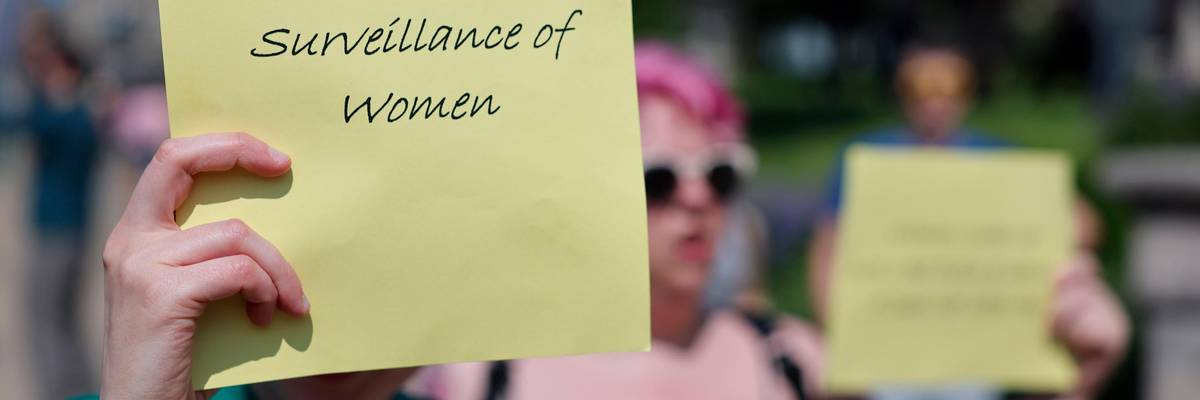
A woman holds a placard saying, "Abolish patriarchal surveillance of women" during a protest to demand safe and legal access to abortion on May 14, 2022. (Photo: Jeremy Hogan/SOPA Images/LightRocket via Getty Images)
Digital rights advocates on Tuesday said an abortion case in Nebraska illustrates how powerful tech companies like Facebook could play a major role in prosecutions of people who self-manage abortions as more states ban the procedure, and called on the social media platform to reform its privacy policies to protect users.
The case in Nebraska centers on a 17-year-old girl and her mother, Celeste and Jessica Burgess, who sent messages on Facebook regarding plans to terminate Celeste's pregnancy prior to Roe v. Wade being overturned in June.
"If companies don't want to end up repeatedly handing over data for abortion investigations, they need to rethink their practices on data collection, storage, and encryption."
According to court documents posted by Vice Tuesday, a friend of Celeste's called the police after seeing her take the first of two abortion pills. The teenager, who is being tried as an adult, was estimated to be 23 weeks and two days into her pregnancy. Abortion is legal until 22 weeks of pregnancy in Nebraska.
Celeste's fetus was stillborn shortly after she took the pills, according to the court filings.
Jessica Burgess was charged last month with three felonies and two misdemeanors and Celeste was charged with one felony and two misdemeanors, all related to performing an illegal abortion, concealing the fetus's body, and providing false information. They both pleaded not guilty.
After receiving the tip from Celeste's acquaintance, Detective Ben McBride of the Norfolk Police Investigations Unit obtained a warrant to access digital communications of both Celeste and her mother. The police seized six smartphones and seven laptops from the family and ordered Facebook to turn over messages between the two.
Facebook stores user information on its servers and messages sent through Facebook Messenger are often visible to the company. In order to use end-to-end encryption, which makes messages unreadable to Facebook and anyone who requests access, users have to be using the mobile device Messenger app and have to select a setting to mark the conversation as "secret."
Facebook told NBC News that the warrant it was ordered to comply with said nothing about a user discussing abortion care and that police told the company the case they were investigating involved "a stillborn baby who was burned and buried."
While the alleged details of the Burgess case are distinct from the majority of medication abortions--which are approved by the Food and Drug Administration for use in the first trimester of pregnancy--digital rights advocates warned that the current policies of companies like Facebook will make people vulnerable to prosecution as Republican legislators impose abortion bans.
"If companies don't want to end up repeatedly handing over data for abortion investigations, they need to rethink their practices on data collection, storage, and encryption," Jake Laperruque, deputy director of surveillance at the Center of Democracy and Technology, told NBC.
At The Verge on Wednesday, James Vincent wrote that "by highlighting the detail that the warrant didn't mention abortion, Meta [Facebook's parent company] seems to be attempting to distance itself from criticism that its current data-collection policies can and will be used to prosecute women in the U.S. who have illegal abortions."
Rights groups including Fight for the Future say the company must make end-to-end encryption the default for all conversations that happen on its platform.
"Meta has the ability to make end-to-end encryption the default for all of its messages, ensuring that no one but the message senders--not even people at Facebook or Instagram themselves--can access private conversations," Caitlin George, managing director of Fight for the Future, told The Verge.
"Until Meta gives up surveilling private messages and begins protecting its users with end-to-end encryption, it remains complicit in the surveillance and criminalization of pregnant people," George added.
The Burgess case gained national attention as reproductive justice and legal advocacy group If/When/How released a report on the criminalization of self-managed medication abortions, finding that although "only seven states historically criminalized self-managed abortion"--and only Nevada, South Carolina, and Oklahoma do now following a push by advocacy groups--"overzealous police and prosecutors have circumvented the law's parameters" in at least 26 states.
In 43% of the 61 cases If/When/How examined, police considered homicide or murder charges.
While "there has been a lot of focus on period tracker apps in recent months," wrote study co-author Laura Huss, "what we've seen is that even less sophisticated forms of data and technology--text messages and Google histories--were wielded as evidence in some of these cases."
As in the Burgess case, more than a quarter of cases were initially reported by an acquaintance.
"The fact remains that abortion stigma, perpetuated by abortion restrictions, leads to criminalization even when there is no authorizing statute," the report reads. "Isolating 21st Century criminalization lends insight into what the criminalization of abortion is likely to look like in a post-Roe America."
Dear Common Dreams reader, It’s been nearly 30 years since I co-founded Common Dreams with my late wife, Lina Newhouser. We had the radical notion that journalism should serve the public good, not corporate profits. It was clear to us from the outset what it would take to build such a project. No paid advertisements. No corporate sponsors. No millionaire publisher telling us what to think or do. Many people said we wouldn't last a year, but we proved those doubters wrong. Together with a tremendous team of journalists and dedicated staff, we built an independent media outlet free from the constraints of profits and corporate control. Our mission has always been simple: To inform. To inspire. To ignite change for the common good. Building Common Dreams was not easy. Our survival was never guaranteed. When you take on the most powerful forces—Wall Street greed, fossil fuel industry destruction, Big Tech lobbyists, and uber-rich oligarchs who have spent billions upon billions rigging the economy and democracy in their favor—the only bulwark you have is supporters who believe in your work. But here’s the urgent message from me today. It's never been this bad out there. And it's never been this hard to keep us going. At the very moment Common Dreams is most needed, the threats we face are intensifying. We need your support now more than ever. We don't accept corporate advertising and never will. We don't have a paywall because we don't think people should be blocked from critical news based on their ability to pay. Everything we do is funded by the donations of readers like you. When everyone does the little they can afford, we are strong. But if that support retreats or dries up, so do we. Will you donate now to make sure Common Dreams not only survives but thrives? —Craig Brown, Co-founder |
Digital rights advocates on Tuesday said an abortion case in Nebraska illustrates how powerful tech companies like Facebook could play a major role in prosecutions of people who self-manage abortions as more states ban the procedure, and called on the social media platform to reform its privacy policies to protect users.
The case in Nebraska centers on a 17-year-old girl and her mother, Celeste and Jessica Burgess, who sent messages on Facebook regarding plans to terminate Celeste's pregnancy prior to Roe v. Wade being overturned in June.
"If companies don't want to end up repeatedly handing over data for abortion investigations, they need to rethink their practices on data collection, storage, and encryption."
According to court documents posted by Vice Tuesday, a friend of Celeste's called the police after seeing her take the first of two abortion pills. The teenager, who is being tried as an adult, was estimated to be 23 weeks and two days into her pregnancy. Abortion is legal until 22 weeks of pregnancy in Nebraska.
Celeste's fetus was stillborn shortly after she took the pills, according to the court filings.
Jessica Burgess was charged last month with three felonies and two misdemeanors and Celeste was charged with one felony and two misdemeanors, all related to performing an illegal abortion, concealing the fetus's body, and providing false information. They both pleaded not guilty.
After receiving the tip from Celeste's acquaintance, Detective Ben McBride of the Norfolk Police Investigations Unit obtained a warrant to access digital communications of both Celeste and her mother. The police seized six smartphones and seven laptops from the family and ordered Facebook to turn over messages between the two.
Facebook stores user information on its servers and messages sent through Facebook Messenger are often visible to the company. In order to use end-to-end encryption, which makes messages unreadable to Facebook and anyone who requests access, users have to be using the mobile device Messenger app and have to select a setting to mark the conversation as "secret."
Facebook told NBC News that the warrant it was ordered to comply with said nothing about a user discussing abortion care and that police told the company the case they were investigating involved "a stillborn baby who was burned and buried."
While the alleged details of the Burgess case are distinct from the majority of medication abortions--which are approved by the Food and Drug Administration for use in the first trimester of pregnancy--digital rights advocates warned that the current policies of companies like Facebook will make people vulnerable to prosecution as Republican legislators impose abortion bans.
"If companies don't want to end up repeatedly handing over data for abortion investigations, they need to rethink their practices on data collection, storage, and encryption," Jake Laperruque, deputy director of surveillance at the Center of Democracy and Technology, told NBC.
At The Verge on Wednesday, James Vincent wrote that "by highlighting the detail that the warrant didn't mention abortion, Meta [Facebook's parent company] seems to be attempting to distance itself from criticism that its current data-collection policies can and will be used to prosecute women in the U.S. who have illegal abortions."
Rights groups including Fight for the Future say the company must make end-to-end encryption the default for all conversations that happen on its platform.
"Meta has the ability to make end-to-end encryption the default for all of its messages, ensuring that no one but the message senders--not even people at Facebook or Instagram themselves--can access private conversations," Caitlin George, managing director of Fight for the Future, told The Verge.
"Until Meta gives up surveilling private messages and begins protecting its users with end-to-end encryption, it remains complicit in the surveillance and criminalization of pregnant people," George added.
The Burgess case gained national attention as reproductive justice and legal advocacy group If/When/How released a report on the criminalization of self-managed medication abortions, finding that although "only seven states historically criminalized self-managed abortion"--and only Nevada, South Carolina, and Oklahoma do now following a push by advocacy groups--"overzealous police and prosecutors have circumvented the law's parameters" in at least 26 states.
In 43% of the 61 cases If/When/How examined, police considered homicide or murder charges.
While "there has been a lot of focus on period tracker apps in recent months," wrote study co-author Laura Huss, "what we've seen is that even less sophisticated forms of data and technology--text messages and Google histories--were wielded as evidence in some of these cases."
As in the Burgess case, more than a quarter of cases were initially reported by an acquaintance.
"The fact remains that abortion stigma, perpetuated by abortion restrictions, leads to criminalization even when there is no authorizing statute," the report reads. "Isolating 21st Century criminalization lends insight into what the criminalization of abortion is likely to look like in a post-Roe America."
Digital rights advocates on Tuesday said an abortion case in Nebraska illustrates how powerful tech companies like Facebook could play a major role in prosecutions of people who self-manage abortions as more states ban the procedure, and called on the social media platform to reform its privacy policies to protect users.
The case in Nebraska centers on a 17-year-old girl and her mother, Celeste and Jessica Burgess, who sent messages on Facebook regarding plans to terminate Celeste's pregnancy prior to Roe v. Wade being overturned in June.
"If companies don't want to end up repeatedly handing over data for abortion investigations, they need to rethink their practices on data collection, storage, and encryption."
According to court documents posted by Vice Tuesday, a friend of Celeste's called the police after seeing her take the first of two abortion pills. The teenager, who is being tried as an adult, was estimated to be 23 weeks and two days into her pregnancy. Abortion is legal until 22 weeks of pregnancy in Nebraska.
Celeste's fetus was stillborn shortly after she took the pills, according to the court filings.
Jessica Burgess was charged last month with three felonies and two misdemeanors and Celeste was charged with one felony and two misdemeanors, all related to performing an illegal abortion, concealing the fetus's body, and providing false information. They both pleaded not guilty.
After receiving the tip from Celeste's acquaintance, Detective Ben McBride of the Norfolk Police Investigations Unit obtained a warrant to access digital communications of both Celeste and her mother. The police seized six smartphones and seven laptops from the family and ordered Facebook to turn over messages between the two.
Facebook stores user information on its servers and messages sent through Facebook Messenger are often visible to the company. In order to use end-to-end encryption, which makes messages unreadable to Facebook and anyone who requests access, users have to be using the mobile device Messenger app and have to select a setting to mark the conversation as "secret."
Facebook told NBC News that the warrant it was ordered to comply with said nothing about a user discussing abortion care and that police told the company the case they were investigating involved "a stillborn baby who was burned and buried."
While the alleged details of the Burgess case are distinct from the majority of medication abortions--which are approved by the Food and Drug Administration for use in the first trimester of pregnancy--digital rights advocates warned that the current policies of companies like Facebook will make people vulnerable to prosecution as Republican legislators impose abortion bans.
"If companies don't want to end up repeatedly handing over data for abortion investigations, they need to rethink their practices on data collection, storage, and encryption," Jake Laperruque, deputy director of surveillance at the Center of Democracy and Technology, told NBC.
At The Verge on Wednesday, James Vincent wrote that "by highlighting the detail that the warrant didn't mention abortion, Meta [Facebook's parent company] seems to be attempting to distance itself from criticism that its current data-collection policies can and will be used to prosecute women in the U.S. who have illegal abortions."
Rights groups including Fight for the Future say the company must make end-to-end encryption the default for all conversations that happen on its platform.
"Meta has the ability to make end-to-end encryption the default for all of its messages, ensuring that no one but the message senders--not even people at Facebook or Instagram themselves--can access private conversations," Caitlin George, managing director of Fight for the Future, told The Verge.
"Until Meta gives up surveilling private messages and begins protecting its users with end-to-end encryption, it remains complicit in the surveillance and criminalization of pregnant people," George added.
The Burgess case gained national attention as reproductive justice and legal advocacy group If/When/How released a report on the criminalization of self-managed medication abortions, finding that although "only seven states historically criminalized self-managed abortion"--and only Nevada, South Carolina, and Oklahoma do now following a push by advocacy groups--"overzealous police and prosecutors have circumvented the law's parameters" in at least 26 states.
In 43% of the 61 cases If/When/How examined, police considered homicide or murder charges.
While "there has been a lot of focus on period tracker apps in recent months," wrote study co-author Laura Huss, "what we've seen is that even less sophisticated forms of data and technology--text messages and Google histories--were wielded as evidence in some of these cases."
As in the Burgess case, more than a quarter of cases were initially reported by an acquaintance.
"The fact remains that abortion stigma, perpetuated by abortion restrictions, leads to criminalization even when there is no authorizing statute," the report reads. "Isolating 21st Century criminalization lends insight into what the criminalization of abortion is likely to look like in a post-Roe America."