SUBSCRIBE TO OUR FREE NEWSLETTER
Daily news & progressive opinion—funded by the people, not the corporations—delivered straight to your inbox.
5
#000000
#FFFFFF
To donate by check, phone, or other method, see our More Ways to Give page.
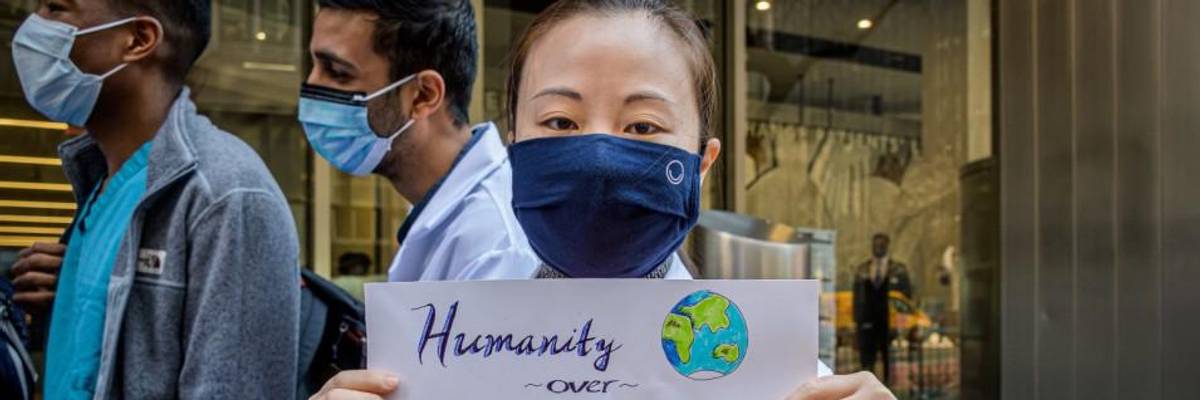
Health equity campaigners on Thursday called for a fairer system of developing and distributing Covid-19 medications after pharmaceutical company Pfizer announced record second-quarter revenue, more than half of which is attributable to sales of coronavirus vaccines and treatments that remain out of reach for much of the Global South.
"Millions of people in low- and middle-income countries faced death and devastation without access to vaccines while Pfizer sold doses to the highest bidders."
New York-based Pfizer announced Thursday its adjusted earnings for the second quarter were $2.04 per share, a 92% increase from the same period last year and well ahead of a consensus forecast of $1.79 per share. The company's revenue grew by 47% to $27.7 billion compared to the second quarter last year, while its net income soared 78% to $9.9 billion. Around $8.85 billion of Pfizer's total revenue came from sales of its Comirnaty coronavirus vaccine, while Paxlovid, its oral antiviral treatment, earned the company $8.1 billion. Pfizer also said that Covid-related sales should bring in about $54 billion in total revenues this year.
Additionally, during the first half of 2022, Pfizer has returned $6.5 billion to shareholders through stock buybacks and dividends, compared to $5.1 billion invested in research and development, belying Big Pharma claims that massive profits are imperative for the creation of new medicines.
"Pfizer is set for an obscene $100 billion pandemic windfall in 2022, even as the world remains billions of doses away from vaccinating everyone," Tim Bierley, pharma campaigner at the U.K.-based advocacy group Global Justice Now, said in a statement. "After 18 months of refusing to share its lifesaving vaccine technology with countries in the Global South, now we face a situation where huge parts of the world can't access Pfizer's lifesaving Covid-19 treatment. This is all because of a business model that puts shareholder greed before people's lives."
"Two years of terrible vaccine inequality have led to hundreds of thousands of unnecessary deaths, yet the only lesson Pfizer has learned is that billions can be made from a publicly funded medicine," Bierley added. "As leaders consider how we prepare for future pandemics, the priority must be to replace this pharmaceutical model, which illogically rewards the hoarding of scientific knowledge. It's time for a more cooperative, less profit-centered system, which puts global public health first."
While nearly 70% of the world's people have received at least one dose of Covid-19 vaccine, massive inequities in inoculation remain the rule, not the exception. According to the Johns Hopkins Coronavirus Resource Center, there are 36 countries in which less than 25% of the population is fully vaccinated, the vast majority of them in sub-Saharan Africa. Ten nations have full vaccination rates below 10%, with war-torn Yemen (1.5%), Haiti (1.4%), and Burundi (0.1%) currently having the world's lowest inoculation rates.
"Millions of people in low- and middle-income countries faced death and devastation without access to vaccines while Pfizer sold doses to the highest bidders," Mohga Kamal-Yanni, policy co-lead for the People's Vaccine Alliance, said in response to Pfizer's Q2 earnings. "Now we're seeing the same inequality in access to lifesaving Covid-19 treatments like Paxlovid. Pfizer's CEO can make all the half-hearted equity pledges he wants, but he will never wash that stain from his company's reputation."
Related Content

Kamal-Yanni asserted that "world leaders have repeatedly said that we must learn the lessons of this pandemic to better respond to future health crises. The one key lesson is that leaders cannot leave decisions on supply, allocation, and price to pharmaceutical companies."
"Companies like Pfizer will always put high profit before lives," he added. "The world needs to build a fairer system of creating and distributing medical technologies before the next pandemic, or risk repeating the mistakes of Covid-19."
Some activists have pointed to the fact that Africa still does not have any doses of vaccine against monkeypox--now a World Health Organization-designated global emergency--despite being the only continent where people have died from the virus, as evidence that little has been learned from the Covid-19 pandemic.
News of Pfizer's record revenue came a week after the company, along with U.K.-based Flynn Pharma, were fined the equivalent of $85 million by British regulators for overcharging the country's National Health Service for a lifesaving epilepsy drug.
Health equity campaigners on Thursday called for a fairer system of developing and distributing Covid-19 medications after pharmaceutical company Pfizer announced record second-quarter revenue, more than half of which is attributable to sales of coronavirus vaccines and treatments that remain out of reach for much of the Global South.
"Millions of people in low- and middle-income countries faced death and devastation without access to vaccines while Pfizer sold doses to the highest bidders."
New York-based Pfizer announced Thursday its adjusted earnings for the second quarter were $2.04 per share, a 92% increase from the same period last year and well ahead of a consensus forecast of $1.79 per share. The company's revenue grew by 47% to $27.7 billion compared to the second quarter last year, while its net income soared 78% to $9.9 billion. Around $8.85 billion of Pfizer's total revenue came from sales of its Comirnaty coronavirus vaccine, while Paxlovid, its oral antiviral treatment, earned the company $8.1 billion. Pfizer also said that Covid-related sales should bring in about $54 billion in total revenues this year.
Additionally, during the first half of 2022, Pfizer has returned $6.5 billion to shareholders through stock buybacks and dividends, compared to $5.1 billion invested in research and development, belying Big Pharma claims that massive profits are imperative for the creation of new medicines.
"Pfizer is set for an obscene $100 billion pandemic windfall in 2022, even as the world remains billions of doses away from vaccinating everyone," Tim Bierley, pharma campaigner at the U.K.-based advocacy group Global Justice Now, said in a statement. "After 18 months of refusing to share its lifesaving vaccine technology with countries in the Global South, now we face a situation where huge parts of the world can't access Pfizer's lifesaving Covid-19 treatment. This is all because of a business model that puts shareholder greed before people's lives."
"Two years of terrible vaccine inequality have led to hundreds of thousands of unnecessary deaths, yet the only lesson Pfizer has learned is that billions can be made from a publicly funded medicine," Bierley added. "As leaders consider how we prepare for future pandemics, the priority must be to replace this pharmaceutical model, which illogically rewards the hoarding of scientific knowledge. It's time for a more cooperative, less profit-centered system, which puts global public health first."
While nearly 70% of the world's people have received at least one dose of Covid-19 vaccine, massive inequities in inoculation remain the rule, not the exception. According to the Johns Hopkins Coronavirus Resource Center, there are 36 countries in which less than 25% of the population is fully vaccinated, the vast majority of them in sub-Saharan Africa. Ten nations have full vaccination rates below 10%, with war-torn Yemen (1.5%), Haiti (1.4%), and Burundi (0.1%) currently having the world's lowest inoculation rates.
"Millions of people in low- and middle-income countries faced death and devastation without access to vaccines while Pfizer sold doses to the highest bidders," Mohga Kamal-Yanni, policy co-lead for the People's Vaccine Alliance, said in response to Pfizer's Q2 earnings. "Now we're seeing the same inequality in access to lifesaving Covid-19 treatments like Paxlovid. Pfizer's CEO can make all the half-hearted equity pledges he wants, but he will never wash that stain from his company's reputation."
Related Content
Kamal-Yanni asserted that "world leaders have repeatedly said that we must learn the lessons of this pandemic to better respond to future health crises. The one key lesson is that leaders cannot leave decisions on supply, allocation, and price to pharmaceutical companies."
"Companies like Pfizer will always put high profit before lives," he added. "The world needs to build a fairer system of creating and distributing medical technologies before the next pandemic, or risk repeating the mistakes of Covid-19."
Some activists have pointed to the fact that Africa still does not have any doses of vaccine against monkeypox--now a World Health Organization-designated global emergency--despite being the only continent where people have died from the virus, as evidence that little has been learned from the Covid-19 pandemic.
News of Pfizer's record revenue came a week after the company, along with U.K.-based Flynn Pharma, were fined the equivalent of $85 million by British regulators for overcharging the country's National Health Service for a lifesaving epilepsy drug.
Health equity campaigners on Thursday called for a fairer system of developing and distributing Covid-19 medications after pharmaceutical company Pfizer announced record second-quarter revenue, more than half of which is attributable to sales of coronavirus vaccines and treatments that remain out of reach for much of the Global South.
"Millions of people in low- and middle-income countries faced death and devastation without access to vaccines while Pfizer sold doses to the highest bidders."
New York-based Pfizer announced Thursday its adjusted earnings for the second quarter were $2.04 per share, a 92% increase from the same period last year and well ahead of a consensus forecast of $1.79 per share. The company's revenue grew by 47% to $27.7 billion compared to the second quarter last year, while its net income soared 78% to $9.9 billion. Around $8.85 billion of Pfizer's total revenue came from sales of its Comirnaty coronavirus vaccine, while Paxlovid, its oral antiviral treatment, earned the company $8.1 billion. Pfizer also said that Covid-related sales should bring in about $54 billion in total revenues this year.
Additionally, during the first half of 2022, Pfizer has returned $6.5 billion to shareholders through stock buybacks and dividends, compared to $5.1 billion invested in research and development, belying Big Pharma claims that massive profits are imperative for the creation of new medicines.
"Pfizer is set for an obscene $100 billion pandemic windfall in 2022, even as the world remains billions of doses away from vaccinating everyone," Tim Bierley, pharma campaigner at the U.K.-based advocacy group Global Justice Now, said in a statement. "After 18 months of refusing to share its lifesaving vaccine technology with countries in the Global South, now we face a situation where huge parts of the world can't access Pfizer's lifesaving Covid-19 treatment. This is all because of a business model that puts shareholder greed before people's lives."
"Two years of terrible vaccine inequality have led to hundreds of thousands of unnecessary deaths, yet the only lesson Pfizer has learned is that billions can be made from a publicly funded medicine," Bierley added. "As leaders consider how we prepare for future pandemics, the priority must be to replace this pharmaceutical model, which illogically rewards the hoarding of scientific knowledge. It's time for a more cooperative, less profit-centered system, which puts global public health first."
While nearly 70% of the world's people have received at least one dose of Covid-19 vaccine, massive inequities in inoculation remain the rule, not the exception. According to the Johns Hopkins Coronavirus Resource Center, there are 36 countries in which less than 25% of the population is fully vaccinated, the vast majority of them in sub-Saharan Africa. Ten nations have full vaccination rates below 10%, with war-torn Yemen (1.5%), Haiti (1.4%), and Burundi (0.1%) currently having the world's lowest inoculation rates.
"Millions of people in low- and middle-income countries faced death and devastation without access to vaccines while Pfizer sold doses to the highest bidders," Mohga Kamal-Yanni, policy co-lead for the People's Vaccine Alliance, said in response to Pfizer's Q2 earnings. "Now we're seeing the same inequality in access to lifesaving Covid-19 treatments like Paxlovid. Pfizer's CEO can make all the half-hearted equity pledges he wants, but he will never wash that stain from his company's reputation."
Related Content
Kamal-Yanni asserted that "world leaders have repeatedly said that we must learn the lessons of this pandemic to better respond to future health crises. The one key lesson is that leaders cannot leave decisions on supply, allocation, and price to pharmaceutical companies."
"Companies like Pfizer will always put high profit before lives," he added. "The world needs to build a fairer system of creating and distributing medical technologies before the next pandemic, or risk repeating the mistakes of Covid-19."
Some activists have pointed to the fact that Africa still does not have any doses of vaccine against monkeypox--now a World Health Organization-designated global emergency--despite being the only continent where people have died from the virus, as evidence that little has been learned from the Covid-19 pandemic.
News of Pfizer's record revenue came a week after the company, along with U.K.-based Flynn Pharma, were fined the equivalent of $85 million by British regulators for overcharging the country's National Health Service for a lifesaving epilepsy drug.