SUBSCRIBE TO OUR FREE NEWSLETTER
Daily news & progressive opinion—funded by the people, not the corporations—delivered straight to your inbox.
5
#000000
#FFFFFF
To donate by check, phone, or other method, see our More Ways to Give page.
Daily news & progressive opinion—funded by the people, not the corporations—delivered straight to your inbox.
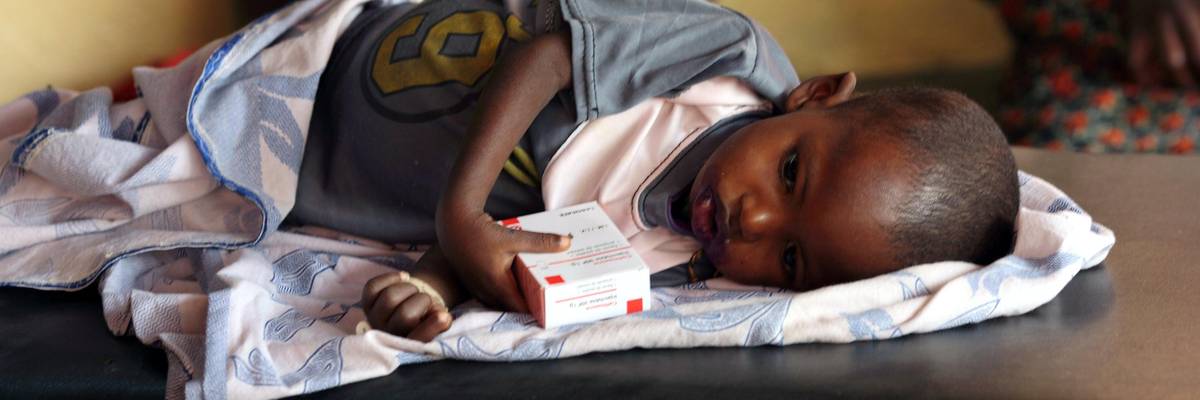
A child who suffers from severe malnutrition lies on a hospital bed, on March 19, 2012 in Diapaga, eastern Burkina Faso. (Photo: Raphael De Bengy/AFP via Getty Images)
The failure by global policymakers to act decisively to address the climate emergency threatens to erase decades of progress in the fight against childhood malnutrition in the Global South, according to a new study by researchers at Cornell University.
The study shows that children in low-income countries are increasingly suffering from both acute and chronic malnutrition as their communities experience the effects of extreme heat, which is becoming more prevalent and severe around the world as fossil fuel extraction persists and carbon emissions rise.
"As the number of hot days increases, we find that the prevalence of child malnutrition increases to a pretty high degree."
Sylvia Blom, who earned a Ph.D. from Cornell University in 2021 and led the study published earlier this month in the Journal of Environmental Economics and Management, said in a statement last week that "as the number of hot days increases, we find that the prevalence of child malnutrition increases to a pretty high degree."
Blom and her co-authors compared household survey data from 1993 to 2014 in five West African countries--Benin, Togo, Ghana, Burkina Faso, and Cote d'Ivoire--with geocoded weather data collected by Princeton University, tracking the hours of exposure to extreme heat over children's lifetimes and during heat shocks.
The study examined the effects of extreme heat on more than 32,000 children ages 3 months to 3 years old, finding that the average level of extreme heat exposure increased the prevalence of stunted growth from chronic malnutrition by 12%.
The prevalence of low weight from acute malnutrition increased by 29%.
The research comes as climate experts are warning that global policymakers are not doing enough to limit planetary heating to 1.5degC. If the global temperature rise reaches 2degC, as scientists warn it is likely to without major reductions in emissions, "the average effect of heat exposure on stunting would nearly double," said the researchers.
That means the level of child malnutrition in the Global South would wipe out gains made by anti-poverty initiatives over the study period.
"We're talking about children at a very young age that will have changes for the rest of their lives, so this is permanently scarring their potential," said Ariel Ortiz-Bobea, an associate professor and applied economist at Cornell. "What we are doing to reduce global poverty is being eroded by our lack of action on climate."
Programs that resulted in improved incomes, infrastructure, and child care practices during the study period helped reduce stunted growth by 5.8% on average.
"While this progress has been welcomed in West Africa and in other low- and middle-income countries, it's occurring against the backdrop of rising temperatures and an increased likelihood of extreme weather events," said John Hoddinott, a professor of food and nutrition economics and policy at Cornell. "Our work suggests these rising temperatures risk wiping out that progress."
The researchers said they believe the causal effects of extreme heat on malnutrition are "not physiological responses to direct heat," but are rather related to factors including higher risks that children will be exposed to pathogens from food and water that's been exposed to heat. Lower consumption of protein from animal sources, due to reduced agricultural productivity, could also be behind the spikes in malnutrition.
The study was released as extreme heat killed more than 1,000 people in Europe, broke a 40-year record in Tunisia's capital city as temperatures reached 118degF, and melted tar and buckled roads in China.
"Such extreme heat has direct impacts on human health," said Steven Pawson of the NASA Goddard Space Flight Center.
Dear Common Dreams reader, It’s been nearly 30 years since I co-founded Common Dreams with my late wife, Lina Newhouser. We had the radical notion that journalism should serve the public good, not corporate profits. It was clear to us from the outset what it would take to build such a project. No paid advertisements. No corporate sponsors. No millionaire publisher telling us what to think or do. Many people said we wouldn't last a year, but we proved those doubters wrong. Together with a tremendous team of journalists and dedicated staff, we built an independent media outlet free from the constraints of profits and corporate control. Our mission has always been simple: To inform. To inspire. To ignite change for the common good. Building Common Dreams was not easy. Our survival was never guaranteed. When you take on the most powerful forces—Wall Street greed, fossil fuel industry destruction, Big Tech lobbyists, and uber-rich oligarchs who have spent billions upon billions rigging the economy and democracy in their favor—the only bulwark you have is supporters who believe in your work. But here’s the urgent message from me today. It's never been this bad out there. And it's never been this hard to keep us going. At the very moment Common Dreams is most needed, the threats we face are intensifying. We need your support now more than ever. We don't accept corporate advertising and never will. We don't have a paywall because we don't think people should be blocked from critical news based on their ability to pay. Everything we do is funded by the donations of readers like you. When everyone does the little they can afford, we are strong. But if that support retreats or dries up, so do we. Will you donate now to make sure Common Dreams not only survives but thrives? —Craig Brown, Co-founder |
The failure by global policymakers to act decisively to address the climate emergency threatens to erase decades of progress in the fight against childhood malnutrition in the Global South, according to a new study by researchers at Cornell University.
The study shows that children in low-income countries are increasingly suffering from both acute and chronic malnutrition as their communities experience the effects of extreme heat, which is becoming more prevalent and severe around the world as fossil fuel extraction persists and carbon emissions rise.
"As the number of hot days increases, we find that the prevalence of child malnutrition increases to a pretty high degree."
Sylvia Blom, who earned a Ph.D. from Cornell University in 2021 and led the study published earlier this month in the Journal of Environmental Economics and Management, said in a statement last week that "as the number of hot days increases, we find that the prevalence of child malnutrition increases to a pretty high degree."
Blom and her co-authors compared household survey data from 1993 to 2014 in five West African countries--Benin, Togo, Ghana, Burkina Faso, and Cote d'Ivoire--with geocoded weather data collected by Princeton University, tracking the hours of exposure to extreme heat over children's lifetimes and during heat shocks.
The study examined the effects of extreme heat on more than 32,000 children ages 3 months to 3 years old, finding that the average level of extreme heat exposure increased the prevalence of stunted growth from chronic malnutrition by 12%.
The prevalence of low weight from acute malnutrition increased by 29%.
The research comes as climate experts are warning that global policymakers are not doing enough to limit planetary heating to 1.5degC. If the global temperature rise reaches 2degC, as scientists warn it is likely to without major reductions in emissions, "the average effect of heat exposure on stunting would nearly double," said the researchers.
That means the level of child malnutrition in the Global South would wipe out gains made by anti-poverty initiatives over the study period.
"We're talking about children at a very young age that will have changes for the rest of their lives, so this is permanently scarring their potential," said Ariel Ortiz-Bobea, an associate professor and applied economist at Cornell. "What we are doing to reduce global poverty is being eroded by our lack of action on climate."
Programs that resulted in improved incomes, infrastructure, and child care practices during the study period helped reduce stunted growth by 5.8% on average.
"While this progress has been welcomed in West Africa and in other low- and middle-income countries, it's occurring against the backdrop of rising temperatures and an increased likelihood of extreme weather events," said John Hoddinott, a professor of food and nutrition economics and policy at Cornell. "Our work suggests these rising temperatures risk wiping out that progress."
The researchers said they believe the causal effects of extreme heat on malnutrition are "not physiological responses to direct heat," but are rather related to factors including higher risks that children will be exposed to pathogens from food and water that's been exposed to heat. Lower consumption of protein from animal sources, due to reduced agricultural productivity, could also be behind the spikes in malnutrition.
The study was released as extreme heat killed more than 1,000 people in Europe, broke a 40-year record in Tunisia's capital city as temperatures reached 118degF, and melted tar and buckled roads in China.
"Such extreme heat has direct impacts on human health," said Steven Pawson of the NASA Goddard Space Flight Center.
The failure by global policymakers to act decisively to address the climate emergency threatens to erase decades of progress in the fight against childhood malnutrition in the Global South, according to a new study by researchers at Cornell University.
The study shows that children in low-income countries are increasingly suffering from both acute and chronic malnutrition as their communities experience the effects of extreme heat, which is becoming more prevalent and severe around the world as fossil fuel extraction persists and carbon emissions rise.
"As the number of hot days increases, we find that the prevalence of child malnutrition increases to a pretty high degree."
Sylvia Blom, who earned a Ph.D. from Cornell University in 2021 and led the study published earlier this month in the Journal of Environmental Economics and Management, said in a statement last week that "as the number of hot days increases, we find that the prevalence of child malnutrition increases to a pretty high degree."
Blom and her co-authors compared household survey data from 1993 to 2014 in five West African countries--Benin, Togo, Ghana, Burkina Faso, and Cote d'Ivoire--with geocoded weather data collected by Princeton University, tracking the hours of exposure to extreme heat over children's lifetimes and during heat shocks.
The study examined the effects of extreme heat on more than 32,000 children ages 3 months to 3 years old, finding that the average level of extreme heat exposure increased the prevalence of stunted growth from chronic malnutrition by 12%.
The prevalence of low weight from acute malnutrition increased by 29%.
The research comes as climate experts are warning that global policymakers are not doing enough to limit planetary heating to 1.5degC. If the global temperature rise reaches 2degC, as scientists warn it is likely to without major reductions in emissions, "the average effect of heat exposure on stunting would nearly double," said the researchers.
That means the level of child malnutrition in the Global South would wipe out gains made by anti-poverty initiatives over the study period.
"We're talking about children at a very young age that will have changes for the rest of their lives, so this is permanently scarring their potential," said Ariel Ortiz-Bobea, an associate professor and applied economist at Cornell. "What we are doing to reduce global poverty is being eroded by our lack of action on climate."
Programs that resulted in improved incomes, infrastructure, and child care practices during the study period helped reduce stunted growth by 5.8% on average.
"While this progress has been welcomed in West Africa and in other low- and middle-income countries, it's occurring against the backdrop of rising temperatures and an increased likelihood of extreme weather events," said John Hoddinott, a professor of food and nutrition economics and policy at Cornell. "Our work suggests these rising temperatures risk wiping out that progress."
The researchers said they believe the causal effects of extreme heat on malnutrition are "not physiological responses to direct heat," but are rather related to factors including higher risks that children will be exposed to pathogens from food and water that's been exposed to heat. Lower consumption of protein from animal sources, due to reduced agricultural productivity, could also be behind the spikes in malnutrition.
The study was released as extreme heat killed more than 1,000 people in Europe, broke a 40-year record in Tunisia's capital city as temperatures reached 118degF, and melted tar and buckled roads in China.
"Such extreme heat has direct impacts on human health," said Steven Pawson of the NASA Goddard Space Flight Center.