SUBSCRIBE TO OUR FREE NEWSLETTER
Daily news & progressive opinion—funded by the people, not the corporations—delivered straight to your inbox.
5
#000000
#FFFFFF
To donate by check, phone, or other method, see our More Ways to Give page.
Daily news & progressive opinion—funded by the people, not the corporations—delivered straight to your inbox.
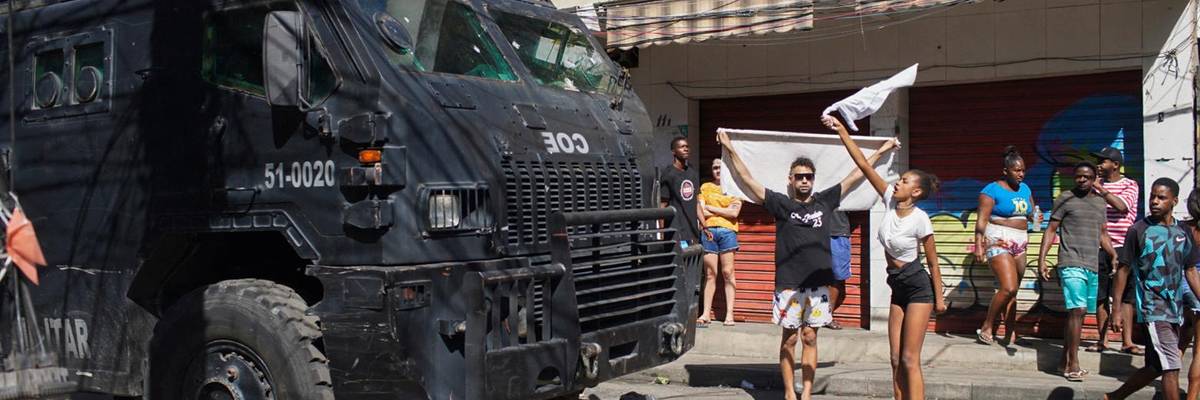
Residents of the Complexo do Alemao favela in Rio de Janeiro protest as a caveirao, or armored assault vehicle, passes during a police raid that killed at least 18 people on July 21, 2022. (Photo: Mauro Pimentel/AFP via Getty Images)
Brazilian progressives and human rights groups on Friday condemned the elite police units and, ultimately, Rio de Janeiro's right-wing governor, whom they held responsible after the latest police massacre of favela residents left at least 19 people dead the previous day.
"This cruel, racist, and selective public safety policy cannot continue!"
According to Folhapress, the joint attack by the notorious Special Police Operations Battalion (BOPE) and Coordination of Special Assets (CORE) units of the military and civil police killed at least 18 people in Complexo do Alemao. The heavily armed officers attacked the community with weapons including helicopters and caveiroes, the armored assault vehicles widely viewed by favela residents--almost all of whom are impoverished Black and Brown people--as symbols of deadly police repression.
One military policeman died during the invasion, which a BOPE commander claimed was launched in response to intelligence indicating a gang might move to invade other favelas or rob banks.
At least two bystanders were killed in the attack, including 49-year-old Solange Mendes, who was reportedly shot in the head when an officer got scared when she passed in an alley, and Leticia Marinho de Sales, 50, who was shot in the chest while in a vehicle stopped at a traffic light. Police warned that the death toll could rise further.
"A totally unprepared policeman shot my mother. Is that what the governor has for us? Go in and kill? Every time he's just going to order a kill?" asked Jessica Sales, the victim's daughter, during an interview with UOL. "What are the police in Rio learning? How to kill a worker?"
The community's outrage was echoed by Brazilian human rights campaigners and progressive politicians.
"In the Ukrainian war and in several other conflicts, it is forbidden to use helicopters as a firing platform in civilian areas, it is an international crime. But in the slums this happens quietly, even today in Alemao, with the [armored helicopter] terrorizing residents," the Federation of Associations of Rio de Janeiro Favelas (FAFERJ) said in a statement, according to O Dia.
FAFERJ added that such state aggression "does not solve the problem of violence; on the contrary, it only makes it worse."
Instituto Marielle Franco, a progressive advocacy group named after a Rio socialist city councilwoman murdered in 2018, tweeted: "Once again, residents of Alemao get shot at, having their houses invaded and broken into, more than 400 police on foot, helicopters, and 10 caveiroes, for what? How many more have to die for this war to end?"
"Residents of Alemao are woken up by gunshots, houses being invaded, and helicopters hovering," the group added. "It's another day without school, without work, without a health center, with rights being neglected. This government's public security policy is to send the police to machine-gun the favela."
Renata Souza, a Rio de Janeiro state lawmaker and member of the Socialism and Liberty Party (PSOL) who grew up in Rio's Favela de Mare, responded to the massacre by tweeting that "the carnage has a name and a surname: Claudio Castro."
"It is unacceptable that Gov. Claudio Castro continues this bloodbath in the favelas of Rio," Souza asserted. "These operations do not solve the problem of violence and result in terror and deaths in the favelas. This cruel, racist, and selective public safety policy cannot continue!"
Souza said she filed a complaint with the Inter-American Commission on Human Rights "about the morning of horror in Alemao yesterday," a move meant to draw "attention to the exorbitant number of police operations that result in massacres" and underscore Article 5 of Brazil's constitution, "which says that there is no death penalty in this country."
Florida Atlantic University professor Luisa Turbino Torres explained that "murdering people became a political tactic in [an] election year for Castro, who justified the killings by arguing that the victims were criminals and, thus, deserved to die. Beyond official numbers, many people are hurt and disappear during these operations."
As Talira Petrone, a federal PSOL lawmaker representing Rio de Janeiro, noted, the Complexo do Alemao raid was the fifth-deadliest police massacre in the city's history. In May, 23 people were killed during a police invasion of the Vila Cruzeiro favela. A year earlier, 28 died during a BOPE-led attack on Jacarezinho.
The Jacarezinho raid prompted Brazil's Supreme Court to establish rules regulating police use of force during raids. The court's order limits lethal force to situations necessary to save lives and when all other options have been exhausted.
Thursday's raid was the deadliest police incursion in Complexo do Alemao since 19 people including children were killed during an April 2007 raid by federal, state, and local forces. A national lawyers' group found that at least 11 of those killed had no connection to the drug gangs police claimed to target.
As Petrone pointed out, Black people are 4.5 times more likely to be approached by police than whites in Rio de Janeiro and Sao Paulo. During the first half of 2019, 80% of people killed by police in Rio de Janeiro were Black, according to the Institute of Public Security.
Over the past five years, Brazilian police have killed more than 22,000 people, most of them Black.
Dear Common Dreams reader, It’s been nearly 30 years since I co-founded Common Dreams with my late wife, Lina Newhouser. We had the radical notion that journalism should serve the public good, not corporate profits. It was clear to us from the outset what it would take to build such a project. No paid advertisements. No corporate sponsors. No millionaire publisher telling us what to think or do. Many people said we wouldn't last a year, but we proved those doubters wrong. Together with a tremendous team of journalists and dedicated staff, we built an independent media outlet free from the constraints of profits and corporate control. Our mission has always been simple: To inform. To inspire. To ignite change for the common good. Building Common Dreams was not easy. Our survival was never guaranteed. When you take on the most powerful forces—Wall Street greed, fossil fuel industry destruction, Big Tech lobbyists, and uber-rich oligarchs who have spent billions upon billions rigging the economy and democracy in their favor—the only bulwark you have is supporters who believe in your work. But here’s the urgent message from me today. It's never been this bad out there. And it's never been this hard to keep us going. At the very moment Common Dreams is most needed, the threats we face are intensifying. We need your support now more than ever. We don't accept corporate advertising and never will. We don't have a paywall because we don't think people should be blocked from critical news based on their ability to pay. Everything we do is funded by the donations of readers like you. When everyone does the little they can afford, we are strong. But if that support retreats or dries up, so do we. Will you donate now to make sure Common Dreams not only survives but thrives? —Craig Brown, Co-founder |
Brazilian progressives and human rights groups on Friday condemned the elite police units and, ultimately, Rio de Janeiro's right-wing governor, whom they held responsible after the latest police massacre of favela residents left at least 19 people dead the previous day.
"This cruel, racist, and selective public safety policy cannot continue!"
According to Folhapress, the joint attack by the notorious Special Police Operations Battalion (BOPE) and Coordination of Special Assets (CORE) units of the military and civil police killed at least 18 people in Complexo do Alemao. The heavily armed officers attacked the community with weapons including helicopters and caveiroes, the armored assault vehicles widely viewed by favela residents--almost all of whom are impoverished Black and Brown people--as symbols of deadly police repression.
One military policeman died during the invasion, which a BOPE commander claimed was launched in response to intelligence indicating a gang might move to invade other favelas or rob banks.
At least two bystanders were killed in the attack, including 49-year-old Solange Mendes, who was reportedly shot in the head when an officer got scared when she passed in an alley, and Leticia Marinho de Sales, 50, who was shot in the chest while in a vehicle stopped at a traffic light. Police warned that the death toll could rise further.
"A totally unprepared policeman shot my mother. Is that what the governor has for us? Go in and kill? Every time he's just going to order a kill?" asked Jessica Sales, the victim's daughter, during an interview with UOL. "What are the police in Rio learning? How to kill a worker?"
The community's outrage was echoed by Brazilian human rights campaigners and progressive politicians.
"In the Ukrainian war and in several other conflicts, it is forbidden to use helicopters as a firing platform in civilian areas, it is an international crime. But in the slums this happens quietly, even today in Alemao, with the [armored helicopter] terrorizing residents," the Federation of Associations of Rio de Janeiro Favelas (FAFERJ) said in a statement, according to O Dia.
FAFERJ added that such state aggression "does not solve the problem of violence; on the contrary, it only makes it worse."
Instituto Marielle Franco, a progressive advocacy group named after a Rio socialist city councilwoman murdered in 2018, tweeted: "Once again, residents of Alemao get shot at, having their houses invaded and broken into, more than 400 police on foot, helicopters, and 10 caveiroes, for what? How many more have to die for this war to end?"
"Residents of Alemao are woken up by gunshots, houses being invaded, and helicopters hovering," the group added. "It's another day without school, without work, without a health center, with rights being neglected. This government's public security policy is to send the police to machine-gun the favela."
Renata Souza, a Rio de Janeiro state lawmaker and member of the Socialism and Liberty Party (PSOL) who grew up in Rio's Favela de Mare, responded to the massacre by tweeting that "the carnage has a name and a surname: Claudio Castro."
"It is unacceptable that Gov. Claudio Castro continues this bloodbath in the favelas of Rio," Souza asserted. "These operations do not solve the problem of violence and result in terror and deaths in the favelas. This cruel, racist, and selective public safety policy cannot continue!"
Souza said she filed a complaint with the Inter-American Commission on Human Rights "about the morning of horror in Alemao yesterday," a move meant to draw "attention to the exorbitant number of police operations that result in massacres" and underscore Article 5 of Brazil's constitution, "which says that there is no death penalty in this country."
Florida Atlantic University professor Luisa Turbino Torres explained that "murdering people became a political tactic in [an] election year for Castro, who justified the killings by arguing that the victims were criminals and, thus, deserved to die. Beyond official numbers, many people are hurt and disappear during these operations."
As Talira Petrone, a federal PSOL lawmaker representing Rio de Janeiro, noted, the Complexo do Alemao raid was the fifth-deadliest police massacre in the city's history. In May, 23 people were killed during a police invasion of the Vila Cruzeiro favela. A year earlier, 28 died during a BOPE-led attack on Jacarezinho.
The Jacarezinho raid prompted Brazil's Supreme Court to establish rules regulating police use of force during raids. The court's order limits lethal force to situations necessary to save lives and when all other options have been exhausted.
Thursday's raid was the deadliest police incursion in Complexo do Alemao since 19 people including children were killed during an April 2007 raid by federal, state, and local forces. A national lawyers' group found that at least 11 of those killed had no connection to the drug gangs police claimed to target.
As Petrone pointed out, Black people are 4.5 times more likely to be approached by police than whites in Rio de Janeiro and Sao Paulo. During the first half of 2019, 80% of people killed by police in Rio de Janeiro were Black, according to the Institute of Public Security.
Over the past five years, Brazilian police have killed more than 22,000 people, most of them Black.
Brazilian progressives and human rights groups on Friday condemned the elite police units and, ultimately, Rio de Janeiro's right-wing governor, whom they held responsible after the latest police massacre of favela residents left at least 19 people dead the previous day.
"This cruel, racist, and selective public safety policy cannot continue!"
According to Folhapress, the joint attack by the notorious Special Police Operations Battalion (BOPE) and Coordination of Special Assets (CORE) units of the military and civil police killed at least 18 people in Complexo do Alemao. The heavily armed officers attacked the community with weapons including helicopters and caveiroes, the armored assault vehicles widely viewed by favela residents--almost all of whom are impoverished Black and Brown people--as symbols of deadly police repression.
One military policeman died during the invasion, which a BOPE commander claimed was launched in response to intelligence indicating a gang might move to invade other favelas or rob banks.
At least two bystanders were killed in the attack, including 49-year-old Solange Mendes, who was reportedly shot in the head when an officer got scared when she passed in an alley, and Leticia Marinho de Sales, 50, who was shot in the chest while in a vehicle stopped at a traffic light. Police warned that the death toll could rise further.
"A totally unprepared policeman shot my mother. Is that what the governor has for us? Go in and kill? Every time he's just going to order a kill?" asked Jessica Sales, the victim's daughter, during an interview with UOL. "What are the police in Rio learning? How to kill a worker?"
The community's outrage was echoed by Brazilian human rights campaigners and progressive politicians.
"In the Ukrainian war and in several other conflicts, it is forbidden to use helicopters as a firing platform in civilian areas, it is an international crime. But in the slums this happens quietly, even today in Alemao, with the [armored helicopter] terrorizing residents," the Federation of Associations of Rio de Janeiro Favelas (FAFERJ) said in a statement, according to O Dia.
FAFERJ added that such state aggression "does not solve the problem of violence; on the contrary, it only makes it worse."
Instituto Marielle Franco, a progressive advocacy group named after a Rio socialist city councilwoman murdered in 2018, tweeted: "Once again, residents of Alemao get shot at, having their houses invaded and broken into, more than 400 police on foot, helicopters, and 10 caveiroes, for what? How many more have to die for this war to end?"
"Residents of Alemao are woken up by gunshots, houses being invaded, and helicopters hovering," the group added. "It's another day without school, without work, without a health center, with rights being neglected. This government's public security policy is to send the police to machine-gun the favela."
Renata Souza, a Rio de Janeiro state lawmaker and member of the Socialism and Liberty Party (PSOL) who grew up in Rio's Favela de Mare, responded to the massacre by tweeting that "the carnage has a name and a surname: Claudio Castro."
"It is unacceptable that Gov. Claudio Castro continues this bloodbath in the favelas of Rio," Souza asserted. "These operations do not solve the problem of violence and result in terror and deaths in the favelas. This cruel, racist, and selective public safety policy cannot continue!"
Souza said she filed a complaint with the Inter-American Commission on Human Rights "about the morning of horror in Alemao yesterday," a move meant to draw "attention to the exorbitant number of police operations that result in massacres" and underscore Article 5 of Brazil's constitution, "which says that there is no death penalty in this country."
Florida Atlantic University professor Luisa Turbino Torres explained that "murdering people became a political tactic in [an] election year for Castro, who justified the killings by arguing that the victims were criminals and, thus, deserved to die. Beyond official numbers, many people are hurt and disappear during these operations."
As Talira Petrone, a federal PSOL lawmaker representing Rio de Janeiro, noted, the Complexo do Alemao raid was the fifth-deadliest police massacre in the city's history. In May, 23 people were killed during a police invasion of the Vila Cruzeiro favela. A year earlier, 28 died during a BOPE-led attack on Jacarezinho.
The Jacarezinho raid prompted Brazil's Supreme Court to establish rules regulating police use of force during raids. The court's order limits lethal force to situations necessary to save lives and when all other options have been exhausted.
Thursday's raid was the deadliest police incursion in Complexo do Alemao since 19 people including children were killed during an April 2007 raid by federal, state, and local forces. A national lawyers' group found that at least 11 of those killed had no connection to the drug gangs police claimed to target.
As Petrone pointed out, Black people are 4.5 times more likely to be approached by police than whites in Rio de Janeiro and Sao Paulo. During the first half of 2019, 80% of people killed by police in Rio de Janeiro were Black, according to the Institute of Public Security.
Over the past five years, Brazilian police have killed more than 22,000 people, most of them Black.