SUBSCRIBE TO OUR FREE NEWSLETTER
Daily news & progressive opinion—funded by the people, not the corporations—delivered straight to your inbox.
5
#000000
#FFFFFF
To donate by check, phone, or other method, see our More Ways to Give page.
Daily news & progressive opinion—funded by the people, not the corporations—delivered straight to your inbox.
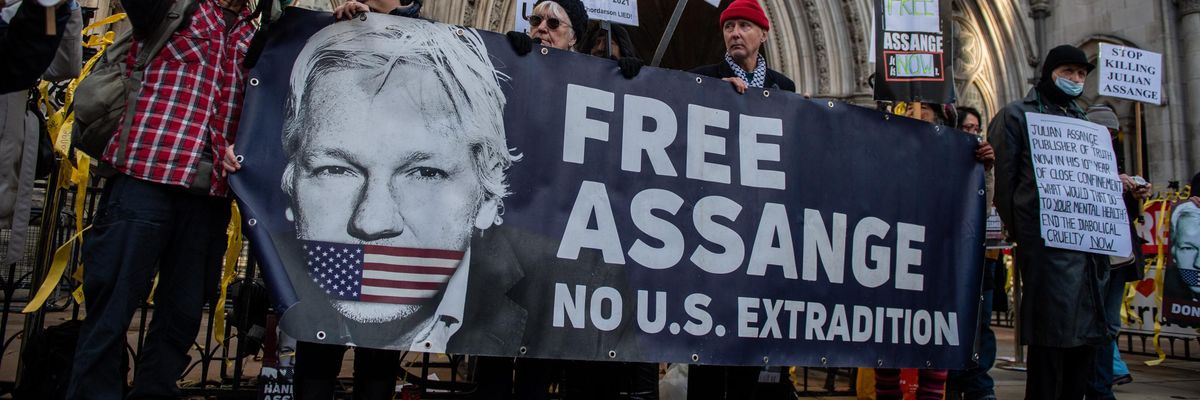
Supporters of Julian Assange rally outside the Royal Courts of Justice on December 10, 2021 in London. (Photo: Chris J. Ratcliffe/Getty Images)
The U.K. government on Friday formally approved the extradition of WikiLeaks founder Julian Assange to the United States to face espionage charges, a decision that human rights groups condemned as a dire threat to journalism worldwide.
Assange, who has been detained in a high-security London prison since 2019, is expected to appeal the move by U.K. Home Secretary Priti Patel, whose office insisted that the publisher's extradition to the U.S. would not be "incompatible with his human rights, including his right to a fair trial and to freedom of expression."
"We call on the U.K. to refrain from extraditing Julian Assange, for the U.S. to drop the charges, and for Assange to be freed."
But Amnesty International's Agnes Callamard, who previously worked as a United Nations human rights expert, disagreed with Patel's assessment, warning that "allowing Julian Assange to be extradited to the U.S. would put him at great risk and sends a chilling message to journalists the world over."
"If the extradition proceeds, Amnesty International is extremely concerned that Assange faces a high risk of prolonged solitary confinement, which would violate the prohibition on torture or other ill treatment," Callamard said in a statement. "Diplomatic assurances provided by the U.S. that Assange will not be kept in solitary confinement cannot be taken on face value given previous history."
"We call on the U.K. to refrain from extraditing Julian Assange, for the U.S. to drop the charges, and for Assange to be freed," Callamard added.
If found guilty of all 17 Espionage Act charges--which were originally brought by the Trump administration--Assange could face a 175-year prison sentence, which the U.S. has said he could serve in his native Australia. A British judge had previously rejected U.S. attempts to secure Assange's extradition on the grounds that the country's prison system is so brutal that it would endanger the journalist's life.
The Biden administration has continued pursuing the charges against Assange despite vocal warnings and pushback from human rights and press freedom groups.
Stella Assange, the WikiLeaks founder's wife, warned Friday that the U.K. government has "approved sending Julian Assange to the country that plotted his assassination," referring to reports that the CIA--then under the leadership of Mike Pompeo--considered kidnapping or killing the journalist, who published classified information that exposed U.S. war crimes.
In a statement responding to Patel's decision, WikiLeaks said that "this is a dark day for press freedom and for British democracy."
"Anyone in this country who cares about freedom of expression should be deeply ashamed," the organization continued. "Julian did nothing wrong. He has committed no crime and is not a criminal. He is a journalist and a publisher, and he is being punished for doing his job."
"Today is not the end of the fight," WikiLeaks added. "It is only the beginning of a new legal battle. We will appeal through the legal system, the next appeal will be before the High Court. We will fight louder and harder on the streets, we will organize, and we will make Julian's story be known to all."
Dear Common Dreams reader, It’s been nearly 30 years since I co-founded Common Dreams with my late wife, Lina Newhouser. We had the radical notion that journalism should serve the public good, not corporate profits. It was clear to us from the outset what it would take to build such a project. No paid advertisements. No corporate sponsors. No millionaire publisher telling us what to think or do. Many people said we wouldn't last a year, but we proved those doubters wrong. Together with a tremendous team of journalists and dedicated staff, we built an independent media outlet free from the constraints of profits and corporate control. Our mission has always been simple: To inform. To inspire. To ignite change for the common good. Building Common Dreams was not easy. Our survival was never guaranteed. When you take on the most powerful forces—Wall Street greed, fossil fuel industry destruction, Big Tech lobbyists, and uber-rich oligarchs who have spent billions upon billions rigging the economy and democracy in their favor—the only bulwark you have is supporters who believe in your work. But here’s the urgent message from me today. It's never been this bad out there. And it's never been this hard to keep us going. At the very moment Common Dreams is most needed, the threats we face are intensifying. We need your support now more than ever. We don't accept corporate advertising and never will. We don't have a paywall because we don't think people should be blocked from critical news based on their ability to pay. Everything we do is funded by the donations of readers like you. When everyone does the little they can afford, we are strong. But if that support retreats or dries up, so do we. Will you donate now to make sure Common Dreams not only survives but thrives? —Craig Brown, Co-founder |
The U.K. government on Friday formally approved the extradition of WikiLeaks founder Julian Assange to the United States to face espionage charges, a decision that human rights groups condemned as a dire threat to journalism worldwide.
Assange, who has been detained in a high-security London prison since 2019, is expected to appeal the move by U.K. Home Secretary Priti Patel, whose office insisted that the publisher's extradition to the U.S. would not be "incompatible with his human rights, including his right to a fair trial and to freedom of expression."
"We call on the U.K. to refrain from extraditing Julian Assange, for the U.S. to drop the charges, and for Assange to be freed."
But Amnesty International's Agnes Callamard, who previously worked as a United Nations human rights expert, disagreed with Patel's assessment, warning that "allowing Julian Assange to be extradited to the U.S. would put him at great risk and sends a chilling message to journalists the world over."
"If the extradition proceeds, Amnesty International is extremely concerned that Assange faces a high risk of prolonged solitary confinement, which would violate the prohibition on torture or other ill treatment," Callamard said in a statement. "Diplomatic assurances provided by the U.S. that Assange will not be kept in solitary confinement cannot be taken on face value given previous history."
"We call on the U.K. to refrain from extraditing Julian Assange, for the U.S. to drop the charges, and for Assange to be freed," Callamard added.
If found guilty of all 17 Espionage Act charges--which were originally brought by the Trump administration--Assange could face a 175-year prison sentence, which the U.S. has said he could serve in his native Australia. A British judge had previously rejected U.S. attempts to secure Assange's extradition on the grounds that the country's prison system is so brutal that it would endanger the journalist's life.
The Biden administration has continued pursuing the charges against Assange despite vocal warnings and pushback from human rights and press freedom groups.
Stella Assange, the WikiLeaks founder's wife, warned Friday that the U.K. government has "approved sending Julian Assange to the country that plotted his assassination," referring to reports that the CIA--then under the leadership of Mike Pompeo--considered kidnapping or killing the journalist, who published classified information that exposed U.S. war crimes.
In a statement responding to Patel's decision, WikiLeaks said that "this is a dark day for press freedom and for British democracy."
"Anyone in this country who cares about freedom of expression should be deeply ashamed," the organization continued. "Julian did nothing wrong. He has committed no crime and is not a criminal. He is a journalist and a publisher, and he is being punished for doing his job."
"Today is not the end of the fight," WikiLeaks added. "It is only the beginning of a new legal battle. We will appeal through the legal system, the next appeal will be before the High Court. We will fight louder and harder on the streets, we will organize, and we will make Julian's story be known to all."
The U.K. government on Friday formally approved the extradition of WikiLeaks founder Julian Assange to the United States to face espionage charges, a decision that human rights groups condemned as a dire threat to journalism worldwide.
Assange, who has been detained in a high-security London prison since 2019, is expected to appeal the move by U.K. Home Secretary Priti Patel, whose office insisted that the publisher's extradition to the U.S. would not be "incompatible with his human rights, including his right to a fair trial and to freedom of expression."
"We call on the U.K. to refrain from extraditing Julian Assange, for the U.S. to drop the charges, and for Assange to be freed."
But Amnesty International's Agnes Callamard, who previously worked as a United Nations human rights expert, disagreed with Patel's assessment, warning that "allowing Julian Assange to be extradited to the U.S. would put him at great risk and sends a chilling message to journalists the world over."
"If the extradition proceeds, Amnesty International is extremely concerned that Assange faces a high risk of prolonged solitary confinement, which would violate the prohibition on torture or other ill treatment," Callamard said in a statement. "Diplomatic assurances provided by the U.S. that Assange will not be kept in solitary confinement cannot be taken on face value given previous history."
"We call on the U.K. to refrain from extraditing Julian Assange, for the U.S. to drop the charges, and for Assange to be freed," Callamard added.
If found guilty of all 17 Espionage Act charges--which were originally brought by the Trump administration--Assange could face a 175-year prison sentence, which the U.S. has said he could serve in his native Australia. A British judge had previously rejected U.S. attempts to secure Assange's extradition on the grounds that the country's prison system is so brutal that it would endanger the journalist's life.
The Biden administration has continued pursuing the charges against Assange despite vocal warnings and pushback from human rights and press freedom groups.
Stella Assange, the WikiLeaks founder's wife, warned Friday that the U.K. government has "approved sending Julian Assange to the country that plotted his assassination," referring to reports that the CIA--then under the leadership of Mike Pompeo--considered kidnapping or killing the journalist, who published classified information that exposed U.S. war crimes.
In a statement responding to Patel's decision, WikiLeaks said that "this is a dark day for press freedom and for British democracy."
"Anyone in this country who cares about freedom of expression should be deeply ashamed," the organization continued. "Julian did nothing wrong. He has committed no crime and is not a criminal. He is a journalist and a publisher, and he is being punished for doing his job."
"Today is not the end of the fight," WikiLeaks added. "It is only the beginning of a new legal battle. We will appeal through the legal system, the next appeal will be before the High Court. We will fight louder and harder on the streets, we will organize, and we will make Julian's story be known to all."