SUBSCRIBE TO OUR FREE NEWSLETTER
Daily news & progressive opinion—funded by the people, not the corporations—delivered straight to your inbox.
5
#000000
#FFFFFF
To donate by check, phone, or other method, see our More Ways to Give page.
Daily news & progressive opinion—funded by the people, not the corporations—delivered straight to your inbox.
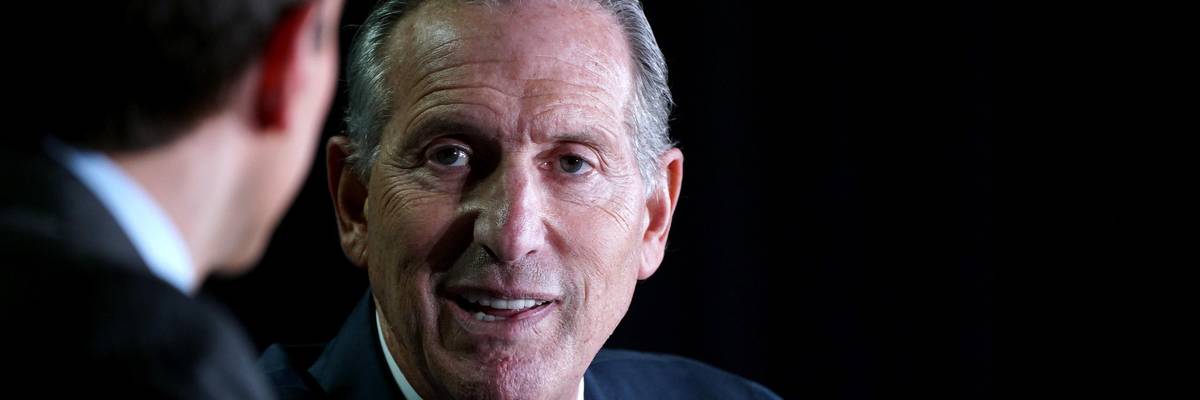
Starbucks CEO Howard Schultz speaks onstage at the New York Times DealBook D.C. policy forum on June 9, 2022 in Washington, D.C. (Photo: Leigh Vogel/Getty Images for the New York Times)
Starbucks CEO Howard Schultz made it clear Thursday that he does not intend to hold good-faith negotiations with Starbucks Workers United--the union that has won elections at more than 140 coffee shops nationwide since December--potentially exposing the corporation to a fresh legal fight with the National Labor Relations Board.
When asked by Andrew Ross Sorkin of the New York Times if he could ever see himself "embracing the union," Schultz responded tersely: "No."
"The customer experience," the billionaire claimed during a live interview, will be degraded "if a third party is integrated into our business."
As Jordan Zakarin of More Perfect Union reported Friday, Schultz's comment "marks a significant and potentially illegal shift in the company's public statements about its relationship" with Starbucks Workers United.
"Schultz's statement could run afoul of the National Labor Relations Act, which requires a constructive approach from employers when its workers vote to form a union," Zakarin noted. "The law demands that during collective bargaining, employers must 'confer in good faith with respect to wages, hours, and other terms and conditions of employment.'"
He continued:
Up to this point, Starbucks executives have been careful to insist that the company would bargain in good faith--often in those exact terms.
In December, immediately following the union's first victories in Buffalo, Rossann Williams, Starbucks president for North America, stated in a public letter that "we will bargain in good faith with the union that represents partners in the one Buffalo store that voted in favor of union representation."
Similar statements, from Schultz, Williams, and spokespersons for the company, have been made regularly for the past seven months.
Veteran labor journalist Steven Greenhouse responded to the interview by saying that Schultz in his remarks "seems to declare permanent war against the union."
"Schultz sounds so hugely anti-union," Greenhouse continued, "that he seems totally willing to refuse to cooperate in any way whatsoever with the union to help make Starbucks a better company and serve its customers better."
"If I were a Starbucks shareholder," he added, "this refusal to work with the union would worry me."
Greenhouse also pointed out the hypocrisy of Schultz's derogatory reference to the union as a "third party."
Referring to high-level company executives and the union-busting law firm hired by Schultz to fend off worker organizing, Greenhouse said that "Starbucks didn't call the dozens of managers and $500-an-hour Littler Mendelson lawyers it flew to Buffalo from out of town a 'third party.'"
Peter Certo of the Institute for Policy Studies, meanwhile, responded to Schultz's comments by issuing a caustic reminder that "Hillary Clinton was going to make this man her labor secretary."
Dear Common Dreams reader, It’s been nearly 30 years since I co-founded Common Dreams with my late wife, Lina Newhouser. We had the radical notion that journalism should serve the public good, not corporate profits. It was clear to us from the outset what it would take to build such a project. No paid advertisements. No corporate sponsors. No millionaire publisher telling us what to think or do. Many people said we wouldn't last a year, but we proved those doubters wrong. Together with a tremendous team of journalists and dedicated staff, we built an independent media outlet free from the constraints of profits and corporate control. Our mission has always been simple: To inform. To inspire. To ignite change for the common good. Building Common Dreams was not easy. Our survival was never guaranteed. When you take on the most powerful forces—Wall Street greed, fossil fuel industry destruction, Big Tech lobbyists, and uber-rich oligarchs who have spent billions upon billions rigging the economy and democracy in their favor—the only bulwark you have is supporters who believe in your work. But here’s the urgent message from me today. It's never been this bad out there. And it's never been this hard to keep us going. At the very moment Common Dreams is most needed, the threats we face are intensifying. We need your support now more than ever. We don't accept corporate advertising and never will. We don't have a paywall because we don't think people should be blocked from critical news based on their ability to pay. Everything we do is funded by the donations of readers like you. When everyone does the little they can afford, we are strong. But if that support retreats or dries up, so do we. Will you donate now to make sure Common Dreams not only survives but thrives? —Craig Brown, Co-founder |
Starbucks CEO Howard Schultz made it clear Thursday that he does not intend to hold good-faith negotiations with Starbucks Workers United--the union that has won elections at more than 140 coffee shops nationwide since December--potentially exposing the corporation to a fresh legal fight with the National Labor Relations Board.
When asked by Andrew Ross Sorkin of the New York Times if he could ever see himself "embracing the union," Schultz responded tersely: "No."
"The customer experience," the billionaire claimed during a live interview, will be degraded "if a third party is integrated into our business."
As Jordan Zakarin of More Perfect Union reported Friday, Schultz's comment "marks a significant and potentially illegal shift in the company's public statements about its relationship" with Starbucks Workers United.
"Schultz's statement could run afoul of the National Labor Relations Act, which requires a constructive approach from employers when its workers vote to form a union," Zakarin noted. "The law demands that during collective bargaining, employers must 'confer in good faith with respect to wages, hours, and other terms and conditions of employment.'"
He continued:
Up to this point, Starbucks executives have been careful to insist that the company would bargain in good faith--often in those exact terms.
In December, immediately following the union's first victories in Buffalo, Rossann Williams, Starbucks president for North America, stated in a public letter that "we will bargain in good faith with the union that represents partners in the one Buffalo store that voted in favor of union representation."
Similar statements, from Schultz, Williams, and spokespersons for the company, have been made regularly for the past seven months.
Veteran labor journalist Steven Greenhouse responded to the interview by saying that Schultz in his remarks "seems to declare permanent war against the union."
"Schultz sounds so hugely anti-union," Greenhouse continued, "that he seems totally willing to refuse to cooperate in any way whatsoever with the union to help make Starbucks a better company and serve its customers better."
"If I were a Starbucks shareholder," he added, "this refusal to work with the union would worry me."
Greenhouse also pointed out the hypocrisy of Schultz's derogatory reference to the union as a "third party."
Referring to high-level company executives and the union-busting law firm hired by Schultz to fend off worker organizing, Greenhouse said that "Starbucks didn't call the dozens of managers and $500-an-hour Littler Mendelson lawyers it flew to Buffalo from out of town a 'third party.'"
Peter Certo of the Institute for Policy Studies, meanwhile, responded to Schultz's comments by issuing a caustic reminder that "Hillary Clinton was going to make this man her labor secretary."
Starbucks CEO Howard Schultz made it clear Thursday that he does not intend to hold good-faith negotiations with Starbucks Workers United--the union that has won elections at more than 140 coffee shops nationwide since December--potentially exposing the corporation to a fresh legal fight with the National Labor Relations Board.
When asked by Andrew Ross Sorkin of the New York Times if he could ever see himself "embracing the union," Schultz responded tersely: "No."
"The customer experience," the billionaire claimed during a live interview, will be degraded "if a third party is integrated into our business."
As Jordan Zakarin of More Perfect Union reported Friday, Schultz's comment "marks a significant and potentially illegal shift in the company's public statements about its relationship" with Starbucks Workers United.
"Schultz's statement could run afoul of the National Labor Relations Act, which requires a constructive approach from employers when its workers vote to form a union," Zakarin noted. "The law demands that during collective bargaining, employers must 'confer in good faith with respect to wages, hours, and other terms and conditions of employment.'"
He continued:
Up to this point, Starbucks executives have been careful to insist that the company would bargain in good faith--often in those exact terms.
In December, immediately following the union's first victories in Buffalo, Rossann Williams, Starbucks president for North America, stated in a public letter that "we will bargain in good faith with the union that represents partners in the one Buffalo store that voted in favor of union representation."
Similar statements, from Schultz, Williams, and spokespersons for the company, have been made regularly for the past seven months.
Veteran labor journalist Steven Greenhouse responded to the interview by saying that Schultz in his remarks "seems to declare permanent war against the union."
"Schultz sounds so hugely anti-union," Greenhouse continued, "that he seems totally willing to refuse to cooperate in any way whatsoever with the union to help make Starbucks a better company and serve its customers better."
"If I were a Starbucks shareholder," he added, "this refusal to work with the union would worry me."
Greenhouse also pointed out the hypocrisy of Schultz's derogatory reference to the union as a "third party."
Referring to high-level company executives and the union-busting law firm hired by Schultz to fend off worker organizing, Greenhouse said that "Starbucks didn't call the dozens of managers and $500-an-hour Littler Mendelson lawyers it flew to Buffalo from out of town a 'third party.'"
Peter Certo of the Institute for Policy Studies, meanwhile, responded to Schultz's comments by issuing a caustic reminder that "Hillary Clinton was going to make this man her labor secretary."