SUBSCRIBE TO OUR FREE NEWSLETTER
Daily news & progressive opinion—funded by the people, not the corporations—delivered straight to your inbox.
5
#000000
#FFFFFF
To donate by check, phone, or other method, see our More Ways to Give page.
Daily news & progressive opinion—funded by the people, not the corporations—delivered straight to your inbox.
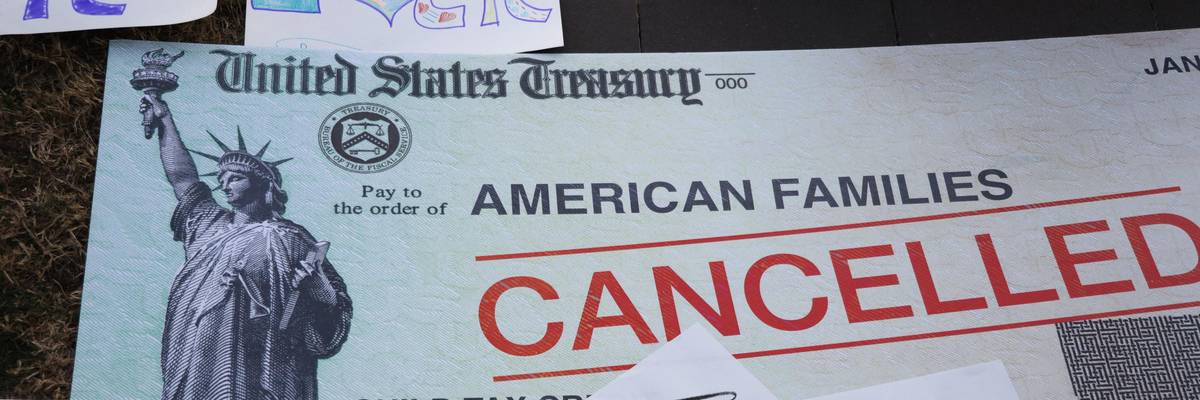
Children draw on top of a "cancelled check" prop during a rally for the Child Tax Credit in front of the U.S. Capitol on December 13, 2021 in Washington, D.C. (Photo: Alex Wong/Getty Images)
More than 40 civil rights and racial justice groups on Monday called on Senate Majority Leader Chuck Schumer to ensure that the U.S. Senate votes to reinstate the monthly enhanced Child Tax Credit, which last year was credited with slashing child poverty by 30%.
Restoring the payments, which ended in December after Sen. Joe Manchin (D-W.Va.) announced he would not support his party's signature Build Back Better Agenda, would be "the most immediate, meaningful response to higher prices that Congress can deliver to 36 million families" who previously benefited from the Child Tax Credit (CTC), said the groups, including ParentsTogether Action, NAACP, and People's Action.
"Ending these lifesaving payments drove up hunger and forced parents to make impossible choices to try to keep their families fed and housed."
The groups noted that the monthly CTC payments, which were fully refundable, helped millions of Black and Latino families who have been "historically left out of the full Child Tax Credit" and who "experience food hardship at twice the rate of white families."
Before the American Rescue Plan expanded the CTC and made it a monthly payment of up to $300 per child for the second half of last year, "27 million children in this country were excluded from this benefit, including approximately half of Black and Latino children," wrote the groups.
"It feels totally inexcusable that Congress isn't acting to reinstate those CTC payments, especially right now as families are struggling so much," Allison Johnson, campaigns director at ParentsTogether Action, told CNBC last week.
The letter followed reporting by CNBC which showed that with inflation pushing prices of groceries and other essentials up in recent months following the end of the monthly payments, nearly half of families who received the CTC last year are now struggling to afford sufficient food.
Nearly two-thirds of parents surveyed by ParentsTogether Action last month reported that they have changed the kinds of food they're buying in order to afford grocery bills, and 45% said they have skipped meals so their children would have enough to eat.
Nearly 10% of the 500 respondents said both they and their children had skipped meals since the payments ended.
"Ending these lifesaving payments drove up hunger and forced parents to make impossible choices to try to keep their families fed and housed," Justin Ruben, co-director of ParentsTogether Action, said in a statement last month. "It's long past time Congress acts to extend monthly Child Checks now, before more kids suffer."
A majority of families who received the monthly CTC last year have now stopped saving for the future or an emergency, and more than 60% are struggling to meet their families' basic needs.
With inflation pushing prices up--and corporations using the skyrocketing profits to benefit their shareholders instead of easing the burden on consumers--the average American household is now spending $327 more per month than usual, with lower- and middle-income families hit harder.
"This toll on family budgets could be offset by a single monthly CTC payment of $300 per younger child," said the groups.
Writer and public health researcher Abdullah Shihipar was among those who noted that families' economic struggles could soon be compounded because the universal free lunch program that was put in place when the coronavirus pandemic began is set to expire in less than a month.
"Thanks to congressional inaction, we are in for a hungry summer," said Salaam Bhatti, deputy director of the Virginia Poverty Law Center.
This country and this world are at a monumental crossroads. US voters have an opportunity to beat back the forces of fascism and confront the billionaires who are rigging the economy, our media system, and our democracy, making it increasingly impossible for ordinary people to get by. We’re not just talking about the election. We’re talking about what must be done once these fascist elements are vanquished from power. We need a bolder set of solutions than what either major party has so far been willing to offer and a working-class movement ready to fight like hell for it. Trump didn't emerge from nowhere. The conditions that fueled MAGA authoritarianism were created by decades of radical neoliberal economic policies and a corrupt political system dominated by corporate interests. They slashed taxes on the super-rich, promising that the benefits would trickle down. They said giveaways to the corporate titans would make life more affordable for the rest of us. It was all bullshit. And when a bitter, betrayed populace searches for someone to blame, right-wing demagogues have little trouble finding scapegoats. People know when they're being lied to, but you won't hear any of this from the corporate media. Only independent journalism—powered and funded by people who believe in building a better world—can deliver truly trustworthy daily news. If you share our vision, please contribute whatever you can to sustain our work. |
More than 40 civil rights and racial justice groups on Monday called on Senate Majority Leader Chuck Schumer to ensure that the U.S. Senate votes to reinstate the monthly enhanced Child Tax Credit, which last year was credited with slashing child poverty by 30%.
Restoring the payments, which ended in December after Sen. Joe Manchin (D-W.Va.) announced he would not support his party's signature Build Back Better Agenda, would be "the most immediate, meaningful response to higher prices that Congress can deliver to 36 million families" who previously benefited from the Child Tax Credit (CTC), said the groups, including ParentsTogether Action, NAACP, and People's Action.
"Ending these lifesaving payments drove up hunger and forced parents to make impossible choices to try to keep their families fed and housed."
The groups noted that the monthly CTC payments, which were fully refundable, helped millions of Black and Latino families who have been "historically left out of the full Child Tax Credit" and who "experience food hardship at twice the rate of white families."
Before the American Rescue Plan expanded the CTC and made it a monthly payment of up to $300 per child for the second half of last year, "27 million children in this country were excluded from this benefit, including approximately half of Black and Latino children," wrote the groups.
"It feels totally inexcusable that Congress isn't acting to reinstate those CTC payments, especially right now as families are struggling so much," Allison Johnson, campaigns director at ParentsTogether Action, told CNBC last week.
The letter followed reporting by CNBC which showed that with inflation pushing prices of groceries and other essentials up in recent months following the end of the monthly payments, nearly half of families who received the CTC last year are now struggling to afford sufficient food.
Nearly two-thirds of parents surveyed by ParentsTogether Action last month reported that they have changed the kinds of food they're buying in order to afford grocery bills, and 45% said they have skipped meals so their children would have enough to eat.
Nearly 10% of the 500 respondents said both they and their children had skipped meals since the payments ended.
"Ending these lifesaving payments drove up hunger and forced parents to make impossible choices to try to keep their families fed and housed," Justin Ruben, co-director of ParentsTogether Action, said in a statement last month. "It's long past time Congress acts to extend monthly Child Checks now, before more kids suffer."
A majority of families who received the monthly CTC last year have now stopped saving for the future or an emergency, and more than 60% are struggling to meet their families' basic needs.
With inflation pushing prices up--and corporations using the skyrocketing profits to benefit their shareholders instead of easing the burden on consumers--the average American household is now spending $327 more per month than usual, with lower- and middle-income families hit harder.
"This toll on family budgets could be offset by a single monthly CTC payment of $300 per younger child," said the groups.
Writer and public health researcher Abdullah Shihipar was among those who noted that families' economic struggles could soon be compounded because the universal free lunch program that was put in place when the coronavirus pandemic began is set to expire in less than a month.
"Thanks to congressional inaction, we are in for a hungry summer," said Salaam Bhatti, deputy director of the Virginia Poverty Law Center.