SUBSCRIBE TO OUR FREE NEWSLETTER
Daily news & progressive opinion—funded by the people, not the corporations—delivered straight to your inbox.
5
#000000
#FFFFFF
To donate by check, phone, or other method, see our More Ways to Give page.
Climate scientists and concerned citizens are sounding the alarm as daily, weekly, and monthly records for atmospheric carbon dioxide levels continue to be shattered while the fossil fuel-powered capitalist economic system responsible for skyrocketing greenhouse gas pollution plows ahead.
New data from the National Oceanic and Atmospheric Administration (NOAA) shows that the weekly average CO2 concentration at the Mauna Loa Observatory in Hawaii reached 421.13 parts per million (ppm) from May 8 to May 14--the highest in recorded history and up from 418.34 ppm one year ago and 397.38 ppm one decade ago.
"We simply do not know a planet like this," meteorologist Eric Holthaus said Monday. "We are in a climate emergency."
According to NOAA, the daily average CO2 concentration at Mauna Loa hit 422.04 ppm on May 14, just slightly below the agency's all-time record of 422.06 ppm observed on April 26. Researchers from the Scripps Institution of Oceanography at UC San Diego, meanwhile, measured 421.68 ppm of CO2 at Mauna Loa on May 13, which they consider the daily record as of Monday.
Those record-breaking daily and weekly measurements came after the monthly average CO2 concentration at Mauna Loa surpassed 420 ppm for the first time in human history, with NOAA observing 420.23 ppm in April compared with Scripps at 420.02 ppm.
Pieter Tans, a senior scientist at NOAA, recently told Axios that "it is likely May will be higher still."
"The window to act on climate change is closing," American Clean Power warned recently on social media. "Accelerating the transition to clean energy will help reduce emissions and secure a healthier future for all."
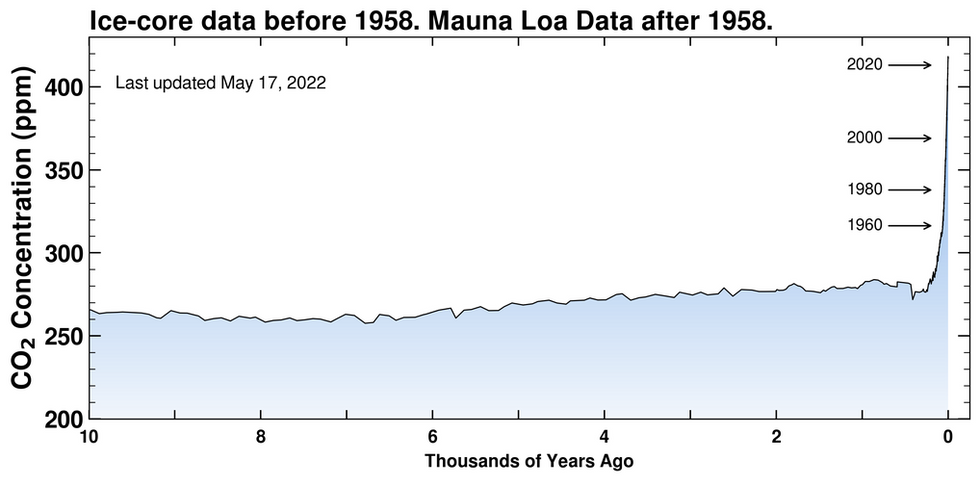
Twenty years ago, the highest monthly average CO2 concentration was 375.93 ppm, according to NOAA. In 1958, the first year scientists began collecting data at Mauna Loa, it was 317.51 ppm.
Climate scientist James Hansen, who alerted congressional lawmakers to the life-threatening dangers of the climate crisis in 1988, has long called for reducing atmospheric CO2 to below 350 ppm, and there is now a scientific consensus that the livability of the planet decreases beyond such a concentration.
Nevertheless, the annual rate of increase in CO2 levels over the past six decades is now roughly 100 times faster than earlier increases that occurred naturally thousands of years ago.
"The world effectively has made no serious progress compared to what is required," Tans said earlier this month. "We really need to focus on decreasing emissions and we haven't had much success globally because the rate of increase of CO2 remains as high as it has been in the last decade."
"CO2 has a longevity of hundreds to thousands of years," he noted, "so we are really making a very long-term climate commitment."
Speaking with the Financial Times recently, Tans added that "we are going in the wrong direction, at maximum speed."
California-based activist Joe Sanberg put it even more bluntly last week.
"It's shocking that we're staring down the barrel of the greatest existential crisis humanity has ever faced and we still haven't passed a Green New Deal," Sanberg tweeted. "Time is running out. Either we drive the fossil fuel industry into extinction--or the human race."
Climate scientists and concerned citizens are sounding the alarm as daily, weekly, and monthly records for atmospheric carbon dioxide levels continue to be shattered while the fossil fuel-powered capitalist economic system responsible for skyrocketing greenhouse gas pollution plows ahead.
New data from the National Oceanic and Atmospheric Administration (NOAA) shows that the weekly average CO2 concentration at the Mauna Loa Observatory in Hawaii reached 421.13 parts per million (ppm) from May 8 to May 14--the highest in recorded history and up from 418.34 ppm one year ago and 397.38 ppm one decade ago.
"We simply do not know a planet like this," meteorologist Eric Holthaus said Monday. "We are in a climate emergency."
According to NOAA, the daily average CO2 concentration at Mauna Loa hit 422.04 ppm on May 14, just slightly below the agency's all-time record of 422.06 ppm observed on April 26. Researchers from the Scripps Institution of Oceanography at UC San Diego, meanwhile, measured 421.68 ppm of CO2 at Mauna Loa on May 13, which they consider the daily record as of Monday.
Those record-breaking daily and weekly measurements came after the monthly average CO2 concentration at Mauna Loa surpassed 420 ppm for the first time in human history, with NOAA observing 420.23 ppm in April compared with Scripps at 420.02 ppm.
Pieter Tans, a senior scientist at NOAA, recently told Axios that "it is likely May will be higher still."
"The window to act on climate change is closing," American Clean Power warned recently on social media. "Accelerating the transition to clean energy will help reduce emissions and secure a healthier future for all."
Twenty years ago, the highest monthly average CO2 concentration was 375.93 ppm, according to NOAA. In 1958, the first year scientists began collecting data at Mauna Loa, it was 317.51 ppm.
Climate scientist James Hansen, who alerted congressional lawmakers to the life-threatening dangers of the climate crisis in 1988, has long called for reducing atmospheric CO2 to below 350 ppm, and there is now a scientific consensus that the livability of the planet decreases beyond such a concentration.
Nevertheless, the annual rate of increase in CO2 levels over the past six decades is now roughly 100 times faster than earlier increases that occurred naturally thousands of years ago.
"The world effectively has made no serious progress compared to what is required," Tans said earlier this month. "We really need to focus on decreasing emissions and we haven't had much success globally because the rate of increase of CO2 remains as high as it has been in the last decade."
"CO2 has a longevity of hundreds to thousands of years," he noted, "so we are really making a very long-term climate commitment."
Speaking with the Financial Times recently, Tans added that "we are going in the wrong direction, at maximum speed."
California-based activist Joe Sanberg put it even more bluntly last week.
"It's shocking that we're staring down the barrel of the greatest existential crisis humanity has ever faced and we still haven't passed a Green New Deal," Sanberg tweeted. "Time is running out. Either we drive the fossil fuel industry into extinction--or the human race."
Climate scientists and concerned citizens are sounding the alarm as daily, weekly, and monthly records for atmospheric carbon dioxide levels continue to be shattered while the fossil fuel-powered capitalist economic system responsible for skyrocketing greenhouse gas pollution plows ahead.
New data from the National Oceanic and Atmospheric Administration (NOAA) shows that the weekly average CO2 concentration at the Mauna Loa Observatory in Hawaii reached 421.13 parts per million (ppm) from May 8 to May 14--the highest in recorded history and up from 418.34 ppm one year ago and 397.38 ppm one decade ago.
"We simply do not know a planet like this," meteorologist Eric Holthaus said Monday. "We are in a climate emergency."
According to NOAA, the daily average CO2 concentration at Mauna Loa hit 422.04 ppm on May 14, just slightly below the agency's all-time record of 422.06 ppm observed on April 26. Researchers from the Scripps Institution of Oceanography at UC San Diego, meanwhile, measured 421.68 ppm of CO2 at Mauna Loa on May 13, which they consider the daily record as of Monday.
Those record-breaking daily and weekly measurements came after the monthly average CO2 concentration at Mauna Loa surpassed 420 ppm for the first time in human history, with NOAA observing 420.23 ppm in April compared with Scripps at 420.02 ppm.
Pieter Tans, a senior scientist at NOAA, recently told Axios that "it is likely May will be higher still."
"The window to act on climate change is closing," American Clean Power warned recently on social media. "Accelerating the transition to clean energy will help reduce emissions and secure a healthier future for all."
Twenty years ago, the highest monthly average CO2 concentration was 375.93 ppm, according to NOAA. In 1958, the first year scientists began collecting data at Mauna Loa, it was 317.51 ppm.
Climate scientist James Hansen, who alerted congressional lawmakers to the life-threatening dangers of the climate crisis in 1988, has long called for reducing atmospheric CO2 to below 350 ppm, and there is now a scientific consensus that the livability of the planet decreases beyond such a concentration.
Nevertheless, the annual rate of increase in CO2 levels over the past six decades is now roughly 100 times faster than earlier increases that occurred naturally thousands of years ago.
"The world effectively has made no serious progress compared to what is required," Tans said earlier this month. "We really need to focus on decreasing emissions and we haven't had much success globally because the rate of increase of CO2 remains as high as it has been in the last decade."
"CO2 has a longevity of hundreds to thousands of years," he noted, "so we are really making a very long-term climate commitment."
Speaking with the Financial Times recently, Tans added that "we are going in the wrong direction, at maximum speed."
California-based activist Joe Sanberg put it even more bluntly last week.
"It's shocking that we're staring down the barrel of the greatest existential crisis humanity has ever faced and we still haven't passed a Green New Deal," Sanberg tweeted. "Time is running out. Either we drive the fossil fuel industry into extinction--or the human race."