SUBSCRIBE TO OUR FREE NEWSLETTER
Daily news & progressive opinion—funded by the people, not the corporations—delivered straight to your inbox.
5
#000000
#FFFFFF
To donate by check, phone, or other method, see our More Ways to Give page.
Daily news & progressive opinion—funded by the people, not the corporations—delivered straight to your inbox.
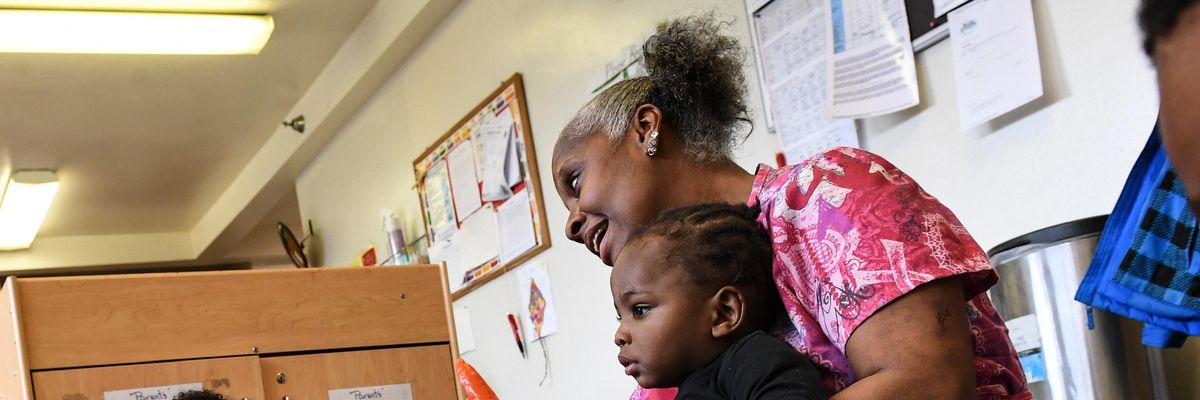
Childcare worker Debbie James-Dean sits with children at a Kids Are Us Learning Center in Southeast Washington, D.C., on March 24, 2017. In New Mexico, families earning up to $111,000 per year are now eligible for a pilot program providing free child care. (Photo: Toni L. Sandys/The Washington Post via Getty Images)
With millions of parents across the U.S. forced to leave the workforce due to an inability to find affordable child care during the coronavirus pandemic, families making up to $111,000 per year in New Mexico are set to benefit from a pilot program that went into effect May 1 waiving all child care payments for more than a year.
"This makes New Mexico the first state to offer no-cost care to such a broad range of incomes."
Families earning up to 400% of the federal poverty level are now eligible for the state's child care assistance program. With the median household income standing at just over $51,000, the expansion of the program "will help A LOT of families," said Washington Post reporter Casey Parks.
The state is also eliminating child care copays for middle class families who benefit from subsidies, making child care free for 30,000 households across the state--the broadest swath of a state population to benefit from a free child care program, according to officials.
"This makes New Mexico the first state to offer no-cost care to such a broad range of incomes," said the New Mexico Center on Law and Poverty, which sued the state in 2018 alleging officials arbitrarily denied families access to child care assistance. "This is great for families and workers!"
Advocates credited organizations like OLE, a coalition of parents and care providers which also joined the 2018 lawsuit, with pushing for years for better policies for families in the state.
"Let's be clear: this didn't happen by accident," said grassroots group Community Change. "Parents, providers, and advocates never backed down."
The state is drawing from its Early Childhood Education and Care Fund to run the pilot program. The fund, which Grisham established in 2020, draws on taxes from oil and natural gas production.
The governor hopes to use the state's Land Grant Permanent Fund to finance universal no-cost child care after the pilot program ends in June 2023.
"We can and will be first in the country to achieve this incredible goal," Grisham said last week.
The state is also spending $10 million from the American Rescue Plan (ARP) to increase its supply of child care centers. According to a 2018 analysis by the Center for American Progress, 53% of New Mexico residents live in "child care deserts."
New Mexico is strengthening its investment in child care as families across the U.S. grapple with the loss earlier this year of the expanded Child Tax Credit, which sent monthly per-child payments to 36 million families for the last six months of 2021 but was eliminated after Sen. Joe Manchin (D-W.Va.) joined the Republican Party in opposing its continuation.
Provisions in the Build Back Better Act including universal free pre-kindergarten for all three- and four-year-olds and subsidies that would ensure no family pays more than 7% of their income on child care are also languishing in the Senate.
"We need federal dollars to make this happen everywhere in this country," said Dorian Warren, co-president of Community Change, of New Mexico's program.
Households nationwide are also facing higher prices for gas, groceries, and other essentials as companies rake in record profits and reward their shareholders instead of raising wages or lessening the burden on consumers.
The expansion of no-cost child care is "such an important step forward for New Mexico, and it comes at a time when families are in real need of any economic relief," Amber Wallin, executive director of New Mexico Voices for Children, told the Post last week.
New Mexico's program began as child care providers and parents prepare for a national day of action next week called "A Day Without Child Care," in which advocates will call for "a caring economy that values early education and care providers."
On May 9, organizers are calling on the public to join them in demanding:
Since negotiations over the Build Back Better Act stalled in the Senate, progressives have ramped up their calls for policies that would invest in families' wellbeing including universal child care--paid for with a tax on the wealthiest Americans' assets.
Last month, Rep. Jamaal Bowman (D-N.Y.) introduced the Babies Over Billionaires Act to tax the unrealized capital gains of the top 0.01% of taxpayers with over $100 million in assets.
"Finally, maybe we could have paid family leave," Bowman said last week. "Finally, maybe we could have universal child care. Finally, maybe we could have universal pre-K, and all of the things that we need to secure a healthy, thriving democracy and society for everyone."
Dear Common Dreams reader, It’s been nearly 30 years since I co-founded Common Dreams with my late wife, Lina Newhouser. We had the radical notion that journalism should serve the public good, not corporate profits. It was clear to us from the outset what it would take to build such a project. No paid advertisements. No corporate sponsors. No millionaire publisher telling us what to think or do. Many people said we wouldn't last a year, but we proved those doubters wrong. Together with a tremendous team of journalists and dedicated staff, we built an independent media outlet free from the constraints of profits and corporate control. Our mission has always been simple: To inform. To inspire. To ignite change for the common good. Building Common Dreams was not easy. Our survival was never guaranteed. When you take on the most powerful forces—Wall Street greed, fossil fuel industry destruction, Big Tech lobbyists, and uber-rich oligarchs who have spent billions upon billions rigging the economy and democracy in their favor—the only bulwark you have is supporters who believe in your work. But here’s the urgent message from me today. It's never been this bad out there. And it's never been this hard to keep us going. At the very moment Common Dreams is most needed, the threats we face are intensifying. We need your support now more than ever. We don't accept corporate advertising and never will. We don't have a paywall because we don't think people should be blocked from critical news based on their ability to pay. Everything we do is funded by the donations of readers like you. When everyone does the little they can afford, we are strong. But if that support retreats or dries up, so do we. Will you donate now to make sure Common Dreams not only survives but thrives? —Craig Brown, Co-founder |
With millions of parents across the U.S. forced to leave the workforce due to an inability to find affordable child care during the coronavirus pandemic, families making up to $111,000 per year in New Mexico are set to benefit from a pilot program that went into effect May 1 waiving all child care payments for more than a year.
"This makes New Mexico the first state to offer no-cost care to such a broad range of incomes."
Families earning up to 400% of the federal poverty level are now eligible for the state's child care assistance program. With the median household income standing at just over $51,000, the expansion of the program "will help A LOT of families," said Washington Post reporter Casey Parks.
The state is also eliminating child care copays for middle class families who benefit from subsidies, making child care free for 30,000 households across the state--the broadest swath of a state population to benefit from a free child care program, according to officials.
"This makes New Mexico the first state to offer no-cost care to such a broad range of incomes," said the New Mexico Center on Law and Poverty, which sued the state in 2018 alleging officials arbitrarily denied families access to child care assistance. "This is great for families and workers!"
Advocates credited organizations like OLE, a coalition of parents and care providers which also joined the 2018 lawsuit, with pushing for years for better policies for families in the state.
"Let's be clear: this didn't happen by accident," said grassroots group Community Change. "Parents, providers, and advocates never backed down."
The state is drawing from its Early Childhood Education and Care Fund to run the pilot program. The fund, which Grisham established in 2020, draws on taxes from oil and natural gas production.
The governor hopes to use the state's Land Grant Permanent Fund to finance universal no-cost child care after the pilot program ends in June 2023.
"We can and will be first in the country to achieve this incredible goal," Grisham said last week.
The state is also spending $10 million from the American Rescue Plan (ARP) to increase its supply of child care centers. According to a 2018 analysis by the Center for American Progress, 53% of New Mexico residents live in "child care deserts."
New Mexico is strengthening its investment in child care as families across the U.S. grapple with the loss earlier this year of the expanded Child Tax Credit, which sent monthly per-child payments to 36 million families for the last six months of 2021 but was eliminated after Sen. Joe Manchin (D-W.Va.) joined the Republican Party in opposing its continuation.
Provisions in the Build Back Better Act including universal free pre-kindergarten for all three- and four-year-olds and subsidies that would ensure no family pays more than 7% of their income on child care are also languishing in the Senate.
"We need federal dollars to make this happen everywhere in this country," said Dorian Warren, co-president of Community Change, of New Mexico's program.
Households nationwide are also facing higher prices for gas, groceries, and other essentials as companies rake in record profits and reward their shareholders instead of raising wages or lessening the burden on consumers.
The expansion of no-cost child care is "such an important step forward for New Mexico, and it comes at a time when families are in real need of any economic relief," Amber Wallin, executive director of New Mexico Voices for Children, told the Post last week.
New Mexico's program began as child care providers and parents prepare for a national day of action next week called "A Day Without Child Care," in which advocates will call for "a caring economy that values early education and care providers."
On May 9, organizers are calling on the public to join them in demanding:
Since negotiations over the Build Back Better Act stalled in the Senate, progressives have ramped up their calls for policies that would invest in families' wellbeing including universal child care--paid for with a tax on the wealthiest Americans' assets.
Last month, Rep. Jamaal Bowman (D-N.Y.) introduced the Babies Over Billionaires Act to tax the unrealized capital gains of the top 0.01% of taxpayers with over $100 million in assets.
"Finally, maybe we could have paid family leave," Bowman said last week. "Finally, maybe we could have universal child care. Finally, maybe we could have universal pre-K, and all of the things that we need to secure a healthy, thriving democracy and society for everyone."
With millions of parents across the U.S. forced to leave the workforce due to an inability to find affordable child care during the coronavirus pandemic, families making up to $111,000 per year in New Mexico are set to benefit from a pilot program that went into effect May 1 waiving all child care payments for more than a year.
"This makes New Mexico the first state to offer no-cost care to such a broad range of incomes."
Families earning up to 400% of the federal poverty level are now eligible for the state's child care assistance program. With the median household income standing at just over $51,000, the expansion of the program "will help A LOT of families," said Washington Post reporter Casey Parks.
The state is also eliminating child care copays for middle class families who benefit from subsidies, making child care free for 30,000 households across the state--the broadest swath of a state population to benefit from a free child care program, according to officials.
"This makes New Mexico the first state to offer no-cost care to such a broad range of incomes," said the New Mexico Center on Law and Poverty, which sued the state in 2018 alleging officials arbitrarily denied families access to child care assistance. "This is great for families and workers!"
Advocates credited organizations like OLE, a coalition of parents and care providers which also joined the 2018 lawsuit, with pushing for years for better policies for families in the state.
"Let's be clear: this didn't happen by accident," said grassroots group Community Change. "Parents, providers, and advocates never backed down."
The state is drawing from its Early Childhood Education and Care Fund to run the pilot program. The fund, which Grisham established in 2020, draws on taxes from oil and natural gas production.
The governor hopes to use the state's Land Grant Permanent Fund to finance universal no-cost child care after the pilot program ends in June 2023.
"We can and will be first in the country to achieve this incredible goal," Grisham said last week.
The state is also spending $10 million from the American Rescue Plan (ARP) to increase its supply of child care centers. According to a 2018 analysis by the Center for American Progress, 53% of New Mexico residents live in "child care deserts."
New Mexico is strengthening its investment in child care as families across the U.S. grapple with the loss earlier this year of the expanded Child Tax Credit, which sent monthly per-child payments to 36 million families for the last six months of 2021 but was eliminated after Sen. Joe Manchin (D-W.Va.) joined the Republican Party in opposing its continuation.
Provisions in the Build Back Better Act including universal free pre-kindergarten for all three- and four-year-olds and subsidies that would ensure no family pays more than 7% of their income on child care are also languishing in the Senate.
"We need federal dollars to make this happen everywhere in this country," said Dorian Warren, co-president of Community Change, of New Mexico's program.
Households nationwide are also facing higher prices for gas, groceries, and other essentials as companies rake in record profits and reward their shareholders instead of raising wages or lessening the burden on consumers.
The expansion of no-cost child care is "such an important step forward for New Mexico, and it comes at a time when families are in real need of any economic relief," Amber Wallin, executive director of New Mexico Voices for Children, told the Post last week.
New Mexico's program began as child care providers and parents prepare for a national day of action next week called "A Day Without Child Care," in which advocates will call for "a caring economy that values early education and care providers."
On May 9, organizers are calling on the public to join them in demanding:
Since negotiations over the Build Back Better Act stalled in the Senate, progressives have ramped up their calls for policies that would invest in families' wellbeing including universal child care--paid for with a tax on the wealthiest Americans' assets.
Last month, Rep. Jamaal Bowman (D-N.Y.) introduced the Babies Over Billionaires Act to tax the unrealized capital gains of the top 0.01% of taxpayers with over $100 million in assets.
"Finally, maybe we could have paid family leave," Bowman said last week. "Finally, maybe we could have universal child care. Finally, maybe we could have universal pre-K, and all of the things that we need to secure a healthy, thriving democracy and society for everyone."