SUBSCRIBE TO OUR FREE NEWSLETTER
Daily news & progressive opinion—funded by the people, not the corporations—delivered straight to your inbox.
5
#000000
#FFFFFF
To donate by check, phone, or other method, see our More Ways to Give page.
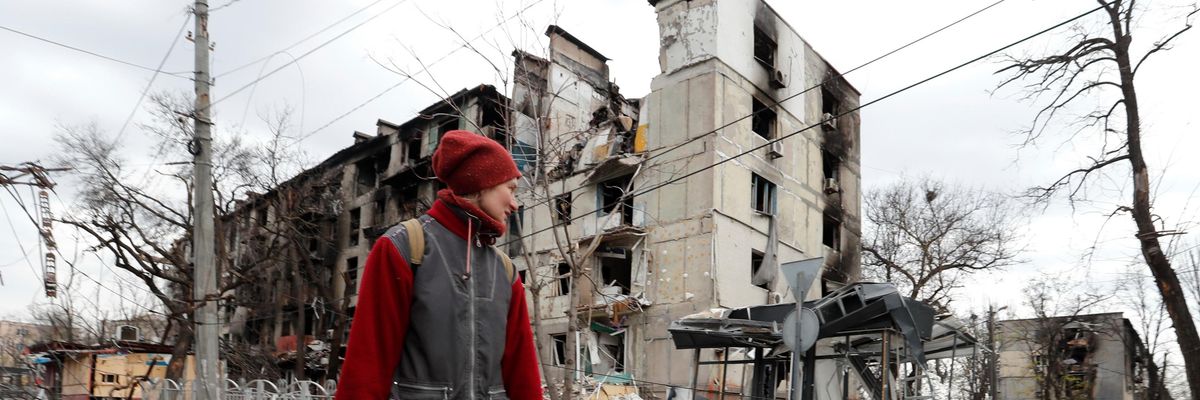
Ukrainian officials made urgent appeals Thursday for a humanitarian corridor to allow trapped civilians, including children, to safely escape Mariupol as Russian forces surrounded a steel plant that is believed to be Ukraine's final holdout in the strategic port city.
Declaring that his forces have secured the "liberation" of Mariupol--where Ukrainian officials say at least 20,000 people have been killed--Russian President Vladimir Putin ordered troops not to storm the steel plant but to "block it off so that a fly can't get in." Ukraine's leadership said Putin's claim of victory in Mariupol is "premature."
Around 2,000 Ukrainian fighters remain holed up in the Azovstal metallurgical plant along with around 1,000 civilians, and the fighters have rejected Russia's calls for a complete surrender. Mariupol's mayor, Vadym Boychenko, has accused Russia of committing "war crimes" and "genocide" in its efforts to seize control of the city.
Iryna Vereshchuk, Ukraine's deputy prime minister, called on Russian forces to allow the establishment of a humanitarian corridor to let civilians and wounded soldiers escape the plant.
"There are now about 1,000 civilians and 500 wounded soldiers. They all need to be removed from Azovstal today," said Vereshchuk. "I call on world leaders and the international community to focus their efforts on Azovstal now... This is a key point and a key moment for the humanitarian effort."
Late Wednesday, Ukrainian President Volodymyr Zelenskyy said he would be willing to negotiate the exchange of Russian prisoners of war for Ukrainian civilians trapped in Mariupol, much of which has been reduced to rubble by near-constant Russian bombardment. Attempts to establish ceasefires in Mariupol have repeatedly collapsed, making it difficult to evacuate civilians and deliver humanitarian aid to the besieged city.
Zelenskyy said the Russian side has not agreed to the proposed exchange.
"The situation in Mariupol is deteriorating," Zelenskyy warned. "As far as I know, there are about a thousand civilians behind our guys in Mariupol, including children and women."
"We are ready for the sake of our people--both military and civilian--for any format of exchange," Zelenskyy added. "And whether I like it or not, in the course of the remaining three years that the people have given me, I am ready to hold a dialogue with the president of Russia on the end of the war."
Zelenskyy claimed Thursday that, overall, 120,000 civilians have been blocked from leaving Mariupol.
Related Content

As the Associated Press noted Thursday, the "scale of suffering" in Mariupol "has made it a worldwide focal point, and its definitive fall would deprive Ukraine of a vital port, complete a land bridge between Russia and the Crimean Peninsula, and free up Russian troops to move elsewhere in the Donbas."
Diplomatic talks to end Russia's weeks-long war have been ongoing for weeks but have yet to produce a breakthrough as Moscow ramps up its assault on eastern Ukraine. Russia's delegation has reportedly sent its Ukrainian counterpart a new "draft document" outlining Moscow's demands, but it's not clear how the document differs from previous proposals or whether Ukraine will find it acceptable.
Earlier this week, United Nations Secretary-General Antonio Guterres sent separate letters to Zelenskyy and Putin requesting meetings with the two leaders in their respective capitals, an effort aimed at advancing peace talks. Zelenskyy has also offered to meet with Putin directly, but the Russian president has not accepted.
More than 5 million people have fled Ukraine in the nearly two months since Russia launched its full-scale invasion, according to the U.N., and millions more have been internally displaced.
Stephane Dujarric, a spokesperson for Guterres, said Wednesday that "at this time of great peril and consequence," the secretary-general "would like to discuss urgent steps to bring about peace in Ukraine and the future of multilateralism based on the charter of the United Nations and international law."
This story has been updated to include new comments from the Ukrainian president.
Ukrainian officials made urgent appeals Thursday for a humanitarian corridor to allow trapped civilians, including children, to safely escape Mariupol as Russian forces surrounded a steel plant that is believed to be Ukraine's final holdout in the strategic port city.
Declaring that his forces have secured the "liberation" of Mariupol--where Ukrainian officials say at least 20,000 people have been killed--Russian President Vladimir Putin ordered troops not to storm the steel plant but to "block it off so that a fly can't get in." Ukraine's leadership said Putin's claim of victory in Mariupol is "premature."
Around 2,000 Ukrainian fighters remain holed up in the Azovstal metallurgical plant along with around 1,000 civilians, and the fighters have rejected Russia's calls for a complete surrender. Mariupol's mayor, Vadym Boychenko, has accused Russia of committing "war crimes" and "genocide" in its efforts to seize control of the city.
Iryna Vereshchuk, Ukraine's deputy prime minister, called on Russian forces to allow the establishment of a humanitarian corridor to let civilians and wounded soldiers escape the plant.
"There are now about 1,000 civilians and 500 wounded soldiers. They all need to be removed from Azovstal today," said Vereshchuk. "I call on world leaders and the international community to focus their efforts on Azovstal now... This is a key point and a key moment for the humanitarian effort."
Late Wednesday, Ukrainian President Volodymyr Zelenskyy said he would be willing to negotiate the exchange of Russian prisoners of war for Ukrainian civilians trapped in Mariupol, much of which has been reduced to rubble by near-constant Russian bombardment. Attempts to establish ceasefires in Mariupol have repeatedly collapsed, making it difficult to evacuate civilians and deliver humanitarian aid to the besieged city.
Zelenskyy said the Russian side has not agreed to the proposed exchange.
"The situation in Mariupol is deteriorating," Zelenskyy warned. "As far as I know, there are about a thousand civilians behind our guys in Mariupol, including children and women."
"We are ready for the sake of our people--both military and civilian--for any format of exchange," Zelenskyy added. "And whether I like it or not, in the course of the remaining three years that the people have given me, I am ready to hold a dialogue with the president of Russia on the end of the war."
Zelenskyy claimed Thursday that, overall, 120,000 civilians have been blocked from leaving Mariupol.
Related Content
As the Associated Press noted Thursday, the "scale of suffering" in Mariupol "has made it a worldwide focal point, and its definitive fall would deprive Ukraine of a vital port, complete a land bridge between Russia and the Crimean Peninsula, and free up Russian troops to move elsewhere in the Donbas."
Diplomatic talks to end Russia's weeks-long war have been ongoing for weeks but have yet to produce a breakthrough as Moscow ramps up its assault on eastern Ukraine. Russia's delegation has reportedly sent its Ukrainian counterpart a new "draft document" outlining Moscow's demands, but it's not clear how the document differs from previous proposals or whether Ukraine will find it acceptable.
Earlier this week, United Nations Secretary-General Antonio Guterres sent separate letters to Zelenskyy and Putin requesting meetings with the two leaders in their respective capitals, an effort aimed at advancing peace talks. Zelenskyy has also offered to meet with Putin directly, but the Russian president has not accepted.
More than 5 million people have fled Ukraine in the nearly two months since Russia launched its full-scale invasion, according to the U.N., and millions more have been internally displaced.
Stephane Dujarric, a spokesperson for Guterres, said Wednesday that "at this time of great peril and consequence," the secretary-general "would like to discuss urgent steps to bring about peace in Ukraine and the future of multilateralism based on the charter of the United Nations and international law."
This story has been updated to include new comments from the Ukrainian president.
Ukrainian officials made urgent appeals Thursday for a humanitarian corridor to allow trapped civilians, including children, to safely escape Mariupol as Russian forces surrounded a steel plant that is believed to be Ukraine's final holdout in the strategic port city.
Declaring that his forces have secured the "liberation" of Mariupol--where Ukrainian officials say at least 20,000 people have been killed--Russian President Vladimir Putin ordered troops not to storm the steel plant but to "block it off so that a fly can't get in." Ukraine's leadership said Putin's claim of victory in Mariupol is "premature."
Around 2,000 Ukrainian fighters remain holed up in the Azovstal metallurgical plant along with around 1,000 civilians, and the fighters have rejected Russia's calls for a complete surrender. Mariupol's mayor, Vadym Boychenko, has accused Russia of committing "war crimes" and "genocide" in its efforts to seize control of the city.
Iryna Vereshchuk, Ukraine's deputy prime minister, called on Russian forces to allow the establishment of a humanitarian corridor to let civilians and wounded soldiers escape the plant.
"There are now about 1,000 civilians and 500 wounded soldiers. They all need to be removed from Azovstal today," said Vereshchuk. "I call on world leaders and the international community to focus their efforts on Azovstal now... This is a key point and a key moment for the humanitarian effort."
Late Wednesday, Ukrainian President Volodymyr Zelenskyy said he would be willing to negotiate the exchange of Russian prisoners of war for Ukrainian civilians trapped in Mariupol, much of which has been reduced to rubble by near-constant Russian bombardment. Attempts to establish ceasefires in Mariupol have repeatedly collapsed, making it difficult to evacuate civilians and deliver humanitarian aid to the besieged city.
Zelenskyy said the Russian side has not agreed to the proposed exchange.
"The situation in Mariupol is deteriorating," Zelenskyy warned. "As far as I know, there are about a thousand civilians behind our guys in Mariupol, including children and women."
"We are ready for the sake of our people--both military and civilian--for any format of exchange," Zelenskyy added. "And whether I like it or not, in the course of the remaining three years that the people have given me, I am ready to hold a dialogue with the president of Russia on the end of the war."
Zelenskyy claimed Thursday that, overall, 120,000 civilians have been blocked from leaving Mariupol.
Related Content
As the Associated Press noted Thursday, the "scale of suffering" in Mariupol "has made it a worldwide focal point, and its definitive fall would deprive Ukraine of a vital port, complete a land bridge between Russia and the Crimean Peninsula, and free up Russian troops to move elsewhere in the Donbas."
Diplomatic talks to end Russia's weeks-long war have been ongoing for weeks but have yet to produce a breakthrough as Moscow ramps up its assault on eastern Ukraine. Russia's delegation has reportedly sent its Ukrainian counterpart a new "draft document" outlining Moscow's demands, but it's not clear how the document differs from previous proposals or whether Ukraine will find it acceptable.
Earlier this week, United Nations Secretary-General Antonio Guterres sent separate letters to Zelenskyy and Putin requesting meetings with the two leaders in their respective capitals, an effort aimed at advancing peace talks. Zelenskyy has also offered to meet with Putin directly, but the Russian president has not accepted.
More than 5 million people have fled Ukraine in the nearly two months since Russia launched its full-scale invasion, according to the U.N., and millions more have been internally displaced.
Stephane Dujarric, a spokesperson for Guterres, said Wednesday that "at this time of great peril and consequence," the secretary-general "would like to discuss urgent steps to bring about peace in Ukraine and the future of multilateralism based on the charter of the United Nations and international law."
This story has been updated to include new comments from the Ukrainian president.