SUBSCRIBE TO OUR FREE NEWSLETTER
Daily news & progressive opinion—funded by the people, not the corporations—delivered straight to your inbox.
5
#000000
#FFFFFF
To donate by check, phone, or other method, see our More Ways to Give page.
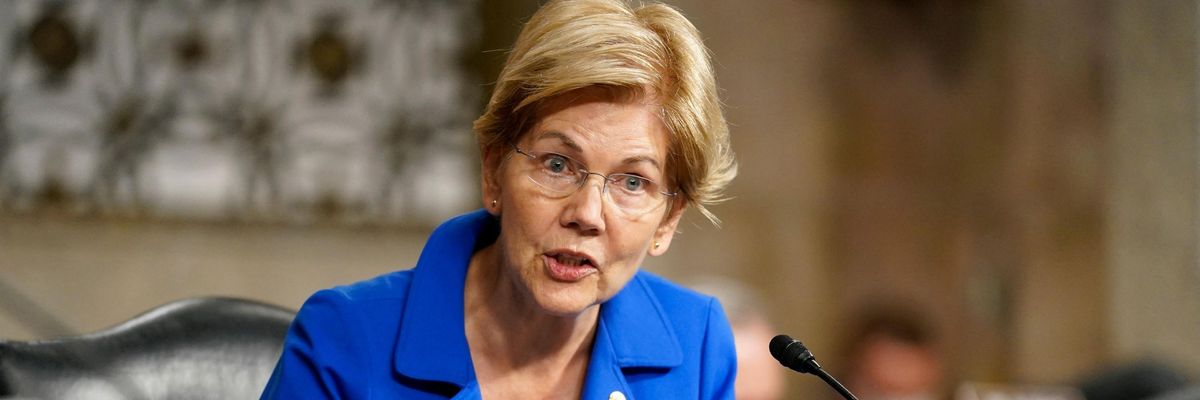
Sen. Elizabeth Warren and Rep. Judy Chu on Wednesday demanded that the Internal Revenue Service halt its disproportionate targeting of low-income Americans and instead focus its attention and resources on "wealthy tax cheats."
"Lower-income Americans are audited by the IRS at five times the rate of everyone else."
In a letter to IRS Commissioner Charles Rettig, a Trump appointee, the Democratic lawmakers acknowledge that the agency's ability to pursue tax-avoiding wealthy individuals and large corporations is constrained by budget shortfalls stemming from years of Republican-imposed cuts.
But Warren (D-Mass) and Chu (D-Calif.) expressed outrage that the IRS has for years chosen to use its limited staffing and budget to audit the poor at roughly the same rate as members of the top 1%, who often have more complicated returns. A recent study led by two IRS researchers estimated that the richest 1% of U.S. households don't report 21% of their income.
Last month, the Transactional Records Access Clearinghouse (TRAC) released an analysis showing that the IRS audited low-income wage earners at a rate five times higher than everyone else in Fiscal Year 2021.
"Over half--fully 54%--of all correspondence audits last year targeted the small proportion of returns with gross receipts of less than $25,000 claiming an earned income tax credit," the analysis found. "Even taxpayers with total positive income from $200,000 to $1,000,000 had only one-third the odds of audit compared with these lowest-income wage earners."
When Chu pressed Rettig on TRAC's findings during a March 17 congressional hearing, the IRS chief dismissed the analysis as "absolutely 100% false" and complained that he's "tired of having to deal with this issue."
But Rettig pointed to IRS data from years prior to FY 2021--the period TRAC examined--to support his claim. Additionally, as Warren and Chu pointed out in their letter Wednesday, even the figures Rettig cited do not bolster his criticism of TRAC's study.
"The IRS data referenced by Commissioner Rettig show that in Tax Year 2018, taxpayers with incomes below $25,000 were nearly 2.5 times more likely to be audited compared to all other taxpayers," the lawmakers wrote. "The most vulnerable taxpayers should not shoulder the burden of insufficient IRS enforcement funding simply because they require fewer resources to audit."
Warren and Chu stressed that IRS auditing practices can have significant material consequences for poor families.
"Correspondence audits of low-income individuals have discouraged taxpayers from filing taxes and from claiming the Earned Income Tax Credit (EITC), an important credit that reduces poverty and incentivizes people to join the labor force," the lawmakers wrote. "This works against the IRS' goal of increasing EITC awareness and the EITC participation rate."
Related Content

The version of the Build Back Better Act that the House passed in November included tens of billions in funds to help the IRS crack down on rich tax dodgers, but the legislation died in the Senate due in large part to opposition from Sen. Joe Manchin (D-W.Va.).
A recently enacted omnibus spending package increases the IRS budget by $675 million, a 6% boost but less than the House originally requested. According to Treasury Department estimates, every $1 invested in IRS enforcement efforts yields $6 in additional federal revenue.
"We are working to secure substantial, permanent funding so the IRS can take on the tax cheating of giant corporations and the ultra-wealthy," Warren and Chu wrote Wednesday. "But, we also urge you to move swiftly to end the targeting of low-income Americans, in line with the administration's commitment not to increase audits of taxpayers making under $400,000."
Sen. Elizabeth Warren and Rep. Judy Chu on Wednesday demanded that the Internal Revenue Service halt its disproportionate targeting of low-income Americans and instead focus its attention and resources on "wealthy tax cheats."
"Lower-income Americans are audited by the IRS at five times the rate of everyone else."
In a letter to IRS Commissioner Charles Rettig, a Trump appointee, the Democratic lawmakers acknowledge that the agency's ability to pursue tax-avoiding wealthy individuals and large corporations is constrained by budget shortfalls stemming from years of Republican-imposed cuts.
But Warren (D-Mass) and Chu (D-Calif.) expressed outrage that the IRS has for years chosen to use its limited staffing and budget to audit the poor at roughly the same rate as members of the top 1%, who often have more complicated returns. A recent study led by two IRS researchers estimated that the richest 1% of U.S. households don't report 21% of their income.
Last month, the Transactional Records Access Clearinghouse (TRAC) released an analysis showing that the IRS audited low-income wage earners at a rate five times higher than everyone else in Fiscal Year 2021.
"Over half--fully 54%--of all correspondence audits last year targeted the small proportion of returns with gross receipts of less than $25,000 claiming an earned income tax credit," the analysis found. "Even taxpayers with total positive income from $200,000 to $1,000,000 had only one-third the odds of audit compared with these lowest-income wage earners."
When Chu pressed Rettig on TRAC's findings during a March 17 congressional hearing, the IRS chief dismissed the analysis as "absolutely 100% false" and complained that he's "tired of having to deal with this issue."
But Rettig pointed to IRS data from years prior to FY 2021--the period TRAC examined--to support his claim. Additionally, as Warren and Chu pointed out in their letter Wednesday, even the figures Rettig cited do not bolster his criticism of TRAC's study.
"The IRS data referenced by Commissioner Rettig show that in Tax Year 2018, taxpayers with incomes below $25,000 were nearly 2.5 times more likely to be audited compared to all other taxpayers," the lawmakers wrote. "The most vulnerable taxpayers should not shoulder the burden of insufficient IRS enforcement funding simply because they require fewer resources to audit."
Warren and Chu stressed that IRS auditing practices can have significant material consequences for poor families.
"Correspondence audits of low-income individuals have discouraged taxpayers from filing taxes and from claiming the Earned Income Tax Credit (EITC), an important credit that reduces poverty and incentivizes people to join the labor force," the lawmakers wrote. "This works against the IRS' goal of increasing EITC awareness and the EITC participation rate."
Related Content
The version of the Build Back Better Act that the House passed in November included tens of billions in funds to help the IRS crack down on rich tax dodgers, but the legislation died in the Senate due in large part to opposition from Sen. Joe Manchin (D-W.Va.).
A recently enacted omnibus spending package increases the IRS budget by $675 million, a 6% boost but less than the House originally requested. According to Treasury Department estimates, every $1 invested in IRS enforcement efforts yields $6 in additional federal revenue.
"We are working to secure substantial, permanent funding so the IRS can take on the tax cheating of giant corporations and the ultra-wealthy," Warren and Chu wrote Wednesday. "But, we also urge you to move swiftly to end the targeting of low-income Americans, in line with the administration's commitment not to increase audits of taxpayers making under $400,000."
Sen. Elizabeth Warren and Rep. Judy Chu on Wednesday demanded that the Internal Revenue Service halt its disproportionate targeting of low-income Americans and instead focus its attention and resources on "wealthy tax cheats."
"Lower-income Americans are audited by the IRS at five times the rate of everyone else."
In a letter to IRS Commissioner Charles Rettig, a Trump appointee, the Democratic lawmakers acknowledge that the agency's ability to pursue tax-avoiding wealthy individuals and large corporations is constrained by budget shortfalls stemming from years of Republican-imposed cuts.
But Warren (D-Mass) and Chu (D-Calif.) expressed outrage that the IRS has for years chosen to use its limited staffing and budget to audit the poor at roughly the same rate as members of the top 1%, who often have more complicated returns. A recent study led by two IRS researchers estimated that the richest 1% of U.S. households don't report 21% of their income.
Last month, the Transactional Records Access Clearinghouse (TRAC) released an analysis showing that the IRS audited low-income wage earners at a rate five times higher than everyone else in Fiscal Year 2021.
"Over half--fully 54%--of all correspondence audits last year targeted the small proportion of returns with gross receipts of less than $25,000 claiming an earned income tax credit," the analysis found. "Even taxpayers with total positive income from $200,000 to $1,000,000 had only one-third the odds of audit compared with these lowest-income wage earners."
When Chu pressed Rettig on TRAC's findings during a March 17 congressional hearing, the IRS chief dismissed the analysis as "absolutely 100% false" and complained that he's "tired of having to deal with this issue."
But Rettig pointed to IRS data from years prior to FY 2021--the period TRAC examined--to support his claim. Additionally, as Warren and Chu pointed out in their letter Wednesday, even the figures Rettig cited do not bolster his criticism of TRAC's study.
"The IRS data referenced by Commissioner Rettig show that in Tax Year 2018, taxpayers with incomes below $25,000 were nearly 2.5 times more likely to be audited compared to all other taxpayers," the lawmakers wrote. "The most vulnerable taxpayers should not shoulder the burden of insufficient IRS enforcement funding simply because they require fewer resources to audit."
Warren and Chu stressed that IRS auditing practices can have significant material consequences for poor families.
"Correspondence audits of low-income individuals have discouraged taxpayers from filing taxes and from claiming the Earned Income Tax Credit (EITC), an important credit that reduces poverty and incentivizes people to join the labor force," the lawmakers wrote. "This works against the IRS' goal of increasing EITC awareness and the EITC participation rate."
Related Content
The version of the Build Back Better Act that the House passed in November included tens of billions in funds to help the IRS crack down on rich tax dodgers, but the legislation died in the Senate due in large part to opposition from Sen. Joe Manchin (D-W.Va.).
A recently enacted omnibus spending package increases the IRS budget by $675 million, a 6% boost but less than the House originally requested. According to Treasury Department estimates, every $1 invested in IRS enforcement efforts yields $6 in additional federal revenue.
"We are working to secure substantial, permanent funding so the IRS can take on the tax cheating of giant corporations and the ultra-wealthy," Warren and Chu wrote Wednesday. "But, we also urge you to move swiftly to end the targeting of low-income Americans, in line with the administration's commitment not to increase audits of taxpayers making under $400,000."