SUBSCRIBE TO OUR FREE NEWSLETTER
Daily news & progressive opinion—funded by the people, not the corporations—delivered straight to your inbox.
5
#000000
#FFFFFF
To donate by check, phone, or other method, see our More Ways to Give page.
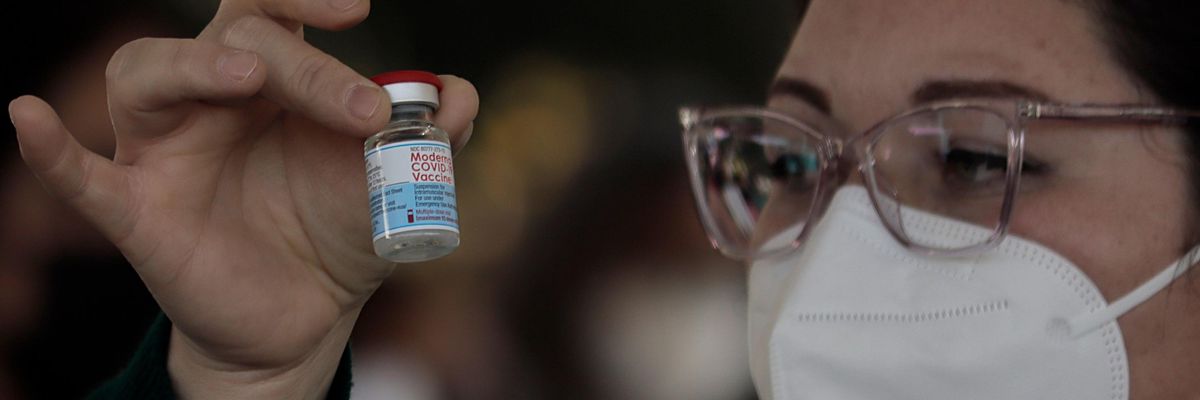
Republican and Democratic congressional negotiators on Monday are reportedly set to announce a $10 billion coronavirus funding package that contains no money to fight the pandemic globally, prompting outrage from public health experts who say the decision will prolong the Covid-19 crisis.
"Failing to fund the global fight against Covid-19 is a choice to extend the pandemic, to accept preventable suffering and insecurity for all, and to live with the knowledge that, deep in the time of the world's greatest need, the United States gave up," tweeted Peter Maybarduk, Access to Medicines director at Public Citizen.
"There's no shortage of money. Just will."
Lawmakers were initially considering a package that included $1 billion in funds for the global pandemic response, money that would go toward worldwide vaccination initiatives and other key programs that are languishing due to cash shortfalls. The Biden administration is already facing mounting backlash for falling well short of its modest vaccine donation pledges.
But The Washington Post reported Monday that lawmakers "were unable to agree on how to pay for" the $1 billion in Covid-19 aid, even though it amounted to a fraction of the $5 billion the White House asked for last month.
The reported agreement to strip global Covid-19 money from the spending deal comes weeks after Congress approved a $782 billion military budget, $29 billion more than President Joe Biden originally requested last year.
"The deal set to be announced Monday is expected to repurpose funding from previous stimulus packages," the Post noted. Republican lawmakers have repeatedly questioned the need for any new Covid-19 funding and demanded that money for the pandemic come from already-approved sources.
The agreed-upon $10 billion aid package, which is expected to receive a vote as soon as this week, will fund the purchase of tests, vaccines, and therapeutics for the U.S.
Jen Kates, director of global health policy at the Kaiser Family Foundation, told the Post that the decision to drop money for the international pandemic response is "a victory for the virus."
"It demonstrates that one of the main take-home messages of this experience--that this is truly a global phenomenon--has not resonated or at least not resonated above politics," Kates added.
According to Our World in Data, just 14.5% of people in low-income countries have received at least one coronavirus vaccine dose as rich nations and pharmaceutical companies continue to hoard doses and technology.
Related Content

Politico reported last week that "for nearly three months, top officials at the U.S. Agency for International Development privately warned the White House and lawmakers on Capitol Hill that USAID would soon run out of money to help put Covid-19 shots in arms across the world, jeopardizing one of President Joe Biden's key Covid promises."
Experts have long warned that failure to ensure global, equitable access to coronavirus vaccines increases the likelihood of variants emerging and spreading--a fear that appears to have been validated by worldwide infection waves caused by the Delta and Omicron mutations.
Recent surges in Asia and Europe, believed to have been driven by a highly infectious Omicron subvariant, have heightened concerns that another U.S. wave is imminent just as Congress is skimping on pandemic preparation and response funding. The subvariant currently accounts for more than half of all new coronavirus cases in the U.S., according to the Centers for Disease Control and Prevention.
"Congress is about to announce $10 billion in Covid funding. That money is needed for domestic purposes and is good," Robert Weissman, the president of Public Citizen, said Monday. "But zero for global Covid equals many needless deaths in poor countries--and heightened risk of new variants."
A research paper published in February estimated that an investment of $61 billion could fund the production of three coronavirus vaccine doses for every person in low- and lower-middle-income countries--and save more than a million lives.
"There's no shortage of money," Weissman said. "Just will."
Republican and Democratic congressional negotiators on Monday are reportedly set to announce a $10 billion coronavirus funding package that contains no money to fight the pandemic globally, prompting outrage from public health experts who say the decision will prolong the Covid-19 crisis.
"Failing to fund the global fight against Covid-19 is a choice to extend the pandemic, to accept preventable suffering and insecurity for all, and to live with the knowledge that, deep in the time of the world's greatest need, the United States gave up," tweeted Peter Maybarduk, Access to Medicines director at Public Citizen.
"There's no shortage of money. Just will."
Lawmakers were initially considering a package that included $1 billion in funds for the global pandemic response, money that would go toward worldwide vaccination initiatives and other key programs that are languishing due to cash shortfalls. The Biden administration is already facing mounting backlash for falling well short of its modest vaccine donation pledges.
But The Washington Post reported Monday that lawmakers "were unable to agree on how to pay for" the $1 billion in Covid-19 aid, even though it amounted to a fraction of the $5 billion the White House asked for last month.
The reported agreement to strip global Covid-19 money from the spending deal comes weeks after Congress approved a $782 billion military budget, $29 billion more than President Joe Biden originally requested last year.
"The deal set to be announced Monday is expected to repurpose funding from previous stimulus packages," the Post noted. Republican lawmakers have repeatedly questioned the need for any new Covid-19 funding and demanded that money for the pandemic come from already-approved sources.
The agreed-upon $10 billion aid package, which is expected to receive a vote as soon as this week, will fund the purchase of tests, vaccines, and therapeutics for the U.S.
Jen Kates, director of global health policy at the Kaiser Family Foundation, told the Post that the decision to drop money for the international pandemic response is "a victory for the virus."
"It demonstrates that one of the main take-home messages of this experience--that this is truly a global phenomenon--has not resonated or at least not resonated above politics," Kates added.
According to Our World in Data, just 14.5% of people in low-income countries have received at least one coronavirus vaccine dose as rich nations and pharmaceutical companies continue to hoard doses and technology.
Related Content
Politico reported last week that "for nearly three months, top officials at the U.S. Agency for International Development privately warned the White House and lawmakers on Capitol Hill that USAID would soon run out of money to help put Covid-19 shots in arms across the world, jeopardizing one of President Joe Biden's key Covid promises."
Experts have long warned that failure to ensure global, equitable access to coronavirus vaccines increases the likelihood of variants emerging and spreading--a fear that appears to have been validated by worldwide infection waves caused by the Delta and Omicron mutations.
Recent surges in Asia and Europe, believed to have been driven by a highly infectious Omicron subvariant, have heightened concerns that another U.S. wave is imminent just as Congress is skimping on pandemic preparation and response funding. The subvariant currently accounts for more than half of all new coronavirus cases in the U.S., according to the Centers for Disease Control and Prevention.
"Congress is about to announce $10 billion in Covid funding. That money is needed for domestic purposes and is good," Robert Weissman, the president of Public Citizen, said Monday. "But zero for global Covid equals many needless deaths in poor countries--and heightened risk of new variants."
A research paper published in February estimated that an investment of $61 billion could fund the production of three coronavirus vaccine doses for every person in low- and lower-middle-income countries--and save more than a million lives.
"There's no shortage of money," Weissman said. "Just will."
Republican and Democratic congressional negotiators on Monday are reportedly set to announce a $10 billion coronavirus funding package that contains no money to fight the pandemic globally, prompting outrage from public health experts who say the decision will prolong the Covid-19 crisis.
"Failing to fund the global fight against Covid-19 is a choice to extend the pandemic, to accept preventable suffering and insecurity for all, and to live with the knowledge that, deep in the time of the world's greatest need, the United States gave up," tweeted Peter Maybarduk, Access to Medicines director at Public Citizen.
"There's no shortage of money. Just will."
Lawmakers were initially considering a package that included $1 billion in funds for the global pandemic response, money that would go toward worldwide vaccination initiatives and other key programs that are languishing due to cash shortfalls. The Biden administration is already facing mounting backlash for falling well short of its modest vaccine donation pledges.
But The Washington Post reported Monday that lawmakers "were unable to agree on how to pay for" the $1 billion in Covid-19 aid, even though it amounted to a fraction of the $5 billion the White House asked for last month.
The reported agreement to strip global Covid-19 money from the spending deal comes weeks after Congress approved a $782 billion military budget, $29 billion more than President Joe Biden originally requested last year.
"The deal set to be announced Monday is expected to repurpose funding from previous stimulus packages," the Post noted. Republican lawmakers have repeatedly questioned the need for any new Covid-19 funding and demanded that money for the pandemic come from already-approved sources.
The agreed-upon $10 billion aid package, which is expected to receive a vote as soon as this week, will fund the purchase of tests, vaccines, and therapeutics for the U.S.
Jen Kates, director of global health policy at the Kaiser Family Foundation, told the Post that the decision to drop money for the international pandemic response is "a victory for the virus."
"It demonstrates that one of the main take-home messages of this experience--that this is truly a global phenomenon--has not resonated or at least not resonated above politics," Kates added.
According to Our World in Data, just 14.5% of people in low-income countries have received at least one coronavirus vaccine dose as rich nations and pharmaceutical companies continue to hoard doses and technology.
Related Content
Politico reported last week that "for nearly three months, top officials at the U.S. Agency for International Development privately warned the White House and lawmakers on Capitol Hill that USAID would soon run out of money to help put Covid-19 shots in arms across the world, jeopardizing one of President Joe Biden's key Covid promises."
Experts have long warned that failure to ensure global, equitable access to coronavirus vaccines increases the likelihood of variants emerging and spreading--a fear that appears to have been validated by worldwide infection waves caused by the Delta and Omicron mutations.
Recent surges in Asia and Europe, believed to have been driven by a highly infectious Omicron subvariant, have heightened concerns that another U.S. wave is imminent just as Congress is skimping on pandemic preparation and response funding. The subvariant currently accounts for more than half of all new coronavirus cases in the U.S., according to the Centers for Disease Control and Prevention.
"Congress is about to announce $10 billion in Covid funding. That money is needed for domestic purposes and is good," Robert Weissman, the president of Public Citizen, said Monday. "But zero for global Covid equals many needless deaths in poor countries--and heightened risk of new variants."
A research paper published in February estimated that an investment of $61 billion could fund the production of three coronavirus vaccine doses for every person in low- and lower-middle-income countries--and save more than a million lives.
"There's no shortage of money," Weissman said. "Just will."