SUBSCRIBE TO OUR FREE NEWSLETTER
Daily news & progressive opinion—funded by the people, not the corporations—delivered straight to your inbox.
5
#000000
#FFFFFF
To donate by check, phone, or other method, see our More Ways to Give page.
Daily news & progressive opinion—funded by the people, not the corporations—delivered straight to your inbox.
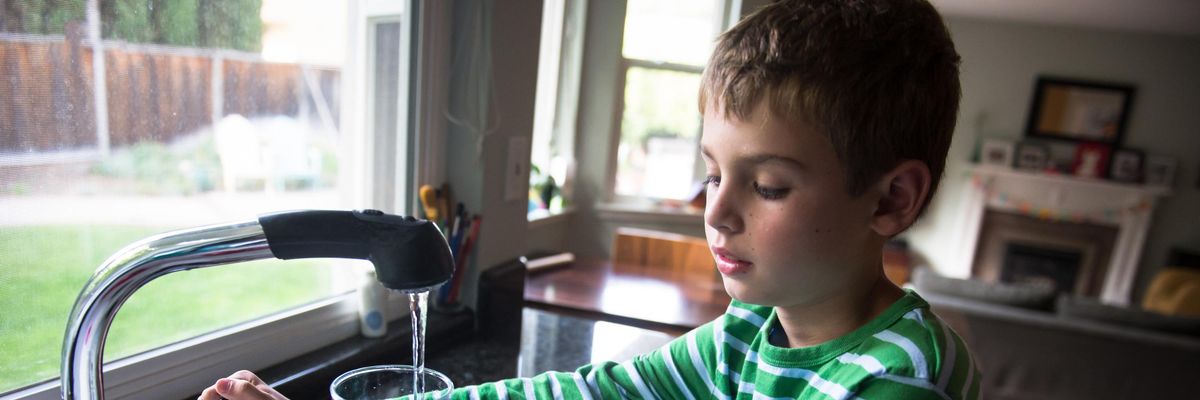
A boy pours tap water into a drinking glass. On Thursday, the Biden administration announced it will not impose new limits on perchlorate in drinking water. (Photo: Teresa Short/Getty Images)
Public health advocates said Thursday that they plan to resume litigation against the Environmental Protection Agency after the Biden administration announced it would uphold former President Donald Trump's decision to not regulate drinking water levels of a chemical used to make rocket fuel and explosives.
Former President Barack Obama's administration proposed limits for perchlorate after finding in 2011 that drinking water for 16 million people may have unsafe levels of the contaminant, which poses a risk to the development of children and fetuses.
"Tap water across America will remain contaminated by this toxic chemical."
Groups including the Natural Resources Defense Council (NRDC) were outraged when Trump refused to impose the limits, claiming regulation was "not in the public interest." The EPA's announcement this week sparked renewed criticism, with the NRDC calling the decision "unscientific and unlawful."
"The Trump EPA gave perchlorate a pass; it was a bad decision then, and it's a bad decision now," said Erik D. Olson, senior strategic director for health at the organization. "Tap water across America will remain contaminated by this toxic chemical, which threatens the brain development of babies in the womb, infants, and young children at extremely low levels."
The Trump administration claimed that 56 parts per billion (ppb) was an acceptable level of perchlorate in drinking water--far higher than limits that Massachusetts and California have imposed at the state level, requiring water to contain no more than two ppb and six ppb, respectively.
Before Thursday's announcement, the American Academy of Pediatrics had called on the EPA to establish the "strongest possible" limits on the chemical.
Exposure to perchlorate has been linked to measurable decreases in IQ in newborns; the chemical interferes with the thyroid gland and stunts the production of hormones needed for proper child development.
High concentrations of perchlorate have been found in at least 26 states, with communities near military bases at high risk for exposure because the chemical is a component in munitions.
The limits proposed by the Obama administration were met with aggressive lobbying by military contractors including Northrup Grumman and Lockheed Martin and were never imposed. The NRDC sued the EPA after it failed to set new standards, securing a court order requiring the agency to regulate the chemical by 2019.
The group then sued the Trump administration when it announced it would not impose limits, but paused the litigation after Biden won the 2020 election.
The risk sciences department at the Johns Hopkins Bloomberg School of Public Health said the EPA's decision represents "a step backwards that leaves the states and communities most impacted out there by themselves."
The EPA said that instead of imposing limits, it will develop a plan to clean up detonation sites with very high levels of perchlorate contamination, provide a "web-based toolkit" to advise water systems about perchlorate, and "continue to consider new information on the health effects and occurrence of perchlorate."
According to Olson, "By refusing to establish a standard or water testing requirements, the EPA decision will also keep members of the public in the dark, without even basic information about whether they are being exposed to perchlorate."
Dear Common Dreams reader, It’s been nearly 30 years since I co-founded Common Dreams with my late wife, Lina Newhouser. We had the radical notion that journalism should serve the public good, not corporate profits. It was clear to us from the outset what it would take to build such a project. No paid advertisements. No corporate sponsors. No millionaire publisher telling us what to think or do. Many people said we wouldn't last a year, but we proved those doubters wrong. Together with a tremendous team of journalists and dedicated staff, we built an independent media outlet free from the constraints of profits and corporate control. Our mission has always been simple: To inform. To inspire. To ignite change for the common good. Building Common Dreams was not easy. Our survival was never guaranteed. When you take on the most powerful forces—Wall Street greed, fossil fuel industry destruction, Big Tech lobbyists, and uber-rich oligarchs who have spent billions upon billions rigging the economy and democracy in their favor—the only bulwark you have is supporters who believe in your work. But here’s the urgent message from me today. It's never been this bad out there. And it's never been this hard to keep us going. At the very moment Common Dreams is most needed, the threats we face are intensifying. We need your support now more than ever. We don't accept corporate advertising and never will. We don't have a paywall because we don't think people should be blocked from critical news based on their ability to pay. Everything we do is funded by the donations of readers like you. When everyone does the little they can afford, we are strong. But if that support retreats or dries up, so do we. Will you donate now to make sure Common Dreams not only survives but thrives? —Craig Brown, Co-founder |
Public health advocates said Thursday that they plan to resume litigation against the Environmental Protection Agency after the Biden administration announced it would uphold former President Donald Trump's decision to not regulate drinking water levels of a chemical used to make rocket fuel and explosives.
Former President Barack Obama's administration proposed limits for perchlorate after finding in 2011 that drinking water for 16 million people may have unsafe levels of the contaminant, which poses a risk to the development of children and fetuses.
"Tap water across America will remain contaminated by this toxic chemical."
Groups including the Natural Resources Defense Council (NRDC) were outraged when Trump refused to impose the limits, claiming regulation was "not in the public interest." The EPA's announcement this week sparked renewed criticism, with the NRDC calling the decision "unscientific and unlawful."
"The Trump EPA gave perchlorate a pass; it was a bad decision then, and it's a bad decision now," said Erik D. Olson, senior strategic director for health at the organization. "Tap water across America will remain contaminated by this toxic chemical, which threatens the brain development of babies in the womb, infants, and young children at extremely low levels."
The Trump administration claimed that 56 parts per billion (ppb) was an acceptable level of perchlorate in drinking water--far higher than limits that Massachusetts and California have imposed at the state level, requiring water to contain no more than two ppb and six ppb, respectively.
Before Thursday's announcement, the American Academy of Pediatrics had called on the EPA to establish the "strongest possible" limits on the chemical.
Exposure to perchlorate has been linked to measurable decreases in IQ in newborns; the chemical interferes with the thyroid gland and stunts the production of hormones needed for proper child development.
High concentrations of perchlorate have been found in at least 26 states, with communities near military bases at high risk for exposure because the chemical is a component in munitions.
The limits proposed by the Obama administration were met with aggressive lobbying by military contractors including Northrup Grumman and Lockheed Martin and were never imposed. The NRDC sued the EPA after it failed to set new standards, securing a court order requiring the agency to regulate the chemical by 2019.
The group then sued the Trump administration when it announced it would not impose limits, but paused the litigation after Biden won the 2020 election.
The risk sciences department at the Johns Hopkins Bloomberg School of Public Health said the EPA's decision represents "a step backwards that leaves the states and communities most impacted out there by themselves."
The EPA said that instead of imposing limits, it will develop a plan to clean up detonation sites with very high levels of perchlorate contamination, provide a "web-based toolkit" to advise water systems about perchlorate, and "continue to consider new information on the health effects and occurrence of perchlorate."
According to Olson, "By refusing to establish a standard or water testing requirements, the EPA decision will also keep members of the public in the dark, without even basic information about whether they are being exposed to perchlorate."
Public health advocates said Thursday that they plan to resume litigation against the Environmental Protection Agency after the Biden administration announced it would uphold former President Donald Trump's decision to not regulate drinking water levels of a chemical used to make rocket fuel and explosives.
Former President Barack Obama's administration proposed limits for perchlorate after finding in 2011 that drinking water for 16 million people may have unsafe levels of the contaminant, which poses a risk to the development of children and fetuses.
"Tap water across America will remain contaminated by this toxic chemical."
Groups including the Natural Resources Defense Council (NRDC) were outraged when Trump refused to impose the limits, claiming regulation was "not in the public interest." The EPA's announcement this week sparked renewed criticism, with the NRDC calling the decision "unscientific and unlawful."
"The Trump EPA gave perchlorate a pass; it was a bad decision then, and it's a bad decision now," said Erik D. Olson, senior strategic director for health at the organization. "Tap water across America will remain contaminated by this toxic chemical, which threatens the brain development of babies in the womb, infants, and young children at extremely low levels."
The Trump administration claimed that 56 parts per billion (ppb) was an acceptable level of perchlorate in drinking water--far higher than limits that Massachusetts and California have imposed at the state level, requiring water to contain no more than two ppb and six ppb, respectively.
Before Thursday's announcement, the American Academy of Pediatrics had called on the EPA to establish the "strongest possible" limits on the chemical.
Exposure to perchlorate has been linked to measurable decreases in IQ in newborns; the chemical interferes with the thyroid gland and stunts the production of hormones needed for proper child development.
High concentrations of perchlorate have been found in at least 26 states, with communities near military bases at high risk for exposure because the chemical is a component in munitions.
The limits proposed by the Obama administration were met with aggressive lobbying by military contractors including Northrup Grumman and Lockheed Martin and were never imposed. The NRDC sued the EPA after it failed to set new standards, securing a court order requiring the agency to regulate the chemical by 2019.
The group then sued the Trump administration when it announced it would not impose limits, but paused the litigation after Biden won the 2020 election.
The risk sciences department at the Johns Hopkins Bloomberg School of Public Health said the EPA's decision represents "a step backwards that leaves the states and communities most impacted out there by themselves."
The EPA said that instead of imposing limits, it will develop a plan to clean up detonation sites with very high levels of perchlorate contamination, provide a "web-based toolkit" to advise water systems about perchlorate, and "continue to consider new information on the health effects and occurrence of perchlorate."
According to Olson, "By refusing to establish a standard or water testing requirements, the EPA decision will also keep members of the public in the dark, without even basic information about whether they are being exposed to perchlorate."