SUBSCRIBE TO OUR FREE NEWSLETTER
Daily news & progressive opinion—funded by the people, not the corporations—delivered straight to your inbox.
5
#000000
#FFFFFF
To donate by check, phone, or other method, see our More Ways to Give page.
Daily news & progressive opinion—funded by the people, not the corporations—delivered straight to your inbox.
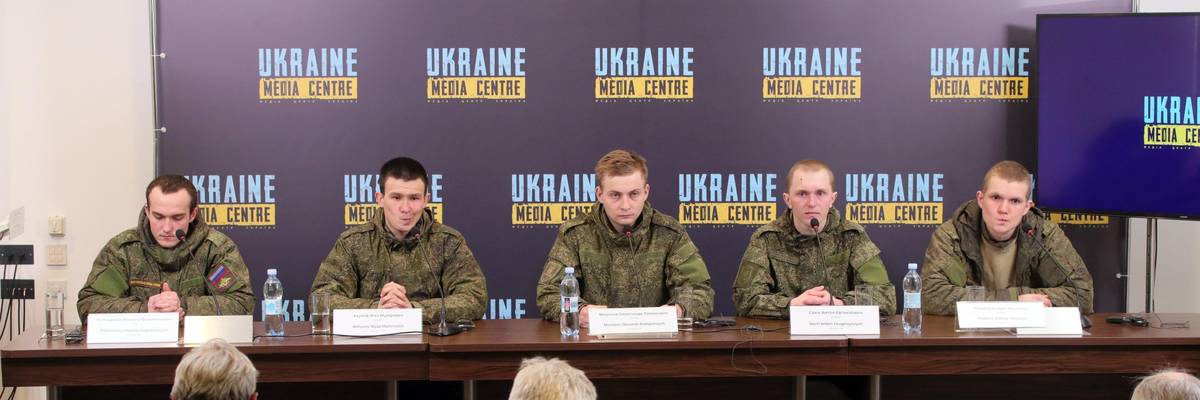
Russian prisoners of war appear during a media briefing in Kyiv, Ukraine on March 14, 2022. (Photo: Pavlo Bagmut/Ukrinform/Future Publishing via Getty Images)
A leading international human rights group said Thursday that if genuine, unverified videos showing Ukrainian troops shooting Russian prisoners of war would depict war crimes, while calling on Ukraine to "ensure an effective investigation" into the alleged abuse.
Human Rights Watch (HRW) said in a statement that "if confirmed, the beating and shooting of captured combatants in their legs would constitute a war crime, and Ukraine needs to demonstrate that it is able and willing to prevent and punish serious violations of international humanitarian law."
HRW senior legal adviser Aisling Reidy said that "all the information in the videos that suggests abuse, and maybe worse, of POWs needs to be subject to an effective investigation. It should be possible to verify if abuse took place, and from there to hold those responsible to account."
The incident appears to have occurred at a dairy farm in a village near Kharkiv two days after Ukrainian forces retook the area. The videos were posted on social media late last month. On March 28, Ukrainian journalist Yuri Butusov published video recorded at the same dairy farm showing the charred remains of what appeared to be people in Russian military uniforms. It is not known if they are the same soldiers who appeared in the previous videos.
Ukrainian officials said the videos would be investigated. Security Service of Ukraine (SSU) published a statement suggesting the videos could be "directly managed by Russian special services," and that prisoners of war taken by Ukrainian forces "are treated in accordance with the Geneva Convention."
Russian "occupiers spread fakes to divert attention from their atrocities," SSU said. "Russian fakes are similar to Russian TV series: cheap, vulgar, predictable, and with poor acting."
However, experts consulted by HRW said the videos showing the men being shot were consistent with wounds caused by gunshots.
Olexiy Arestovych, an adviser to Ukrainian President Volodymyr Zelenskyy, said March 27 on Telegram that he "would like to remind all our military, civilian, and defense forces once again that the abuse of prisoners is a war crime that has no amnesty under military law and has no statute of limitations."
Since invading Ukraine in late February, Russian forces have been accused of war crimes including bombing residential areas with cluster munitions; attacking humanitarian corridors and civilian infrastructure including homes, medical facilities, schools, and shelters; shooting unarmed civilians; torture; sex crimes; and kidnapping and forcibly deporting civilians.
International Criminal Court Prosecutor Karim A. A. Khan announced four days into the invasion that he was launching a probe of "alleged war crimes and crimes against humanity" committed in Ukraine.
Dear Common Dreams reader, It’s been nearly 30 years since I co-founded Common Dreams with my late wife, Lina Newhouser. We had the radical notion that journalism should serve the public good, not corporate profits. It was clear to us from the outset what it would take to build such a project. No paid advertisements. No corporate sponsors. No millionaire publisher telling us what to think or do. Many people said we wouldn't last a year, but we proved those doubters wrong. Together with a tremendous team of journalists and dedicated staff, we built an independent media outlet free from the constraints of profits and corporate control. Our mission has always been simple: To inform. To inspire. To ignite change for the common good. Building Common Dreams was not easy. Our survival was never guaranteed. When you take on the most powerful forces—Wall Street greed, fossil fuel industry destruction, Big Tech lobbyists, and uber-rich oligarchs who have spent billions upon billions rigging the economy and democracy in their favor—the only bulwark you have is supporters who believe in your work. But here’s the urgent message from me today. It's never been this bad out there. And it's never been this hard to keep us going. At the very moment Common Dreams is most needed, the threats we face are intensifying. We need your support now more than ever. We don't accept corporate advertising and never will. We don't have a paywall because we don't think people should be blocked from critical news based on their ability to pay. Everything we do is funded by the donations of readers like you. When everyone does the little they can afford, we are strong. But if that support retreats or dries up, so do we. Will you donate now to make sure Common Dreams not only survives but thrives? —Craig Brown, Co-founder |
A leading international human rights group said Thursday that if genuine, unverified videos showing Ukrainian troops shooting Russian prisoners of war would depict war crimes, while calling on Ukraine to "ensure an effective investigation" into the alleged abuse.
Human Rights Watch (HRW) said in a statement that "if confirmed, the beating and shooting of captured combatants in their legs would constitute a war crime, and Ukraine needs to demonstrate that it is able and willing to prevent and punish serious violations of international humanitarian law."
HRW senior legal adviser Aisling Reidy said that "all the information in the videos that suggests abuse, and maybe worse, of POWs needs to be subject to an effective investigation. It should be possible to verify if abuse took place, and from there to hold those responsible to account."
The incident appears to have occurred at a dairy farm in a village near Kharkiv two days after Ukrainian forces retook the area. The videos were posted on social media late last month. On March 28, Ukrainian journalist Yuri Butusov published video recorded at the same dairy farm showing the charred remains of what appeared to be people in Russian military uniforms. It is not known if they are the same soldiers who appeared in the previous videos.
Ukrainian officials said the videos would be investigated. Security Service of Ukraine (SSU) published a statement suggesting the videos could be "directly managed by Russian special services," and that prisoners of war taken by Ukrainian forces "are treated in accordance with the Geneva Convention."
Russian "occupiers spread fakes to divert attention from their atrocities," SSU said. "Russian fakes are similar to Russian TV series: cheap, vulgar, predictable, and with poor acting."
However, experts consulted by HRW said the videos showing the men being shot were consistent with wounds caused by gunshots.
Olexiy Arestovych, an adviser to Ukrainian President Volodymyr Zelenskyy, said March 27 on Telegram that he "would like to remind all our military, civilian, and defense forces once again that the abuse of prisoners is a war crime that has no amnesty under military law and has no statute of limitations."
Since invading Ukraine in late February, Russian forces have been accused of war crimes including bombing residential areas with cluster munitions; attacking humanitarian corridors and civilian infrastructure including homes, medical facilities, schools, and shelters; shooting unarmed civilians; torture; sex crimes; and kidnapping and forcibly deporting civilians.
International Criminal Court Prosecutor Karim A. A. Khan announced four days into the invasion that he was launching a probe of "alleged war crimes and crimes against humanity" committed in Ukraine.
A leading international human rights group said Thursday that if genuine, unverified videos showing Ukrainian troops shooting Russian prisoners of war would depict war crimes, while calling on Ukraine to "ensure an effective investigation" into the alleged abuse.
Human Rights Watch (HRW) said in a statement that "if confirmed, the beating and shooting of captured combatants in their legs would constitute a war crime, and Ukraine needs to demonstrate that it is able and willing to prevent and punish serious violations of international humanitarian law."
HRW senior legal adviser Aisling Reidy said that "all the information in the videos that suggests abuse, and maybe worse, of POWs needs to be subject to an effective investigation. It should be possible to verify if abuse took place, and from there to hold those responsible to account."
The incident appears to have occurred at a dairy farm in a village near Kharkiv two days after Ukrainian forces retook the area. The videos were posted on social media late last month. On March 28, Ukrainian journalist Yuri Butusov published video recorded at the same dairy farm showing the charred remains of what appeared to be people in Russian military uniforms. It is not known if they are the same soldiers who appeared in the previous videos.
Ukrainian officials said the videos would be investigated. Security Service of Ukraine (SSU) published a statement suggesting the videos could be "directly managed by Russian special services," and that prisoners of war taken by Ukrainian forces "are treated in accordance with the Geneva Convention."
Russian "occupiers spread fakes to divert attention from their atrocities," SSU said. "Russian fakes are similar to Russian TV series: cheap, vulgar, predictable, and with poor acting."
However, experts consulted by HRW said the videos showing the men being shot were consistent with wounds caused by gunshots.
Olexiy Arestovych, an adviser to Ukrainian President Volodymyr Zelenskyy, said March 27 on Telegram that he "would like to remind all our military, civilian, and defense forces once again that the abuse of prisoners is a war crime that has no amnesty under military law and has no statute of limitations."
Since invading Ukraine in late February, Russian forces have been accused of war crimes including bombing residential areas with cluster munitions; attacking humanitarian corridors and civilian infrastructure including homes, medical facilities, schools, and shelters; shooting unarmed civilians; torture; sex crimes; and kidnapping and forcibly deporting civilians.
International Criminal Court Prosecutor Karim A. A. Khan announced four days into the invasion that he was launching a probe of "alleged war crimes and crimes against humanity" committed in Ukraine.