SUBSCRIBE TO OUR FREE NEWSLETTER
Daily news & progressive opinion—funded by the people, not the corporations—delivered straight to your inbox.
5
#000000
#FFFFFF
To donate by check, phone, or other method, see our More Ways to Give page.
Daily news & progressive opinion—funded by the people, not the corporations—delivered straight to your inbox.
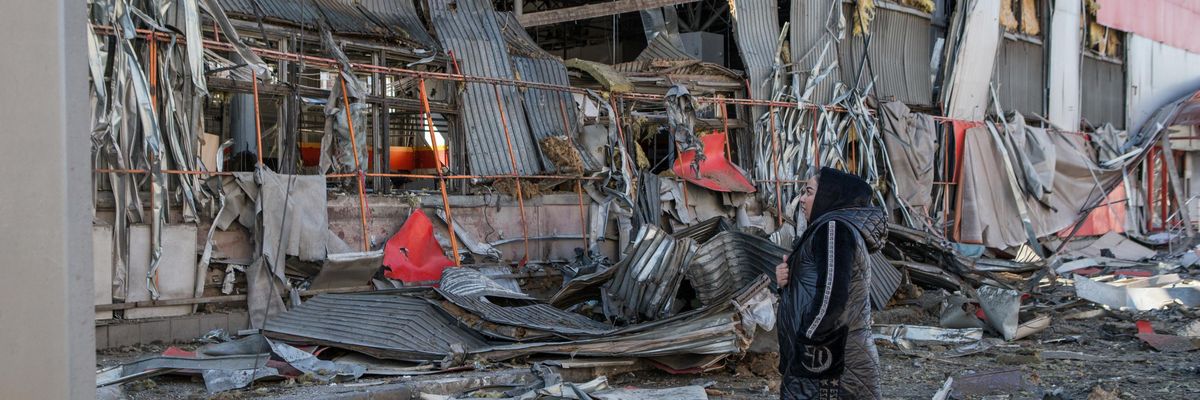
Businesses in Kharkiv, Ukraine are shown after being bombed by Russian artillery on March 15, 2022. (Photo: Andrea Carrubba/Anadolu Agency via Getty Images)
The United Nations asserted Wednesday that Russian forces have used cluster munitions to bomb areas populated by civilians at least two dozen times since invading Ukraine on February 24--attacks which may constitute war crimes, according to international human rights experts.
"For more than one month now, the entire population of Ukraine has been enduring a living nightmare," said U.N. High Commissioner for Human Rights Michelle Bachelet. "The lives of millions of people are in upheaval as they are forced to flee their homes or hide in basements and bomb shelters as their cities are pummeled and destroyed."
"The situation inside Ukraine is spiraling."
The U.N. said "credible reports" have indicated that Russian President Vladimir Putin's military has used cluster munitions in cities including Kharkiv, the second-largest city in Ukraine.
At least three civilians were killed by cluster bombs--which scatter submunitions and create de facto landmines throughout wide areas--in Kharkiv late last month, when the Russians fired the munitions in at least three residential neighborhoods in the city.
"Due to their wide area effects, the use of cluster munitions in populated areas is incompatible with the international humanitarian law principles governing the conduct of hostilities," said the U.N. earlier this month.
The Center for Strategic Communications and Information Security in Ukraine on Wednesday accused the Russians of using "weapons of mass destruction aimed to destroy every living creature in the area."
The use of cluster bombs has been outlawed by 123 countries that are party to the Convention on Cluster Munitions, a binding agreement which went into force in 2010. The U.S. and Russia are two of the countries that have not signed onto the agreement, drawing international condemnation.
Human Rights Watch on Wednesday also accused Russian forces of using antipersonnel landmines in its attacks on Russia. Calling the use of landmines "unacceptable," Hector Guerra, director of the International Campaign to Ban Landmines and Cluster Munition Coalition, said "there is an urgent need for risk education in Ukrainian communities affected by mines, cluster munition remnants, and other explosive remnants of war resulting from Russia's use of these banned weapons."
Russia's invasion has forced more than four million Ukrainians to flee the country and internally displaced more than six million people including 2.5 million children, according to the United Nations.
"The situation inside Ukraine is spiraling," UNICEF executive director Catherine Russell said Wednesday as the U.N. reported that there are dire shortages of medical supplies, food, shelter, and basic household items throughout Ukraine.
The U.N. has been unable to assess exactly how many people have been killed in cities facing "constant shelling and intensive fighting," including Mariupol and Volnovakha. On Wednesday, after a monthlong siege on the port city that has deprived residents of water, food, and fuel, Russia announced a ceasefire in Mariupol in order to evacuate civilians.
Bachelet called on Putin "to heed the clear and strong calls" of the U.N. General Assembly and Human Rights Council "and immediately act to withdraw its troops from Ukrainian territory."
"The hostilities must stop, without delay," she said.
The Human Rights Council on Wednesday named three investigators--Erik Mose of Norway, Jasminka Dzumhur of Bosnia and Herzegovina, and Pablo de Greiff of Colombia--to lead the recently-formed Commission of Inquiry on Ukraine probing Russia's alleged rights violations in the country since the invasion began.
Dear Common Dreams reader, It’s been nearly 30 years since I co-founded Common Dreams with my late wife, Lina Newhouser. We had the radical notion that journalism should serve the public good, not corporate profits. It was clear to us from the outset what it would take to build such a project. No paid advertisements. No corporate sponsors. No millionaire publisher telling us what to think or do. Many people said we wouldn't last a year, but we proved those doubters wrong. Together with a tremendous team of journalists and dedicated staff, we built an independent media outlet free from the constraints of profits and corporate control. Our mission has always been simple: To inform. To inspire. To ignite change for the common good. Building Common Dreams was not easy. Our survival was never guaranteed. When you take on the most powerful forces—Wall Street greed, fossil fuel industry destruction, Big Tech lobbyists, and uber-rich oligarchs who have spent billions upon billions rigging the economy and democracy in their favor—the only bulwark you have is supporters who believe in your work. But here’s the urgent message from me today. It's never been this bad out there. And it's never been this hard to keep us going. At the very moment Common Dreams is most needed, the threats we face are intensifying. We need your support now more than ever. We don't accept corporate advertising and never will. We don't have a paywall because we don't think people should be blocked from critical news based on their ability to pay. Everything we do is funded by the donations of readers like you. When everyone does the little they can afford, we are strong. But if that support retreats or dries up, so do we. Will you donate now to make sure Common Dreams not only survives but thrives? —Craig Brown, Co-founder |
The United Nations asserted Wednesday that Russian forces have used cluster munitions to bomb areas populated by civilians at least two dozen times since invading Ukraine on February 24--attacks which may constitute war crimes, according to international human rights experts.
"For more than one month now, the entire population of Ukraine has been enduring a living nightmare," said U.N. High Commissioner for Human Rights Michelle Bachelet. "The lives of millions of people are in upheaval as they are forced to flee their homes or hide in basements and bomb shelters as their cities are pummeled and destroyed."
"The situation inside Ukraine is spiraling."
The U.N. said "credible reports" have indicated that Russian President Vladimir Putin's military has used cluster munitions in cities including Kharkiv, the second-largest city in Ukraine.
At least three civilians were killed by cluster bombs--which scatter submunitions and create de facto landmines throughout wide areas--in Kharkiv late last month, when the Russians fired the munitions in at least three residential neighborhoods in the city.
"Due to their wide area effects, the use of cluster munitions in populated areas is incompatible with the international humanitarian law principles governing the conduct of hostilities," said the U.N. earlier this month.
The Center for Strategic Communications and Information Security in Ukraine on Wednesday accused the Russians of using "weapons of mass destruction aimed to destroy every living creature in the area."
The use of cluster bombs has been outlawed by 123 countries that are party to the Convention on Cluster Munitions, a binding agreement which went into force in 2010. The U.S. and Russia are two of the countries that have not signed onto the agreement, drawing international condemnation.
Human Rights Watch on Wednesday also accused Russian forces of using antipersonnel landmines in its attacks on Russia. Calling the use of landmines "unacceptable," Hector Guerra, director of the International Campaign to Ban Landmines and Cluster Munition Coalition, said "there is an urgent need for risk education in Ukrainian communities affected by mines, cluster munition remnants, and other explosive remnants of war resulting from Russia's use of these banned weapons."
Russia's invasion has forced more than four million Ukrainians to flee the country and internally displaced more than six million people including 2.5 million children, according to the United Nations.
"The situation inside Ukraine is spiraling," UNICEF executive director Catherine Russell said Wednesday as the U.N. reported that there are dire shortages of medical supplies, food, shelter, and basic household items throughout Ukraine.
The U.N. has been unable to assess exactly how many people have been killed in cities facing "constant shelling and intensive fighting," including Mariupol and Volnovakha. On Wednesday, after a monthlong siege on the port city that has deprived residents of water, food, and fuel, Russia announced a ceasefire in Mariupol in order to evacuate civilians.
Bachelet called on Putin "to heed the clear and strong calls" of the U.N. General Assembly and Human Rights Council "and immediately act to withdraw its troops from Ukrainian territory."
"The hostilities must stop, without delay," she said.
The Human Rights Council on Wednesday named three investigators--Erik Mose of Norway, Jasminka Dzumhur of Bosnia and Herzegovina, and Pablo de Greiff of Colombia--to lead the recently-formed Commission of Inquiry on Ukraine probing Russia's alleged rights violations in the country since the invasion began.
The United Nations asserted Wednesday that Russian forces have used cluster munitions to bomb areas populated by civilians at least two dozen times since invading Ukraine on February 24--attacks which may constitute war crimes, according to international human rights experts.
"For more than one month now, the entire population of Ukraine has been enduring a living nightmare," said U.N. High Commissioner for Human Rights Michelle Bachelet. "The lives of millions of people are in upheaval as they are forced to flee their homes or hide in basements and bomb shelters as their cities are pummeled and destroyed."
"The situation inside Ukraine is spiraling."
The U.N. said "credible reports" have indicated that Russian President Vladimir Putin's military has used cluster munitions in cities including Kharkiv, the second-largest city in Ukraine.
At least three civilians were killed by cluster bombs--which scatter submunitions and create de facto landmines throughout wide areas--in Kharkiv late last month, when the Russians fired the munitions in at least three residential neighborhoods in the city.
"Due to their wide area effects, the use of cluster munitions in populated areas is incompatible with the international humanitarian law principles governing the conduct of hostilities," said the U.N. earlier this month.
The Center for Strategic Communications and Information Security in Ukraine on Wednesday accused the Russians of using "weapons of mass destruction aimed to destroy every living creature in the area."
The use of cluster bombs has been outlawed by 123 countries that are party to the Convention on Cluster Munitions, a binding agreement which went into force in 2010. The U.S. and Russia are two of the countries that have not signed onto the agreement, drawing international condemnation.
Human Rights Watch on Wednesday also accused Russian forces of using antipersonnel landmines in its attacks on Russia. Calling the use of landmines "unacceptable," Hector Guerra, director of the International Campaign to Ban Landmines and Cluster Munition Coalition, said "there is an urgent need for risk education in Ukrainian communities affected by mines, cluster munition remnants, and other explosive remnants of war resulting from Russia's use of these banned weapons."
Russia's invasion has forced more than four million Ukrainians to flee the country and internally displaced more than six million people including 2.5 million children, according to the United Nations.
"The situation inside Ukraine is spiraling," UNICEF executive director Catherine Russell said Wednesday as the U.N. reported that there are dire shortages of medical supplies, food, shelter, and basic household items throughout Ukraine.
The U.N. has been unable to assess exactly how many people have been killed in cities facing "constant shelling and intensive fighting," including Mariupol and Volnovakha. On Wednesday, after a monthlong siege on the port city that has deprived residents of water, food, and fuel, Russia announced a ceasefire in Mariupol in order to evacuate civilians.
Bachelet called on Putin "to heed the clear and strong calls" of the U.N. General Assembly and Human Rights Council "and immediately act to withdraw its troops from Ukrainian territory."
"The hostilities must stop, without delay," she said.
The Human Rights Council on Wednesday named three investigators--Erik Mose of Norway, Jasminka Dzumhur of Bosnia and Herzegovina, and Pablo de Greiff of Colombia--to lead the recently-formed Commission of Inquiry on Ukraine probing Russia's alleged rights violations in the country since the invasion began.