

SUBSCRIBE TO OUR FREE NEWSLETTER
Daily news & progressive opinion—funded by the people, not the corporations—delivered straight to your inbox.
5
#000000
#FFFFFF
To donate by check, phone, or other method, see our More Ways to Give page.
Daily news & progressive opinion—funded by the people, not the corporations—delivered straight to your inbox.
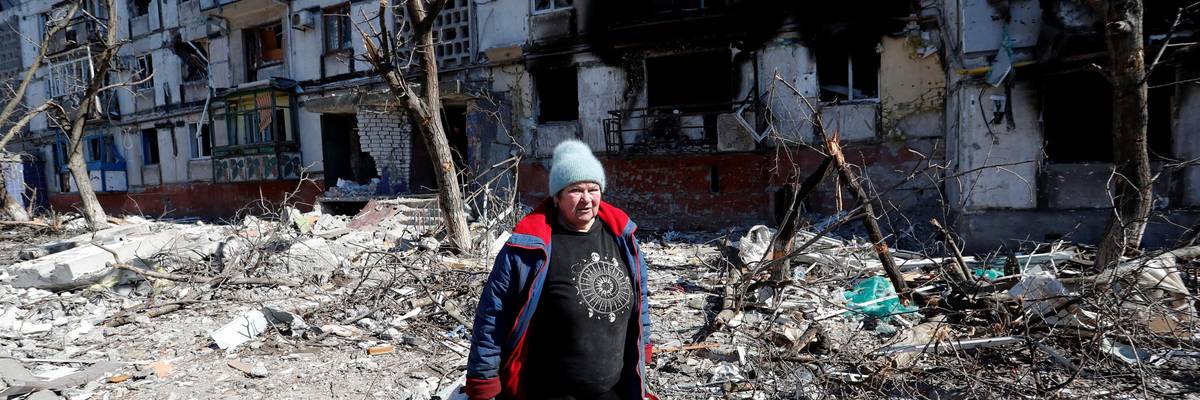
A resident walks past a damaged building in Mariupol, Ukraine on March 28, 2022. (Photo: Victor/Xinhua via Getty Images)
Russian officials on Wednesday said they would implement a cease-fire and open a humanitarian corridor out of the embattled Ukrainian city of Mariupol, where thousands of civilians have reportedly been killed over the past five weeks of relentless attacks.
The Russian Defense Ministry said that a humanitarian corridor from Mariupol to Zaporizhzhia via the Russian-controlled port of Berdiansk would be open Thursday at 10:00 am local time, Al Jazeera reports.
Some Ukrainians were skeptical of the Russian announcement. Russian forces have been accused of targeting fleeing civilians--including in previously designated humanitarian corridors they promised not to attack--and continued to bombard the outskirts of the capital Kyiv and other cities Wednesday after pledging to scale back attacks.
The cease-fire announcement came after Russian President Vladimir Putin demanded Mariupol surrender as a precondition for an end to shelling of the besieged city of more than 440,000 inhabitants. There has been no such surrender.
Mariupol has suffered widespread destruction during the more than monthlong Russian onslaught. Ukrainian officials say food and water are in short supply and that Russian forces are deliberately blocking humanitarian aid and capturing residents who attempt to escape the city. Thousands of Mariupol residents have reportedly been forcibly transferred to Russia, where they face indefinite detention and interrogation.
On Monday, Mayor Vadym Boichenko said that nearly 5,000 people including 210 children have died in the city, where some 160,000 civilians remain trapped. The Mariupol City Council said last week that around 300 civilians were killed in a Russian airstrike targeting a drama theater sheltering up to 1,300 people and clearly marked with the word "children."
It is still unclear how many people were killed or injured in a March 20 Russian attack on Mariupol's Art School No. 12, where 400 women, children, and elders were reportedly sheltering.
Boichenko's office said Monday that 40% of the buildings in the port city have been completely destroyed, and 90% have been damaged.
Global human rights advocates have been calling for a cease-fire not just in Mariupol but throughout Ukraine as peace talks resumed this week in Turkey.
"A cessation of hostilities will allow essential humanitarian aid to be delivered, and enable civilians to move around safely," United Nations Secretary-General Antonio Guterres said on Monday. "It will save lives, prevent suffering, and protect civilians."
Dear Common Dreams reader, It’s been nearly 30 years since I co-founded Common Dreams with my late wife, Lina Newhouser. We had the radical notion that journalism should serve the public good, not corporate profits. It was clear to us from the outset what it would take to build such a project. No paid advertisements. No corporate sponsors. No millionaire publisher telling us what to think or do. Many people said we wouldn't last a year, but we proved those doubters wrong. Together with a tremendous team of journalists and dedicated staff, we built an independent media outlet free from the constraints of profits and corporate control. Our mission has always been simple: To inform. To inspire. To ignite change for the common good. Building Common Dreams was not easy. Our survival was never guaranteed. When you take on the most powerful forces—Wall Street greed, fossil fuel industry destruction, Big Tech lobbyists, and uber-rich oligarchs who have spent billions upon billions rigging the economy and democracy in their favor—the only bulwark you have is supporters who believe in your work. But here’s the urgent message from me today. It's never been this bad out there. And it's never been this hard to keep us going. At the very moment Common Dreams is most needed, the threats we face are intensifying. We need your support now more than ever. We don't accept corporate advertising and never will. We don't have a paywall because we don't think people should be blocked from critical news based on their ability to pay. Everything we do is funded by the donations of readers like you. When everyone does the little they can afford, we are strong. But if that support retreats or dries up, so do we. Will you donate now to make sure Common Dreams not only survives but thrives? —Craig Brown, Co-founder |
Russian officials on Wednesday said they would implement a cease-fire and open a humanitarian corridor out of the embattled Ukrainian city of Mariupol, where thousands of civilians have reportedly been killed over the past five weeks of relentless attacks.
The Russian Defense Ministry said that a humanitarian corridor from Mariupol to Zaporizhzhia via the Russian-controlled port of Berdiansk would be open Thursday at 10:00 am local time, Al Jazeera reports.
Some Ukrainians were skeptical of the Russian announcement. Russian forces have been accused of targeting fleeing civilians--including in previously designated humanitarian corridors they promised not to attack--and continued to bombard the outskirts of the capital Kyiv and other cities Wednesday after pledging to scale back attacks.
The cease-fire announcement came after Russian President Vladimir Putin demanded Mariupol surrender as a precondition for an end to shelling of the besieged city of more than 440,000 inhabitants. There has been no such surrender.
Mariupol has suffered widespread destruction during the more than monthlong Russian onslaught. Ukrainian officials say food and water are in short supply and that Russian forces are deliberately blocking humanitarian aid and capturing residents who attempt to escape the city. Thousands of Mariupol residents have reportedly been forcibly transferred to Russia, where they face indefinite detention and interrogation.
On Monday, Mayor Vadym Boichenko said that nearly 5,000 people including 210 children have died in the city, where some 160,000 civilians remain trapped. The Mariupol City Council said last week that around 300 civilians were killed in a Russian airstrike targeting a drama theater sheltering up to 1,300 people and clearly marked with the word "children."
It is still unclear how many people were killed or injured in a March 20 Russian attack on Mariupol's Art School No. 12, where 400 women, children, and elders were reportedly sheltering.
Boichenko's office said Monday that 40% of the buildings in the port city have been completely destroyed, and 90% have been damaged.
Global human rights advocates have been calling for a cease-fire not just in Mariupol but throughout Ukraine as peace talks resumed this week in Turkey.
"A cessation of hostilities will allow essential humanitarian aid to be delivered, and enable civilians to move around safely," United Nations Secretary-General Antonio Guterres said on Monday. "It will save lives, prevent suffering, and protect civilians."
Russian officials on Wednesday said they would implement a cease-fire and open a humanitarian corridor out of the embattled Ukrainian city of Mariupol, where thousands of civilians have reportedly been killed over the past five weeks of relentless attacks.
The Russian Defense Ministry said that a humanitarian corridor from Mariupol to Zaporizhzhia via the Russian-controlled port of Berdiansk would be open Thursday at 10:00 am local time, Al Jazeera reports.
Some Ukrainians were skeptical of the Russian announcement. Russian forces have been accused of targeting fleeing civilians--including in previously designated humanitarian corridors they promised not to attack--and continued to bombard the outskirts of the capital Kyiv and other cities Wednesday after pledging to scale back attacks.
The cease-fire announcement came after Russian President Vladimir Putin demanded Mariupol surrender as a precondition for an end to shelling of the besieged city of more than 440,000 inhabitants. There has been no such surrender.
Mariupol has suffered widespread destruction during the more than monthlong Russian onslaught. Ukrainian officials say food and water are in short supply and that Russian forces are deliberately blocking humanitarian aid and capturing residents who attempt to escape the city. Thousands of Mariupol residents have reportedly been forcibly transferred to Russia, where they face indefinite detention and interrogation.
On Monday, Mayor Vadym Boichenko said that nearly 5,000 people including 210 children have died in the city, where some 160,000 civilians remain trapped. The Mariupol City Council said last week that around 300 civilians were killed in a Russian airstrike targeting a drama theater sheltering up to 1,300 people and clearly marked with the word "children."
It is still unclear how many people were killed or injured in a March 20 Russian attack on Mariupol's Art School No. 12, where 400 women, children, and elders were reportedly sheltering.
Boichenko's office said Monday that 40% of the buildings in the port city have been completely destroyed, and 90% have been damaged.
Global human rights advocates have been calling for a cease-fire not just in Mariupol but throughout Ukraine as peace talks resumed this week in Turkey.
"A cessation of hostilities will allow essential humanitarian aid to be delivered, and enable civilians to move around safely," United Nations Secretary-General Antonio Guterres said on Monday. "It will save lives, prevent suffering, and protect civilians."

