SUBSCRIBE TO OUR FREE NEWSLETTER
Daily news & progressive opinion—funded by the people, not the corporations—delivered straight to your inbox.
5
#000000
#FFFFFF
To donate by check, phone, or other method, see our More Ways to Give page.
Daily news & progressive opinion—funded by the people, not the corporations—delivered straight to your inbox.
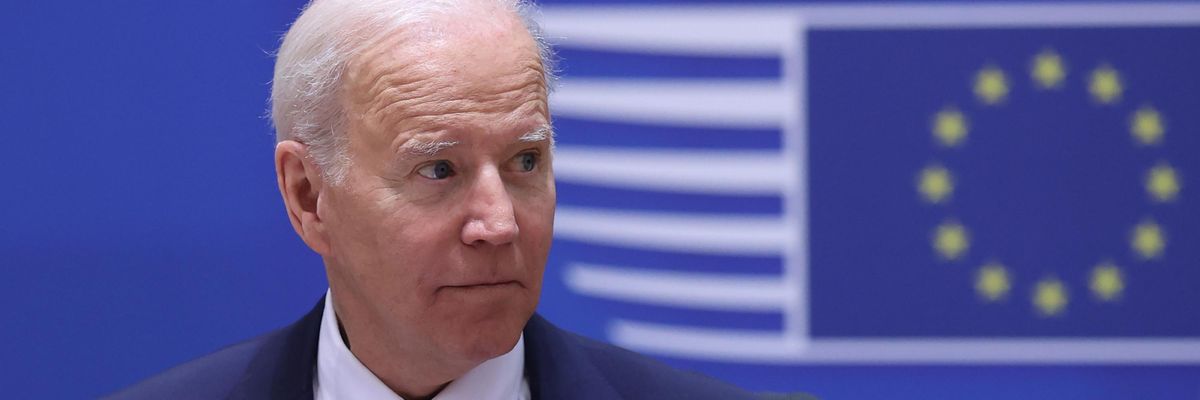
U.S. President Joe Biden attends the E.U. Leaders' Summit in Brussels, Belgium on March 24, 2022. (Photo: Dursun Aydemir/Anadolu Agency via Getty Images)
More than a dozen progressive organizations sent a letter to U.S. President Joe Biden on Tuesday, urging his administration to do everything in its power to bring about a diplomatic solution to the war in Ukraine and to avoid doing anything that would cause a further escalation, which they warned might lead to a direct military clash between NATO and Russia, both flush with nuclear weapons.
"Compromise is difficult given Russia's actions, but compromise is necessary to diplomacy and will save lives."
"Even as we rally the world to oppose Russia's outrageous and illegal invasion of Ukraine, and provide needed assistance to help the Ukrainian people, it is not too early to lay the groundwork for U.S. contributions to a negotiated peace," wrote the coalition, which includes Just Foreign Policy, Physicians for Social Responsibility, the Quincy Institute for Responsible Statecraft, and Veterans for Peace.
"We understand that the government of Ukraine must play the leading role in any such negotiations, and that the success of negotiations depends on Russian willingness to accept meaningful sovereignty for the people of Ukraine," the coalition continued. "Yet the United States will also play a critical role in the success of any negotiated peace."
The U.S., for instance, "controls the sanctions currently devastating the Russian economy," the letter states. "Tying the easing of some of these sanctions to the success of diplomacy would provide an important incentive for Russian concessions."
"In addition, any negotiated settlement will involve establishing future Ukrainian and European security arrangements in which the United States will play a key role," says the letter. "There are actions the U.S. can take in these areas, and assurances the U.S. can give, which no other party anywhere in the world can match. While Ukraine and Russia are the main parties to any negotiation, both will certainly look to the U.S. to agree to and commit to support any new security arrangements resulting from diplomacy."
While "it does not appear that a peace deal fully acceptable to the Ukrainian government is yet on the table," the coalition noted, "the devastating human, military, and economic costs of war are pushing the Russian government to become more realistic in their negotiating demands."
Significant progress appeared to be made Tuesday as Russian and Ukrainian diplomats met in Istanbul.
Moscow announced that it will "fundamentally cut back" offensive operations near Kyiv and Chernihiv in order to increase "trust" during future discussions, though its delegation emphasized that it was not agreeing to a ceasefire. Kyiv, meanwhile, offered to remain neutral in exchange for security guarantees and proposed a 15-year timeline to resolve the dispute over Crimea through "bilateral negotiations."
"Compromise is difficult given Russia's actions, but compromise is necessary to diplomacy and will save lives," the letter adds. "We believe that the potential emerging outlines of an agreement, involving neutrality for Ukraine, security guarantees, and a settlement of issues involving Crimea and the Donbas, could be compatible with meaningful Ukrainian sovereignty and continued cultural and economic openness to the West."
Just days after Biden's bellicose denunciation of Russian President Vladimir Putin sparked fears that the U.S. might seek to oust the Kremlin's leader, the coalition pointed out several "concrete ways" the president can "maximize" support for a diplomatic solution:
"If there is no successful diplomatic resolution, the implications for the Ukrainian people and the world are dire," stressed the coalition.
"You have, correctly in our view, rejected a direct U.S. military defense of Ukraine using American troops or planes," the groups told Biden. "Such a direct clash between the U.S. and Russia would irresponsibly risk massive and potentially nuclear escalation of the war. But without external forces and without a diplomatic settlement, Ukraine is isolated against a much larger opponent and the civilian death toll will only increase as Russia's assault continues."
The coalition pointed out that "an extended war in Ukraine would carry enormous costs for the Ukrainian people" as well as "enormous risks to human and environmental well-being around the world," including the possibility of nuclear catastrophe, severe economic losses, food insecurity, and political instability.
"If we wish to truly support the Ukrainian people," added the coalition, "we must be willing to support a negotiated settlement."
Dear Common Dreams reader, It’s been nearly 30 years since I co-founded Common Dreams with my late wife, Lina Newhouser. We had the radical notion that journalism should serve the public good, not corporate profits. It was clear to us from the outset what it would take to build such a project. No paid advertisements. No corporate sponsors. No millionaire publisher telling us what to think or do. Many people said we wouldn't last a year, but we proved those doubters wrong. Together with a tremendous team of journalists and dedicated staff, we built an independent media outlet free from the constraints of profits and corporate control. Our mission has always been simple: To inform. To inspire. To ignite change for the common good. Building Common Dreams was not easy. Our survival was never guaranteed. When you take on the most powerful forces—Wall Street greed, fossil fuel industry destruction, Big Tech lobbyists, and uber-rich oligarchs who have spent billions upon billions rigging the economy and democracy in their favor—the only bulwark you have is supporters who believe in your work. But here’s the urgent message from me today. It's never been this bad out there. And it's never been this hard to keep us going. At the very moment Common Dreams is most needed, the threats we face are intensifying. We need your support now more than ever. We don't accept corporate advertising and never will. We don't have a paywall because we don't think people should be blocked from critical news based on their ability to pay. Everything we do is funded by the donations of readers like you. When everyone does the little they can afford, we are strong. But if that support retreats or dries up, so do we. Will you donate now to make sure Common Dreams not only survives but thrives? —Craig Brown, Co-founder |
More than a dozen progressive organizations sent a letter to U.S. President Joe Biden on Tuesday, urging his administration to do everything in its power to bring about a diplomatic solution to the war in Ukraine and to avoid doing anything that would cause a further escalation, which they warned might lead to a direct military clash between NATO and Russia, both flush with nuclear weapons.
"Compromise is difficult given Russia's actions, but compromise is necessary to diplomacy and will save lives."
"Even as we rally the world to oppose Russia's outrageous and illegal invasion of Ukraine, and provide needed assistance to help the Ukrainian people, it is not too early to lay the groundwork for U.S. contributions to a negotiated peace," wrote the coalition, which includes Just Foreign Policy, Physicians for Social Responsibility, the Quincy Institute for Responsible Statecraft, and Veterans for Peace.
"We understand that the government of Ukraine must play the leading role in any such negotiations, and that the success of negotiations depends on Russian willingness to accept meaningful sovereignty for the people of Ukraine," the coalition continued. "Yet the United States will also play a critical role in the success of any negotiated peace."
The U.S., for instance, "controls the sanctions currently devastating the Russian economy," the letter states. "Tying the easing of some of these sanctions to the success of diplomacy would provide an important incentive for Russian concessions."
"In addition, any negotiated settlement will involve establishing future Ukrainian and European security arrangements in which the United States will play a key role," says the letter. "There are actions the U.S. can take in these areas, and assurances the U.S. can give, which no other party anywhere in the world can match. While Ukraine and Russia are the main parties to any negotiation, both will certainly look to the U.S. to agree to and commit to support any new security arrangements resulting from diplomacy."
While "it does not appear that a peace deal fully acceptable to the Ukrainian government is yet on the table," the coalition noted, "the devastating human, military, and economic costs of war are pushing the Russian government to become more realistic in their negotiating demands."
Significant progress appeared to be made Tuesday as Russian and Ukrainian diplomats met in Istanbul.
Moscow announced that it will "fundamentally cut back" offensive operations near Kyiv and Chernihiv in order to increase "trust" during future discussions, though its delegation emphasized that it was not agreeing to a ceasefire. Kyiv, meanwhile, offered to remain neutral in exchange for security guarantees and proposed a 15-year timeline to resolve the dispute over Crimea through "bilateral negotiations."
"Compromise is difficult given Russia's actions, but compromise is necessary to diplomacy and will save lives," the letter adds. "We believe that the potential emerging outlines of an agreement, involving neutrality for Ukraine, security guarantees, and a settlement of issues involving Crimea and the Donbas, could be compatible with meaningful Ukrainian sovereignty and continued cultural and economic openness to the West."
Just days after Biden's bellicose denunciation of Russian President Vladimir Putin sparked fears that the U.S. might seek to oust the Kremlin's leader, the coalition pointed out several "concrete ways" the president can "maximize" support for a diplomatic solution:
"If there is no successful diplomatic resolution, the implications for the Ukrainian people and the world are dire," stressed the coalition.
"You have, correctly in our view, rejected a direct U.S. military defense of Ukraine using American troops or planes," the groups told Biden. "Such a direct clash between the U.S. and Russia would irresponsibly risk massive and potentially nuclear escalation of the war. But without external forces and without a diplomatic settlement, Ukraine is isolated against a much larger opponent and the civilian death toll will only increase as Russia's assault continues."
The coalition pointed out that "an extended war in Ukraine would carry enormous costs for the Ukrainian people" as well as "enormous risks to human and environmental well-being around the world," including the possibility of nuclear catastrophe, severe economic losses, food insecurity, and political instability.
"If we wish to truly support the Ukrainian people," added the coalition, "we must be willing to support a negotiated settlement."
More than a dozen progressive organizations sent a letter to U.S. President Joe Biden on Tuesday, urging his administration to do everything in its power to bring about a diplomatic solution to the war in Ukraine and to avoid doing anything that would cause a further escalation, which they warned might lead to a direct military clash between NATO and Russia, both flush with nuclear weapons.
"Compromise is difficult given Russia's actions, but compromise is necessary to diplomacy and will save lives."
"Even as we rally the world to oppose Russia's outrageous and illegal invasion of Ukraine, and provide needed assistance to help the Ukrainian people, it is not too early to lay the groundwork for U.S. contributions to a negotiated peace," wrote the coalition, which includes Just Foreign Policy, Physicians for Social Responsibility, the Quincy Institute for Responsible Statecraft, and Veterans for Peace.
"We understand that the government of Ukraine must play the leading role in any such negotiations, and that the success of negotiations depends on Russian willingness to accept meaningful sovereignty for the people of Ukraine," the coalition continued. "Yet the United States will also play a critical role in the success of any negotiated peace."
The U.S., for instance, "controls the sanctions currently devastating the Russian economy," the letter states. "Tying the easing of some of these sanctions to the success of diplomacy would provide an important incentive for Russian concessions."
"In addition, any negotiated settlement will involve establishing future Ukrainian and European security arrangements in which the United States will play a key role," says the letter. "There are actions the U.S. can take in these areas, and assurances the U.S. can give, which no other party anywhere in the world can match. While Ukraine and Russia are the main parties to any negotiation, both will certainly look to the U.S. to agree to and commit to support any new security arrangements resulting from diplomacy."
While "it does not appear that a peace deal fully acceptable to the Ukrainian government is yet on the table," the coalition noted, "the devastating human, military, and economic costs of war are pushing the Russian government to become more realistic in their negotiating demands."
Significant progress appeared to be made Tuesday as Russian and Ukrainian diplomats met in Istanbul.
Moscow announced that it will "fundamentally cut back" offensive operations near Kyiv and Chernihiv in order to increase "trust" during future discussions, though its delegation emphasized that it was not agreeing to a ceasefire. Kyiv, meanwhile, offered to remain neutral in exchange for security guarantees and proposed a 15-year timeline to resolve the dispute over Crimea through "bilateral negotiations."
"Compromise is difficult given Russia's actions, but compromise is necessary to diplomacy and will save lives," the letter adds. "We believe that the potential emerging outlines of an agreement, involving neutrality for Ukraine, security guarantees, and a settlement of issues involving Crimea and the Donbas, could be compatible with meaningful Ukrainian sovereignty and continued cultural and economic openness to the West."
Just days after Biden's bellicose denunciation of Russian President Vladimir Putin sparked fears that the U.S. might seek to oust the Kremlin's leader, the coalition pointed out several "concrete ways" the president can "maximize" support for a diplomatic solution:
"If there is no successful diplomatic resolution, the implications for the Ukrainian people and the world are dire," stressed the coalition.
"You have, correctly in our view, rejected a direct U.S. military defense of Ukraine using American troops or planes," the groups told Biden. "Such a direct clash between the U.S. and Russia would irresponsibly risk massive and potentially nuclear escalation of the war. But without external forces and without a diplomatic settlement, Ukraine is isolated against a much larger opponent and the civilian death toll will only increase as Russia's assault continues."
The coalition pointed out that "an extended war in Ukraine would carry enormous costs for the Ukrainian people" as well as "enormous risks to human and environmental well-being around the world," including the possibility of nuclear catastrophe, severe economic losses, food insecurity, and political instability.
"If we wish to truly support the Ukrainian people," added the coalition, "we must be willing to support a negotiated settlement."