SUBSCRIBE TO OUR FREE NEWSLETTER
Daily news & progressive opinion—funded by the people, not the corporations—delivered straight to your inbox.
5
#000000
#FFFFFF
To donate by check, phone, or other method, see our More Ways to Give page.
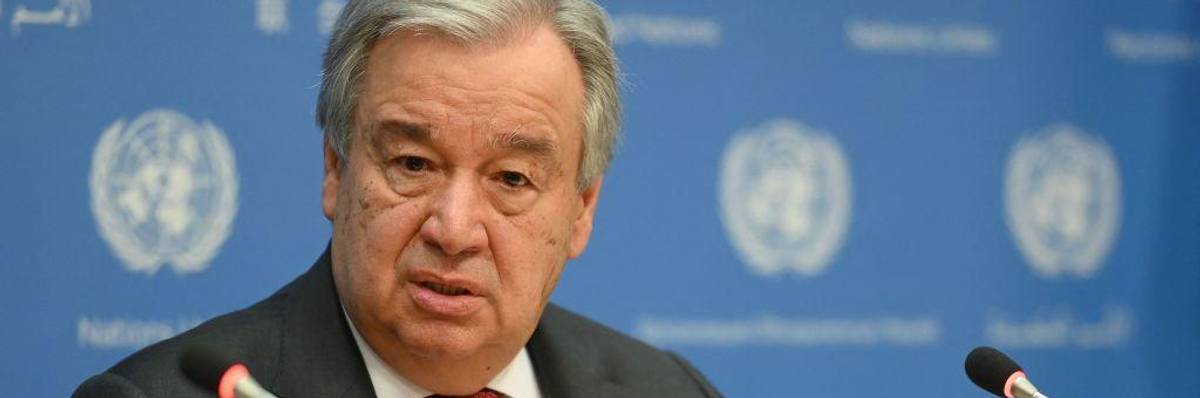
As the death toll from Russia's war on Ukraine continued to grow, particularly in key cities like Mariupol, United Nations Secretary-General Antonio Guterres on Monday called for "an immediate humanitarian cease-fire to allow for progress in serious political negotiations" on a peace agreement.
"A cessation of hostilities... will save lives, prevent suffering, and protect civilians."
"Since the beginning of the Russian invasion one month ago, the war has led to the senseless loss of thousands of lives; the displacement of ten million people, mainly women and children; the systematic destruction of essential infrastructure; and skyrocketing food and energy prices worldwide," he told reporters outside the U.N. Security Council. "This must stop."
Guterres noted efforts by various U.N. agencies to provide aid--including "food, shelter, blankets, medicine, bottled water, and hygiene supplies"--to affected Ukrainians.
"Our agencies and partners are procuring vital supplies and setting up pipelines for delivery throughout Ukraine in the coming weeks. But let's be clear, the solution to this humanitarian tragedy is not humanitarian. It is political," he continued. "A cessation of hostilities will allow essential humanitarian aid to be delivered and enable civilians to move around safely. It will save lives, prevent suffering, and protect civilians."
Guterres has asked Martin Griffiths, the U.N. under-secretary-general for humanitarian affairs and emergency relief coordinator, to "explore with the parties involved the possible agreements and arrangements for a humanitarian cease-fire."
In addition to providing relief to Ukrainians, the U.N. leader said, "I hope a cease-fire will also help to address the global consequences of this war, which risk compounding the deep hunger crisis in many developing countries that already lack fiscal space to invest in their recovery from the pandemic, and now face soaring food and energy costs."
"I strongly appeal to the parties to this conflict, and to the international community as a whole, to work with us for peace in solidarity with the people of Ukraine and across the world," added Guterres.
The U.N. chief's comments came a day before in-person talks between Kyiv and Moscow are set to resume in Turkey and as the mayor of Mariupol--a besieged Ukrainian port city--said nearly 5,000 residents, including 210 children, have been killed since the Russian invasion began on February 24.
Related Content

So far the Office of the U.N. High Commissioner for Human Rights (OHCHR) has only officially recorded 2,975 civilian casualties--1,151 deaths and 1,824 injuries--but "believes that the actual figures are considerably higher, as the receipt of information from some locations where intense hostilities have been going on has been delayed and many reports are still pending corroboration."
Specifically, the OHCHR said Monday, casualty figures are still being corroborated from Mariupol and Volnovakha (Donetsk region), Izium (Kharkiv region), Popasna and Rubizhne (Luhansk region), and Trostianets (Sumy region), where there are allegations of numerous civilian casualties."
Russia's ongoing assault of Mariupol has made it difficult for civilians to evacuate. As many as 1,300 people were believed to have sought safety in a city theater that was bombed on March 16.
The Mariupol City Council said last week that according to eyewitnesses, "about 300 people died in the Drama Theater... as a result of a bombing by Russian aircraft," and that "there cannot and never will be an explanation for this inhuman cruelty."
As the death toll from Russia's war on Ukraine continued to grow, particularly in key cities like Mariupol, United Nations Secretary-General Antonio Guterres on Monday called for "an immediate humanitarian cease-fire to allow for progress in serious political negotiations" on a peace agreement.
"A cessation of hostilities... will save lives, prevent suffering, and protect civilians."
"Since the beginning of the Russian invasion one month ago, the war has led to the senseless loss of thousands of lives; the displacement of ten million people, mainly women and children; the systematic destruction of essential infrastructure; and skyrocketing food and energy prices worldwide," he told reporters outside the U.N. Security Council. "This must stop."
Guterres noted efforts by various U.N. agencies to provide aid--including "food, shelter, blankets, medicine, bottled water, and hygiene supplies"--to affected Ukrainians.
"Our agencies and partners are procuring vital supplies and setting up pipelines for delivery throughout Ukraine in the coming weeks. But let's be clear, the solution to this humanitarian tragedy is not humanitarian. It is political," he continued. "A cessation of hostilities will allow essential humanitarian aid to be delivered and enable civilians to move around safely. It will save lives, prevent suffering, and protect civilians."
Guterres has asked Martin Griffiths, the U.N. under-secretary-general for humanitarian affairs and emergency relief coordinator, to "explore with the parties involved the possible agreements and arrangements for a humanitarian cease-fire."
In addition to providing relief to Ukrainians, the U.N. leader said, "I hope a cease-fire will also help to address the global consequences of this war, which risk compounding the deep hunger crisis in many developing countries that already lack fiscal space to invest in their recovery from the pandemic, and now face soaring food and energy costs."
"I strongly appeal to the parties to this conflict, and to the international community as a whole, to work with us for peace in solidarity with the people of Ukraine and across the world," added Guterres.
The U.N. chief's comments came a day before in-person talks between Kyiv and Moscow are set to resume in Turkey and as the mayor of Mariupol--a besieged Ukrainian port city--said nearly 5,000 residents, including 210 children, have been killed since the Russian invasion began on February 24.
Related Content
So far the Office of the U.N. High Commissioner for Human Rights (OHCHR) has only officially recorded 2,975 civilian casualties--1,151 deaths and 1,824 injuries--but "believes that the actual figures are considerably higher, as the receipt of information from some locations where intense hostilities have been going on has been delayed and many reports are still pending corroboration."
Specifically, the OHCHR said Monday, casualty figures are still being corroborated from Mariupol and Volnovakha (Donetsk region), Izium (Kharkiv region), Popasna and Rubizhne (Luhansk region), and Trostianets (Sumy region), where there are allegations of numerous civilian casualties."
Russia's ongoing assault of Mariupol has made it difficult for civilians to evacuate. As many as 1,300 people were believed to have sought safety in a city theater that was bombed on March 16.
The Mariupol City Council said last week that according to eyewitnesses, "about 300 people died in the Drama Theater... as a result of a bombing by Russian aircraft," and that "there cannot and never will be an explanation for this inhuman cruelty."
As the death toll from Russia's war on Ukraine continued to grow, particularly in key cities like Mariupol, United Nations Secretary-General Antonio Guterres on Monday called for "an immediate humanitarian cease-fire to allow for progress in serious political negotiations" on a peace agreement.
"A cessation of hostilities... will save lives, prevent suffering, and protect civilians."
"Since the beginning of the Russian invasion one month ago, the war has led to the senseless loss of thousands of lives; the displacement of ten million people, mainly women and children; the systematic destruction of essential infrastructure; and skyrocketing food and energy prices worldwide," he told reporters outside the U.N. Security Council. "This must stop."
Guterres noted efforts by various U.N. agencies to provide aid--including "food, shelter, blankets, medicine, bottled water, and hygiene supplies"--to affected Ukrainians.
"Our agencies and partners are procuring vital supplies and setting up pipelines for delivery throughout Ukraine in the coming weeks. But let's be clear, the solution to this humanitarian tragedy is not humanitarian. It is political," he continued. "A cessation of hostilities will allow essential humanitarian aid to be delivered and enable civilians to move around safely. It will save lives, prevent suffering, and protect civilians."
Guterres has asked Martin Griffiths, the U.N. under-secretary-general for humanitarian affairs and emergency relief coordinator, to "explore with the parties involved the possible agreements and arrangements for a humanitarian cease-fire."
In addition to providing relief to Ukrainians, the U.N. leader said, "I hope a cease-fire will also help to address the global consequences of this war, which risk compounding the deep hunger crisis in many developing countries that already lack fiscal space to invest in their recovery from the pandemic, and now face soaring food and energy costs."
"I strongly appeal to the parties to this conflict, and to the international community as a whole, to work with us for peace in solidarity with the people of Ukraine and across the world," added Guterres.
The U.N. chief's comments came a day before in-person talks between Kyiv and Moscow are set to resume in Turkey and as the mayor of Mariupol--a besieged Ukrainian port city--said nearly 5,000 residents, including 210 children, have been killed since the Russian invasion began on February 24.
Related Content
So far the Office of the U.N. High Commissioner for Human Rights (OHCHR) has only officially recorded 2,975 civilian casualties--1,151 deaths and 1,824 injuries--but "believes that the actual figures are considerably higher, as the receipt of information from some locations where intense hostilities have been going on has been delayed and many reports are still pending corroboration."
Specifically, the OHCHR said Monday, casualty figures are still being corroborated from Mariupol and Volnovakha (Donetsk region), Izium (Kharkiv region), Popasna and Rubizhne (Luhansk region), and Trostianets (Sumy region), where there are allegations of numerous civilian casualties."
Russia's ongoing assault of Mariupol has made it difficult for civilians to evacuate. As many as 1,300 people were believed to have sought safety in a city theater that was bombed on March 16.
The Mariupol City Council said last week that according to eyewitnesses, "about 300 people died in the Drama Theater... as a result of a bombing by Russian aircraft," and that "there cannot and never will be an explanation for this inhuman cruelty."