SUBSCRIBE TO OUR FREE NEWSLETTER
Daily news & progressive opinion—funded by the people, not the corporations—delivered straight to your inbox.
5
#000000
#FFFFFF
To donate by check, phone, or other method, see our More Ways to Give page.
Daily news & progressive opinion—funded by the people, not the corporations—delivered straight to your inbox.
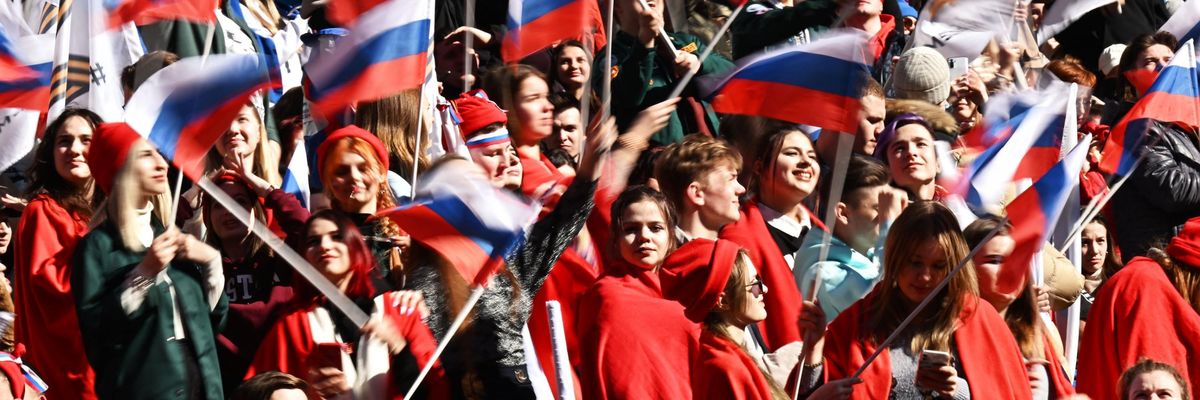
People wave Russian flags as they gather for a concert and pro-war rally on the eighth anniversary of Russia's annexation of Crimea at the Luzhniki Stadium in Moscow on March 18, 2022. (Photo: Ramil Sitdikov/POOL/AFP)
As the Russian military continued its bombardment of Ukrainian cities Friday, President Vladimir Putin's government reportedly bussed state employees to a pro-Kremlin rally in Moscow marking the eighth anniversary of the country's internationally-condemned annexation of Crimea and supporting the war that began nearly a month ago.
Moscow authorities claimed 200,000 people gathered "in and around" Luzhniki Stadium, with Reuters reporting that government employees were told they would be fired if they didn't attend the rally. The Kyiv Independent reported that at least 81,000 people were in attendance.
"I can think of many different videos to show this crowd. Images from Mariupol or Kharkiv or Sumy or Volnovakha."
Putin made a rare public appearance, addressing the crowd for several minutes about what he called the country's "special operation" in Ukraine--the invasion which began February 24 and has killed thousands of civilians, according to Ukrainian authorities, as well as forcing about three million people to flee the country.
The Russian president pushed claims that the country is waging war to save people in the eastern Donbas region of Ukraine from "genocide" and to "denazify" the former Soviet state.
"We know what we should do now and how we should do it and we will implement all our plans," Putin told the crowd, claiming that Kyiv has hit the Donbas with "punitive military operations" since 2014, when Ukraine's Russian-aligned regime was replaced with a Western-facing government.
International observers have dismissed Putin's claims of genocide as baseless, while historians from across the globe signed a statement last month condemning Putin's distortion of the presence of right-wing factions in Ukraine as a problem demanding "denazification" via war.
At the rally, attendees displayed signs with the letter "Z," a symbol of support for the military, and banners reading, "For a world without Nazism" while organizers displayed a video showing Ukrainian flags being thrown on the ground.
According to a survey conducted by several independent research organizations earlier this month, 58% of Russians support Putin's invasion, while 23% are opposed--indicating "relatively modest support... compared with typical levels in the early stages of past incursions."
Anti-war Russians have been internationally praised for attending protests in recent weeks, with thousands of people detained.
According to Washington Post reporter Mary Ilyushina, symbols "representing Ukraine and the West" were banned at Friday's rally.
As Putin spoke and pro-Russia songs were performed at the rally, hundreds of people were unaccounted for at a theater in the besieged port city of Mariupol, where city officials say they have identified 2,400 civilians killed in the attacks.
An early morning missile attack in the western city of Lviv, less than 50 miles from the Polish border, was also reported, sparking concerns that Russia's attacks could spread westward.
According to the World Health Organization, Russian forces have attacked at least 43 hospitals and health facilities, including a maternity hospital, killing at least 12 people and injuring 34.
"I can think of many different videos to show this crowd," tweeted BBC correspondent Sarah Rainsford, who was expelled from Moscow last year after being labeled a national security threat, of the rally-goers gathered at Luzhniki Stadium. "Images from Mariupol or Kharkiv or Sumy or Volnovakha... I just don't think many in Luzhniki would even believe their eyes anymore."
Dear Common Dreams reader, It’s been nearly 30 years since I co-founded Common Dreams with my late wife, Lina Newhouser. We had the radical notion that journalism should serve the public good, not corporate profits. It was clear to us from the outset what it would take to build such a project. No paid advertisements. No corporate sponsors. No millionaire publisher telling us what to think or do. Many people said we wouldn't last a year, but we proved those doubters wrong. Together with a tremendous team of journalists and dedicated staff, we built an independent media outlet free from the constraints of profits and corporate control. Our mission has always been simple: To inform. To inspire. To ignite change for the common good. Building Common Dreams was not easy. Our survival was never guaranteed. When you take on the most powerful forces—Wall Street greed, fossil fuel industry destruction, Big Tech lobbyists, and uber-rich oligarchs who have spent billions upon billions rigging the economy and democracy in their favor—the only bulwark you have is supporters who believe in your work. But here’s the urgent message from me today. It's never been this bad out there. And it's never been this hard to keep us going. At the very moment Common Dreams is most needed, the threats we face are intensifying. We need your support now more than ever. We don't accept corporate advertising and never will. We don't have a paywall because we don't think people should be blocked from critical news based on their ability to pay. Everything we do is funded by the donations of readers like you. When everyone does the little they can afford, we are strong. But if that support retreats or dries up, so do we. Will you donate now to make sure Common Dreams not only survives but thrives? —Craig Brown, Co-founder |
As the Russian military continued its bombardment of Ukrainian cities Friday, President Vladimir Putin's government reportedly bussed state employees to a pro-Kremlin rally in Moscow marking the eighth anniversary of the country's internationally-condemned annexation of Crimea and supporting the war that began nearly a month ago.
Moscow authorities claimed 200,000 people gathered "in and around" Luzhniki Stadium, with Reuters reporting that government employees were told they would be fired if they didn't attend the rally. The Kyiv Independent reported that at least 81,000 people were in attendance.
"I can think of many different videos to show this crowd. Images from Mariupol or Kharkiv or Sumy or Volnovakha."
Putin made a rare public appearance, addressing the crowd for several minutes about what he called the country's "special operation" in Ukraine--the invasion which began February 24 and has killed thousands of civilians, according to Ukrainian authorities, as well as forcing about three million people to flee the country.
The Russian president pushed claims that the country is waging war to save people in the eastern Donbas region of Ukraine from "genocide" and to "denazify" the former Soviet state.
"We know what we should do now and how we should do it and we will implement all our plans," Putin told the crowd, claiming that Kyiv has hit the Donbas with "punitive military operations" since 2014, when Ukraine's Russian-aligned regime was replaced with a Western-facing government.
International observers have dismissed Putin's claims of genocide as baseless, while historians from across the globe signed a statement last month condemning Putin's distortion of the presence of right-wing factions in Ukraine as a problem demanding "denazification" via war.
At the rally, attendees displayed signs with the letter "Z," a symbol of support for the military, and banners reading, "For a world without Nazism" while organizers displayed a video showing Ukrainian flags being thrown on the ground.
According to a survey conducted by several independent research organizations earlier this month, 58% of Russians support Putin's invasion, while 23% are opposed--indicating "relatively modest support... compared with typical levels in the early stages of past incursions."
Anti-war Russians have been internationally praised for attending protests in recent weeks, with thousands of people detained.
According to Washington Post reporter Mary Ilyushina, symbols "representing Ukraine and the West" were banned at Friday's rally.
As Putin spoke and pro-Russia songs were performed at the rally, hundreds of people were unaccounted for at a theater in the besieged port city of Mariupol, where city officials say they have identified 2,400 civilians killed in the attacks.
An early morning missile attack in the western city of Lviv, less than 50 miles from the Polish border, was also reported, sparking concerns that Russia's attacks could spread westward.
According to the World Health Organization, Russian forces have attacked at least 43 hospitals and health facilities, including a maternity hospital, killing at least 12 people and injuring 34.
"I can think of many different videos to show this crowd," tweeted BBC correspondent Sarah Rainsford, who was expelled from Moscow last year after being labeled a national security threat, of the rally-goers gathered at Luzhniki Stadium. "Images from Mariupol or Kharkiv or Sumy or Volnovakha... I just don't think many in Luzhniki would even believe their eyes anymore."
As the Russian military continued its bombardment of Ukrainian cities Friday, President Vladimir Putin's government reportedly bussed state employees to a pro-Kremlin rally in Moscow marking the eighth anniversary of the country's internationally-condemned annexation of Crimea and supporting the war that began nearly a month ago.
Moscow authorities claimed 200,000 people gathered "in and around" Luzhniki Stadium, with Reuters reporting that government employees were told they would be fired if they didn't attend the rally. The Kyiv Independent reported that at least 81,000 people were in attendance.
"I can think of many different videos to show this crowd. Images from Mariupol or Kharkiv or Sumy or Volnovakha."
Putin made a rare public appearance, addressing the crowd for several minutes about what he called the country's "special operation" in Ukraine--the invasion which began February 24 and has killed thousands of civilians, according to Ukrainian authorities, as well as forcing about three million people to flee the country.
The Russian president pushed claims that the country is waging war to save people in the eastern Donbas region of Ukraine from "genocide" and to "denazify" the former Soviet state.
"We know what we should do now and how we should do it and we will implement all our plans," Putin told the crowd, claiming that Kyiv has hit the Donbas with "punitive military operations" since 2014, when Ukraine's Russian-aligned regime was replaced with a Western-facing government.
International observers have dismissed Putin's claims of genocide as baseless, while historians from across the globe signed a statement last month condemning Putin's distortion of the presence of right-wing factions in Ukraine as a problem demanding "denazification" via war.
At the rally, attendees displayed signs with the letter "Z," a symbol of support for the military, and banners reading, "For a world without Nazism" while organizers displayed a video showing Ukrainian flags being thrown on the ground.
According to a survey conducted by several independent research organizations earlier this month, 58% of Russians support Putin's invasion, while 23% are opposed--indicating "relatively modest support... compared with typical levels in the early stages of past incursions."
Anti-war Russians have been internationally praised for attending protests in recent weeks, with thousands of people detained.
According to Washington Post reporter Mary Ilyushina, symbols "representing Ukraine and the West" were banned at Friday's rally.
As Putin spoke and pro-Russia songs were performed at the rally, hundreds of people were unaccounted for at a theater in the besieged port city of Mariupol, where city officials say they have identified 2,400 civilians killed in the attacks.
An early morning missile attack in the western city of Lviv, less than 50 miles from the Polish border, was also reported, sparking concerns that Russia's attacks could spread westward.
According to the World Health Organization, Russian forces have attacked at least 43 hospitals and health facilities, including a maternity hospital, killing at least 12 people and injuring 34.
"I can think of many different videos to show this crowd," tweeted BBC correspondent Sarah Rainsford, who was expelled from Moscow last year after being labeled a national security threat, of the rally-goers gathered at Luzhniki Stadium. "Images from Mariupol or Kharkiv or Sumy or Volnovakha... I just don't think many in Luzhniki would even believe their eyes anymore."