SUBSCRIBE TO OUR FREE NEWSLETTER
Daily news & progressive opinion—funded by the people, not the corporations—delivered straight to your inbox.
5
#000000
#FFFFFF
To donate by check, phone, or other method, see our More Ways to Give page.
Daily news & progressive opinion—funded by the people, not the corporations—delivered straight to your inbox.
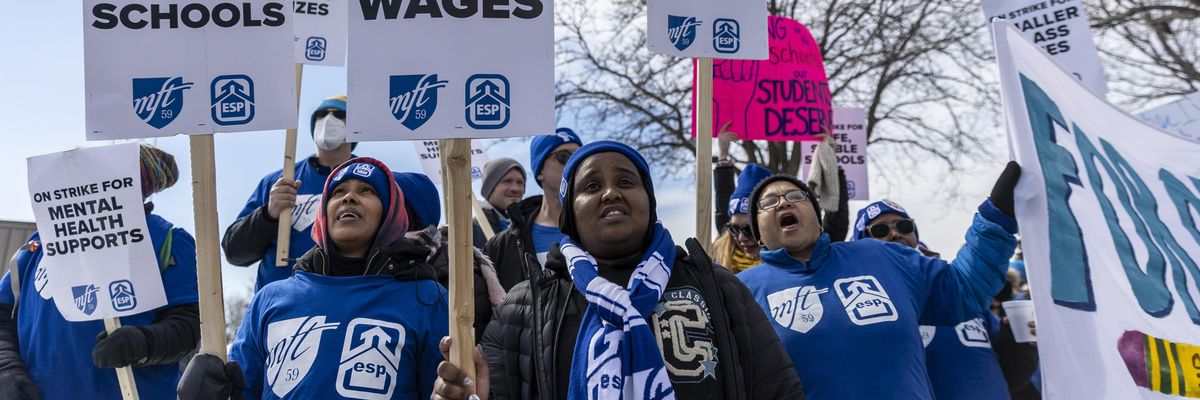
Striking Minneapolis teachers and education support professionals hold placards in front of the Justice Page Middle school in Minneapolis, Minnesota on March 8, 2022. (Photo: Kerem Yucel/Anadolu Agency via Getty Images)
The Minneapolis teachers' strike entered a second day Wednesday as union representatives and district officials resumed negotiations over smaller class sizes, improved student supports, and better pay.
"We don't believe we have a budget crisis in Minneapolis Public Schools. We have a values and priorities crisis."
In addition to demanding caps on class sizes and counselors in every school, the union is seeking higher starting salaries for educational support professionals (ESPs) as well as "a 12% salary increase for first-year educators and 5% increase for second-year teachers," the Star Tribune reported.
Minneapolis Public Schools (MPS) Superintendent Ed Graff, meanwhile, said Tuesday that "the union and district were 'still very far apart' and that while both sides have made concessions--union bargainers initially asked for a 20% salary increase for first-year teachers--the price tag for the union's current ask is about $166 million over the district's budget," according to the newspaper.
However, Shaun Laden, president of the ESP chapter of the Minneapolis Federation of Teachers (MFT), countered district leaders' claims that the union's demands cannot be met due to a growing gap between revenue and expenses caused by decades of underfunding and made worse by rising costs and declining enrollment.
"We don't believe we have a budget crisis in Minneapolis Public Schools," he said Wednesday. "We have a values and priorities crisis."
The Star Tribune reported that "union leaders are also taking aim at the state Legislature, which this year must decide how to spend a historic $9.3 billion surplus."
During a picket in front of the state Capitol, Laden called for lawmakers to "release the dough!"
Progressive economists, as Common Dreams reported last month, have encouraged states to use billions of dollars in available federal Covid-19 relief funds to jumpstart long-term investments in the nation's shrinking education workforce.
Ahead of a 90-minute bargaining session at MPS headquarters, district officials said Wednesday morning that they remained "committed to meeting and negotiating with MFT in order to reach a contract agreement in order to get our students back in their classrooms as quickly as possible."
Classes for the district's 28,700 students are canceled for the duration of the strike.
One MPS parent, whose family joined the picket line in support of "teachers and ESPs striking for the schools our educators and students deserve," said that his kids' teacher is "great" but overburdened with 41 students in her class.
Education Minnesota--a statewide affiliate of the American Federation of Teachers (AFT), the National Education Association (NEA), and the AFL-CIO that has roughly 90,000 members from 463 local unions--said that MFT Local 59 "won't stop until they get the resources and supports their students need!"
The Minneapolis teachers' strike--the first educational work stoppage in the city since 1970--began Tuesday morning after union leaders and district officials failed to reach a resolution by a Monday night deadline.
"MPS has the resources to make these investments. The question is whether they value Minneapolis students as much as their educators do."
Following 13 months of negotiations, "the district has failed to deliver a contract that makes vital investments in our students, our educators, and our community," MFT said in a statement. A whopping 97% of teachers and 98% of ESPs voted to authorize the strike.
Greta Callahan, president of the teachers' chapter of MFT, told the New York Times on the eve of the strike that MPS continues "to look at our proposals and say, 'These are add-ons that we can't afford.' And we're saying, 'No, you need to rewrite the whole system and do things differently.'"
"We're on strike for safe and stable schools and systemic change," Callahan said at a Tuesday morning news conference outside Justice Page Middle School in south Minneapolis.
"We're ready to get back to the table," she added. "We want this to be the shortest strike possible."
According to MFT Local 59, bargaining priorities include:
Callahan was joined at Tuesday morning's news conference by high-profile labor leaders, including AFT president Randi Weingarten and NEA president Becky Pringle.
"The federal government has provided an unprecedented amount of recovery funding to school districts to address problems related to the pandemic, including student recovery, staff shortages, and school safety," Weingarten said in a statement. "There is no excuse for districts to make cuts in light of this historic infusion of funds."
Pringle echoed that sentiment, saying that "with over $250 million in pandemic relief funds, the time is now to invest in the safe and stable schools that Minneapolis students need now more than ever."
"The last two years have demonstrated that the status quo is not good enough," said Pringle. "Minneapolis students and their families have weathered a pandemic, continued police violence, and an economic system that has left students, their families, and educators behind. These students deserve class sizes small enough for one-to-one attention as well as investments in mental health services and social-emotional learning."
"MPS must also invest in systematic changes that improve the recruitment and retention of educators of color as well as a living wage for education support professionals," Pringle continued. "Education support professionals represent a critical workforce in our schools providing essential supports students depend on."
"MPS has the resources to make these investments," she added. "The question is whether they value Minneapolis students as much as their educators do."
"No matter what happens in this struggle, its political impact will certainly reverberate well beyond Minnesota."
Denise Specht, president of Education Minnesota, said that "nearly 90,000 educators across Minnesota are standing with our union family in Minneapolis because what they're fighting for is what we're all fighting for: Schools that will give every student the chance to pursue their dreams."
"The same issues are being negotiated all over the state, from living wages for ESPs, to more mental health supports for students, to managing the crushing caseload for SpEd teachers, to recruiting and retaining more teachers of color, to creating time for educators to give their students enough individual attention," said Specht. "We're in a rich state with a $9.25 billion surplus. No educator should have to fight this hard for the schools our students deserve, but if that's what it takes, we're with you."
Eric Blanc, author of Red State Revolt: The Teachers' Strike Wave and Working-Class Politics, interviewed Callahan and Laden on Wednesday.
Writing in The Nation, he argued that the stakes of the Minneapolis teachers' strike extend far beyond Minnesota, given that the pandemic "has pushed public education to a breaking point across the country" and put its future in "unprecedented limbo."
"No matter what happens in this struggle, its political impact will certainly reverberate well beyond Minnesota," wrote Blanc. "A demoralizing defeat for teachers and ESPs will embolden pro-privatization, anti-union forces across the country to ramp up their efforts to dismantle public schools."
"A victory, in contrast, will infuse fights against K-12 with a much-needed jolt of hope," he added, "and enable organized educators to reshape the political narrative over the future of our schools."
Dear Common Dreams reader, It’s been nearly 30 years since I co-founded Common Dreams with my late wife, Lina Newhouser. We had the radical notion that journalism should serve the public good, not corporate profits. It was clear to us from the outset what it would take to build such a project. No paid advertisements. No corporate sponsors. No millionaire publisher telling us what to think or do. Many people said we wouldn't last a year, but we proved those doubters wrong. Together with a tremendous team of journalists and dedicated staff, we built an independent media outlet free from the constraints of profits and corporate control. Our mission has always been simple: To inform. To inspire. To ignite change for the common good. Building Common Dreams was not easy. Our survival was never guaranteed. When you take on the most powerful forces—Wall Street greed, fossil fuel industry destruction, Big Tech lobbyists, and uber-rich oligarchs who have spent billions upon billions rigging the economy and democracy in their favor—the only bulwark you have is supporters who believe in your work. But here’s the urgent message from me today. It's never been this bad out there. And it's never been this hard to keep us going. At the very moment Common Dreams is most needed, the threats we face are intensifying. We need your support now more than ever. We don't accept corporate advertising and never will. We don't have a paywall because we don't think people should be blocked from critical news based on their ability to pay. Everything we do is funded by the donations of readers like you. When everyone does the little they can afford, we are strong. But if that support retreats or dries up, so do we. Will you donate now to make sure Common Dreams not only survives but thrives? —Craig Brown, Co-founder |
The Minneapolis teachers' strike entered a second day Wednesday as union representatives and district officials resumed negotiations over smaller class sizes, improved student supports, and better pay.
"We don't believe we have a budget crisis in Minneapolis Public Schools. We have a values and priorities crisis."
In addition to demanding caps on class sizes and counselors in every school, the union is seeking higher starting salaries for educational support professionals (ESPs) as well as "a 12% salary increase for first-year educators and 5% increase for second-year teachers," the Star Tribune reported.
Minneapolis Public Schools (MPS) Superintendent Ed Graff, meanwhile, said Tuesday that "the union and district were 'still very far apart' and that while both sides have made concessions--union bargainers initially asked for a 20% salary increase for first-year teachers--the price tag for the union's current ask is about $166 million over the district's budget," according to the newspaper.
However, Shaun Laden, president of the ESP chapter of the Minneapolis Federation of Teachers (MFT), countered district leaders' claims that the union's demands cannot be met due to a growing gap between revenue and expenses caused by decades of underfunding and made worse by rising costs and declining enrollment.
"We don't believe we have a budget crisis in Minneapolis Public Schools," he said Wednesday. "We have a values and priorities crisis."
The Star Tribune reported that "union leaders are also taking aim at the state Legislature, which this year must decide how to spend a historic $9.3 billion surplus."
During a picket in front of the state Capitol, Laden called for lawmakers to "release the dough!"
Progressive economists, as Common Dreams reported last month, have encouraged states to use billions of dollars in available federal Covid-19 relief funds to jumpstart long-term investments in the nation's shrinking education workforce.
Ahead of a 90-minute bargaining session at MPS headquarters, district officials said Wednesday morning that they remained "committed to meeting and negotiating with MFT in order to reach a contract agreement in order to get our students back in their classrooms as quickly as possible."
Classes for the district's 28,700 students are canceled for the duration of the strike.
One MPS parent, whose family joined the picket line in support of "teachers and ESPs striking for the schools our educators and students deserve," said that his kids' teacher is "great" but overburdened with 41 students in her class.
Education Minnesota--a statewide affiliate of the American Federation of Teachers (AFT), the National Education Association (NEA), and the AFL-CIO that has roughly 90,000 members from 463 local unions--said that MFT Local 59 "won't stop until they get the resources and supports their students need!"
The Minneapolis teachers' strike--the first educational work stoppage in the city since 1970--began Tuesday morning after union leaders and district officials failed to reach a resolution by a Monday night deadline.
"MPS has the resources to make these investments. The question is whether they value Minneapolis students as much as their educators do."
Following 13 months of negotiations, "the district has failed to deliver a contract that makes vital investments in our students, our educators, and our community," MFT said in a statement. A whopping 97% of teachers and 98% of ESPs voted to authorize the strike.
Greta Callahan, president of the teachers' chapter of MFT, told the New York Times on the eve of the strike that MPS continues "to look at our proposals and say, 'These are add-ons that we can't afford.' And we're saying, 'No, you need to rewrite the whole system and do things differently.'"
"We're on strike for safe and stable schools and systemic change," Callahan said at a Tuesday morning news conference outside Justice Page Middle School in south Minneapolis.
"We're ready to get back to the table," she added. "We want this to be the shortest strike possible."
According to MFT Local 59, bargaining priorities include:
Callahan was joined at Tuesday morning's news conference by high-profile labor leaders, including AFT president Randi Weingarten and NEA president Becky Pringle.
"The federal government has provided an unprecedented amount of recovery funding to school districts to address problems related to the pandemic, including student recovery, staff shortages, and school safety," Weingarten said in a statement. "There is no excuse for districts to make cuts in light of this historic infusion of funds."
Pringle echoed that sentiment, saying that "with over $250 million in pandemic relief funds, the time is now to invest in the safe and stable schools that Minneapolis students need now more than ever."
"The last two years have demonstrated that the status quo is not good enough," said Pringle. "Minneapolis students and their families have weathered a pandemic, continued police violence, and an economic system that has left students, their families, and educators behind. These students deserve class sizes small enough for one-to-one attention as well as investments in mental health services and social-emotional learning."
"MPS must also invest in systematic changes that improve the recruitment and retention of educators of color as well as a living wage for education support professionals," Pringle continued. "Education support professionals represent a critical workforce in our schools providing essential supports students depend on."
"MPS has the resources to make these investments," she added. "The question is whether they value Minneapolis students as much as their educators do."
"No matter what happens in this struggle, its political impact will certainly reverberate well beyond Minnesota."
Denise Specht, president of Education Minnesota, said that "nearly 90,000 educators across Minnesota are standing with our union family in Minneapolis because what they're fighting for is what we're all fighting for: Schools that will give every student the chance to pursue their dreams."
"The same issues are being negotiated all over the state, from living wages for ESPs, to more mental health supports for students, to managing the crushing caseload for SpEd teachers, to recruiting and retaining more teachers of color, to creating time for educators to give their students enough individual attention," said Specht. "We're in a rich state with a $9.25 billion surplus. No educator should have to fight this hard for the schools our students deserve, but if that's what it takes, we're with you."
Eric Blanc, author of Red State Revolt: The Teachers' Strike Wave and Working-Class Politics, interviewed Callahan and Laden on Wednesday.
Writing in The Nation, he argued that the stakes of the Minneapolis teachers' strike extend far beyond Minnesota, given that the pandemic "has pushed public education to a breaking point across the country" and put its future in "unprecedented limbo."
"No matter what happens in this struggle, its political impact will certainly reverberate well beyond Minnesota," wrote Blanc. "A demoralizing defeat for teachers and ESPs will embolden pro-privatization, anti-union forces across the country to ramp up their efforts to dismantle public schools."
"A victory, in contrast, will infuse fights against K-12 with a much-needed jolt of hope," he added, "and enable organized educators to reshape the political narrative over the future of our schools."
The Minneapolis teachers' strike entered a second day Wednesday as union representatives and district officials resumed negotiations over smaller class sizes, improved student supports, and better pay.
"We don't believe we have a budget crisis in Minneapolis Public Schools. We have a values and priorities crisis."
In addition to demanding caps on class sizes and counselors in every school, the union is seeking higher starting salaries for educational support professionals (ESPs) as well as "a 12% salary increase for first-year educators and 5% increase for second-year teachers," the Star Tribune reported.
Minneapolis Public Schools (MPS) Superintendent Ed Graff, meanwhile, said Tuesday that "the union and district were 'still very far apart' and that while both sides have made concessions--union bargainers initially asked for a 20% salary increase for first-year teachers--the price tag for the union's current ask is about $166 million over the district's budget," according to the newspaper.
However, Shaun Laden, president of the ESP chapter of the Minneapolis Federation of Teachers (MFT), countered district leaders' claims that the union's demands cannot be met due to a growing gap between revenue and expenses caused by decades of underfunding and made worse by rising costs and declining enrollment.
"We don't believe we have a budget crisis in Minneapolis Public Schools," he said Wednesday. "We have a values and priorities crisis."
The Star Tribune reported that "union leaders are also taking aim at the state Legislature, which this year must decide how to spend a historic $9.3 billion surplus."
During a picket in front of the state Capitol, Laden called for lawmakers to "release the dough!"
Progressive economists, as Common Dreams reported last month, have encouraged states to use billions of dollars in available federal Covid-19 relief funds to jumpstart long-term investments in the nation's shrinking education workforce.
Ahead of a 90-minute bargaining session at MPS headquarters, district officials said Wednesday morning that they remained "committed to meeting and negotiating with MFT in order to reach a contract agreement in order to get our students back in their classrooms as quickly as possible."
Classes for the district's 28,700 students are canceled for the duration of the strike.
One MPS parent, whose family joined the picket line in support of "teachers and ESPs striking for the schools our educators and students deserve," said that his kids' teacher is "great" but overburdened with 41 students in her class.
Education Minnesota--a statewide affiliate of the American Federation of Teachers (AFT), the National Education Association (NEA), and the AFL-CIO that has roughly 90,000 members from 463 local unions--said that MFT Local 59 "won't stop until they get the resources and supports their students need!"
The Minneapolis teachers' strike--the first educational work stoppage in the city since 1970--began Tuesday morning after union leaders and district officials failed to reach a resolution by a Monday night deadline.
"MPS has the resources to make these investments. The question is whether they value Minneapolis students as much as their educators do."
Following 13 months of negotiations, "the district has failed to deliver a contract that makes vital investments in our students, our educators, and our community," MFT said in a statement. A whopping 97% of teachers and 98% of ESPs voted to authorize the strike.
Greta Callahan, president of the teachers' chapter of MFT, told the New York Times on the eve of the strike that MPS continues "to look at our proposals and say, 'These are add-ons that we can't afford.' And we're saying, 'No, you need to rewrite the whole system and do things differently.'"
"We're on strike for safe and stable schools and systemic change," Callahan said at a Tuesday morning news conference outside Justice Page Middle School in south Minneapolis.
"We're ready to get back to the table," she added. "We want this to be the shortest strike possible."
According to MFT Local 59, bargaining priorities include:
Callahan was joined at Tuesday morning's news conference by high-profile labor leaders, including AFT president Randi Weingarten and NEA president Becky Pringle.
"The federal government has provided an unprecedented amount of recovery funding to school districts to address problems related to the pandemic, including student recovery, staff shortages, and school safety," Weingarten said in a statement. "There is no excuse for districts to make cuts in light of this historic infusion of funds."
Pringle echoed that sentiment, saying that "with over $250 million in pandemic relief funds, the time is now to invest in the safe and stable schools that Minneapolis students need now more than ever."
"The last two years have demonstrated that the status quo is not good enough," said Pringle. "Minneapolis students and their families have weathered a pandemic, continued police violence, and an economic system that has left students, their families, and educators behind. These students deserve class sizes small enough for one-to-one attention as well as investments in mental health services and social-emotional learning."
"MPS must also invest in systematic changes that improve the recruitment and retention of educators of color as well as a living wage for education support professionals," Pringle continued. "Education support professionals represent a critical workforce in our schools providing essential supports students depend on."
"MPS has the resources to make these investments," she added. "The question is whether they value Minneapolis students as much as their educators do."
"No matter what happens in this struggle, its political impact will certainly reverberate well beyond Minnesota."
Denise Specht, president of Education Minnesota, said that "nearly 90,000 educators across Minnesota are standing with our union family in Minneapolis because what they're fighting for is what we're all fighting for: Schools that will give every student the chance to pursue their dreams."
"The same issues are being negotiated all over the state, from living wages for ESPs, to more mental health supports for students, to managing the crushing caseload for SpEd teachers, to recruiting and retaining more teachers of color, to creating time for educators to give their students enough individual attention," said Specht. "We're in a rich state with a $9.25 billion surplus. No educator should have to fight this hard for the schools our students deserve, but if that's what it takes, we're with you."
Eric Blanc, author of Red State Revolt: The Teachers' Strike Wave and Working-Class Politics, interviewed Callahan and Laden on Wednesday.
Writing in The Nation, he argued that the stakes of the Minneapolis teachers' strike extend far beyond Minnesota, given that the pandemic "has pushed public education to a breaking point across the country" and put its future in "unprecedented limbo."
"No matter what happens in this struggle, its political impact will certainly reverberate well beyond Minnesota," wrote Blanc. "A demoralizing defeat for teachers and ESPs will embolden pro-privatization, anti-union forces across the country to ramp up their efforts to dismantle public schools."
"A victory, in contrast, will infuse fights against K-12 with a much-needed jolt of hope," he added, "and enable organized educators to reshape the political narrative over the future of our schools."