SUBSCRIBE TO OUR FREE NEWSLETTER
Daily news & progressive opinion—funded by the people, not the corporations—delivered straight to your inbox.
5
#000000
#FFFFFF
To donate by check, phone, or other method, see our More Ways to Give page.
A federal judge who has overseen Pacific Gas & Electric's soon-to-expire felony probation is calling for the California utility company to be broken up, warning that PG&E is emerging from its five-year probationary period as "a continuing menace" to the state.
Noting that PG&E pled guilty to dozens of manslaughter charges and caused more than 30 wildfires since entering probation in 2017, U.S. District Judge William Alsup wrote in a report last week that he "must acknowledge failure" in his attempt to rehabilitate the company.
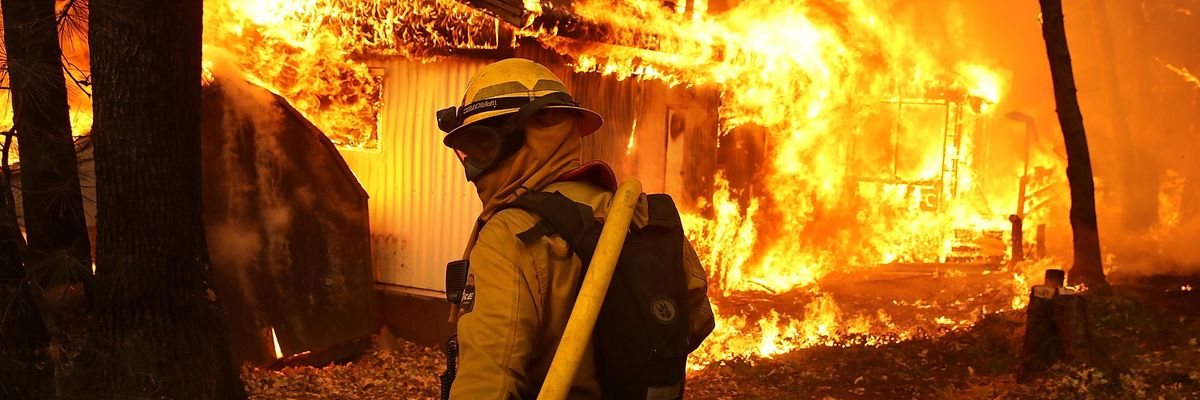
"While on probation, PG&E has set at least 31 wildfires, burned nearly one and one-half million acres, burned 23,956 structures, and killed 113 Californians."
"In these five years, PG&E has gone on a crime spree," Alsup wrote. "While on probation, PG&E has set at least 31 wildfires, burned nearly one and one-half million acres, burned 23,956 structures, and killed 113 Californians."
The company's executives entered probation, which is set to end at midnight Tuesday, after being convicted in 2016 of crimes that caused a natural gas explosion in San Bruno in 2010, killing eight people.
In 2020, PG&E CEO Bill Johnson pled guilty on behalf of the company to 84 counts of involuntary manslaughter related to the 2018 Camp Fire, which destroyed the town of Paradise--leaving just 5% of its buildings undamaged.
An investigation revealed that the company let its power grid deteriorate and scaled back inspections of its equipment, allowing a hook connected to a transmission tower to break and start the Camp Fire.
Last year, PG&E's failure to remove a pine tree that its contractors had marked for clearance years earlier was blamed for the Zogg Fire, which filled four people ranging in age from eight to 79. The company was charged with 11 more felony counts including manslaughter.
As the charges have mounted in the past five years, victims have called on prosecutors and Alsup to extend the company's probation to no avail.
According to former California power regulator Catherine Sandoval, federal prosecutors have declined to extend the period of court supervision because "there appears to be no binding case law on this point."
Closing out the probation, Alsup recommended that PG&E be broken up into two separate utilities.
"Less sprawling utilities would be easier to train and to instill practices and procedures that truly put safety first," the judge wrote.
As it stands, he said, "we remain trapped in a tragic era of PG&E wildfires because for decades it neglected its duties concerning hazard-tree removal and vegetation clearance, even though such duties were required by California's Public Resource Code."
Related Content

The company's outsourcing of tree clearance to independent contractors has been a main driver of its continued sparking of wildfires, said Alsup, including the Kincade and Dixie Fires during the probation.
Earlier this month, Cal Fire concluded that the Dixie Fire--the second-largest wildfire in California history--was caused when a tree fell on PG&E's power line.
"PG&E and its reckless disregard for its own power line infrastructure puts thousands of families at risk of losing everything, even their lives," said Environmental Working Group president Ken Cook.
The Mercury News editorial board on Saturday wrote that Alsup's admission that he cannot stop PG&E's "reign of terror" was "stunning."
"In effect, the judge told Californians that they cannot count on the courts to hold PG&E accountable. But the 16 million customers served by PG&E can't keep waiting," wrote the board, adding that the state must take action to avoid further death and destruction:
As we have said repeatedly, the state and the California Public Utilities Commission must step up and initiate a takeover of the utility. Now. Before PG&E wreaks further havoc on our lives.
The question now is not whether to take over the failed utility, but how: What is the best way to replace the company? Should it be split up? Run by the state? By a nonprofit? By another utility company? It's past time for state officials to figure that out--and to act.
"It's long past time to end this outrage," added the editors.
Alsup noted in his report that the vast majority of survivors are still awaiting compensation from the $97 billion power company while "management pays itself handsome salaries and bonuses, all paid from revenues collected from customers."
In a brief filed with Alsup during PG&E's probation, Sandoval accused the company of "cognitive immaturity" and "lazy thinking" that has led to its persistent crimes against Californians, calling for the company's executives to submit to counseling as an individual might after being released from incarceration or probation.
"PG&E, the corporation, needs the training an individual criminal defendant would have received in prison to break the cycle of criminal thinking that endangers public safety," wrote Sandoval.
A federal judge who has overseen Pacific Gas & Electric's soon-to-expire felony probation is calling for the California utility company to be broken up, warning that PG&E is emerging from its five-year probationary period as "a continuing menace" to the state.
Noting that PG&E pled guilty to dozens of manslaughter charges and caused more than 30 wildfires since entering probation in 2017, U.S. District Judge William Alsup wrote in a report last week that he "must acknowledge failure" in his attempt to rehabilitate the company.
"While on probation, PG&E has set at least 31 wildfires, burned nearly one and one-half million acres, burned 23,956 structures, and killed 113 Californians."
"In these five years, PG&E has gone on a crime spree," Alsup wrote. "While on probation, PG&E has set at least 31 wildfires, burned nearly one and one-half million acres, burned 23,956 structures, and killed 113 Californians."
The company's executives entered probation, which is set to end at midnight Tuesday, after being convicted in 2016 of crimes that caused a natural gas explosion in San Bruno in 2010, killing eight people.
In 2020, PG&E CEO Bill Johnson pled guilty on behalf of the company to 84 counts of involuntary manslaughter related to the 2018 Camp Fire, which destroyed the town of Paradise--leaving just 5% of its buildings undamaged.
An investigation revealed that the company let its power grid deteriorate and scaled back inspections of its equipment, allowing a hook connected to a transmission tower to break and start the Camp Fire.
Last year, PG&E's failure to remove a pine tree that its contractors had marked for clearance years earlier was blamed for the Zogg Fire, which filled four people ranging in age from eight to 79. The company was charged with 11 more felony counts including manslaughter.
As the charges have mounted in the past five years, victims have called on prosecutors and Alsup to extend the company's probation to no avail.
According to former California power regulator Catherine Sandoval, federal prosecutors have declined to extend the period of court supervision because "there appears to be no binding case law on this point."
Closing out the probation, Alsup recommended that PG&E be broken up into two separate utilities.
"Less sprawling utilities would be easier to train and to instill practices and procedures that truly put safety first," the judge wrote.
As it stands, he said, "we remain trapped in a tragic era of PG&E wildfires because for decades it neglected its duties concerning hazard-tree removal and vegetation clearance, even though such duties were required by California's Public Resource Code."
Related Content
The company's outsourcing of tree clearance to independent contractors has been a main driver of its continued sparking of wildfires, said Alsup, including the Kincade and Dixie Fires during the probation.
Earlier this month, Cal Fire concluded that the Dixie Fire--the second-largest wildfire in California history--was caused when a tree fell on PG&E's power line.
"PG&E and its reckless disregard for its own power line infrastructure puts thousands of families at risk of losing everything, even their lives," said Environmental Working Group president Ken Cook.
The Mercury News editorial board on Saturday wrote that Alsup's admission that he cannot stop PG&E's "reign of terror" was "stunning."
"In effect, the judge told Californians that they cannot count on the courts to hold PG&E accountable. But the 16 million customers served by PG&E can't keep waiting," wrote the board, adding that the state must take action to avoid further death and destruction:
As we have said repeatedly, the state and the California Public Utilities Commission must step up and initiate a takeover of the utility. Now. Before PG&E wreaks further havoc on our lives.
The question now is not whether to take over the failed utility, but how: What is the best way to replace the company? Should it be split up? Run by the state? By a nonprofit? By another utility company? It's past time for state officials to figure that out--and to act.
"It's long past time to end this outrage," added the editors.
Alsup noted in his report that the vast majority of survivors are still awaiting compensation from the $97 billion power company while "management pays itself handsome salaries and bonuses, all paid from revenues collected from customers."
In a brief filed with Alsup during PG&E's probation, Sandoval accused the company of "cognitive immaturity" and "lazy thinking" that has led to its persistent crimes against Californians, calling for the company's executives to submit to counseling as an individual might after being released from incarceration or probation.
"PG&E, the corporation, needs the training an individual criminal defendant would have received in prison to break the cycle of criminal thinking that endangers public safety," wrote Sandoval.
A federal judge who has overseen Pacific Gas & Electric's soon-to-expire felony probation is calling for the California utility company to be broken up, warning that PG&E is emerging from its five-year probationary period as "a continuing menace" to the state.
Noting that PG&E pled guilty to dozens of manslaughter charges and caused more than 30 wildfires since entering probation in 2017, U.S. District Judge William Alsup wrote in a report last week that he "must acknowledge failure" in his attempt to rehabilitate the company.
"While on probation, PG&E has set at least 31 wildfires, burned nearly one and one-half million acres, burned 23,956 structures, and killed 113 Californians."
"In these five years, PG&E has gone on a crime spree," Alsup wrote. "While on probation, PG&E has set at least 31 wildfires, burned nearly one and one-half million acres, burned 23,956 structures, and killed 113 Californians."
The company's executives entered probation, which is set to end at midnight Tuesday, after being convicted in 2016 of crimes that caused a natural gas explosion in San Bruno in 2010, killing eight people.
In 2020, PG&E CEO Bill Johnson pled guilty on behalf of the company to 84 counts of involuntary manslaughter related to the 2018 Camp Fire, which destroyed the town of Paradise--leaving just 5% of its buildings undamaged.
An investigation revealed that the company let its power grid deteriorate and scaled back inspections of its equipment, allowing a hook connected to a transmission tower to break and start the Camp Fire.
Last year, PG&E's failure to remove a pine tree that its contractors had marked for clearance years earlier was blamed for the Zogg Fire, which filled four people ranging in age from eight to 79. The company was charged with 11 more felony counts including manslaughter.
As the charges have mounted in the past five years, victims have called on prosecutors and Alsup to extend the company's probation to no avail.
According to former California power regulator Catherine Sandoval, federal prosecutors have declined to extend the period of court supervision because "there appears to be no binding case law on this point."
Closing out the probation, Alsup recommended that PG&E be broken up into two separate utilities.
"Less sprawling utilities would be easier to train and to instill practices and procedures that truly put safety first," the judge wrote.
As it stands, he said, "we remain trapped in a tragic era of PG&E wildfires because for decades it neglected its duties concerning hazard-tree removal and vegetation clearance, even though such duties were required by California's Public Resource Code."
Related Content
The company's outsourcing of tree clearance to independent contractors has been a main driver of its continued sparking of wildfires, said Alsup, including the Kincade and Dixie Fires during the probation.
Earlier this month, Cal Fire concluded that the Dixie Fire--the second-largest wildfire in California history--was caused when a tree fell on PG&E's power line.
"PG&E and its reckless disregard for its own power line infrastructure puts thousands of families at risk of losing everything, even their lives," said Environmental Working Group president Ken Cook.
The Mercury News editorial board on Saturday wrote that Alsup's admission that he cannot stop PG&E's "reign of terror" was "stunning."
"In effect, the judge told Californians that they cannot count on the courts to hold PG&E accountable. But the 16 million customers served by PG&E can't keep waiting," wrote the board, adding that the state must take action to avoid further death and destruction:
As we have said repeatedly, the state and the California Public Utilities Commission must step up and initiate a takeover of the utility. Now. Before PG&E wreaks further havoc on our lives.
The question now is not whether to take over the failed utility, but how: What is the best way to replace the company? Should it be split up? Run by the state? By a nonprofit? By another utility company? It's past time for state officials to figure that out--and to act.
"It's long past time to end this outrage," added the editors.
Alsup noted in his report that the vast majority of survivors are still awaiting compensation from the $97 billion power company while "management pays itself handsome salaries and bonuses, all paid from revenues collected from customers."
In a brief filed with Alsup during PG&E's probation, Sandoval accused the company of "cognitive immaturity" and "lazy thinking" that has led to its persistent crimes against Californians, calling for the company's executives to submit to counseling as an individual might after being released from incarceration or probation.
"PG&E, the corporation, needs the training an individual criminal defendant would have received in prison to break the cycle of criminal thinking that endangers public safety," wrote Sandoval.