

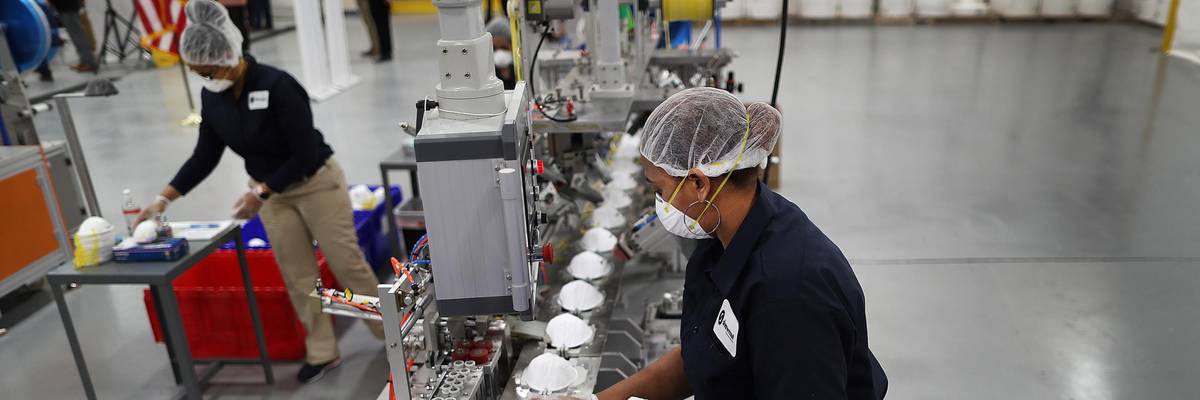
Workers gather N-95 masks as they come off an assembly line in West Bridgewater, Massachusetts on March 10, 2021. (Photo: John Tlumacki/The Boston Globe via Getty Images)
As Omicron Surges, Sanders Says Congress Must Ensure Mass Distribution of N95 Masks
"As we face the rapidly spreading Omicron variant, we should remember that not all face masks are created equal."
Sen. Bernie Sanders on Sunday demanded that Congress act urgently to ensure the widespread distribution of N95 masks to U.S. households as the highly contagious Omicron variant continues to rip through the country, overwhelming already-strained hospitals nationwide.
"As we face the rapidly spreading Omicron variant, we should remember that not all face masks are created equal," Sanders (I-Vt.), chair of the Senate Budget Committee, wrote on Twitter. "Congress must demand the mass production and distribution of N-95 masks, the most effective way to stop the spread of the Covid virus."
"Ideally, a set of masks would be mailed to each U.S. household every month."
Sanders' call comes as experts are vocally emphasizing the importance of high-quality masks in stemming the transmission of Omicron, which was first detected in southern Africa last month and has since become the dominant variant in the U.S. and other countries.
The Centers for Disease Control and Prevention estimates that Omicron now accounts for nearly 75% of new Covid-19 cases in the U.S., which has recorded the most coronavirus deaths in the world. Dr. Anthony Fauci, President Joe Biden's chief medical adviser, warned Sunday that Omicron cases "likely will go much higher" in the coming days.
"Even though we're pleased by the evidence from multiple countries that it looks like there is a lesser degree of severity, we've got to be careful that we don't get complacent about that," Fauci said in an appearance on ABC. "It might still lead to a lot of hospitalization in the United States."
With Omicron infections spiking, public health experts have stressed that medical-grade N95 masks are easily preferable to cloth masks, which--according to University of Oxford professor Trish Greenhalgh--are often mere "fashion accessories" that don't provide adequate protection.
Linsey Marr, a virus researcher at Virginia Tech, similarly argued in an interview with NPR last week that "cloth masks are not going to cut it with Omicron."
"I have a lot of confidence in the vaccines, if you're boosted, in protecting against severe outcomes, and I have a lot of confidence in an N95 and similar types of respirators," Marr said. "And I think that with those two things, you can still go about a lot of your normal activities."
Last week, after initially mocking the idea, the Biden administration announced a plan to distribute 500 million rapid at-home coronavirus tests to U.S. households that request them. But the federal government has yet to pursue a similar strategy with masks despite months of pleas from healthcare workers, experts, and lawmakers.
"Ideally, a set of masks would be mailed to each U.S. household every month--the costs of doing so pale in comparison to the pandemic's toll on lives and the economy," physicians Abraar Karan and Ranu Dhillon and patient advocate Devabhaktuni Srikrishna wrote in a January op-ed for STAT.
"The use of such masks would, in combination with other risk-reduction strategies, create safer workspaces for essential workers," the trio argued.
In July of 2020, Sanders introduced legislation that would have required the federal government to manufacture and deliver high-quality masks to every person in the country. The bill garnered dozens of co-sponsors in the House and Senate--as well as the endorsements of a number of advocacy organizations--but has not advanced in either chamber.
While the U.S. is no longer facing the kinds of severe N95 shortages that hampered the nation's early response to the pandemic, quality face-coverings can still be difficult to find due to the proliferation of counterfeits on Amazon and other e-commerce sites. Nonprofit groups such as Project N95 have attempted to help people navigate the morass of fakes and locate genuinely high-quality masks.
In recent days, public health experts have criticized the CDC for explicitly recommending against N95 masks for the general public in its formal guidance, which argues that such masks "should be prioritized for healthcare personnel."
Dr. Leana Wen, an emergency physician and visiting professor of health policy and management at the George Washington University Milken Institute School of Public Health, told CNN last week that it has "been many months since supply of N95s [has been] an issue."
"If we're going to go as far as to say that masks are required--when we don't come from a mask-wearing culture and people don't like wearing masks--at least recommend that they wear the most effective mask," said Wen.
We are at a crossroads
This country and this world are at a monumental crossroads. In a few short weeks, US voters will have an opportunity to beat back the forces of fascism and confront the billionaires who are rigging the economy, our media system, and our democracy, making it increasingly impossible for ordinary people to get by. We’re not just talking about the election. We’re talking about what must be done once these fascist elements are vanquished from power. We need a bolder set of solutions than what either major party has so far been willing to offer and a working-class movement ready to fight like hell for it. Trump didn't emerge from nowhere. The conditions that fueled MAGA authoritarianism were created by decades of radical neoliberal economic policies and a corrupt political system dominated by corporate interests. They slashed taxes on the super-rich, promising that the benefits would trickle down. They said giveaways to the corporate titans would make life more affordable for the rest of us. It was all bullshit. And when a bitter, betrayed populace searches for someone to blame, right-wing demagogues have little trouble finding scapegoats. People know when they're being lied to, but you won't hear any of this from the corporate media. Only independent journalism—powered and funded by people who believe in building a better world—can deliver truly trustworthy daily news. Our Fall Campaign is underway, and we need your help. To power our newsroom through the rest of the year, we need to raise $125,000 by midnight on October 31. So if you share our vision, please contribute whatever you can to sustain our work. |
Sen. Bernie Sanders on Sunday demanded that Congress act urgently to ensure the widespread distribution of N95 masks to U.S. households as the highly contagious Omicron variant continues to rip through the country, overwhelming already-strained hospitals nationwide.
"As we face the rapidly spreading Omicron variant, we should remember that not all face masks are created equal," Sanders (I-Vt.), chair of the Senate Budget Committee, wrote on Twitter. "Congress must demand the mass production and distribution of N-95 masks, the most effective way to stop the spread of the Covid virus."
"Ideally, a set of masks would be mailed to each U.S. household every month."
Sanders' call comes as experts are vocally emphasizing the importance of high-quality masks in stemming the transmission of Omicron, which was first detected in southern Africa last month and has since become the dominant variant in the U.S. and other countries.
The Centers for Disease Control and Prevention estimates that Omicron now accounts for nearly 75% of new Covid-19 cases in the U.S., which has recorded the most coronavirus deaths in the world. Dr. Anthony Fauci, President Joe Biden's chief medical adviser, warned Sunday that Omicron cases "likely will go much higher" in the coming days.
"Even though we're pleased by the evidence from multiple countries that it looks like there is a lesser degree of severity, we've got to be careful that we don't get complacent about that," Fauci said in an appearance on ABC. "It might still lead to a lot of hospitalization in the United States."
With Omicron infections spiking, public health experts have stressed that medical-grade N95 masks are easily preferable to cloth masks, which--according to University of Oxford professor Trish Greenhalgh--are often mere "fashion accessories" that don't provide adequate protection.
Linsey Marr, a virus researcher at Virginia Tech, similarly argued in an interview with NPR last week that "cloth masks are not going to cut it with Omicron."
"I have a lot of confidence in the vaccines, if you're boosted, in protecting against severe outcomes, and I have a lot of confidence in an N95 and similar types of respirators," Marr said. "And I think that with those two things, you can still go about a lot of your normal activities."
Last week, after initially mocking the idea, the Biden administration announced a plan to distribute 500 million rapid at-home coronavirus tests to U.S. households that request them. But the federal government has yet to pursue a similar strategy with masks despite months of pleas from healthcare workers, experts, and lawmakers.
"Ideally, a set of masks would be mailed to each U.S. household every month--the costs of doing so pale in comparison to the pandemic's toll on lives and the economy," physicians Abraar Karan and Ranu Dhillon and patient advocate Devabhaktuni Srikrishna wrote in a January op-ed for STAT.
"The use of such masks would, in combination with other risk-reduction strategies, create safer workspaces for essential workers," the trio argued.
In July of 2020, Sanders introduced legislation that would have required the federal government to manufacture and deliver high-quality masks to every person in the country. The bill garnered dozens of co-sponsors in the House and Senate--as well as the endorsements of a number of advocacy organizations--but has not advanced in either chamber.
While the U.S. is no longer facing the kinds of severe N95 shortages that hampered the nation's early response to the pandemic, quality face-coverings can still be difficult to find due to the proliferation of counterfeits on Amazon and other e-commerce sites. Nonprofit groups such as Project N95 have attempted to help people navigate the morass of fakes and locate genuinely high-quality masks.
In recent days, public health experts have criticized the CDC for explicitly recommending against N95 masks for the general public in its formal guidance, which argues that such masks "should be prioritized for healthcare personnel."
Dr. Leana Wen, an emergency physician and visiting professor of health policy and management at the George Washington University Milken Institute School of Public Health, told CNN last week that it has "been many months since supply of N95s [has been] an issue."
"If we're going to go as far as to say that masks are required--when we don't come from a mask-wearing culture and people don't like wearing masks--at least recommend that they wear the most effective mask," said Wen.
Sen. Bernie Sanders on Sunday demanded that Congress act urgently to ensure the widespread distribution of N95 masks to U.S. households as the highly contagious Omicron variant continues to rip through the country, overwhelming already-strained hospitals nationwide.
"As we face the rapidly spreading Omicron variant, we should remember that not all face masks are created equal," Sanders (I-Vt.), chair of the Senate Budget Committee, wrote on Twitter. "Congress must demand the mass production and distribution of N-95 masks, the most effective way to stop the spread of the Covid virus."
"Ideally, a set of masks would be mailed to each U.S. household every month."
Sanders' call comes as experts are vocally emphasizing the importance of high-quality masks in stemming the transmission of Omicron, which was first detected in southern Africa last month and has since become the dominant variant in the U.S. and other countries.
The Centers for Disease Control and Prevention estimates that Omicron now accounts for nearly 75% of new Covid-19 cases in the U.S., which has recorded the most coronavirus deaths in the world. Dr. Anthony Fauci, President Joe Biden's chief medical adviser, warned Sunday that Omicron cases "likely will go much higher" in the coming days.
"Even though we're pleased by the evidence from multiple countries that it looks like there is a lesser degree of severity, we've got to be careful that we don't get complacent about that," Fauci said in an appearance on ABC. "It might still lead to a lot of hospitalization in the United States."
With Omicron infections spiking, public health experts have stressed that medical-grade N95 masks are easily preferable to cloth masks, which--according to University of Oxford professor Trish Greenhalgh--are often mere "fashion accessories" that don't provide adequate protection.
Linsey Marr, a virus researcher at Virginia Tech, similarly argued in an interview with NPR last week that "cloth masks are not going to cut it with Omicron."
"I have a lot of confidence in the vaccines, if you're boosted, in protecting against severe outcomes, and I have a lot of confidence in an N95 and similar types of respirators," Marr said. "And I think that with those two things, you can still go about a lot of your normal activities."
Last week, after initially mocking the idea, the Biden administration announced a plan to distribute 500 million rapid at-home coronavirus tests to U.S. households that request them. But the federal government has yet to pursue a similar strategy with masks despite months of pleas from healthcare workers, experts, and lawmakers.
"Ideally, a set of masks would be mailed to each U.S. household every month--the costs of doing so pale in comparison to the pandemic's toll on lives and the economy," physicians Abraar Karan and Ranu Dhillon and patient advocate Devabhaktuni Srikrishna wrote in a January op-ed for STAT.
"The use of such masks would, in combination with other risk-reduction strategies, create safer workspaces for essential workers," the trio argued.
In July of 2020, Sanders introduced legislation that would have required the federal government to manufacture and deliver high-quality masks to every person in the country. The bill garnered dozens of co-sponsors in the House and Senate--as well as the endorsements of a number of advocacy organizations--but has not advanced in either chamber.
While the U.S. is no longer facing the kinds of severe N95 shortages that hampered the nation's early response to the pandemic, quality face-coverings can still be difficult to find due to the proliferation of counterfeits on Amazon and other e-commerce sites. Nonprofit groups such as Project N95 have attempted to help people navigate the morass of fakes and locate genuinely high-quality masks.
In recent days, public health experts have criticized the CDC for explicitly recommending against N95 masks for the general public in its formal guidance, which argues that such masks "should be prioritized for healthcare personnel."
Dr. Leana Wen, an emergency physician and visiting professor of health policy and management at the George Washington University Milken Institute School of Public Health, told CNN last week that it has "been many months since supply of N95s [has been] an issue."
"If we're going to go as far as to say that masks are required--when we don't come from a mask-wearing culture and people don't like wearing masks--at least recommend that they wear the most effective mask," said Wen.