SUBSCRIBE TO OUR FREE NEWSLETTER
Daily news & progressive opinion—funded by the people, not the corporations—delivered straight to your inbox.
5
#000000
#FFFFFF
To donate by check, phone, or other method, see our More Ways to Give page.
Daily news & progressive opinion—funded by the people, not the corporations—delivered straight to your inbox.
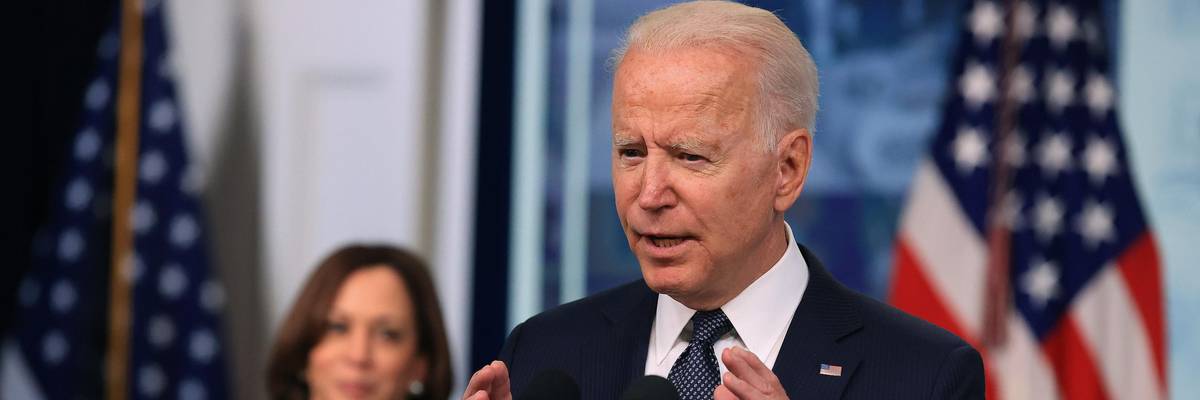
President Joe Biden delivers remarks in the South Court Auditorium in the Eisenhower Executive Office Building on July 15, 2021 in Washington, D.C.
After the White House on Thursday rejected a proposal to impose work requirements on Medicaid recipients in Georgia--the last state with a federal waiver permitting such restrictions--President Joe Biden received praise for "quietly erasing" one of his predecessor's "cruelest legacies."
"The announcement from the Centers for Medicare & Medicaid Services, delivered in a 79-page letter to Georgia's health agency, also reversed a federal waiver allowing the state to charge premiums for the health insurance program for the poor," according to the New York Times.
The Times reported:
Georgia had not yet imposed the proposed work requirements--which limited Medicaid eligibility to those who work at least 80 hours a month--but it could have started the restrictions as early as next week, according to correspondence between the state and federal health agencies.
The premiums that Georgia proposed had also not been enacted. The Medicaid agency said that it was revoking the authority to charge the premiums because those fees "can present a barrier to coverage" and worsen healthcare inequality.
Biden's move dealt "a critical blow to the already reeling effort to attach work requirements to Medicaid," the newspaper noted. "The movement by more than a dozen states managed in practice to enact work requirements in only a few--and only for a short time--as it faced court setbacks, a pandemic, and a new administration that has steadily dismantled such initiatives."
Washington Post columnist Greg Sargent called Biden's elimination of Georgia's Medicaid work requirements--the last remaining proposal of its kind in the U.S.--"a huge deal."
In 2018, Seema Verma, then-director of the Centers for Medicare & Medicaid Services under former President Donald Trump, issued guidance allowing states to apply for a waiver to significantly alter eligibility requirements for Medicaid, a Great Society-era program on which 76 million low-income adults, people with disabilities, and children rely for health insurance.
Nearly 20 Republican-led states quickly jumped at the opportunity to take healthcare away from poor and vulnerable Americans, and the Trump administration ultimately approved policies to deny Medicaid coverage to people who didn't comply with strict work requirements in 13 states.
The Biden White House in February invalidated the previous administration's guidance allowing states to apply for Medicaid eligibility restriction waivers and notified states that had already been given permission to impose work requirements that the policies would soon be reversed due to the detrimental impact of coverage loss on Medicaid recipients, particularly during the Covid-19 pandemic, as Common Dreams reported at the time.
After the Biden administration in March told Medicaid officials in New Hampshire and Arkansas--which was the first and only state to fully implement Medicaid work requirements, taking healthcare away from at least 18,000 people over a period of several months in 2018--that approval for such policies had been revoked, progressives urged the White House to forge ahead with its plan to withdraw all remaining Medicaid work requirements nationwide, which it has done.
"This is a genuine achievement, in both symbolic and practical terms," Sargent and Paul Waldman wrote Friday of Biden's successful neutering of Trump's signature attack on healthcare.
Biden's rejection of Georgia's proposal "was effectively the last nail in the coffin of Trump's zombie attempt to make Medicaid more cumbersome and bureaucratic, in hopes of knocking as many people off health coverage as possible," argued the pair.
According to Sargent and Waldman:
Trump's effort to impose Medicaid work requirements was part of a much larger campaign to undermine and roll back our country's fitful advance toward universal healthcare. This constituted an even broader legacy of cruelty, and arguably outright betrayal.
That's because Trump campaigned in 2016 as a corrective to Paul Ryan-style Republicans who had treated destroying the social safety net as a quasi-religious calling. Trump vowed that "everybody's got to be covered," and insisted no one would die on the street, uninsured.
Once in office, however, "Trump embraced GOP anti-safety-net zealotry by going all in on the Republican effort to destroy the Affordable Care Act," they continued. "That culminated in the 2017 repeal attempt, which fortunately failed. Stymied in that effort, which would have taken coverage away from millions on the ACA's Medicaid expansion, Trump sought to weaken the safety net via other administrative means, such as these Medicaid work requirements."
"And so, in erasing those requirements," Sargent and Waldman added, "Biden is also erasing a larger hangover of Trumpian cruelty."
Sargent and Waldman noted that "the same ACA that Trump tried to destroy is expanding" because the American Rescue Plan signed by Biden in March enhanced ACA subsidies and widened eligibility for them. However, they pointed out, "the ACA expansion in the rescue package expires at the end of next year."
Although the vast majority of congressional Democrats want to extend the ACA expansion by passing the Build Back Better Act, right-wing Democratic Sen. Joe Manchin's (W. Va.) opposition to the legislation puts beefed-up healthcare subsidies at risk, hurting millions of low-income Americans and potentially jeopardizing Democrats' electoral performance.
"If Democrats aren't able to extend it, millions of people will get notice of huge premium increases right before the midterm election," Larry Levitt, executive vice president for health policy at the Kaiser Family Foundation, told Sargent and Waldman.
Dear Common Dreams reader, It’s been nearly 30 years since I co-founded Common Dreams with my late wife, Lina Newhouser. We had the radical notion that journalism should serve the public good, not corporate profits. It was clear to us from the outset what it would take to build such a project. No paid advertisements. No corporate sponsors. No millionaire publisher telling us what to think or do. Many people said we wouldn't last a year, but we proved those doubters wrong. Together with a tremendous team of journalists and dedicated staff, we built an independent media outlet free from the constraints of profits and corporate control. Our mission has always been simple: To inform. To inspire. To ignite change for the common good. Building Common Dreams was not easy. Our survival was never guaranteed. When you take on the most powerful forces—Wall Street greed, fossil fuel industry destruction, Big Tech lobbyists, and uber-rich oligarchs who have spent billions upon billions rigging the economy and democracy in their favor—the only bulwark you have is supporters who believe in your work. But here’s the urgent message from me today. It's never been this bad out there. And it's never been this hard to keep us going. At the very moment Common Dreams is most needed, the threats we face are intensifying. We need your support now more than ever. We don't accept corporate advertising and never will. We don't have a paywall because we don't think people should be blocked from critical news based on their ability to pay. Everything we do is funded by the donations of readers like you. When everyone does the little they can afford, we are strong. But if that support retreats or dries up, so do we. Will you donate now to make sure Common Dreams not only survives but thrives? —Craig Brown, Co-founder |
After the White House on Thursday rejected a proposal to impose work requirements on Medicaid recipients in Georgia--the last state with a federal waiver permitting such restrictions--President Joe Biden received praise for "quietly erasing" one of his predecessor's "cruelest legacies."
"The announcement from the Centers for Medicare & Medicaid Services, delivered in a 79-page letter to Georgia's health agency, also reversed a federal waiver allowing the state to charge premiums for the health insurance program for the poor," according to the New York Times.
The Times reported:
Georgia had not yet imposed the proposed work requirements--which limited Medicaid eligibility to those who work at least 80 hours a month--but it could have started the restrictions as early as next week, according to correspondence between the state and federal health agencies.
The premiums that Georgia proposed had also not been enacted. The Medicaid agency said that it was revoking the authority to charge the premiums because those fees "can present a barrier to coverage" and worsen healthcare inequality.
Biden's move dealt "a critical blow to the already reeling effort to attach work requirements to Medicaid," the newspaper noted. "The movement by more than a dozen states managed in practice to enact work requirements in only a few--and only for a short time--as it faced court setbacks, a pandemic, and a new administration that has steadily dismantled such initiatives."
Washington Post columnist Greg Sargent called Biden's elimination of Georgia's Medicaid work requirements--the last remaining proposal of its kind in the U.S.--"a huge deal."
In 2018, Seema Verma, then-director of the Centers for Medicare & Medicaid Services under former President Donald Trump, issued guidance allowing states to apply for a waiver to significantly alter eligibility requirements for Medicaid, a Great Society-era program on which 76 million low-income adults, people with disabilities, and children rely for health insurance.
Nearly 20 Republican-led states quickly jumped at the opportunity to take healthcare away from poor and vulnerable Americans, and the Trump administration ultimately approved policies to deny Medicaid coverage to people who didn't comply with strict work requirements in 13 states.
The Biden White House in February invalidated the previous administration's guidance allowing states to apply for Medicaid eligibility restriction waivers and notified states that had already been given permission to impose work requirements that the policies would soon be reversed due to the detrimental impact of coverage loss on Medicaid recipients, particularly during the Covid-19 pandemic, as Common Dreams reported at the time.
After the Biden administration in March told Medicaid officials in New Hampshire and Arkansas--which was the first and only state to fully implement Medicaid work requirements, taking healthcare away from at least 18,000 people over a period of several months in 2018--that approval for such policies had been revoked, progressives urged the White House to forge ahead with its plan to withdraw all remaining Medicaid work requirements nationwide, which it has done.
"This is a genuine achievement, in both symbolic and practical terms," Sargent and Paul Waldman wrote Friday of Biden's successful neutering of Trump's signature attack on healthcare.
Biden's rejection of Georgia's proposal "was effectively the last nail in the coffin of Trump's zombie attempt to make Medicaid more cumbersome and bureaucratic, in hopes of knocking as many people off health coverage as possible," argued the pair.
According to Sargent and Waldman:
Trump's effort to impose Medicaid work requirements was part of a much larger campaign to undermine and roll back our country's fitful advance toward universal healthcare. This constituted an even broader legacy of cruelty, and arguably outright betrayal.
That's because Trump campaigned in 2016 as a corrective to Paul Ryan-style Republicans who had treated destroying the social safety net as a quasi-religious calling. Trump vowed that "everybody's got to be covered," and insisted no one would die on the street, uninsured.
Once in office, however, "Trump embraced GOP anti-safety-net zealotry by going all in on the Republican effort to destroy the Affordable Care Act," they continued. "That culminated in the 2017 repeal attempt, which fortunately failed. Stymied in that effort, which would have taken coverage away from millions on the ACA's Medicaid expansion, Trump sought to weaken the safety net via other administrative means, such as these Medicaid work requirements."
"And so, in erasing those requirements," Sargent and Waldman added, "Biden is also erasing a larger hangover of Trumpian cruelty."
Sargent and Waldman noted that "the same ACA that Trump tried to destroy is expanding" because the American Rescue Plan signed by Biden in March enhanced ACA subsidies and widened eligibility for them. However, they pointed out, "the ACA expansion in the rescue package expires at the end of next year."
Although the vast majority of congressional Democrats want to extend the ACA expansion by passing the Build Back Better Act, right-wing Democratic Sen. Joe Manchin's (W. Va.) opposition to the legislation puts beefed-up healthcare subsidies at risk, hurting millions of low-income Americans and potentially jeopardizing Democrats' electoral performance.
"If Democrats aren't able to extend it, millions of people will get notice of huge premium increases right before the midterm election," Larry Levitt, executive vice president for health policy at the Kaiser Family Foundation, told Sargent and Waldman.
After the White House on Thursday rejected a proposal to impose work requirements on Medicaid recipients in Georgia--the last state with a federal waiver permitting such restrictions--President Joe Biden received praise for "quietly erasing" one of his predecessor's "cruelest legacies."
"The announcement from the Centers for Medicare & Medicaid Services, delivered in a 79-page letter to Georgia's health agency, also reversed a federal waiver allowing the state to charge premiums for the health insurance program for the poor," according to the New York Times.
The Times reported:
Georgia had not yet imposed the proposed work requirements--which limited Medicaid eligibility to those who work at least 80 hours a month--but it could have started the restrictions as early as next week, according to correspondence between the state and federal health agencies.
The premiums that Georgia proposed had also not been enacted. The Medicaid agency said that it was revoking the authority to charge the premiums because those fees "can present a barrier to coverage" and worsen healthcare inequality.
Biden's move dealt "a critical blow to the already reeling effort to attach work requirements to Medicaid," the newspaper noted. "The movement by more than a dozen states managed in practice to enact work requirements in only a few--and only for a short time--as it faced court setbacks, a pandemic, and a new administration that has steadily dismantled such initiatives."
Washington Post columnist Greg Sargent called Biden's elimination of Georgia's Medicaid work requirements--the last remaining proposal of its kind in the U.S.--"a huge deal."
In 2018, Seema Verma, then-director of the Centers for Medicare & Medicaid Services under former President Donald Trump, issued guidance allowing states to apply for a waiver to significantly alter eligibility requirements for Medicaid, a Great Society-era program on which 76 million low-income adults, people with disabilities, and children rely for health insurance.
Nearly 20 Republican-led states quickly jumped at the opportunity to take healthcare away from poor and vulnerable Americans, and the Trump administration ultimately approved policies to deny Medicaid coverage to people who didn't comply with strict work requirements in 13 states.
The Biden White House in February invalidated the previous administration's guidance allowing states to apply for Medicaid eligibility restriction waivers and notified states that had already been given permission to impose work requirements that the policies would soon be reversed due to the detrimental impact of coverage loss on Medicaid recipients, particularly during the Covid-19 pandemic, as Common Dreams reported at the time.
After the Biden administration in March told Medicaid officials in New Hampshire and Arkansas--which was the first and only state to fully implement Medicaid work requirements, taking healthcare away from at least 18,000 people over a period of several months in 2018--that approval for such policies had been revoked, progressives urged the White House to forge ahead with its plan to withdraw all remaining Medicaid work requirements nationwide, which it has done.
"This is a genuine achievement, in both symbolic and practical terms," Sargent and Paul Waldman wrote Friday of Biden's successful neutering of Trump's signature attack on healthcare.
Biden's rejection of Georgia's proposal "was effectively the last nail in the coffin of Trump's zombie attempt to make Medicaid more cumbersome and bureaucratic, in hopes of knocking as many people off health coverage as possible," argued the pair.
According to Sargent and Waldman:
Trump's effort to impose Medicaid work requirements was part of a much larger campaign to undermine and roll back our country's fitful advance toward universal healthcare. This constituted an even broader legacy of cruelty, and arguably outright betrayal.
That's because Trump campaigned in 2016 as a corrective to Paul Ryan-style Republicans who had treated destroying the social safety net as a quasi-religious calling. Trump vowed that "everybody's got to be covered," and insisted no one would die on the street, uninsured.
Once in office, however, "Trump embraced GOP anti-safety-net zealotry by going all in on the Republican effort to destroy the Affordable Care Act," they continued. "That culminated in the 2017 repeal attempt, which fortunately failed. Stymied in that effort, which would have taken coverage away from millions on the ACA's Medicaid expansion, Trump sought to weaken the safety net via other administrative means, such as these Medicaid work requirements."
"And so, in erasing those requirements," Sargent and Waldman added, "Biden is also erasing a larger hangover of Trumpian cruelty."
Sargent and Waldman noted that "the same ACA that Trump tried to destroy is expanding" because the American Rescue Plan signed by Biden in March enhanced ACA subsidies and widened eligibility for them. However, they pointed out, "the ACA expansion in the rescue package expires at the end of next year."
Although the vast majority of congressional Democrats want to extend the ACA expansion by passing the Build Back Better Act, right-wing Democratic Sen. Joe Manchin's (W. Va.) opposition to the legislation puts beefed-up healthcare subsidies at risk, hurting millions of low-income Americans and potentially jeopardizing Democrats' electoral performance.
"If Democrats aren't able to extend it, millions of people will get notice of huge premium increases right before the midterm election," Larry Levitt, executive vice president for health policy at the Kaiser Family Foundation, told Sargent and Waldman.