SUBSCRIBE TO OUR FREE NEWSLETTER
Daily news & progressive opinion—funded by the people, not the corporations—delivered straight to your inbox.
5
#000000
#FFFFFF
To donate by check, phone, or other method, see our More Ways to Give page.
Daily news & progressive opinion—funded by the people, not the corporations—delivered straight to your inbox.
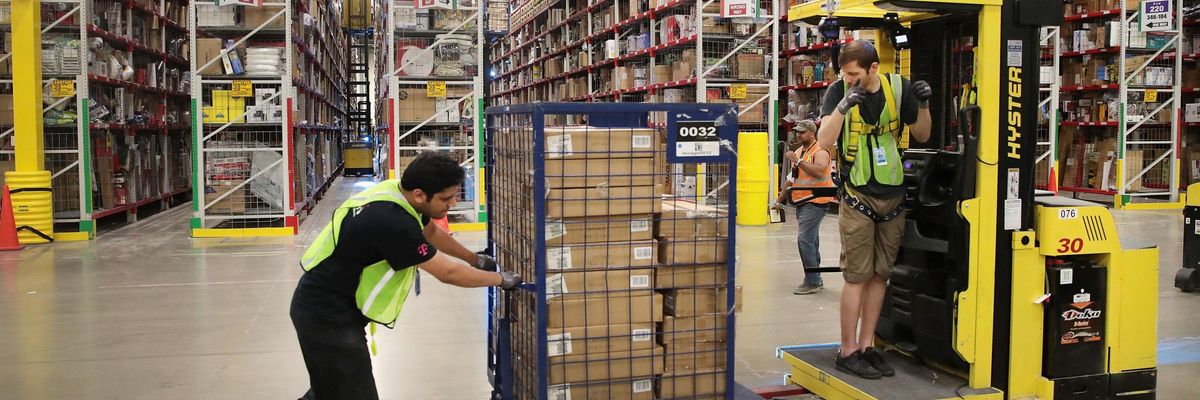
Workers pack and ship customer orders at the 750,000-square-foot Amazon fulfillment center on August 1, 2017 in Romeoville, Illinois. (Photo: Scott Olson/Getty Images)
"I'm looking to you to stand up to corporations like Amazon and protect us."
"We are living in a country where machines are getting better treatment than people."
That was Courtenay Brown's message to U.S. senators during a subcommittee hearing on Tuesday. The Newark, New Jersey resident and Navy veteran has worked at an Amazon fulfillment center for more than three years.
Brown--also a leader at United for Respect, a movement of Amazon and Walmart workers fighting for better labor conditions--said in her "powerful" and "compelling" testimony that she wanted to "raise the alarm about Amazon's business model, its threat to working people, and its threat to our economy."
As a process guide at an Amazon facility in Avenel, New Jersey, Brown sorts groceries for delivery, work she described as "physically and mentally exhausting," before noting that "on top of that, we are monitored every single second as we scan items."
According to Brown:
So pausing even to wipe the sweat off our forehead can lead to a write-up as managers monitor our locations and times we spend doing work. If we fall behind in any way during our 12-hour shift, we risk being disciplined. We are pushed to our limit to the point where we can't even take regular bathroom breaks. Often we literally have to run to and from the bathroom in under two minutes so we don't get in trouble. The constant pressure and surveillance is one reason why Amazon has twice the level of injuries and turnover compared to similar employers.
Taking aim at Amazon's founder and former CEO--who competes with Telsa's Elon Musk for the title of the world's richest person--Brown detailed her difficulties with the e-commerce giant's bereavement policy in the wake of her mother's death, explaining that she had to take "a month of unpaid time off, while Jeff Bezos made $75 billion last year thanks to me and my coworkers."
"Amazon's multibillion-dollar wealth is made possible by offering one- and two-day delivery," she said, "and the corporation has achieved this speed and scale through sheer brutality--watching, timing, and punishing associates like me and my coworkers for not working fast enough and not allowing associates to take time off to adequately recover, rest, and prevent burnout."
"We are living in a country where machines are getting better treatment than people," she asserted. "The machines at my facility undergo routine maintenance checks to ensure they don't burn out. Meanwhile, research has shown that workplace injury rates are higher at Amazon facilities with more robotic and automated technology."
"Amazon's high-tech sweatshop caused me to develop plantar fasciitis--a debilitating pain in my heel--because I'm having to stand up for long periods of time at work with little to no rest. The burning sensation around my heels is so painful that I take what little time I have to run to the bathroom just to cry," Brown continued, noting that one time she begged doctors to keep her at the emergency room longer because she had to return to work.
The Amazon worker accused the company of setting up facilities "in Black and Brown communities desperate for work" and pointed out that Bezos recently told shareholders he plans to use more automated control of warehouse workers--or what she called "dehumanizing tactics designed to break our bodies."
Warning members of the Senate Finance Committee's panel on fiscal responsibility and economic growth that "Amazon has built an empire on our backs, and now other employers, like Walmart, are racing to copy" its model, Brown implored them to take action.
"I'm asking you to help me put an end to inhumane, exploitative processes that leave America's workers injured, exhausted, and mentally battered each day," she said.
Brown's testimony came during a wide-ranging hearing entitled "Promoting Competition, Growth, and Privacy Protection in the Technology Sector." The subcommittee's chair, Sen. Elizabeth Warren (D-Mass.), asked Brown how the Covid-19 pandemic has impacted logistical operations.
Brown also shared her experience working under Amazon's surveillance with The Washington Post last week.
"They basically can see everything you do, and it's all to their benefit," the 31-year-old said. "They don't value you as a human being. It's demeaning."
In an emailed statement to the Post, Amazon spokesperson Kelly Nantel framed the employee monitoring as beneficial to not only the company but also its workers.
"Like any business, we use technology to maintain a level of security within our operations to help keep our employees, buildings, and inventory safe--it would be irresponsible if we didn't do so," Nantel said. "It's also important to note that while the technology helps keep our employees safe, it also allows them to be more efficient in their jobs."
The newspaper noted that some workers don't agree with Nantel's framing--such as Chris Smalls, a former employee at an Amazon facility in Staten Island who is leading a unionization effort there.
"It's one of the big reasons people want to unionize," Smalls said of the monitoring policies. "Who wants to be surveilled all day? It's not prison. It's work."
Staten Island isn't the only place where Amazon employees are fighting for a union. A regional director for the National Labor Relations Board determined last week that following allegations of unlawful interference by the company in an unsuccessful April union election, workers at a warehouse in Bessemer, Alabama will get to vote again.
The Alabama decision came on Cyber Monday, the biggest online shopping day of the year, and followed a Black Friday that saw Amazon workers walk out of facilities around the world to demand better working conditions.
Amazon's treatment of its workers and opposition to unionization efforts have fueled demands for the Senate to pass the House-approved Protecting the Right to Organize (PRO) Act.
Dear Common Dreams reader, It’s been nearly 30 years since I co-founded Common Dreams with my late wife, Lina Newhouser. We had the radical notion that journalism should serve the public good, not corporate profits. It was clear to us from the outset what it would take to build such a project. No paid advertisements. No corporate sponsors. No millionaire publisher telling us what to think or do. Many people said we wouldn't last a year, but we proved those doubters wrong. Together with a tremendous team of journalists and dedicated staff, we built an independent media outlet free from the constraints of profits and corporate control. Our mission has always been simple: To inform. To inspire. To ignite change for the common good. Building Common Dreams was not easy. Our survival was never guaranteed. When you take on the most powerful forces—Wall Street greed, fossil fuel industry destruction, Big Tech lobbyists, and uber-rich oligarchs who have spent billions upon billions rigging the economy and democracy in their favor—the only bulwark you have is supporters who believe in your work. But here’s the urgent message from me today. It's never been this bad out there. And it's never been this hard to keep us going. At the very moment Common Dreams is most needed, the threats we face are intensifying. We need your support now more than ever. We don't accept corporate advertising and never will. We don't have a paywall because we don't think people should be blocked from critical news based on their ability to pay. Everything we do is funded by the donations of readers like you. When everyone does the little they can afford, we are strong. But if that support retreats or dries up, so do we. Will you donate now to make sure Common Dreams not only survives but thrives? —Craig Brown, Co-founder |
"I'm looking to you to stand up to corporations like Amazon and protect us."
"We are living in a country where machines are getting better treatment than people."
That was Courtenay Brown's message to U.S. senators during a subcommittee hearing on Tuesday. The Newark, New Jersey resident and Navy veteran has worked at an Amazon fulfillment center for more than three years.
Brown--also a leader at United for Respect, a movement of Amazon and Walmart workers fighting for better labor conditions--said in her "powerful" and "compelling" testimony that she wanted to "raise the alarm about Amazon's business model, its threat to working people, and its threat to our economy."
As a process guide at an Amazon facility in Avenel, New Jersey, Brown sorts groceries for delivery, work she described as "physically and mentally exhausting," before noting that "on top of that, we are monitored every single second as we scan items."
According to Brown:
So pausing even to wipe the sweat off our forehead can lead to a write-up as managers monitor our locations and times we spend doing work. If we fall behind in any way during our 12-hour shift, we risk being disciplined. We are pushed to our limit to the point where we can't even take regular bathroom breaks. Often we literally have to run to and from the bathroom in under two minutes so we don't get in trouble. The constant pressure and surveillance is one reason why Amazon has twice the level of injuries and turnover compared to similar employers.
Taking aim at Amazon's founder and former CEO--who competes with Telsa's Elon Musk for the title of the world's richest person--Brown detailed her difficulties with the e-commerce giant's bereavement policy in the wake of her mother's death, explaining that she had to take "a month of unpaid time off, while Jeff Bezos made $75 billion last year thanks to me and my coworkers."
"Amazon's multibillion-dollar wealth is made possible by offering one- and two-day delivery," she said, "and the corporation has achieved this speed and scale through sheer brutality--watching, timing, and punishing associates like me and my coworkers for not working fast enough and not allowing associates to take time off to adequately recover, rest, and prevent burnout."
"We are living in a country where machines are getting better treatment than people," she asserted. "The machines at my facility undergo routine maintenance checks to ensure they don't burn out. Meanwhile, research has shown that workplace injury rates are higher at Amazon facilities with more robotic and automated technology."
"Amazon's high-tech sweatshop caused me to develop plantar fasciitis--a debilitating pain in my heel--because I'm having to stand up for long periods of time at work with little to no rest. The burning sensation around my heels is so painful that I take what little time I have to run to the bathroom just to cry," Brown continued, noting that one time she begged doctors to keep her at the emergency room longer because she had to return to work.
The Amazon worker accused the company of setting up facilities "in Black and Brown communities desperate for work" and pointed out that Bezos recently told shareholders he plans to use more automated control of warehouse workers--or what she called "dehumanizing tactics designed to break our bodies."
Warning members of the Senate Finance Committee's panel on fiscal responsibility and economic growth that "Amazon has built an empire on our backs, and now other employers, like Walmart, are racing to copy" its model, Brown implored them to take action.
"I'm asking you to help me put an end to inhumane, exploitative processes that leave America's workers injured, exhausted, and mentally battered each day," she said.
Brown's testimony came during a wide-ranging hearing entitled "Promoting Competition, Growth, and Privacy Protection in the Technology Sector." The subcommittee's chair, Sen. Elizabeth Warren (D-Mass.), asked Brown how the Covid-19 pandemic has impacted logistical operations.
Brown also shared her experience working under Amazon's surveillance with The Washington Post last week.
"They basically can see everything you do, and it's all to their benefit," the 31-year-old said. "They don't value you as a human being. It's demeaning."
In an emailed statement to the Post, Amazon spokesperson Kelly Nantel framed the employee monitoring as beneficial to not only the company but also its workers.
"Like any business, we use technology to maintain a level of security within our operations to help keep our employees, buildings, and inventory safe--it would be irresponsible if we didn't do so," Nantel said. "It's also important to note that while the technology helps keep our employees safe, it also allows them to be more efficient in their jobs."
The newspaper noted that some workers don't agree with Nantel's framing--such as Chris Smalls, a former employee at an Amazon facility in Staten Island who is leading a unionization effort there.
"It's one of the big reasons people want to unionize," Smalls said of the monitoring policies. "Who wants to be surveilled all day? It's not prison. It's work."
Staten Island isn't the only place where Amazon employees are fighting for a union. A regional director for the National Labor Relations Board determined last week that following allegations of unlawful interference by the company in an unsuccessful April union election, workers at a warehouse in Bessemer, Alabama will get to vote again.
The Alabama decision came on Cyber Monday, the biggest online shopping day of the year, and followed a Black Friday that saw Amazon workers walk out of facilities around the world to demand better working conditions.
Amazon's treatment of its workers and opposition to unionization efforts have fueled demands for the Senate to pass the House-approved Protecting the Right to Organize (PRO) Act.
"I'm looking to you to stand up to corporations like Amazon and protect us."
"We are living in a country where machines are getting better treatment than people."
That was Courtenay Brown's message to U.S. senators during a subcommittee hearing on Tuesday. The Newark, New Jersey resident and Navy veteran has worked at an Amazon fulfillment center for more than three years.
Brown--also a leader at United for Respect, a movement of Amazon and Walmart workers fighting for better labor conditions--said in her "powerful" and "compelling" testimony that she wanted to "raise the alarm about Amazon's business model, its threat to working people, and its threat to our economy."
As a process guide at an Amazon facility in Avenel, New Jersey, Brown sorts groceries for delivery, work she described as "physically and mentally exhausting," before noting that "on top of that, we are monitored every single second as we scan items."
According to Brown:
So pausing even to wipe the sweat off our forehead can lead to a write-up as managers monitor our locations and times we spend doing work. If we fall behind in any way during our 12-hour shift, we risk being disciplined. We are pushed to our limit to the point where we can't even take regular bathroom breaks. Often we literally have to run to and from the bathroom in under two minutes so we don't get in trouble. The constant pressure and surveillance is one reason why Amazon has twice the level of injuries and turnover compared to similar employers.
Taking aim at Amazon's founder and former CEO--who competes with Telsa's Elon Musk for the title of the world's richest person--Brown detailed her difficulties with the e-commerce giant's bereavement policy in the wake of her mother's death, explaining that she had to take "a month of unpaid time off, while Jeff Bezos made $75 billion last year thanks to me and my coworkers."
"Amazon's multibillion-dollar wealth is made possible by offering one- and two-day delivery," she said, "and the corporation has achieved this speed and scale through sheer brutality--watching, timing, and punishing associates like me and my coworkers for not working fast enough and not allowing associates to take time off to adequately recover, rest, and prevent burnout."
"We are living in a country where machines are getting better treatment than people," she asserted. "The machines at my facility undergo routine maintenance checks to ensure they don't burn out. Meanwhile, research has shown that workplace injury rates are higher at Amazon facilities with more robotic and automated technology."
"Amazon's high-tech sweatshop caused me to develop plantar fasciitis--a debilitating pain in my heel--because I'm having to stand up for long periods of time at work with little to no rest. The burning sensation around my heels is so painful that I take what little time I have to run to the bathroom just to cry," Brown continued, noting that one time she begged doctors to keep her at the emergency room longer because she had to return to work.
The Amazon worker accused the company of setting up facilities "in Black and Brown communities desperate for work" and pointed out that Bezos recently told shareholders he plans to use more automated control of warehouse workers--or what she called "dehumanizing tactics designed to break our bodies."
Warning members of the Senate Finance Committee's panel on fiscal responsibility and economic growth that "Amazon has built an empire on our backs, and now other employers, like Walmart, are racing to copy" its model, Brown implored them to take action.
"I'm asking you to help me put an end to inhumane, exploitative processes that leave America's workers injured, exhausted, and mentally battered each day," she said.
Brown's testimony came during a wide-ranging hearing entitled "Promoting Competition, Growth, and Privacy Protection in the Technology Sector." The subcommittee's chair, Sen. Elizabeth Warren (D-Mass.), asked Brown how the Covid-19 pandemic has impacted logistical operations.
Brown also shared her experience working under Amazon's surveillance with The Washington Post last week.
"They basically can see everything you do, and it's all to their benefit," the 31-year-old said. "They don't value you as a human being. It's demeaning."
In an emailed statement to the Post, Amazon spokesperson Kelly Nantel framed the employee monitoring as beneficial to not only the company but also its workers.
"Like any business, we use technology to maintain a level of security within our operations to help keep our employees, buildings, and inventory safe--it would be irresponsible if we didn't do so," Nantel said. "It's also important to note that while the technology helps keep our employees safe, it also allows them to be more efficient in their jobs."
The newspaper noted that some workers don't agree with Nantel's framing--such as Chris Smalls, a former employee at an Amazon facility in Staten Island who is leading a unionization effort there.
"It's one of the big reasons people want to unionize," Smalls said of the monitoring policies. "Who wants to be surveilled all day? It's not prison. It's work."
Staten Island isn't the only place where Amazon employees are fighting for a union. A regional director for the National Labor Relations Board determined last week that following allegations of unlawful interference by the company in an unsuccessful April union election, workers at a warehouse in Bessemer, Alabama will get to vote again.
The Alabama decision came on Cyber Monday, the biggest online shopping day of the year, and followed a Black Friday that saw Amazon workers walk out of facilities around the world to demand better working conditions.
Amazon's treatment of its workers and opposition to unionization efforts have fueled demands for the Senate to pass the House-approved Protecting the Right to Organize (PRO) Act.