SUBSCRIBE TO OUR FREE NEWSLETTER
Daily news & progressive opinion—funded by the people, not the corporations—delivered straight to your inbox.
5
#000000
#FFFFFF
To donate by check, phone, or other method, see our More Ways to Give page.
Daily news & progressive opinion—funded by the people, not the corporations—delivered straight to your inbox.
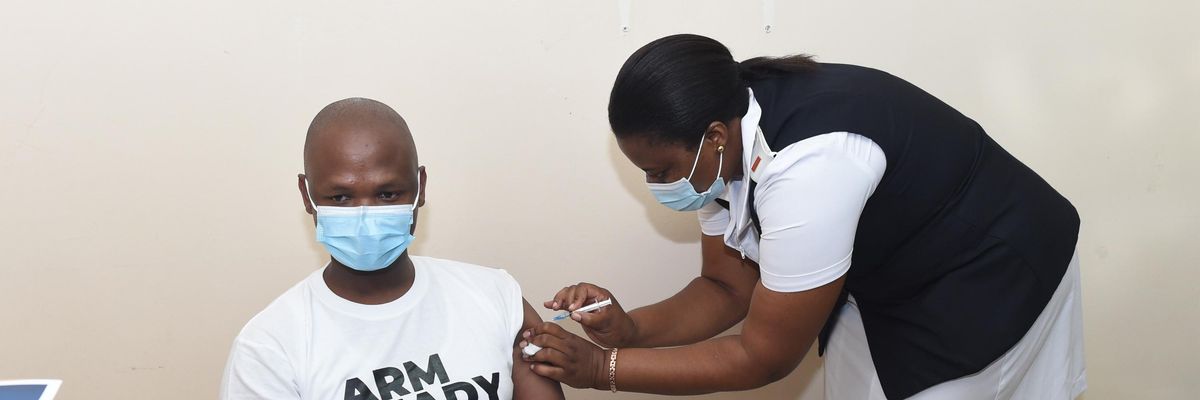
Minister of Health and Wellness Edwin Dikoloti receives the Covid-19 vaccine in Gaborone, Botswana, on March 26, 2021. (Photo: Tshekiso Tebalo/Xinhua via Getty)
An analysis released Monday shows that the number of Americans who have received a coronavirus booster shot to date exceeds the number of people who have gotten a single vaccine dose in eight countries in southern Africa combined, a finding that came as the international community grappled with the threat posed by Omicron.
"If we do not vaccinate the world as quickly as possible, Covid will continue to threaten us all."
According to a Public Citizen review of Centers for Disease Control and Prevention data, around 37 million people have received a booster shot in the U.S., which has authorized boosters for its entire adult population.
Meanwhile, just 30 million people in Botswana, Eswatini, Lesotho, Malawi, Mozambique, Namibia, South Africa, and Zimbabwe--the eight countries on the Biden administration's new travel restriction list--have received at least one coronavirus vaccine dose. The Omicron variant, which the World Health Organization has deemed a "very high" global risk, was first detected in southern Africa--though its origins are not clear.
Zain Rizvi, research director at Public Citizen and author of the new analysis, said the figures throw the global inoculation gap into sharp relief and further demonstrate that the U.S. remains well short of its promise to act as the world's vaccine "arsenal."
"The emergence of the new coronavirus variant, Omicron, has exposed the risks of an unvaccinated world," said Rizvi. "Since the start of the pandemic, the U.S. has sent 11.2 million doses to those eight countries in southern Africa. That is less than what the U.S. distributed at home in one week in November (Nov. 17 - 24)."
In August, the Biden administration dismissed the WHO's call for a temporary moratorium on booster shots, a demand aimed at freeing up additional vaccine supply for low-income nations that have been denied sufficient access. White House Press Secretary Jen Psaki said the WHO's recommendation presented a "false choice" between boosters and adequate global vaccination.
"But until the U.S. government uses its power under the Defense Production Act to share the vaccine recipe and make surge investments in global vaccine production," Rizvi argued Monday, "that choice will remain true--and only become increasingly stark."
The Public Citizen analysis was published as President Joe Biden said in a speech that the Omicron variant is "a cause for concern, not a cause for panic," stressing that "we have the best vaccine in the world, the best medicines, the best scientists."
But the president's words were likely cold comfort for nations that don't have enough vaccine doses in large part because of hoarding by rich countries--including the U.S.--and pharmaceutical companies' refusal to share key technology. Just 27% of all health workers on the African continent have been fully vaccinated against Covid-19, according to the WHO.
Robbie Silverman, senior manager of private sector advocacy at Oxfam America, said in a statement Monday that the emergence of the Omicron variant "affirms what many of world's leading scientists, public health officials, doctors, nurses, and economists have been saying since the beginning of the pandemic: if we do not vaccinate the world as quickly as possible, Covid will continue to threaten us all."
"Our leaders' failure to help bring the vaccines to everyone, everywhere will keep us on a cruel and never-ending cycle of illness, death, and economic suffering. Omicron must be the wake-up call. We need President Biden to lead in negotiating a comprehensive TRIPS waiver at the [World Trade Organization] and press for the sharing of all vaccine technologies immediately. No one is safe until everyone is safe."
Dear Common Dreams reader, It’s been nearly 30 years since I co-founded Common Dreams with my late wife, Lina Newhouser. We had the radical notion that journalism should serve the public good, not corporate profits. It was clear to us from the outset what it would take to build such a project. No paid advertisements. No corporate sponsors. No millionaire publisher telling us what to think or do. Many people said we wouldn't last a year, but we proved those doubters wrong. Together with a tremendous team of journalists and dedicated staff, we built an independent media outlet free from the constraints of profits and corporate control. Our mission has always been simple: To inform. To inspire. To ignite change for the common good. Building Common Dreams was not easy. Our survival was never guaranteed. When you take on the most powerful forces—Wall Street greed, fossil fuel industry destruction, Big Tech lobbyists, and uber-rich oligarchs who have spent billions upon billions rigging the economy and democracy in their favor—the only bulwark you have is supporters who believe in your work. But here’s the urgent message from me today. It's never been this bad out there. And it's never been this hard to keep us going. At the very moment Common Dreams is most needed, the threats we face are intensifying. We need your support now more than ever. We don't accept corporate advertising and never will. We don't have a paywall because we don't think people should be blocked from critical news based on their ability to pay. Everything we do is funded by the donations of readers like you. When everyone does the little they can afford, we are strong. But if that support retreats or dries up, so do we. Will you donate now to make sure Common Dreams not only survives but thrives? —Craig Brown, Co-founder |
An analysis released Monday shows that the number of Americans who have received a coronavirus booster shot to date exceeds the number of people who have gotten a single vaccine dose in eight countries in southern Africa combined, a finding that came as the international community grappled with the threat posed by Omicron.
"If we do not vaccinate the world as quickly as possible, Covid will continue to threaten us all."
According to a Public Citizen review of Centers for Disease Control and Prevention data, around 37 million people have received a booster shot in the U.S., which has authorized boosters for its entire adult population.
Meanwhile, just 30 million people in Botswana, Eswatini, Lesotho, Malawi, Mozambique, Namibia, South Africa, and Zimbabwe--the eight countries on the Biden administration's new travel restriction list--have received at least one coronavirus vaccine dose. The Omicron variant, which the World Health Organization has deemed a "very high" global risk, was first detected in southern Africa--though its origins are not clear.
Zain Rizvi, research director at Public Citizen and author of the new analysis, said the figures throw the global inoculation gap into sharp relief and further demonstrate that the U.S. remains well short of its promise to act as the world's vaccine "arsenal."
"The emergence of the new coronavirus variant, Omicron, has exposed the risks of an unvaccinated world," said Rizvi. "Since the start of the pandemic, the U.S. has sent 11.2 million doses to those eight countries in southern Africa. That is less than what the U.S. distributed at home in one week in November (Nov. 17 - 24)."
In August, the Biden administration dismissed the WHO's call for a temporary moratorium on booster shots, a demand aimed at freeing up additional vaccine supply for low-income nations that have been denied sufficient access. White House Press Secretary Jen Psaki said the WHO's recommendation presented a "false choice" between boosters and adequate global vaccination.
"But until the U.S. government uses its power under the Defense Production Act to share the vaccine recipe and make surge investments in global vaccine production," Rizvi argued Monday, "that choice will remain true--and only become increasingly stark."
The Public Citizen analysis was published as President Joe Biden said in a speech that the Omicron variant is "a cause for concern, not a cause for panic," stressing that "we have the best vaccine in the world, the best medicines, the best scientists."
But the president's words were likely cold comfort for nations that don't have enough vaccine doses in large part because of hoarding by rich countries--including the U.S.--and pharmaceutical companies' refusal to share key technology. Just 27% of all health workers on the African continent have been fully vaccinated against Covid-19, according to the WHO.
Robbie Silverman, senior manager of private sector advocacy at Oxfam America, said in a statement Monday that the emergence of the Omicron variant "affirms what many of world's leading scientists, public health officials, doctors, nurses, and economists have been saying since the beginning of the pandemic: if we do not vaccinate the world as quickly as possible, Covid will continue to threaten us all."
"Our leaders' failure to help bring the vaccines to everyone, everywhere will keep us on a cruel and never-ending cycle of illness, death, and economic suffering. Omicron must be the wake-up call. We need President Biden to lead in negotiating a comprehensive TRIPS waiver at the [World Trade Organization] and press for the sharing of all vaccine technologies immediately. No one is safe until everyone is safe."
An analysis released Monday shows that the number of Americans who have received a coronavirus booster shot to date exceeds the number of people who have gotten a single vaccine dose in eight countries in southern Africa combined, a finding that came as the international community grappled with the threat posed by Omicron.
"If we do not vaccinate the world as quickly as possible, Covid will continue to threaten us all."
According to a Public Citizen review of Centers for Disease Control and Prevention data, around 37 million people have received a booster shot in the U.S., which has authorized boosters for its entire adult population.
Meanwhile, just 30 million people in Botswana, Eswatini, Lesotho, Malawi, Mozambique, Namibia, South Africa, and Zimbabwe--the eight countries on the Biden administration's new travel restriction list--have received at least one coronavirus vaccine dose. The Omicron variant, which the World Health Organization has deemed a "very high" global risk, was first detected in southern Africa--though its origins are not clear.
Zain Rizvi, research director at Public Citizen and author of the new analysis, said the figures throw the global inoculation gap into sharp relief and further demonstrate that the U.S. remains well short of its promise to act as the world's vaccine "arsenal."
"The emergence of the new coronavirus variant, Omicron, has exposed the risks of an unvaccinated world," said Rizvi. "Since the start of the pandemic, the U.S. has sent 11.2 million doses to those eight countries in southern Africa. That is less than what the U.S. distributed at home in one week in November (Nov. 17 - 24)."
In August, the Biden administration dismissed the WHO's call for a temporary moratorium on booster shots, a demand aimed at freeing up additional vaccine supply for low-income nations that have been denied sufficient access. White House Press Secretary Jen Psaki said the WHO's recommendation presented a "false choice" between boosters and adequate global vaccination.
"But until the U.S. government uses its power under the Defense Production Act to share the vaccine recipe and make surge investments in global vaccine production," Rizvi argued Monday, "that choice will remain true--and only become increasingly stark."
The Public Citizen analysis was published as President Joe Biden said in a speech that the Omicron variant is "a cause for concern, not a cause for panic," stressing that "we have the best vaccine in the world, the best medicines, the best scientists."
But the president's words were likely cold comfort for nations that don't have enough vaccine doses in large part because of hoarding by rich countries--including the U.S.--and pharmaceutical companies' refusal to share key technology. Just 27% of all health workers on the African continent have been fully vaccinated against Covid-19, according to the WHO.
Robbie Silverman, senior manager of private sector advocacy at Oxfam America, said in a statement Monday that the emergence of the Omicron variant "affirms what many of world's leading scientists, public health officials, doctors, nurses, and economists have been saying since the beginning of the pandemic: if we do not vaccinate the world as quickly as possible, Covid will continue to threaten us all."
"Our leaders' failure to help bring the vaccines to everyone, everywhere will keep us on a cruel and never-ending cycle of illness, death, and economic suffering. Omicron must be the wake-up call. We need President Biden to lead in negotiating a comprehensive TRIPS waiver at the [World Trade Organization] and press for the sharing of all vaccine technologies immediately. No one is safe until everyone is safe."