SUBSCRIBE TO OUR FREE NEWSLETTER
Daily news & progressive opinion—funded by the people, not the corporations—delivered straight to your inbox.
5
#000000
#FFFFFF
To donate by check, phone, or other method, see our More Ways to Give page.
Daily news & progressive opinion—funded by the people, not the corporations—delivered straight to your inbox.
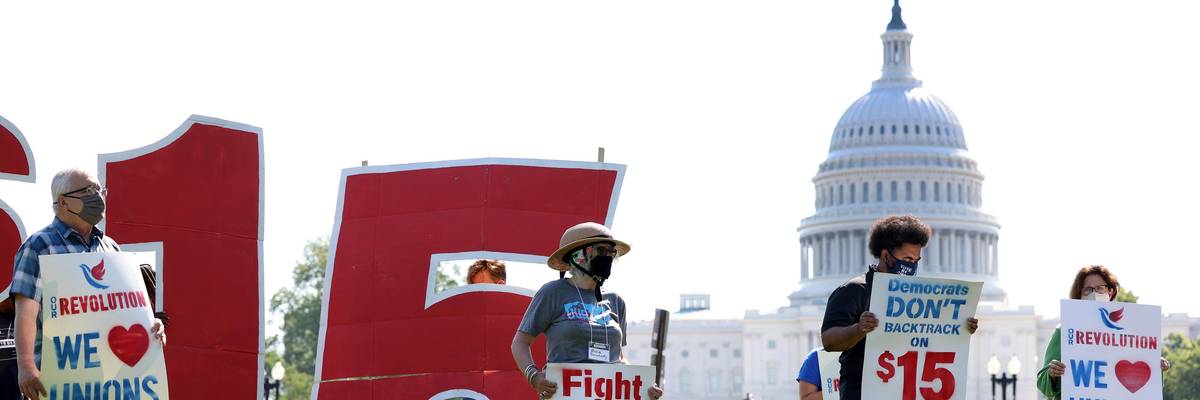
Labor activists hold a rally in support of raising the minimum wage to $15 an hour on the National Mall on May 19, 2021 in Washington, DC. Members of the Service Employee International Union (SEIU) organized the rally in support of striking McDonald's workers who are demanding a wage increase. (Photo by Kevin Dietsch/Getty Images)
Chair of the Congressional Progressive Caucus Pramila Jayapal celebrated Monday's announcement from the U.S. Labor Department that all federal contract workers will be paid at least $15 per hour starting in January, but also took the opportunity to argue that should be the wage floor should for all U.S. workers.
"Great news," tweeted Jayapal in response to the news. "Now, let's take this nationwide and give over 30 million workers a much-needed and well-deserved raise."
In a statement on Monday, the Labor Department said the finalized rule--which will apply to all workers employed under or related to federal contracts--will go into effect on January 30, 2022 and is the culmination of an executive order signed by President Joe Biden in April of this year.
The workers who will benefit from the new wage floor, said Labor Secretary Marty Walsh, "do essential work on our nation's behalf. They build and repair the federal infrastructure, clean and maintain our national parks, monuments and other federal facilities, care for our veterans, and ensure federal workers and military service members are provided with safe and nutritious food."
The federal rule will apply to an estimate 325,000 workers as new contracts are signed after January, though some working under existing contracts may not see that pay bump immediately. According to the Labor Department, the rule does the following:
Workers represented by SEIU applauded the rule.
"It would be such a relief to know that my job is protected because it would mean my family is protected too," said Ana Ayala, a single mother living in Woodbridge, Virginia who works as a janitor and is a member of 32BJ SEIU. "In Virginia, most janitors don't make this much or have these benefits which are so critical as a single mother with a child depending on me."
Ben Zipperer, an economist with the left-leaning Economic Policy Institute, said in a lengthy blog post Monday that while the rule touches a relatively small percentage of the U.S. workforce, its impact could have positive reverberations.
"While not a substitute for a universal $15 minimum wage, there may be important spillover effects," said Zipperer, noting that other private employees will likely raise their wages in order to compete for labor and that higher wages will lead to less turnover and higher-quality services in industries like nursing home care.
"All in all this the new $15 minimum wage for federal contracts is excellent policy, another step to fixing a labor market that doesn't deliver adequate wages," he said.
Earlier this year, the Senate Parliamentarian objected to inclusion of an amendment to raise the federal minimum wage for all U.S. workers to $15 an hour and progressives expressed outrage that the Biden administration did not do more to fight back in order to ensure that wages would be lifted for all.
"At a time when millions of workers are earning starvation wages, when the minimum wage has not been raised by Congress since 2007 and stands at a pathetic $7.25 an hour, it is time to raise the minimum wage to a living wage," Sanders, the chairman of the Senate Budget Committee, said at the time
Dear Common Dreams reader, It’s been nearly 30 years since I co-founded Common Dreams with my late wife, Lina Newhouser. We had the radical notion that journalism should serve the public good, not corporate profits. It was clear to us from the outset what it would take to build such a project. No paid advertisements. No corporate sponsors. No millionaire publisher telling us what to think or do. Many people said we wouldn't last a year, but we proved those doubters wrong. Together with a tremendous team of journalists and dedicated staff, we built an independent media outlet free from the constraints of profits and corporate control. Our mission has always been simple: To inform. To inspire. To ignite change for the common good. Building Common Dreams was not easy. Our survival was never guaranteed. When you take on the most powerful forces—Wall Street greed, fossil fuel industry destruction, Big Tech lobbyists, and uber-rich oligarchs who have spent billions upon billions rigging the economy and democracy in their favor—the only bulwark you have is supporters who believe in your work. But here’s the urgent message from me today. It's never been this bad out there. And it's never been this hard to keep us going. At the very moment Common Dreams is most needed, the threats we face are intensifying. We need your support now more than ever. We don't accept corporate advertising and never will. We don't have a paywall because we don't think people should be blocked from critical news based on their ability to pay. Everything we do is funded by the donations of readers like you. When everyone does the little they can afford, we are strong. But if that support retreats or dries up, so do we. Will you donate now to make sure Common Dreams not only survives but thrives? —Craig Brown, Co-founder |
Chair of the Congressional Progressive Caucus Pramila Jayapal celebrated Monday's announcement from the U.S. Labor Department that all federal contract workers will be paid at least $15 per hour starting in January, but also took the opportunity to argue that should be the wage floor should for all U.S. workers.
"Great news," tweeted Jayapal in response to the news. "Now, let's take this nationwide and give over 30 million workers a much-needed and well-deserved raise."
In a statement on Monday, the Labor Department said the finalized rule--which will apply to all workers employed under or related to federal contracts--will go into effect on January 30, 2022 and is the culmination of an executive order signed by President Joe Biden in April of this year.
The workers who will benefit from the new wage floor, said Labor Secretary Marty Walsh, "do essential work on our nation's behalf. They build and repair the federal infrastructure, clean and maintain our national parks, monuments and other federal facilities, care for our veterans, and ensure federal workers and military service members are provided with safe and nutritious food."
The federal rule will apply to an estimate 325,000 workers as new contracts are signed after January, though some working under existing contracts may not see that pay bump immediately. According to the Labor Department, the rule does the following:
Workers represented by SEIU applauded the rule.
"It would be such a relief to know that my job is protected because it would mean my family is protected too," said Ana Ayala, a single mother living in Woodbridge, Virginia who works as a janitor and is a member of 32BJ SEIU. "In Virginia, most janitors don't make this much or have these benefits which are so critical as a single mother with a child depending on me."
Ben Zipperer, an economist with the left-leaning Economic Policy Institute, said in a lengthy blog post Monday that while the rule touches a relatively small percentage of the U.S. workforce, its impact could have positive reverberations.
"While not a substitute for a universal $15 minimum wage, there may be important spillover effects," said Zipperer, noting that other private employees will likely raise their wages in order to compete for labor and that higher wages will lead to less turnover and higher-quality services in industries like nursing home care.
"All in all this the new $15 minimum wage for federal contracts is excellent policy, another step to fixing a labor market that doesn't deliver adequate wages," he said.
Earlier this year, the Senate Parliamentarian objected to inclusion of an amendment to raise the federal minimum wage for all U.S. workers to $15 an hour and progressives expressed outrage that the Biden administration did not do more to fight back in order to ensure that wages would be lifted for all.
"At a time when millions of workers are earning starvation wages, when the minimum wage has not been raised by Congress since 2007 and stands at a pathetic $7.25 an hour, it is time to raise the minimum wage to a living wage," Sanders, the chairman of the Senate Budget Committee, said at the time
Chair of the Congressional Progressive Caucus Pramila Jayapal celebrated Monday's announcement from the U.S. Labor Department that all federal contract workers will be paid at least $15 per hour starting in January, but also took the opportunity to argue that should be the wage floor should for all U.S. workers.
"Great news," tweeted Jayapal in response to the news. "Now, let's take this nationwide and give over 30 million workers a much-needed and well-deserved raise."
In a statement on Monday, the Labor Department said the finalized rule--which will apply to all workers employed under or related to federal contracts--will go into effect on January 30, 2022 and is the culmination of an executive order signed by President Joe Biden in April of this year.
The workers who will benefit from the new wage floor, said Labor Secretary Marty Walsh, "do essential work on our nation's behalf. They build and repair the federal infrastructure, clean and maintain our national parks, monuments and other federal facilities, care for our veterans, and ensure federal workers and military service members are provided with safe and nutritious food."
The federal rule will apply to an estimate 325,000 workers as new contracts are signed after January, though some working under existing contracts may not see that pay bump immediately. According to the Labor Department, the rule does the following:
Workers represented by SEIU applauded the rule.
"It would be such a relief to know that my job is protected because it would mean my family is protected too," said Ana Ayala, a single mother living in Woodbridge, Virginia who works as a janitor and is a member of 32BJ SEIU. "In Virginia, most janitors don't make this much or have these benefits which are so critical as a single mother with a child depending on me."
Ben Zipperer, an economist with the left-leaning Economic Policy Institute, said in a lengthy blog post Monday that while the rule touches a relatively small percentage of the U.S. workforce, its impact could have positive reverberations.
"While not a substitute for a universal $15 minimum wage, there may be important spillover effects," said Zipperer, noting that other private employees will likely raise their wages in order to compete for labor and that higher wages will lead to less turnover and higher-quality services in industries like nursing home care.
"All in all this the new $15 minimum wage for federal contracts is excellent policy, another step to fixing a labor market that doesn't deliver adequate wages," he said.
Earlier this year, the Senate Parliamentarian objected to inclusion of an amendment to raise the federal minimum wage for all U.S. workers to $15 an hour and progressives expressed outrage that the Biden administration did not do more to fight back in order to ensure that wages would be lifted for all.
"At a time when millions of workers are earning starvation wages, when the minimum wage has not been raised by Congress since 2007 and stands at a pathetic $7.25 an hour, it is time to raise the minimum wage to a living wage," Sanders, the chairman of the Senate Budget Committee, said at the time