SUBSCRIBE TO OUR FREE NEWSLETTER
Daily news & progressive opinion—funded by the people, not the corporations—delivered straight to your inbox.
5
#000000
#FFFFFF
To donate by check, phone, or other method, see our More Ways to Give page.
Daily news & progressive opinion—funded by the people, not the corporations—delivered straight to your inbox.
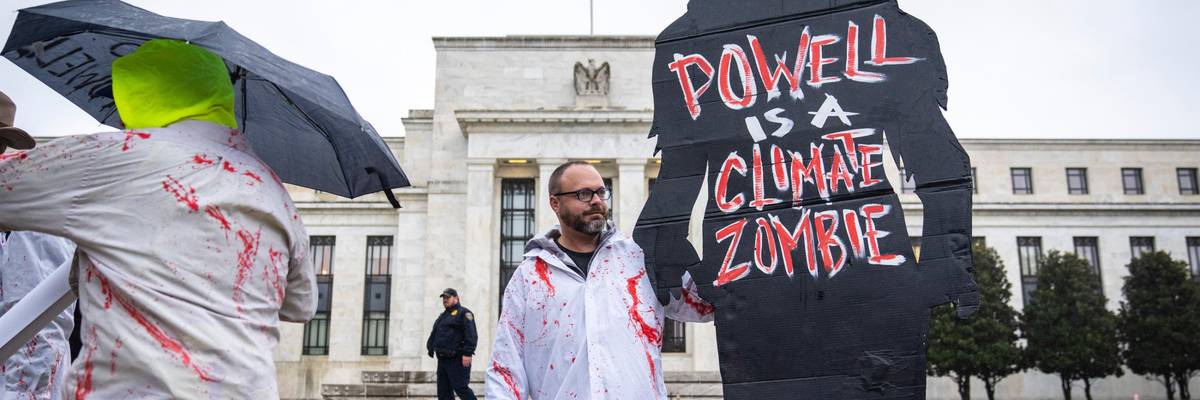
Climate activists rally against Federal Reserve Chair Jerome Powell outside of the Federal Reserve Board Building on October 29, 2021 in Washington, D.C.
With President Joe Biden reportedly nearing a decision on his pick to head the Federal Reserve, progressive lawmakers and advocacy groups are ramping up their criticism of the central bank's current chair over his refusal to treat the climate crisis as a systemic threat.
"The Fed's pandemic bailouts under Jerome Powell kept the fossil fuel industry afloat."
On Friday, Sens. Jeff Merkley (D-Ore.) and Sheldon Whitehouse (D-R.I.) issued a joint statement announcing that they would oppose the renomination of Jerome Powell--a Trump appointee--for a second term as Fed chair.
"Powell refuses to recognize climate change as an urgent and systemic economic threat," the senators said. "During his tenure, Chair Powell first ignored climate change and then resisted calls for the Fed to use its tools to fight it, arguing that climate change 'is really an issue that is assigned to lots of other government agencies, not so much the Fed.'"
"Climate is not a long-term challenge for the Fed; it demands action now," they added. "Climate effects exacerbate supply chain struggles and commodity price volatility... President Biden must appoint a Fed chair who will ensure the Fed is fulfilling its mandate to safeguard our financial system and shares the administration's view that fighting climate change is the responsibility of every policymaker. That person is not Jerome Powell."
Sen. Elizabeth Warren (D-Mass.)--who said in September that Powell's record of weakening Wall Street regulations makes him a "dangerous man"--and progressive House Democrats have also spoken out against the incumbent Fed chair, whose current term expires in February.
Biden has reportedly interviewed both Powell and Fed governor Lael Brainard for the job, and the president could announce his pick as soon as this weekend. Given that Powell--a Republican--would likely have significant support from the Senate GOP, Democrats would need more than three senators to prevent him from staying on for another term.
On Friday evening, the Revolving Door Project (RDP)--which has vocally opposed Powell's renomination for a number of reasons--raised fresh concerns about the Fed chair's potential conflicts of interest, which the group characterized as "disqualifying."
In a statement, RDP director Jeff Hauser said that "Powell explicitly claimed to have received approval from the Office of Government Ethics to continue to hold municipal bonds as the Federal Reserve undertook extraordinary pandemic response efforts, including in the muni bond market."
"But an inquiry from the Revolving Door Project has revealed the absence of any records of any communications of any kind between Powell and the Office of Government Ethics, suggesting that Powell received no such approval, and seemingly contradicting his earlier statement to the press," said Hauser. "These revelations are yet another indictment of Powell's disregard for ethics rules and disrespect for the public he is meant to serve."
While voicing alarm over his possible ethics violations, Powell's progressive critics have largely focused on his climate record at the Fed, which one observer warned is "sleepwalking through climate chaos" and failing to utilize the tools at its disposal to mitigate risks posed by extreme weather and other consequences of planetary heating.
The Wall Street Journal reported Friday that fossil fuel corporations "were disproportionate beneficiaries of Fed programs meant to buoy U.S. businesses during the pandemic."
" Oil and gas companies have raked in record amounts of private-sector financing since the Fed's 2020 interest-rate cuts and corporate bond-buying programs, upending years of declining investment in fossil fuels," the Journal noted.
Yevgeny Shrago, policy counsel at the consumer advocacy group Public Citizen, tweeted in response to the Journal's reporting that "the Fed's pandemic bailouts under Jerome Powell kept the fossil fuel industry afloat--bailouts that were broadened under Republican political pressure to specifically include many of these companies."
Dear Common Dreams reader, It’s been nearly 30 years since I co-founded Common Dreams with my late wife, Lina Newhouser. We had the radical notion that journalism should serve the public good, not corporate profits. It was clear to us from the outset what it would take to build such a project. No paid advertisements. No corporate sponsors. No millionaire publisher telling us what to think or do. Many people said we wouldn't last a year, but we proved those doubters wrong. Together with a tremendous team of journalists and dedicated staff, we built an independent media outlet free from the constraints of profits and corporate control. Our mission has always been simple: To inform. To inspire. To ignite change for the common good. Building Common Dreams was not easy. Our survival was never guaranteed. When you take on the most powerful forces—Wall Street greed, fossil fuel industry destruction, Big Tech lobbyists, and uber-rich oligarchs who have spent billions upon billions rigging the economy and democracy in their favor—the only bulwark you have is supporters who believe in your work. But here’s the urgent message from me today. It's never been this bad out there. And it's never been this hard to keep us going. At the very moment Common Dreams is most needed, the threats we face are intensifying. We need your support now more than ever. We don't accept corporate advertising and never will. We don't have a paywall because we don't think people should be blocked from critical news based on their ability to pay. Everything we do is funded by the donations of readers like you. When everyone does the little they can afford, we are strong. But if that support retreats or dries up, so do we. Will you donate now to make sure Common Dreams not only survives but thrives? —Craig Brown, Co-founder |
With President Joe Biden reportedly nearing a decision on his pick to head the Federal Reserve, progressive lawmakers and advocacy groups are ramping up their criticism of the central bank's current chair over his refusal to treat the climate crisis as a systemic threat.
"The Fed's pandemic bailouts under Jerome Powell kept the fossil fuel industry afloat."
On Friday, Sens. Jeff Merkley (D-Ore.) and Sheldon Whitehouse (D-R.I.) issued a joint statement announcing that they would oppose the renomination of Jerome Powell--a Trump appointee--for a second term as Fed chair.
"Powell refuses to recognize climate change as an urgent and systemic economic threat," the senators said. "During his tenure, Chair Powell first ignored climate change and then resisted calls for the Fed to use its tools to fight it, arguing that climate change 'is really an issue that is assigned to lots of other government agencies, not so much the Fed.'"
"Climate is not a long-term challenge for the Fed; it demands action now," they added. "Climate effects exacerbate supply chain struggles and commodity price volatility... President Biden must appoint a Fed chair who will ensure the Fed is fulfilling its mandate to safeguard our financial system and shares the administration's view that fighting climate change is the responsibility of every policymaker. That person is not Jerome Powell."
Sen. Elizabeth Warren (D-Mass.)--who said in September that Powell's record of weakening Wall Street regulations makes him a "dangerous man"--and progressive House Democrats have also spoken out against the incumbent Fed chair, whose current term expires in February.
Biden has reportedly interviewed both Powell and Fed governor Lael Brainard for the job, and the president could announce his pick as soon as this weekend. Given that Powell--a Republican--would likely have significant support from the Senate GOP, Democrats would need more than three senators to prevent him from staying on for another term.
On Friday evening, the Revolving Door Project (RDP)--which has vocally opposed Powell's renomination for a number of reasons--raised fresh concerns about the Fed chair's potential conflicts of interest, which the group characterized as "disqualifying."
In a statement, RDP director Jeff Hauser said that "Powell explicitly claimed to have received approval from the Office of Government Ethics to continue to hold municipal bonds as the Federal Reserve undertook extraordinary pandemic response efforts, including in the muni bond market."
"But an inquiry from the Revolving Door Project has revealed the absence of any records of any communications of any kind between Powell and the Office of Government Ethics, suggesting that Powell received no such approval, and seemingly contradicting his earlier statement to the press," said Hauser. "These revelations are yet another indictment of Powell's disregard for ethics rules and disrespect for the public he is meant to serve."
While voicing alarm over his possible ethics violations, Powell's progressive critics have largely focused on his climate record at the Fed, which one observer warned is "sleepwalking through climate chaos" and failing to utilize the tools at its disposal to mitigate risks posed by extreme weather and other consequences of planetary heating.
The Wall Street Journal reported Friday that fossil fuel corporations "were disproportionate beneficiaries of Fed programs meant to buoy U.S. businesses during the pandemic."
" Oil and gas companies have raked in record amounts of private-sector financing since the Fed's 2020 interest-rate cuts and corporate bond-buying programs, upending years of declining investment in fossil fuels," the Journal noted.
Yevgeny Shrago, policy counsel at the consumer advocacy group Public Citizen, tweeted in response to the Journal's reporting that "the Fed's pandemic bailouts under Jerome Powell kept the fossil fuel industry afloat--bailouts that were broadened under Republican political pressure to specifically include many of these companies."
With President Joe Biden reportedly nearing a decision on his pick to head the Federal Reserve, progressive lawmakers and advocacy groups are ramping up their criticism of the central bank's current chair over his refusal to treat the climate crisis as a systemic threat.
"The Fed's pandemic bailouts under Jerome Powell kept the fossil fuel industry afloat."
On Friday, Sens. Jeff Merkley (D-Ore.) and Sheldon Whitehouse (D-R.I.) issued a joint statement announcing that they would oppose the renomination of Jerome Powell--a Trump appointee--for a second term as Fed chair.
"Powell refuses to recognize climate change as an urgent and systemic economic threat," the senators said. "During his tenure, Chair Powell first ignored climate change and then resisted calls for the Fed to use its tools to fight it, arguing that climate change 'is really an issue that is assigned to lots of other government agencies, not so much the Fed.'"
"Climate is not a long-term challenge for the Fed; it demands action now," they added. "Climate effects exacerbate supply chain struggles and commodity price volatility... President Biden must appoint a Fed chair who will ensure the Fed is fulfilling its mandate to safeguard our financial system and shares the administration's view that fighting climate change is the responsibility of every policymaker. That person is not Jerome Powell."
Sen. Elizabeth Warren (D-Mass.)--who said in September that Powell's record of weakening Wall Street regulations makes him a "dangerous man"--and progressive House Democrats have also spoken out against the incumbent Fed chair, whose current term expires in February.
Biden has reportedly interviewed both Powell and Fed governor Lael Brainard for the job, and the president could announce his pick as soon as this weekend. Given that Powell--a Republican--would likely have significant support from the Senate GOP, Democrats would need more than three senators to prevent him from staying on for another term.
On Friday evening, the Revolving Door Project (RDP)--which has vocally opposed Powell's renomination for a number of reasons--raised fresh concerns about the Fed chair's potential conflicts of interest, which the group characterized as "disqualifying."
In a statement, RDP director Jeff Hauser said that "Powell explicitly claimed to have received approval from the Office of Government Ethics to continue to hold municipal bonds as the Federal Reserve undertook extraordinary pandemic response efforts, including in the muni bond market."
"But an inquiry from the Revolving Door Project has revealed the absence of any records of any communications of any kind between Powell and the Office of Government Ethics, suggesting that Powell received no such approval, and seemingly contradicting his earlier statement to the press," said Hauser. "These revelations are yet another indictment of Powell's disregard for ethics rules and disrespect for the public he is meant to serve."
While voicing alarm over his possible ethics violations, Powell's progressive critics have largely focused on his climate record at the Fed, which one observer warned is "sleepwalking through climate chaos" and failing to utilize the tools at its disposal to mitigate risks posed by extreme weather and other consequences of planetary heating.
The Wall Street Journal reported Friday that fossil fuel corporations "were disproportionate beneficiaries of Fed programs meant to buoy U.S. businesses during the pandemic."
" Oil and gas companies have raked in record amounts of private-sector financing since the Fed's 2020 interest-rate cuts and corporate bond-buying programs, upending years of declining investment in fossil fuels," the Journal noted.
Yevgeny Shrago, policy counsel at the consumer advocacy group Public Citizen, tweeted in response to the Journal's reporting that "the Fed's pandemic bailouts under Jerome Powell kept the fossil fuel industry afloat--bailouts that were broadened under Republican political pressure to specifically include many of these companies."