SUBSCRIBE TO OUR FREE NEWSLETTER
Daily news & progressive opinion—funded by the people, not the corporations—delivered straight to your inbox.
5
#000000
#FFFFFF
To donate by check, phone, or other method, see our More Ways to Give page.
Daily news & progressive opinion—funded by the people, not the corporations—delivered straight to your inbox.
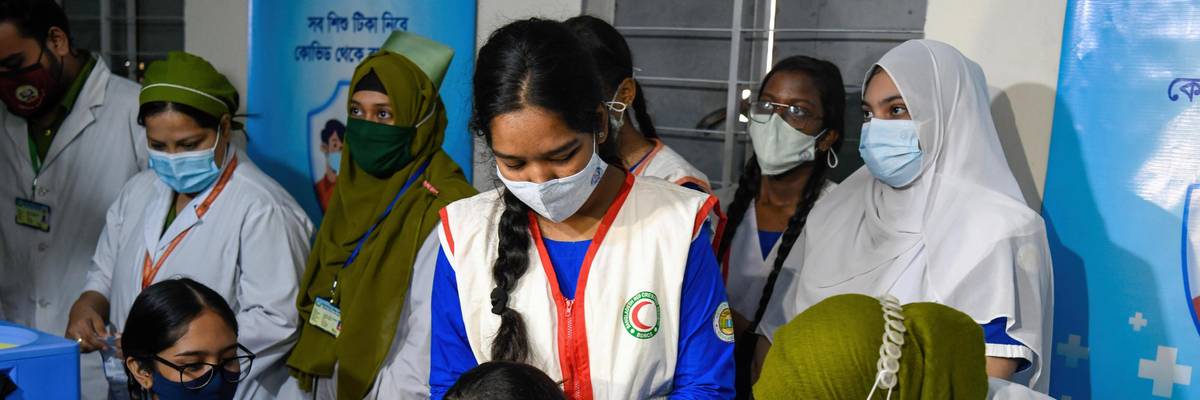
A Bangladeshi health worker administers a dose of the Pfizer-BioNTech coronavirus vaccine in the capital Dhaka on November 1, 2021. (Photo: Piyas Biswas/SOPA Images/LightRocket via Getty Images)
A briefing published Thursday by Amnesty International accused pharma giant Pfizer of making misleading claims about its efforts to provide Covid-19 vaccines to low-income countries, while reserving most doses of the inoculations for wealthier nations.
"Pfizer says it is committed to supplying doses to low- and middle-income countries, but the numbers just don't bear this out. The fact is that this company is still putting profits first."
"Two years after the emergence of the deadly coronavirus, half the world's population [has] received at least one dose of the vaccine--a major milestone on the path to global vaccination," the human rights group says. "Yet a staggering 96% of people in low-income countries remain unvaccinated."
"Despite the ever-increasing numbers of vaccines produced, both states and pharmaceutical companies are continuing to fail to guarantee fair access to lifesaving medicines for all," the briefing contends.
"Pfizer, one the largest and most profitable vaccine developers... has delivered in excess of 1.8 billion doses to date," the publication continues. "Despite its many pledges--some misleadingly phrased--Pfizer... continues to reserve the bulk of its vaccines for higher-income countries."
The report notes that the company is "still refusing to participate in technology sharing initiatives, such as the South African-based [World Health Organization] mRNA technology hub, and has lobbied vigorously against efforts to lift intellectual property restrictions."
"With projected earnings of U.S.$36 billion from vaccines for 2021, Pfizer is still putting profits before people," Amnesty charges.
According to the briefing, Pfizer's claims that its coronavirus vaccine "would be available to every patient, country, and community that seeks access," and that the company's priority was "fair and equitable distribution" of doses, are misleading.
In a June 2021 letter to Amnesty, Pfizer pledged "to provide two billion doses of our Covid-19 vaccine to middle- and low-income countries over the next 18 months," and to deliver 40% of its planned vaccine supply to such nations.
"This claim gives the impression that lower-income countries are receiving a substantial proportion of Pfizer vaccines, but the language is misleading," the briefing asserts. "Pfizer has amalgamated low, lower-middle, and upper-middle countries--over 84% of the global population--into one group and referred to them as 'low and middle-income.' Within this very broad category, the bulk of Pfizer's doses have in fact been going to 'upper-middle' income countries such as Malaysia, Mexico, and Thailand."
Additionally, while Pfizer said it had shipped two billion vaccine doses by the end of September, the company admitted to Amnesty in November that only 154 million doses, or less than 8% of its total--had been sent to 42 low and lower-middle-income countries, and that less than 10% of those shots had gone to low-income countries.
Furthermore, while Pfizer claimed it is "committed to sharing our scientific tools and insights, development expertise, and manufacturing capacity," the briefing notes the company "has opposed sharing of intellectual property through the WHO's Covid-19 Technology Access Pool (C-TAP) and has not joined the newly established Covid-19 mRNA vaccine technology transfer hub in South Africa."
Amnesty also notes that Pfizer has lobbied the Biden administration "to oppose proposals put forward by India and South Africa to the World Trade Organization Council for Trade-Related Aspects of Intellectual Property Rights (TRIPS) to suspend critical intellectual property provisions of the TRIPS Agreement, which it describes as a disincentive to investment and innovation."
Patrick Wilcken, Amnesty's head of business and human rights, said in a statement Thursday that "Pfizer says it is committed to supplying doses to low- and middle-income countries, but the numbers just don't bear this out. The fact is that this company is still putting profits first."
"As much as these companies might want to massage the facts, the numbers are crystal clear--they are still supplying the majority of their doses to richer parts of the world," he continued.
"We're still in the middle of an unprecedented global health and human rights crisis," Wilcken added, "and it is essential that all countries of the world have access to vaccines as soon as possible."
Dear Common Dreams reader, It’s been nearly 30 years since I co-founded Common Dreams with my late wife, Lina Newhouser. We had the radical notion that journalism should serve the public good, not corporate profits. It was clear to us from the outset what it would take to build such a project. No paid advertisements. No corporate sponsors. No millionaire publisher telling us what to think or do. Many people said we wouldn't last a year, but we proved those doubters wrong. Together with a tremendous team of journalists and dedicated staff, we built an independent media outlet free from the constraints of profits and corporate control. Our mission has always been simple: To inform. To inspire. To ignite change for the common good. Building Common Dreams was not easy. Our survival was never guaranteed. When you take on the most powerful forces—Wall Street greed, fossil fuel industry destruction, Big Tech lobbyists, and uber-rich oligarchs who have spent billions upon billions rigging the economy and democracy in their favor—the only bulwark you have is supporters who believe in your work. But here’s the urgent message from me today. It's never been this bad out there. And it's never been this hard to keep us going. At the very moment Common Dreams is most needed, the threats we face are intensifying. We need your support now more than ever. We don't accept corporate advertising and never will. We don't have a paywall because we don't think people should be blocked from critical news based on their ability to pay. Everything we do is funded by the donations of readers like you. When everyone does the little they can afford, we are strong. But if that support retreats or dries up, so do we. Will you donate now to make sure Common Dreams not only survives but thrives? —Craig Brown, Co-founder |
A briefing published Thursday by Amnesty International accused pharma giant Pfizer of making misleading claims about its efforts to provide Covid-19 vaccines to low-income countries, while reserving most doses of the inoculations for wealthier nations.
"Pfizer says it is committed to supplying doses to low- and middle-income countries, but the numbers just don't bear this out. The fact is that this company is still putting profits first."
"Two years after the emergence of the deadly coronavirus, half the world's population [has] received at least one dose of the vaccine--a major milestone on the path to global vaccination," the human rights group says. "Yet a staggering 96% of people in low-income countries remain unvaccinated."
"Despite the ever-increasing numbers of vaccines produced, both states and pharmaceutical companies are continuing to fail to guarantee fair access to lifesaving medicines for all," the briefing contends.
"Pfizer, one the largest and most profitable vaccine developers... has delivered in excess of 1.8 billion doses to date," the publication continues. "Despite its many pledges--some misleadingly phrased--Pfizer... continues to reserve the bulk of its vaccines for higher-income countries."
The report notes that the company is "still refusing to participate in technology sharing initiatives, such as the South African-based [World Health Organization] mRNA technology hub, and has lobbied vigorously against efforts to lift intellectual property restrictions."
"With projected earnings of U.S.$36 billion from vaccines for 2021, Pfizer is still putting profits before people," Amnesty charges.
According to the briefing, Pfizer's claims that its coronavirus vaccine "would be available to every patient, country, and community that seeks access," and that the company's priority was "fair and equitable distribution" of doses, are misleading.
In a June 2021 letter to Amnesty, Pfizer pledged "to provide two billion doses of our Covid-19 vaccine to middle- and low-income countries over the next 18 months," and to deliver 40% of its planned vaccine supply to such nations.
"This claim gives the impression that lower-income countries are receiving a substantial proportion of Pfizer vaccines, but the language is misleading," the briefing asserts. "Pfizer has amalgamated low, lower-middle, and upper-middle countries--over 84% of the global population--into one group and referred to them as 'low and middle-income.' Within this very broad category, the bulk of Pfizer's doses have in fact been going to 'upper-middle' income countries such as Malaysia, Mexico, and Thailand."
Additionally, while Pfizer said it had shipped two billion vaccine doses by the end of September, the company admitted to Amnesty in November that only 154 million doses, or less than 8% of its total--had been sent to 42 low and lower-middle-income countries, and that less than 10% of those shots had gone to low-income countries.
Furthermore, while Pfizer claimed it is "committed to sharing our scientific tools and insights, development expertise, and manufacturing capacity," the briefing notes the company "has opposed sharing of intellectual property through the WHO's Covid-19 Technology Access Pool (C-TAP) and has not joined the newly established Covid-19 mRNA vaccine technology transfer hub in South Africa."
Amnesty also notes that Pfizer has lobbied the Biden administration "to oppose proposals put forward by India and South Africa to the World Trade Organization Council for Trade-Related Aspects of Intellectual Property Rights (TRIPS) to suspend critical intellectual property provisions of the TRIPS Agreement, which it describes as a disincentive to investment and innovation."
Patrick Wilcken, Amnesty's head of business and human rights, said in a statement Thursday that "Pfizer says it is committed to supplying doses to low- and middle-income countries, but the numbers just don't bear this out. The fact is that this company is still putting profits first."
"As much as these companies might want to massage the facts, the numbers are crystal clear--they are still supplying the majority of their doses to richer parts of the world," he continued.
"We're still in the middle of an unprecedented global health and human rights crisis," Wilcken added, "and it is essential that all countries of the world have access to vaccines as soon as possible."
A briefing published Thursday by Amnesty International accused pharma giant Pfizer of making misleading claims about its efforts to provide Covid-19 vaccines to low-income countries, while reserving most doses of the inoculations for wealthier nations.
"Pfizer says it is committed to supplying doses to low- and middle-income countries, but the numbers just don't bear this out. The fact is that this company is still putting profits first."
"Two years after the emergence of the deadly coronavirus, half the world's population [has] received at least one dose of the vaccine--a major milestone on the path to global vaccination," the human rights group says. "Yet a staggering 96% of people in low-income countries remain unvaccinated."
"Despite the ever-increasing numbers of vaccines produced, both states and pharmaceutical companies are continuing to fail to guarantee fair access to lifesaving medicines for all," the briefing contends.
"Pfizer, one the largest and most profitable vaccine developers... has delivered in excess of 1.8 billion doses to date," the publication continues. "Despite its many pledges--some misleadingly phrased--Pfizer... continues to reserve the bulk of its vaccines for higher-income countries."
The report notes that the company is "still refusing to participate in technology sharing initiatives, such as the South African-based [World Health Organization] mRNA technology hub, and has lobbied vigorously against efforts to lift intellectual property restrictions."
"With projected earnings of U.S.$36 billion from vaccines for 2021, Pfizer is still putting profits before people," Amnesty charges.
According to the briefing, Pfizer's claims that its coronavirus vaccine "would be available to every patient, country, and community that seeks access," and that the company's priority was "fair and equitable distribution" of doses, are misleading.
In a June 2021 letter to Amnesty, Pfizer pledged "to provide two billion doses of our Covid-19 vaccine to middle- and low-income countries over the next 18 months," and to deliver 40% of its planned vaccine supply to such nations.
"This claim gives the impression that lower-income countries are receiving a substantial proportion of Pfizer vaccines, but the language is misleading," the briefing asserts. "Pfizer has amalgamated low, lower-middle, and upper-middle countries--over 84% of the global population--into one group and referred to them as 'low and middle-income.' Within this very broad category, the bulk of Pfizer's doses have in fact been going to 'upper-middle' income countries such as Malaysia, Mexico, and Thailand."
Additionally, while Pfizer said it had shipped two billion vaccine doses by the end of September, the company admitted to Amnesty in November that only 154 million doses, or less than 8% of its total--had been sent to 42 low and lower-middle-income countries, and that less than 10% of those shots had gone to low-income countries.
Furthermore, while Pfizer claimed it is "committed to sharing our scientific tools and insights, development expertise, and manufacturing capacity," the briefing notes the company "has opposed sharing of intellectual property through the WHO's Covid-19 Technology Access Pool (C-TAP) and has not joined the newly established Covid-19 mRNA vaccine technology transfer hub in South Africa."
Amnesty also notes that Pfizer has lobbied the Biden administration "to oppose proposals put forward by India and South Africa to the World Trade Organization Council for Trade-Related Aspects of Intellectual Property Rights (TRIPS) to suspend critical intellectual property provisions of the TRIPS Agreement, which it describes as a disincentive to investment and innovation."
Patrick Wilcken, Amnesty's head of business and human rights, said in a statement Thursday that "Pfizer says it is committed to supplying doses to low- and middle-income countries, but the numbers just don't bear this out. The fact is that this company is still putting profits first."
"As much as these companies might want to massage the facts, the numbers are crystal clear--they are still supplying the majority of their doses to richer parts of the world," he continued.
"We're still in the middle of an unprecedented global health and human rights crisis," Wilcken added, "and it is essential that all countries of the world have access to vaccines as soon as possible."