SUBSCRIBE TO OUR FREE NEWSLETTER
Daily news & progressive opinion—funded by the people, not the corporations—delivered straight to your inbox.
5
#000000
#FFFFFF
To donate by check, phone, or other method, see our More Ways to Give page.
Daily news & progressive opinion—funded by the people, not the corporations—delivered straight to your inbox.
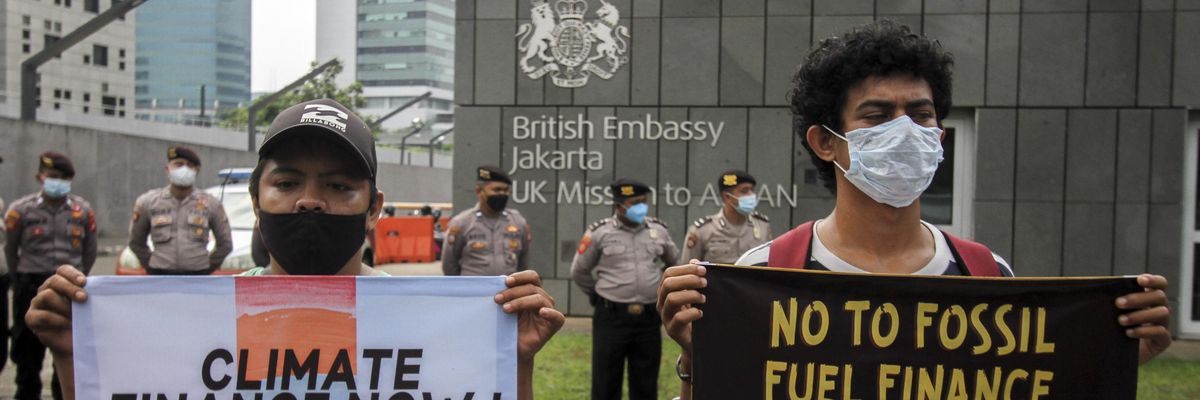
Environment activists hold a demonstration outside the British Embassy in Jakarta, Indonesia on November 3, 2021. (Photo: Eko Siswono Toyudho/Anadolu Agency via Getty Images)
More than 20 countries across the globe--including the U.S., Canada, Finland, Portugal, and Ethiopia--vowed Thursday to cut off public financing for international fossil fuel projects by the end of next year, a pledge climate campaigners hailed as a positive step that must be accompanied by action.
"All governments need to urgently end all support for fossil fuels and ensure a just transition."
The nations' commitment came after research published by Oil Change International and Friends of the Earth U.S. showed that between 2018 and 2020, G20 countries and their multilateral development banks provided at least $63 billion USD per year in international public financing for oil, gas, and coal projects--2.5 times more than they provided for renewable energy.
"Last year at this time, I would not have thought we would see countries commit to ending billions of dollars in support for international fossil fuel projects," Kate DeAngelis, manager of the International Finance Program at Friends of the Earth U.S., said in a statement Thursday. "While this is welcome progress, countries, especially the U.S., must hold firm to these commitments, shutting off the spigot to fossil fuel companies like Pemex and Exxon."
Notably absent from the pledge--which was announced at the COP26 climate summit in Glasgow, Scotland--are some of the world's biggest funders of global fossil fuel projects, including Japan, South Korea, and China. The full list of signatories, including nations and financial institutions, can be viewed here.
While applauding the new commitments as necessary to "stop adding fuel to the fire" of the climate crisis, Laurie van der Burg of Oil Change International told the Washington Post that the pledge must be scrutinized and made as strong as possible to ensure there are no loopholes allowing indirect funding of fossil fuel development.
"Only this way can we avoid the worst climate crisis scenarios," she said.
In May, the International Energy Agency said in a landmark report that governments and banks must stop funding new coal, oil, and gas projects if the world is to reach net zero emissions by 2050.
Released Thursday by the U.K. government, the finance pledge declares:
"Our joint action," the document reads, "is necessary to ensure the world is on an ambitious, clearly defined pathway towards net zero emissions that is consistent with the 1.5degC warming limit and goals of the Paris Agreement, as well as the best available science and technology."
Tasneem Essop, executive director of Climate Action Network International, said in a statement that the new declaration is "a step in the right direction but must be scaled up with more governments and public finance institutions, including the multilateral development banks, committing to end finance for fossil fuels."
"This public money," said Essop, "needs to be urgently redirected into a just energy transition that ensures clean universal energy access for communities in the Global South and support for communities and coal, oil, and gas workers without saddling countries with any further debt."
Speaking to the Post, van der Burg expressed hope that the latest pledge will "lead to the same domino effect that we've seen with coal finance."
This week, dozens of countries joined a global alliance vowing to phase out coal use by the 2030s--the target for developed nations--or the 2040s. As CNBC reported Thursday, "China, India, and the United States, the three biggest burners of coal worldwide, have not signed up."
Katharina Rall, senior environment researcher at Human Rights Watch, said Thursday that the new fossil fuel finance pledge--if fully implemented--would "be an important step toward governments meeting their human rights obligations to address the climate crisis."
"All governments need to urgently end all support for fossil fuels and ensure a just transition to affordable clean energy to help prevent catastrophic climate impacts on human rights," Rall added. "Countries that choose not to sign on... are signaling a lack of regard for their human rights obligations and for the rights of communities around the world already facing a mounting toll from climate impacts."
Dear Common Dreams reader, It’s been nearly 30 years since I co-founded Common Dreams with my late wife, Lina Newhouser. We had the radical notion that journalism should serve the public good, not corporate profits. It was clear to us from the outset what it would take to build such a project. No paid advertisements. No corporate sponsors. No millionaire publisher telling us what to think or do. Many people said we wouldn't last a year, but we proved those doubters wrong. Together with a tremendous team of journalists and dedicated staff, we built an independent media outlet free from the constraints of profits and corporate control. Our mission has always been simple: To inform. To inspire. To ignite change for the common good. Building Common Dreams was not easy. Our survival was never guaranteed. When you take on the most powerful forces—Wall Street greed, fossil fuel industry destruction, Big Tech lobbyists, and uber-rich oligarchs who have spent billions upon billions rigging the economy and democracy in their favor—the only bulwark you have is supporters who believe in your work. But here’s the urgent message from me today. It's never been this bad out there. And it's never been this hard to keep us going. At the very moment Common Dreams is most needed, the threats we face are intensifying. We need your support now more than ever. We don't accept corporate advertising and never will. We don't have a paywall because we don't think people should be blocked from critical news based on their ability to pay. Everything we do is funded by the donations of readers like you. When everyone does the little they can afford, we are strong. But if that support retreats or dries up, so do we. Will you donate now to make sure Common Dreams not only survives but thrives? —Craig Brown, Co-founder |
More than 20 countries across the globe--including the U.S., Canada, Finland, Portugal, and Ethiopia--vowed Thursday to cut off public financing for international fossil fuel projects by the end of next year, a pledge climate campaigners hailed as a positive step that must be accompanied by action.
"All governments need to urgently end all support for fossil fuels and ensure a just transition."
The nations' commitment came after research published by Oil Change International and Friends of the Earth U.S. showed that between 2018 and 2020, G20 countries and their multilateral development banks provided at least $63 billion USD per year in international public financing for oil, gas, and coal projects--2.5 times more than they provided for renewable energy.
"Last year at this time, I would not have thought we would see countries commit to ending billions of dollars in support for international fossil fuel projects," Kate DeAngelis, manager of the International Finance Program at Friends of the Earth U.S., said in a statement Thursday. "While this is welcome progress, countries, especially the U.S., must hold firm to these commitments, shutting off the spigot to fossil fuel companies like Pemex and Exxon."
Notably absent from the pledge--which was announced at the COP26 climate summit in Glasgow, Scotland--are some of the world's biggest funders of global fossil fuel projects, including Japan, South Korea, and China. The full list of signatories, including nations and financial institutions, can be viewed here.
While applauding the new commitments as necessary to "stop adding fuel to the fire" of the climate crisis, Laurie van der Burg of Oil Change International told the Washington Post that the pledge must be scrutinized and made as strong as possible to ensure there are no loopholes allowing indirect funding of fossil fuel development.
"Only this way can we avoid the worst climate crisis scenarios," she said.
In May, the International Energy Agency said in a landmark report that governments and banks must stop funding new coal, oil, and gas projects if the world is to reach net zero emissions by 2050.
Released Thursday by the U.K. government, the finance pledge declares:
"Our joint action," the document reads, "is necessary to ensure the world is on an ambitious, clearly defined pathway towards net zero emissions that is consistent with the 1.5degC warming limit and goals of the Paris Agreement, as well as the best available science and technology."
Tasneem Essop, executive director of Climate Action Network International, said in a statement that the new declaration is "a step in the right direction but must be scaled up with more governments and public finance institutions, including the multilateral development banks, committing to end finance for fossil fuels."
"This public money," said Essop, "needs to be urgently redirected into a just energy transition that ensures clean universal energy access for communities in the Global South and support for communities and coal, oil, and gas workers without saddling countries with any further debt."
Speaking to the Post, van der Burg expressed hope that the latest pledge will "lead to the same domino effect that we've seen with coal finance."
This week, dozens of countries joined a global alliance vowing to phase out coal use by the 2030s--the target for developed nations--or the 2040s. As CNBC reported Thursday, "China, India, and the United States, the three biggest burners of coal worldwide, have not signed up."
Katharina Rall, senior environment researcher at Human Rights Watch, said Thursday that the new fossil fuel finance pledge--if fully implemented--would "be an important step toward governments meeting their human rights obligations to address the climate crisis."
"All governments need to urgently end all support for fossil fuels and ensure a just transition to affordable clean energy to help prevent catastrophic climate impacts on human rights," Rall added. "Countries that choose not to sign on... are signaling a lack of regard for their human rights obligations and for the rights of communities around the world already facing a mounting toll from climate impacts."
More than 20 countries across the globe--including the U.S., Canada, Finland, Portugal, and Ethiopia--vowed Thursday to cut off public financing for international fossil fuel projects by the end of next year, a pledge climate campaigners hailed as a positive step that must be accompanied by action.
"All governments need to urgently end all support for fossil fuels and ensure a just transition."
The nations' commitment came after research published by Oil Change International and Friends of the Earth U.S. showed that between 2018 and 2020, G20 countries and their multilateral development banks provided at least $63 billion USD per year in international public financing for oil, gas, and coal projects--2.5 times more than they provided for renewable energy.
"Last year at this time, I would not have thought we would see countries commit to ending billions of dollars in support for international fossil fuel projects," Kate DeAngelis, manager of the International Finance Program at Friends of the Earth U.S., said in a statement Thursday. "While this is welcome progress, countries, especially the U.S., must hold firm to these commitments, shutting off the spigot to fossil fuel companies like Pemex and Exxon."
Notably absent from the pledge--which was announced at the COP26 climate summit in Glasgow, Scotland--are some of the world's biggest funders of global fossil fuel projects, including Japan, South Korea, and China. The full list of signatories, including nations and financial institutions, can be viewed here.
While applauding the new commitments as necessary to "stop adding fuel to the fire" of the climate crisis, Laurie van der Burg of Oil Change International told the Washington Post that the pledge must be scrutinized and made as strong as possible to ensure there are no loopholes allowing indirect funding of fossil fuel development.
"Only this way can we avoid the worst climate crisis scenarios," she said.
In May, the International Energy Agency said in a landmark report that governments and banks must stop funding new coal, oil, and gas projects if the world is to reach net zero emissions by 2050.
Released Thursday by the U.K. government, the finance pledge declares:
"Our joint action," the document reads, "is necessary to ensure the world is on an ambitious, clearly defined pathway towards net zero emissions that is consistent with the 1.5degC warming limit and goals of the Paris Agreement, as well as the best available science and technology."
Tasneem Essop, executive director of Climate Action Network International, said in a statement that the new declaration is "a step in the right direction but must be scaled up with more governments and public finance institutions, including the multilateral development banks, committing to end finance for fossil fuels."
"This public money," said Essop, "needs to be urgently redirected into a just energy transition that ensures clean universal energy access for communities in the Global South and support for communities and coal, oil, and gas workers without saddling countries with any further debt."
Speaking to the Post, van der Burg expressed hope that the latest pledge will "lead to the same domino effect that we've seen with coal finance."
This week, dozens of countries joined a global alliance vowing to phase out coal use by the 2030s--the target for developed nations--or the 2040s. As CNBC reported Thursday, "China, India, and the United States, the three biggest burners of coal worldwide, have not signed up."
Katharina Rall, senior environment researcher at Human Rights Watch, said Thursday that the new fossil fuel finance pledge--if fully implemented--would "be an important step toward governments meeting their human rights obligations to address the climate crisis."
"All governments need to urgently end all support for fossil fuels and ensure a just transition to affordable clean energy to help prevent catastrophic climate impacts on human rights," Rall added. "Countries that choose not to sign on... are signaling a lack of regard for their human rights obligations and for the rights of communities around the world already facing a mounting toll from climate impacts."