SUBSCRIBE TO OUR FREE NEWSLETTER
Daily news & progressive opinion—funded by the people, not the corporations—delivered straight to your inbox.
5
#000000
#FFFFFF
To donate by check, phone, or other method, see our More Ways to Give page.
Daily news & progressive opinion—funded by the people, not the corporations—delivered straight to your inbox.
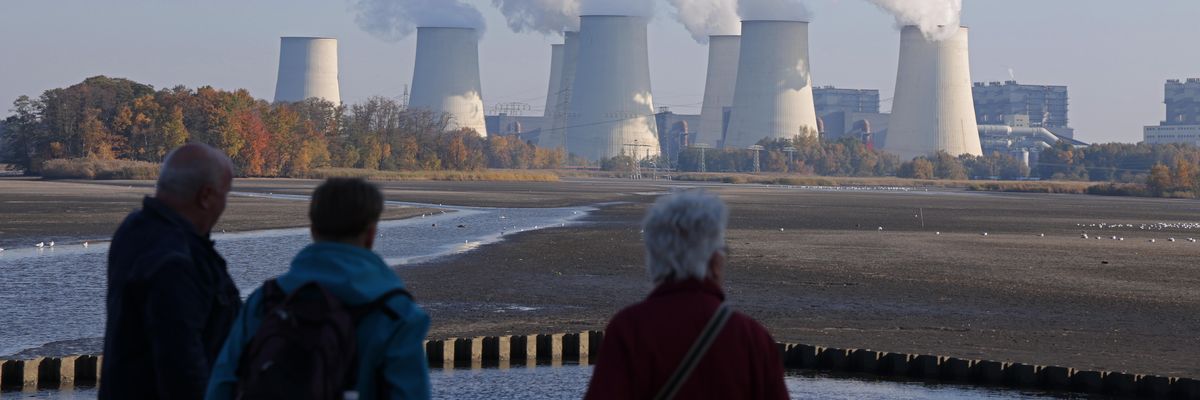
People look at the Jaenschwalde lignite coal-fired power plant, which is among the biggest single emitters of CO2 in Europe, on October 29, 2021, in Peitz, Germany. (Photo: Sean Gallup/Getty Images)
COP26 officials on Thursday are heralding developments they say signal that "the end of coal is in sight"--but advocates for strong climate action suggest holding the applause.
"An agreement that only tackles coal doesn't even solve half the problem."
"Agreed at COP26 is an inadequate agreement that allows coal to continue for nearly 20 more years," tweeted Extinction Rebellion. "But that's excluding major nations who refuse to sign at all."
Among the key developments at the ongoing climate summit in Glasgow, Scotland is the new Global Coal to Clean Power Transition Statement signed by nearly four dozen countries, though notably not the U.S., China, or Australia----among the world's top coal producers.
With the statement, signatories pledge to "make clean power the most affordable and accessible option globally, with ensuing economic and health benefits as we build back better from the Covid pandemic." By signing, countries commit to four specific actions:
A United Nations-led report released last month said that global governments' plans and projections would lead to about 240% more coal in 2030 than would be consistent with meeting the 1.5degC warming limit.
The U.K. government, which is chairing the climate summit, also welcomed the Wednesday addition of 28 new members to the Powering Past Coal Alliance (PPCA), which encourages richer countries to phase out coal by 2030 and other nations by 2050. Neither the U.S. nor Australia is listed as an alliance member.
In an additional development at the summit, over 20 nations, including the U.S., vowed Thursday to stop public financing for international fossil fuel projects, including coal, by the end of next year.
"From the start of the U.K.'s presidency," declared COP26 President Alok Sharma, "we have been clear that COP26 must be the COP that consigns coal to history. With these ambitious commitments we are seeing today, the end of coal power is now within sight."
But Murray Worthy, campaign leader at Global Witness, was far less enthusiastic. He issued a statement reflecting concerns about the agreement to phase out coal power.
"This announcement falls spectacularly short of what this moment requires," he said.
"An agreement that only tackles coal doesn't even solve half the problem," Worthy said, adding that "emissions from oil and gas already far outstrip coal."
Dear Common Dreams reader, It’s been nearly 30 years since I co-founded Common Dreams with my late wife, Lina Newhouser. We had the radical notion that journalism should serve the public good, not corporate profits. It was clear to us from the outset what it would take to build such a project. No paid advertisements. No corporate sponsors. No millionaire publisher telling us what to think or do. Many people said we wouldn't last a year, but we proved those doubters wrong. Together with a tremendous team of journalists and dedicated staff, we built an independent media outlet free from the constraints of profits and corporate control. Our mission has always been simple: To inform. To inspire. To ignite change for the common good. Building Common Dreams was not easy. Our survival was never guaranteed. When you take on the most powerful forces—Wall Street greed, fossil fuel industry destruction, Big Tech lobbyists, and uber-rich oligarchs who have spent billions upon billions rigging the economy and democracy in their favor—the only bulwark you have is supporters who believe in your work. But here’s the urgent message from me today. It's never been this bad out there. And it's never been this hard to keep us going. At the very moment Common Dreams is most needed, the threats we face are intensifying. We need your support now more than ever. We don't accept corporate advertising and never will. We don't have a paywall because we don't think people should be blocked from critical news based on their ability to pay. Everything we do is funded by the donations of readers like you. When everyone does the little they can afford, we are strong. But if that support retreats or dries up, so do we. Will you donate now to make sure Common Dreams not only survives but thrives? —Craig Brown, Co-founder |
COP26 officials on Thursday are heralding developments they say signal that "the end of coal is in sight"--but advocates for strong climate action suggest holding the applause.
"An agreement that only tackles coal doesn't even solve half the problem."
"Agreed at COP26 is an inadequate agreement that allows coal to continue for nearly 20 more years," tweeted Extinction Rebellion. "But that's excluding major nations who refuse to sign at all."
Among the key developments at the ongoing climate summit in Glasgow, Scotland is the new Global Coal to Clean Power Transition Statement signed by nearly four dozen countries, though notably not the U.S., China, or Australia----among the world's top coal producers.
With the statement, signatories pledge to "make clean power the most affordable and accessible option globally, with ensuing economic and health benefits as we build back better from the Covid pandemic." By signing, countries commit to four specific actions:
A United Nations-led report released last month said that global governments' plans and projections would lead to about 240% more coal in 2030 than would be consistent with meeting the 1.5degC warming limit.
The U.K. government, which is chairing the climate summit, also welcomed the Wednesday addition of 28 new members to the Powering Past Coal Alliance (PPCA), which encourages richer countries to phase out coal by 2030 and other nations by 2050. Neither the U.S. nor Australia is listed as an alliance member.
In an additional development at the summit, over 20 nations, including the U.S., vowed Thursday to stop public financing for international fossil fuel projects, including coal, by the end of next year.
"From the start of the U.K.'s presidency," declared COP26 President Alok Sharma, "we have been clear that COP26 must be the COP that consigns coal to history. With these ambitious commitments we are seeing today, the end of coal power is now within sight."
But Murray Worthy, campaign leader at Global Witness, was far less enthusiastic. He issued a statement reflecting concerns about the agreement to phase out coal power.
"This announcement falls spectacularly short of what this moment requires," he said.
"An agreement that only tackles coal doesn't even solve half the problem," Worthy said, adding that "emissions from oil and gas already far outstrip coal."
COP26 officials on Thursday are heralding developments they say signal that "the end of coal is in sight"--but advocates for strong climate action suggest holding the applause.
"An agreement that only tackles coal doesn't even solve half the problem."
"Agreed at COP26 is an inadequate agreement that allows coal to continue for nearly 20 more years," tweeted Extinction Rebellion. "But that's excluding major nations who refuse to sign at all."
Among the key developments at the ongoing climate summit in Glasgow, Scotland is the new Global Coal to Clean Power Transition Statement signed by nearly four dozen countries, though notably not the U.S., China, or Australia----among the world's top coal producers.
With the statement, signatories pledge to "make clean power the most affordable and accessible option globally, with ensuing economic and health benefits as we build back better from the Covid pandemic." By signing, countries commit to four specific actions:
A United Nations-led report released last month said that global governments' plans and projections would lead to about 240% more coal in 2030 than would be consistent with meeting the 1.5degC warming limit.
The U.K. government, which is chairing the climate summit, also welcomed the Wednesday addition of 28 new members to the Powering Past Coal Alliance (PPCA), which encourages richer countries to phase out coal by 2030 and other nations by 2050. Neither the U.S. nor Australia is listed as an alliance member.
In an additional development at the summit, over 20 nations, including the U.S., vowed Thursday to stop public financing for international fossil fuel projects, including coal, by the end of next year.
"From the start of the U.K.'s presidency," declared COP26 President Alok Sharma, "we have been clear that COP26 must be the COP that consigns coal to history. With these ambitious commitments we are seeing today, the end of coal power is now within sight."
But Murray Worthy, campaign leader at Global Witness, was far less enthusiastic. He issued a statement reflecting concerns about the agreement to phase out coal power.
"This announcement falls spectacularly short of what this moment requires," he said.
"An agreement that only tackles coal doesn't even solve half the problem," Worthy said, adding that "emissions from oil and gas already far outstrip coal."