SUBSCRIBE TO OUR FREE NEWSLETTER
Daily news & progressive opinion—funded by the people, not the corporations—delivered straight to your inbox.
5
#000000
#FFFFFF
To donate by check, phone, or other method, see our More Ways to Give page.
Daily news & progressive opinion—funded by the people, not the corporations—delivered straight to your inbox.
A woman carries bucket of water on improvised bridge over dry land alongside the Amazon River at Bom Jesus village at the margin of Solimoes river in Amazonas State, Brazil. (Photo: Jose Caldas/Brazil Photos/LightRocket via Getty Images)
"Governments' failure to act on climate change in the face of overwhelming scientific evidence may well be the biggest intergenerational human rights violation in history."
--Agnes Callamard, Amnesty International
"These trends compel people into displacement, aggravate conflicts and political instability, and fuel recruitment by violent extremist groups," said Bachelet. "In such a situation it should be clear that there can be no purely military solution to the conflicts in the region."
Environmental threats have led to the displacement of four million people across the Sahel region, according to the U.N., with the Office for the Coordination of Humanitarian Affairs (OCHA) saying the area is facing "an exceptional crisis."
The commissioner also identified countries including China, India, and Bangladesh as facing widespread "disaster displacement," with 20 million people in Bangladesh expected to be forced from their homes by 2050 as 17% of the country becomes "submerged by rising sea levels."
"Forecasts of this gravity and impact--including on displacement--cannot be ignored by any policymaker, anywhere," Bachelet said. "They will have cascading economic, social, cultural, and political effects that will impact every society in the world."
In addition to the long-term effects of drought and the heating of the planet driven by continued fossil fuel extraction, the commissioner noted that air pollution--"fueled by the same patterns of unsustainable consumption and production as climate change"--is responsible for an estimated one in six of all premature deaths around the world.
The 33 countries found to be at "extremely high risk" for hazards including air pollution, according to a report issued by UNICEF last month, emit only 9% of global carbon emissions and are home to 2.2 billion children--meaning those countries least responsible for the climate crisis are most at risk for the human rights threats it is causing.
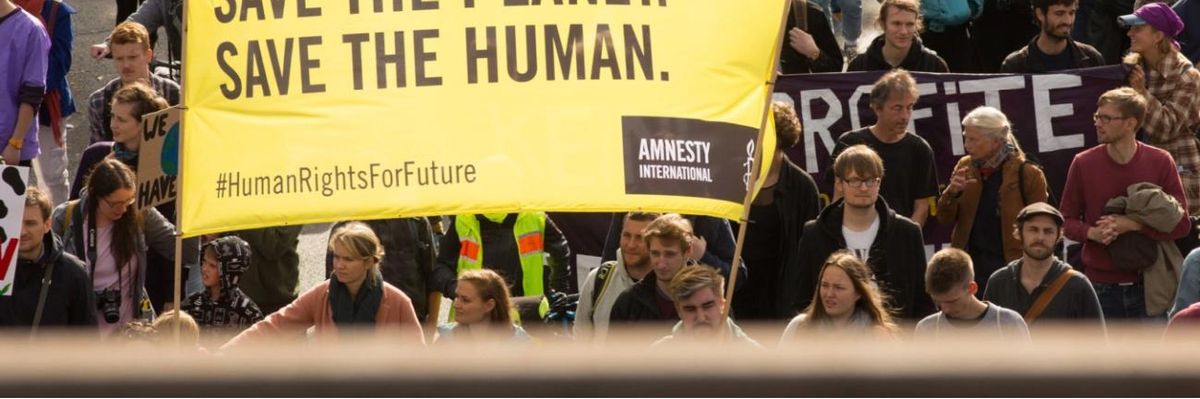
As Bachelet made her statement on the climate emergency's effect on human rights, Amnesty International joined more than 1,000 civil society groups in calling on the Human Rights Council to "recognize a safe, clean, healthy, and sustainable environment as a universal human right."
"Governments' failure to act on climate change in the face of overwhelming scientific evidence may well be the biggest intergenerational human rights violation in history," said Agnes Callamard, secretary general of Amnesty International. "As the primary global human rights body, the HRC must use all the tools at its disposal to counter the crisis. We call on all states to support recognition of the right to a healthy environment, at the U.N. and at national level. Those who do not will be on the wrong side of history and standing against the common future of humanity."
Bachelet looked ahead to the 2021 U.N. Climate Change Conference (COP 26), taking place in Glasgow, Scotland in November, where she said she will be "strongly advocating more ambitious, rights-based and inclusive climate action."
The commissioner's statement amplified a call from more than 100 nations in the Global South earlier this year in which government officials and experts demanded $100 billion in climate financing and net-zero emissions targets "with end-dates well before 2050" in order to "take responsibility" for rich nations' disproportionate role in causing the planetary emergency.
"States' human rights obligations require them to cooperate toward the progressive realization of human rights globally, and this clearly should include adequate financing by those who can best afford it of climate change mitigation, adaptation, and loss and damage," said Bachelet.
Dear Common Dreams reader, It’s been nearly 30 years since I co-founded Common Dreams with my late wife, Lina Newhouser. We had the radical notion that journalism should serve the public good, not corporate profits. It was clear to us from the outset what it would take to build such a project. No paid advertisements. No corporate sponsors. No millionaire publisher telling us what to think or do. Many people said we wouldn't last a year, but we proved those doubters wrong. Together with a tremendous team of journalists and dedicated staff, we built an independent media outlet free from the constraints of profits and corporate control. Our mission has always been simple: To inform. To inspire. To ignite change for the common good. Building Common Dreams was not easy. Our survival was never guaranteed. When you take on the most powerful forces—Wall Street greed, fossil fuel industry destruction, Big Tech lobbyists, and uber-rich oligarchs who have spent billions upon billions rigging the economy and democracy in their favor—the only bulwark you have is supporters who believe in your work. But here’s the urgent message from me today. It's never been this bad out there. And it's never been this hard to keep us going. At the very moment Common Dreams is most needed, the threats we face are intensifying. We need your support now more than ever. We don't accept corporate advertising and never will. We don't have a paywall because we don't think people should be blocked from critical news based on their ability to pay. Everything we do is funded by the donations of readers like you. When everyone does the little they can afford, we are strong. But if that support retreats or dries up, so do we. Will you donate now to make sure Common Dreams not only survives but thrives? —Craig Brown, Co-founder |
"Governments' failure to act on climate change in the face of overwhelming scientific evidence may well be the biggest intergenerational human rights violation in history."
--Agnes Callamard, Amnesty International
"These trends compel people into displacement, aggravate conflicts and political instability, and fuel recruitment by violent extremist groups," said Bachelet. "In such a situation it should be clear that there can be no purely military solution to the conflicts in the region."
Environmental threats have led to the displacement of four million people across the Sahel region, according to the U.N., with the Office for the Coordination of Humanitarian Affairs (OCHA) saying the area is facing "an exceptional crisis."
The commissioner also identified countries including China, India, and Bangladesh as facing widespread "disaster displacement," with 20 million people in Bangladesh expected to be forced from their homes by 2050 as 17% of the country becomes "submerged by rising sea levels."
"Forecasts of this gravity and impact--including on displacement--cannot be ignored by any policymaker, anywhere," Bachelet said. "They will have cascading economic, social, cultural, and political effects that will impact every society in the world."
In addition to the long-term effects of drought and the heating of the planet driven by continued fossil fuel extraction, the commissioner noted that air pollution--"fueled by the same patterns of unsustainable consumption and production as climate change"--is responsible for an estimated one in six of all premature deaths around the world.
The 33 countries found to be at "extremely high risk" for hazards including air pollution, according to a report issued by UNICEF last month, emit only 9% of global carbon emissions and are home to 2.2 billion children--meaning those countries least responsible for the climate crisis are most at risk for the human rights threats it is causing.
As Bachelet made her statement on the climate emergency's effect on human rights, Amnesty International joined more than 1,000 civil society groups in calling on the Human Rights Council to "recognize a safe, clean, healthy, and sustainable environment as a universal human right."
"Governments' failure to act on climate change in the face of overwhelming scientific evidence may well be the biggest intergenerational human rights violation in history," said Agnes Callamard, secretary general of Amnesty International. "As the primary global human rights body, the HRC must use all the tools at its disposal to counter the crisis. We call on all states to support recognition of the right to a healthy environment, at the U.N. and at national level. Those who do not will be on the wrong side of history and standing against the common future of humanity."
Bachelet looked ahead to the 2021 U.N. Climate Change Conference (COP 26), taking place in Glasgow, Scotland in November, where she said she will be "strongly advocating more ambitious, rights-based and inclusive climate action."
The commissioner's statement amplified a call from more than 100 nations in the Global South earlier this year in which government officials and experts demanded $100 billion in climate financing and net-zero emissions targets "with end-dates well before 2050" in order to "take responsibility" for rich nations' disproportionate role in causing the planetary emergency.
"States' human rights obligations require them to cooperate toward the progressive realization of human rights globally, and this clearly should include adequate financing by those who can best afford it of climate change mitigation, adaptation, and loss and damage," said Bachelet.
"Governments' failure to act on climate change in the face of overwhelming scientific evidence may well be the biggest intergenerational human rights violation in history."
--Agnes Callamard, Amnesty International
"These trends compel people into displacement, aggravate conflicts and political instability, and fuel recruitment by violent extremist groups," said Bachelet. "In such a situation it should be clear that there can be no purely military solution to the conflicts in the region."
Environmental threats have led to the displacement of four million people across the Sahel region, according to the U.N., with the Office for the Coordination of Humanitarian Affairs (OCHA) saying the area is facing "an exceptional crisis."
The commissioner also identified countries including China, India, and Bangladesh as facing widespread "disaster displacement," with 20 million people in Bangladesh expected to be forced from their homes by 2050 as 17% of the country becomes "submerged by rising sea levels."
"Forecasts of this gravity and impact--including on displacement--cannot be ignored by any policymaker, anywhere," Bachelet said. "They will have cascading economic, social, cultural, and political effects that will impact every society in the world."
In addition to the long-term effects of drought and the heating of the planet driven by continued fossil fuel extraction, the commissioner noted that air pollution--"fueled by the same patterns of unsustainable consumption and production as climate change"--is responsible for an estimated one in six of all premature deaths around the world.
The 33 countries found to be at "extremely high risk" for hazards including air pollution, according to a report issued by UNICEF last month, emit only 9% of global carbon emissions and are home to 2.2 billion children--meaning those countries least responsible for the climate crisis are most at risk for the human rights threats it is causing.
As Bachelet made her statement on the climate emergency's effect on human rights, Amnesty International joined more than 1,000 civil society groups in calling on the Human Rights Council to "recognize a safe, clean, healthy, and sustainable environment as a universal human right."
"Governments' failure to act on climate change in the face of overwhelming scientific evidence may well be the biggest intergenerational human rights violation in history," said Agnes Callamard, secretary general of Amnesty International. "As the primary global human rights body, the HRC must use all the tools at its disposal to counter the crisis. We call on all states to support recognition of the right to a healthy environment, at the U.N. and at national level. Those who do not will be on the wrong side of history and standing against the common future of humanity."
Bachelet looked ahead to the 2021 U.N. Climate Change Conference (COP 26), taking place in Glasgow, Scotland in November, where she said she will be "strongly advocating more ambitious, rights-based and inclusive climate action."
The commissioner's statement amplified a call from more than 100 nations in the Global South earlier this year in which government officials and experts demanded $100 billion in climate financing and net-zero emissions targets "with end-dates well before 2050" in order to "take responsibility" for rich nations' disproportionate role in causing the planetary emergency.
"States' human rights obligations require them to cooperate toward the progressive realization of human rights globally, and this clearly should include adequate financing by those who can best afford it of climate change mitigation, adaptation, and loss and damage," said Bachelet.