SUBSCRIBE TO OUR FREE NEWSLETTER
Daily news & progressive opinion—funded by the people, not the corporations—delivered straight to your inbox.
5
#000000
#FFFFFF
To donate by check, phone, or other method, see our More Ways to Give page.
Daily news & progressive opinion—funded by the people, not the corporations—delivered straight to your inbox.
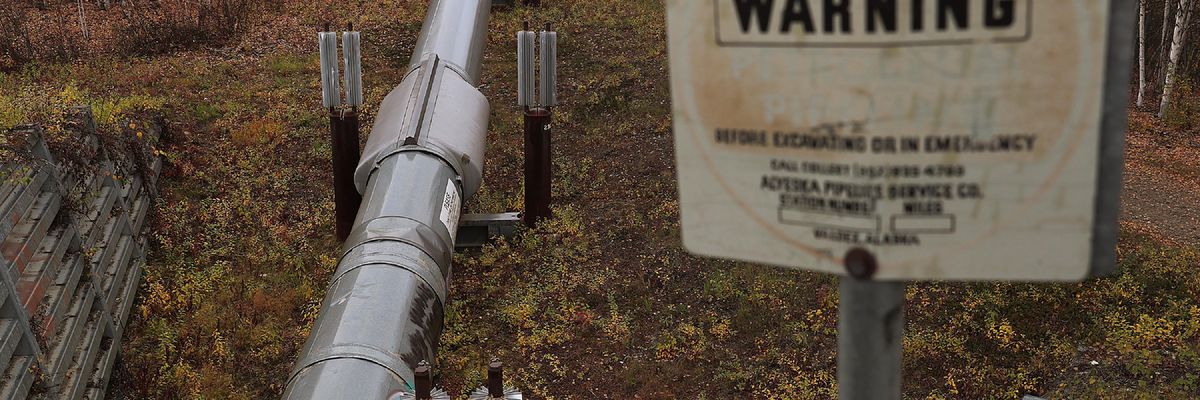
A part of the Trans Alaska Pipeline System is seen on September 17, 2019 in Fairbanks, Alaska. (Photo: Joe Raedle/Getty Images)
A federal judge on Wednesday tossed out construction permits for a sprawling, multibillion-dollar Alaska oil drilling project that the Trump administration approved and the Biden Interior Department defended in court earlier this year, infuriating Indigenous groups, climate advocates, and scientists.
In a 110-page decision (pdf), Judge Sharon Gleason of the U.S. District Court for Alaska ruled that the Trump administration failed to adequately consider the climate impacts of the Willow Project, which--if completed--would produce up to 160,000 barrels of oil a day over a 30-year period.
"We are hopeful that the administration won't give the fossil fuel industry another chance to carve up this irreplaceable Arctic landscape with drilling rigs, roads, and pipelines."
--Jeremy Lieb, Earthjustice
Specifically, Gleason deemed "arbitrary and capricious" the Bureau of Land Management's failure to include potential greenhouse gas emissions from foreign oil consumption in its analysis of the project, which was planned by ConocoPhillips. Gleason also faulted the U.S. Fish and Wildlife Service for not detailing how polar bears would be protected from the massive fossil fuel initiative, which would include the construction of several new oil drilling sites and hundreds of miles of pipeline.
A spokesperson for ConocoPhillips said the company intends to weigh its options in the wake of the judge's decision, which environmentalists hailed as a "resounding win" for the climate.
"We were very surprised to see the Biden administration, which has promised historic progress on climate change, defending this plan in court--but today's decision gives the administration the opportunity to reconsider the project in light of its commitment to address the climate emergency," Earthjustice attorney Jeremy Lieb said in a statement. "We are hopeful that the administration won't give the fossil fuel industry another chance to carve up this irreplaceable Arctic landscape with drilling rigs, roads, and pipelines."
"We must keep Arctic oil in the ground if we want a livable planet for future generations," Lieb added.
Kristen Miller, acting executive director at the Alaska Wilderness League, said Gleason's ruling vindicates environmentalists' warnings that "the Trump bureau downplayed the significance of climate change, underestimated emissions, and ignored the concerns of local Indigenous communities toward increased oil and gas extraction in the region."
"The Biden administration must now review Willow with a fresh eye," said Miller. "The reality is that a massive oil project like Willow, so close to local communities and projected to emit hundreds of millions of metric tons of CO2 into the atmosphere over the course of its lifetime, moves us away from our nation's long-term climate and environmental justice goals and simply should not move forward."
The Willow decision comes as the Biden administration is facing mounting criticism from lawmakers for shielding major fossil fuel projects from legal challenges. In recent weeks, scientists have made increasingly clear that oil and gas extraction must stop immediately if the worst of the climate crisis is to be averted.
On Monday, dozens of Democratic members of Congress sent a letter imploring President Joe Biden to revoke permits for Line 3, a major pipeline project that would damage the climate as much as 50 new coal-fired power plants.
"President Biden: please quit greenlighting fossil fuel projects!" Sen. Jeff Merkley (D-Ore.), one of the lawmakers who led the Line 3 letter, tweeted last week. "This must stop."
Dear Common Dreams reader, It’s been nearly 30 years since I co-founded Common Dreams with my late wife, Lina Newhouser. We had the radical notion that journalism should serve the public good, not corporate profits. It was clear to us from the outset what it would take to build such a project. No paid advertisements. No corporate sponsors. No millionaire publisher telling us what to think or do. Many people said we wouldn't last a year, but we proved those doubters wrong. Together with a tremendous team of journalists and dedicated staff, we built an independent media outlet free from the constraints of profits and corporate control. Our mission has always been simple: To inform. To inspire. To ignite change for the common good. Building Common Dreams was not easy. Our survival was never guaranteed. When you take on the most powerful forces—Wall Street greed, fossil fuel industry destruction, Big Tech lobbyists, and uber-rich oligarchs who have spent billions upon billions rigging the economy and democracy in their favor—the only bulwark you have is supporters who believe in your work. But here’s the urgent message from me today. It's never been this bad out there. And it's never been this hard to keep us going. At the very moment Common Dreams is most needed, the threats we face are intensifying. We need your support now more than ever. We don't accept corporate advertising and never will. We don't have a paywall because we don't think people should be blocked from critical news based on their ability to pay. Everything we do is funded by the donations of readers like you. When everyone does the little they can afford, we are strong. But if that support retreats or dries up, so do we. Will you donate now to make sure Common Dreams not only survives but thrives? —Craig Brown, Co-founder |
A federal judge on Wednesday tossed out construction permits for a sprawling, multibillion-dollar Alaska oil drilling project that the Trump administration approved and the Biden Interior Department defended in court earlier this year, infuriating Indigenous groups, climate advocates, and scientists.
In a 110-page decision (pdf), Judge Sharon Gleason of the U.S. District Court for Alaska ruled that the Trump administration failed to adequately consider the climate impacts of the Willow Project, which--if completed--would produce up to 160,000 barrels of oil a day over a 30-year period.
"We are hopeful that the administration won't give the fossil fuel industry another chance to carve up this irreplaceable Arctic landscape with drilling rigs, roads, and pipelines."
--Jeremy Lieb, Earthjustice
Specifically, Gleason deemed "arbitrary and capricious" the Bureau of Land Management's failure to include potential greenhouse gas emissions from foreign oil consumption in its analysis of the project, which was planned by ConocoPhillips. Gleason also faulted the U.S. Fish and Wildlife Service for not detailing how polar bears would be protected from the massive fossil fuel initiative, which would include the construction of several new oil drilling sites and hundreds of miles of pipeline.
A spokesperson for ConocoPhillips said the company intends to weigh its options in the wake of the judge's decision, which environmentalists hailed as a "resounding win" for the climate.
"We were very surprised to see the Biden administration, which has promised historic progress on climate change, defending this plan in court--but today's decision gives the administration the opportunity to reconsider the project in light of its commitment to address the climate emergency," Earthjustice attorney Jeremy Lieb said in a statement. "We are hopeful that the administration won't give the fossil fuel industry another chance to carve up this irreplaceable Arctic landscape with drilling rigs, roads, and pipelines."
"We must keep Arctic oil in the ground if we want a livable planet for future generations," Lieb added.
Kristen Miller, acting executive director at the Alaska Wilderness League, said Gleason's ruling vindicates environmentalists' warnings that "the Trump bureau downplayed the significance of climate change, underestimated emissions, and ignored the concerns of local Indigenous communities toward increased oil and gas extraction in the region."
"The Biden administration must now review Willow with a fresh eye," said Miller. "The reality is that a massive oil project like Willow, so close to local communities and projected to emit hundreds of millions of metric tons of CO2 into the atmosphere over the course of its lifetime, moves us away from our nation's long-term climate and environmental justice goals and simply should not move forward."
The Willow decision comes as the Biden administration is facing mounting criticism from lawmakers for shielding major fossil fuel projects from legal challenges. In recent weeks, scientists have made increasingly clear that oil and gas extraction must stop immediately if the worst of the climate crisis is to be averted.
On Monday, dozens of Democratic members of Congress sent a letter imploring President Joe Biden to revoke permits for Line 3, a major pipeline project that would damage the climate as much as 50 new coal-fired power plants.
"President Biden: please quit greenlighting fossil fuel projects!" Sen. Jeff Merkley (D-Ore.), one of the lawmakers who led the Line 3 letter, tweeted last week. "This must stop."
A federal judge on Wednesday tossed out construction permits for a sprawling, multibillion-dollar Alaska oil drilling project that the Trump administration approved and the Biden Interior Department defended in court earlier this year, infuriating Indigenous groups, climate advocates, and scientists.
In a 110-page decision (pdf), Judge Sharon Gleason of the U.S. District Court for Alaska ruled that the Trump administration failed to adequately consider the climate impacts of the Willow Project, which--if completed--would produce up to 160,000 barrels of oil a day over a 30-year period.
"We are hopeful that the administration won't give the fossil fuel industry another chance to carve up this irreplaceable Arctic landscape with drilling rigs, roads, and pipelines."
--Jeremy Lieb, Earthjustice
Specifically, Gleason deemed "arbitrary and capricious" the Bureau of Land Management's failure to include potential greenhouse gas emissions from foreign oil consumption in its analysis of the project, which was planned by ConocoPhillips. Gleason also faulted the U.S. Fish and Wildlife Service for not detailing how polar bears would be protected from the massive fossil fuel initiative, which would include the construction of several new oil drilling sites and hundreds of miles of pipeline.
A spokesperson for ConocoPhillips said the company intends to weigh its options in the wake of the judge's decision, which environmentalists hailed as a "resounding win" for the climate.
"We were very surprised to see the Biden administration, which has promised historic progress on climate change, defending this plan in court--but today's decision gives the administration the opportunity to reconsider the project in light of its commitment to address the climate emergency," Earthjustice attorney Jeremy Lieb said in a statement. "We are hopeful that the administration won't give the fossil fuel industry another chance to carve up this irreplaceable Arctic landscape with drilling rigs, roads, and pipelines."
"We must keep Arctic oil in the ground if we want a livable planet for future generations," Lieb added.
Kristen Miller, acting executive director at the Alaska Wilderness League, said Gleason's ruling vindicates environmentalists' warnings that "the Trump bureau downplayed the significance of climate change, underestimated emissions, and ignored the concerns of local Indigenous communities toward increased oil and gas extraction in the region."
"The Biden administration must now review Willow with a fresh eye," said Miller. "The reality is that a massive oil project like Willow, so close to local communities and projected to emit hundreds of millions of metric tons of CO2 into the atmosphere over the course of its lifetime, moves us away from our nation's long-term climate and environmental justice goals and simply should not move forward."
The Willow decision comes as the Biden administration is facing mounting criticism from lawmakers for shielding major fossil fuel projects from legal challenges. In recent weeks, scientists have made increasingly clear that oil and gas extraction must stop immediately if the worst of the climate crisis is to be averted.
On Monday, dozens of Democratic members of Congress sent a letter imploring President Joe Biden to revoke permits for Line 3, a major pipeline project that would damage the climate as much as 50 new coal-fired power plants.
"President Biden: please quit greenlighting fossil fuel projects!" Sen. Jeff Merkley (D-Ore.), one of the lawmakers who led the Line 3 letter, tweeted last week. "This must stop."