SUBSCRIBE TO OUR FREE NEWSLETTER
Daily news & progressive opinion—funded by the people, not the corporations—delivered straight to your inbox.
5
#000000
#FFFFFF
To donate by check, phone, or other method, see our More Ways to Give page.
Daily news & progressive opinion—funded by the people, not the corporations—delivered straight to your inbox.
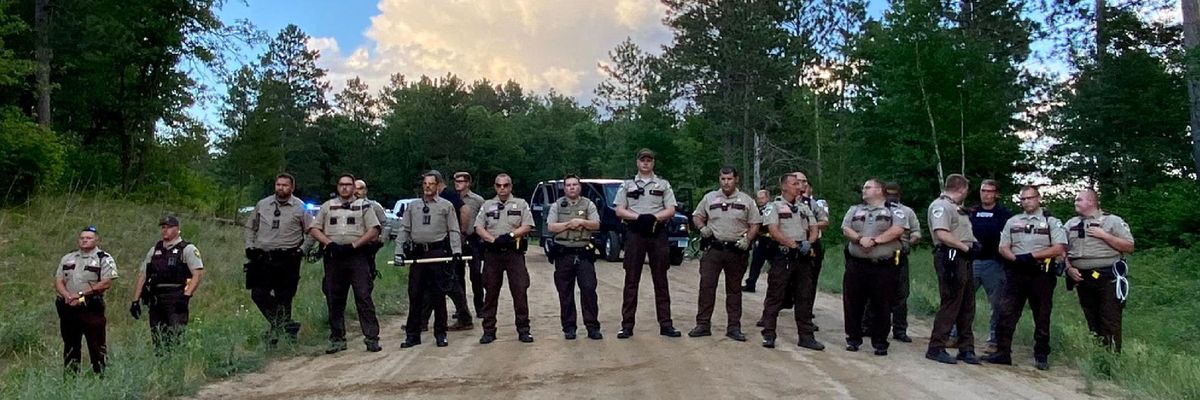
Since June 28, 2021, police in Minnesota have blockaded a driveway to an Indigenous camp of water protectors protesting the Line 3 pipeline. (Photo: Giniw Collective)
Water protectors fighting against Enbridge's Line 3 tar sands pipeline in Minnesota filed suit Friday to stop a police blockade of a camp they use for Indigenous-led organizing, decolonization, and treaty rights trainings as well as religious activities.
The plaintiffs, including Indigenous leaders Tara Houska and Winona LaDuke, are taking legal action in response to the Hubbard County Sheriff Office's ongoing blockade of the private property, which police unexpectedly began late last month. The complaint names the county, Sheriff Corwin "Cory" Aukes, and Mark Lohmeier, the local land commissioner, as defendants.
"The Hubbard County Sheriff has attempted to illegally construct a de facto open-air prison to trap Indigenous environmental protectors and allies on their own property and to prevent others from joining in decolonization and treaty rights trainings and organizing against Enbridge's Line 3 pipeline," said attorney Mara Verheyden-Hilliard in a statement.
Verheyden-Hilliard is legal counsel and director of the Center for Protest Law and Litigation, a project of the Partnership for Civil Justice Fund. The center and EarthRights International are representing the plaintiffs, who are seeking relief related to a relevant easement, the blockade notice, and citations issued by officers blocking the driveway to the Namewag Camp.
"This is an overtly political military-style blockade and checkpoint system being deployed with funding from the Enbridge corporation using the power of the state against its environmental opponents," said Verheyden-Hilliard, referencing that law enforcement agencies in several Minnesota counties have been reimbursed for policing costs related to the pipeline protests.
The arrangement, which the Minnesota Public Utilities Commission mandated when approving the Canadian company's Line 3 proposal in 2018, has outraged activists on the ground.
"You have a foreign company funding the police in northern Minnesota and incentivizing the repression of citizens," LaDuke, executive director of Honor the Earth, told the Star Tribune in April. "They basically have taken your police force and turned it into their security force."
Houska, founder of the Giniw Collective, lives at the camp. She detailed some of the experiences she and others have endured while trying to come and go in recent weeks.
"Hubbard County showing up at a private Indigenous home with a riot line was obscene. They arrested 12 people, violently in some cases," she said Friday. "Being thrown into the dirt of our driveway and cuffed is a gross abuse of power that sets a dangerous precedent for all private landowners."
"At one point, there were almost 50 squad cars on the dirt road in front of our home, sheriffs in the woods, sheriffs pushing forward in our driveway--I prepared myself to go into our sweat lodge, next to our gardens, and be dragged out that way," Houska continued. "Nobody should ever have to do that."
"Shame on Hubbard County, shame on Minnesota, and shame on public servants who have clearly forgotten who their duty is owed to--Enbridge is a foreign corporation sucking Minnesota's rivers dry, violating Anishinaabe treaty rights, and colluding financially with Minnesota's police force," she added. "What part of any of that is in the public interest?"
As Line 3 has faced various legal challenges and opponents of the project--a replacement for an old pipeline with lower capacity--have pressured both Democratic Gov. Tim Walz and President Joe Biden to block it, Indigenous people and climate activists have held peaceful protests in Minnesota, sometimes engaging in civil disobedience that has temporarily halted construction.
The Intercept reported earlier this month that "Namewag is focused on direct actions like locking down to equipment or holding sit-ins at construction sites. Direct actions and other protests against Line 3 have seen more than 500 people arrested or issued citations."
Houska emphasized the necessity of such actions at this stage of the project, telling The Intercept that "if it were not for the hundreds of people that have been arrested fighting Line 3 so far, there's no way--we wouldn't have national news outlets out here covering this story."
Friday's complaint also addresses the purpose of the camp and its residents:
Currently, the property and structures located there are the home of Namewag Camp, a cultural, political, spiritual, and communal camp. It is led by Indigenous women and two-spirit individuals (an Indigenous community nonbinary identity) and is intended to protect Mother Earth, defend the sacred, and live in-balance. The tenants' focus is on systemic change that respects Indigenous sovereignty and the severity of the climate crisis. These tenants and their invitees oppose the construction of the Enbridge Line 3 pipeline which violates the treaty rights of Anishinaabe peoples and nations in its path and desecrates and irreparably harms the Earth.
Namewag Camp is run communally and does not rely on public electric or water resources; it runs on solar power and tenants bring water, food, and other necessities to the property by vehicle. The emergency legal action argues that the police blockade violates private property rights, including an easement covering a driveway that has existed for more than 50 years.
On the morning of June 28, "multiple squad cars from Hubbard County Sheriff's Office arrived to suddenly inform the occupants of the property that the driveway would soon be blockaded," the complaint says, alleging that officers started limiting access to the property more than an hour before the time on the official notice, which was signed by Aukes and Lohmeier.
Accusing Aukes of mounting "what might be the state's most militarized response to an easement dispute in history," the filing says that "the overuse and display of force and authority without notice reflects the reality that this was nothing less than an overt political blockade using the power of the state to disrupt and penalize opposition to the building and expansion of the Enbridge pipeline."
"The property is now landlocked either by law enforcement's physical blockade of access or by law enforcement's issuance of citations, criminalizing and penalizing access to the property," the complaint notes, explaining that the driveway "is the only connection to the only available road."
The legal groups representing the plaintiffs framed the blockade in Hubbard County as "an escalation of a monthslong unlawful campaign of harassment, arrests, disruption, surveillance, and baseless pullovers of Indigenous water protectors and land defenders and their allies who oppose the Line 3 pipeline expansion."
As Marco Simons, general counsel at EarthRights, put it: "Indigenous communities, who have fought in the courts, through public protests and civil disobedience, to halt construction of Line 3 have explicitly stated that they do not want this pipeline anywhere near their protected lands."
"We must put a stop to this blatant display of environmental racism and listen to these communities," he said. "Moreover, we must also examine the unlawful and discriminatory policing tactics against these protestors, who have the constitutional right to protest the expansion of Line 3."
As a part of an effort to put pressure on Acting Assistant Secretary of the Army for Civil Works Jaime Pinkham and the Army Corps of Engineers, Line 3 opponents are planning to project First Daughter and the Black Snake--an award-winning documentary by Keri Pickett, featuring LaDuke--on the corps' Washington, D.C. headquarters on Saturday.
"It is time for the Biden administration and the Army Corps of Engineers to recognize the reality of the climate crisis," LaDuke said Friday. "We cannot afford another risky fossil fuel pipeline tearing through our Earth, water, and sacred wild rice beds. This is a matter of life and death for our people, and our planet."
"We want the administration to stop the human rights violations and protect our future generations," she said. "We are asking the president and Jaime Pinkham to intervene on behalf of the First Nations and the Indigenous people whose human rights are being violated and stop the Line 3 pipeline."
Dear Common Dreams reader, It’s been nearly 30 years since I co-founded Common Dreams with my late wife, Lina Newhouser. We had the radical notion that journalism should serve the public good, not corporate profits. It was clear to us from the outset what it would take to build such a project. No paid advertisements. No corporate sponsors. No millionaire publisher telling us what to think or do. Many people said we wouldn't last a year, but we proved those doubters wrong. Together with a tremendous team of journalists and dedicated staff, we built an independent media outlet free from the constraints of profits and corporate control. Our mission has always been simple: To inform. To inspire. To ignite change for the common good. Building Common Dreams was not easy. Our survival was never guaranteed. When you take on the most powerful forces—Wall Street greed, fossil fuel industry destruction, Big Tech lobbyists, and uber-rich oligarchs who have spent billions upon billions rigging the economy and democracy in their favor—the only bulwark you have is supporters who believe in your work. But here’s the urgent message from me today. It's never been this bad out there. And it's never been this hard to keep us going. At the very moment Common Dreams is most needed, the threats we face are intensifying. We need your support now more than ever. We don't accept corporate advertising and never will. We don't have a paywall because we don't think people should be blocked from critical news based on their ability to pay. Everything we do is funded by the donations of readers like you. When everyone does the little they can afford, we are strong. But if that support retreats or dries up, so do we. Will you donate now to make sure Common Dreams not only survives but thrives? —Craig Brown, Co-founder |
Water protectors fighting against Enbridge's Line 3 tar sands pipeline in Minnesota filed suit Friday to stop a police blockade of a camp they use for Indigenous-led organizing, decolonization, and treaty rights trainings as well as religious activities.
The plaintiffs, including Indigenous leaders Tara Houska and Winona LaDuke, are taking legal action in response to the Hubbard County Sheriff Office's ongoing blockade of the private property, which police unexpectedly began late last month. The complaint names the county, Sheriff Corwin "Cory" Aukes, and Mark Lohmeier, the local land commissioner, as defendants.
"The Hubbard County Sheriff has attempted to illegally construct a de facto open-air prison to trap Indigenous environmental protectors and allies on their own property and to prevent others from joining in decolonization and treaty rights trainings and organizing against Enbridge's Line 3 pipeline," said attorney Mara Verheyden-Hilliard in a statement.
Verheyden-Hilliard is legal counsel and director of the Center for Protest Law and Litigation, a project of the Partnership for Civil Justice Fund. The center and EarthRights International are representing the plaintiffs, who are seeking relief related to a relevant easement, the blockade notice, and citations issued by officers blocking the driveway to the Namewag Camp.
"This is an overtly political military-style blockade and checkpoint system being deployed with funding from the Enbridge corporation using the power of the state against its environmental opponents," said Verheyden-Hilliard, referencing that law enforcement agencies in several Minnesota counties have been reimbursed for policing costs related to the pipeline protests.
The arrangement, which the Minnesota Public Utilities Commission mandated when approving the Canadian company's Line 3 proposal in 2018, has outraged activists on the ground.
"You have a foreign company funding the police in northern Minnesota and incentivizing the repression of citizens," LaDuke, executive director of Honor the Earth, told the Star Tribune in April. "They basically have taken your police force and turned it into their security force."
Houska, founder of the Giniw Collective, lives at the camp. She detailed some of the experiences she and others have endured while trying to come and go in recent weeks.
"Hubbard County showing up at a private Indigenous home with a riot line was obscene. They arrested 12 people, violently in some cases," she said Friday. "Being thrown into the dirt of our driveway and cuffed is a gross abuse of power that sets a dangerous precedent for all private landowners."
"At one point, there were almost 50 squad cars on the dirt road in front of our home, sheriffs in the woods, sheriffs pushing forward in our driveway--I prepared myself to go into our sweat lodge, next to our gardens, and be dragged out that way," Houska continued. "Nobody should ever have to do that."
"Shame on Hubbard County, shame on Minnesota, and shame on public servants who have clearly forgotten who their duty is owed to--Enbridge is a foreign corporation sucking Minnesota's rivers dry, violating Anishinaabe treaty rights, and colluding financially with Minnesota's police force," she added. "What part of any of that is in the public interest?"
As Line 3 has faced various legal challenges and opponents of the project--a replacement for an old pipeline with lower capacity--have pressured both Democratic Gov. Tim Walz and President Joe Biden to block it, Indigenous people and climate activists have held peaceful protests in Minnesota, sometimes engaging in civil disobedience that has temporarily halted construction.
The Intercept reported earlier this month that "Namewag is focused on direct actions like locking down to equipment or holding sit-ins at construction sites. Direct actions and other protests against Line 3 have seen more than 500 people arrested or issued citations."
Houska emphasized the necessity of such actions at this stage of the project, telling The Intercept that "if it were not for the hundreds of people that have been arrested fighting Line 3 so far, there's no way--we wouldn't have national news outlets out here covering this story."
Friday's complaint also addresses the purpose of the camp and its residents:
Currently, the property and structures located there are the home of Namewag Camp, a cultural, political, spiritual, and communal camp. It is led by Indigenous women and two-spirit individuals (an Indigenous community nonbinary identity) and is intended to protect Mother Earth, defend the sacred, and live in-balance. The tenants' focus is on systemic change that respects Indigenous sovereignty and the severity of the climate crisis. These tenants and their invitees oppose the construction of the Enbridge Line 3 pipeline which violates the treaty rights of Anishinaabe peoples and nations in its path and desecrates and irreparably harms the Earth.
Namewag Camp is run communally and does not rely on public electric or water resources; it runs on solar power and tenants bring water, food, and other necessities to the property by vehicle. The emergency legal action argues that the police blockade violates private property rights, including an easement covering a driveway that has existed for more than 50 years.
On the morning of June 28, "multiple squad cars from Hubbard County Sheriff's Office arrived to suddenly inform the occupants of the property that the driveway would soon be blockaded," the complaint says, alleging that officers started limiting access to the property more than an hour before the time on the official notice, which was signed by Aukes and Lohmeier.
Accusing Aukes of mounting "what might be the state's most militarized response to an easement dispute in history," the filing says that "the overuse and display of force and authority without notice reflects the reality that this was nothing less than an overt political blockade using the power of the state to disrupt and penalize opposition to the building and expansion of the Enbridge pipeline."
"The property is now landlocked either by law enforcement's physical blockade of access or by law enforcement's issuance of citations, criminalizing and penalizing access to the property," the complaint notes, explaining that the driveway "is the only connection to the only available road."
The legal groups representing the plaintiffs framed the blockade in Hubbard County as "an escalation of a monthslong unlawful campaign of harassment, arrests, disruption, surveillance, and baseless pullovers of Indigenous water protectors and land defenders and their allies who oppose the Line 3 pipeline expansion."
As Marco Simons, general counsel at EarthRights, put it: "Indigenous communities, who have fought in the courts, through public protests and civil disobedience, to halt construction of Line 3 have explicitly stated that they do not want this pipeline anywhere near their protected lands."
"We must put a stop to this blatant display of environmental racism and listen to these communities," he said. "Moreover, we must also examine the unlawful and discriminatory policing tactics against these protestors, who have the constitutional right to protest the expansion of Line 3."
As a part of an effort to put pressure on Acting Assistant Secretary of the Army for Civil Works Jaime Pinkham and the Army Corps of Engineers, Line 3 opponents are planning to project First Daughter and the Black Snake--an award-winning documentary by Keri Pickett, featuring LaDuke--on the corps' Washington, D.C. headquarters on Saturday.
"It is time for the Biden administration and the Army Corps of Engineers to recognize the reality of the climate crisis," LaDuke said Friday. "We cannot afford another risky fossil fuel pipeline tearing through our Earth, water, and sacred wild rice beds. This is a matter of life and death for our people, and our planet."
"We want the administration to stop the human rights violations and protect our future generations," she said. "We are asking the president and Jaime Pinkham to intervene on behalf of the First Nations and the Indigenous people whose human rights are being violated and stop the Line 3 pipeline."
Water protectors fighting against Enbridge's Line 3 tar sands pipeline in Minnesota filed suit Friday to stop a police blockade of a camp they use for Indigenous-led organizing, decolonization, and treaty rights trainings as well as religious activities.
The plaintiffs, including Indigenous leaders Tara Houska and Winona LaDuke, are taking legal action in response to the Hubbard County Sheriff Office's ongoing blockade of the private property, which police unexpectedly began late last month. The complaint names the county, Sheriff Corwin "Cory" Aukes, and Mark Lohmeier, the local land commissioner, as defendants.
"The Hubbard County Sheriff has attempted to illegally construct a de facto open-air prison to trap Indigenous environmental protectors and allies on their own property and to prevent others from joining in decolonization and treaty rights trainings and organizing against Enbridge's Line 3 pipeline," said attorney Mara Verheyden-Hilliard in a statement.
Verheyden-Hilliard is legal counsel and director of the Center for Protest Law and Litigation, a project of the Partnership for Civil Justice Fund. The center and EarthRights International are representing the plaintiffs, who are seeking relief related to a relevant easement, the blockade notice, and citations issued by officers blocking the driveway to the Namewag Camp.
"This is an overtly political military-style blockade and checkpoint system being deployed with funding from the Enbridge corporation using the power of the state against its environmental opponents," said Verheyden-Hilliard, referencing that law enforcement agencies in several Minnesota counties have been reimbursed for policing costs related to the pipeline protests.
The arrangement, which the Minnesota Public Utilities Commission mandated when approving the Canadian company's Line 3 proposal in 2018, has outraged activists on the ground.
"You have a foreign company funding the police in northern Minnesota and incentivizing the repression of citizens," LaDuke, executive director of Honor the Earth, told the Star Tribune in April. "They basically have taken your police force and turned it into their security force."
Houska, founder of the Giniw Collective, lives at the camp. She detailed some of the experiences she and others have endured while trying to come and go in recent weeks.
"Hubbard County showing up at a private Indigenous home with a riot line was obscene. They arrested 12 people, violently in some cases," she said Friday. "Being thrown into the dirt of our driveway and cuffed is a gross abuse of power that sets a dangerous precedent for all private landowners."
"At one point, there were almost 50 squad cars on the dirt road in front of our home, sheriffs in the woods, sheriffs pushing forward in our driveway--I prepared myself to go into our sweat lodge, next to our gardens, and be dragged out that way," Houska continued. "Nobody should ever have to do that."
"Shame on Hubbard County, shame on Minnesota, and shame on public servants who have clearly forgotten who their duty is owed to--Enbridge is a foreign corporation sucking Minnesota's rivers dry, violating Anishinaabe treaty rights, and colluding financially with Minnesota's police force," she added. "What part of any of that is in the public interest?"
As Line 3 has faced various legal challenges and opponents of the project--a replacement for an old pipeline with lower capacity--have pressured both Democratic Gov. Tim Walz and President Joe Biden to block it, Indigenous people and climate activists have held peaceful protests in Minnesota, sometimes engaging in civil disobedience that has temporarily halted construction.
The Intercept reported earlier this month that "Namewag is focused on direct actions like locking down to equipment or holding sit-ins at construction sites. Direct actions and other protests against Line 3 have seen more than 500 people arrested or issued citations."
Houska emphasized the necessity of such actions at this stage of the project, telling The Intercept that "if it were not for the hundreds of people that have been arrested fighting Line 3 so far, there's no way--we wouldn't have national news outlets out here covering this story."
Friday's complaint also addresses the purpose of the camp and its residents:
Currently, the property and structures located there are the home of Namewag Camp, a cultural, political, spiritual, and communal camp. It is led by Indigenous women and two-spirit individuals (an Indigenous community nonbinary identity) and is intended to protect Mother Earth, defend the sacred, and live in-balance. The tenants' focus is on systemic change that respects Indigenous sovereignty and the severity of the climate crisis. These tenants and their invitees oppose the construction of the Enbridge Line 3 pipeline which violates the treaty rights of Anishinaabe peoples and nations in its path and desecrates and irreparably harms the Earth.
Namewag Camp is run communally and does not rely on public electric or water resources; it runs on solar power and tenants bring water, food, and other necessities to the property by vehicle. The emergency legal action argues that the police blockade violates private property rights, including an easement covering a driveway that has existed for more than 50 years.
On the morning of June 28, "multiple squad cars from Hubbard County Sheriff's Office arrived to suddenly inform the occupants of the property that the driveway would soon be blockaded," the complaint says, alleging that officers started limiting access to the property more than an hour before the time on the official notice, which was signed by Aukes and Lohmeier.
Accusing Aukes of mounting "what might be the state's most militarized response to an easement dispute in history," the filing says that "the overuse and display of force and authority without notice reflects the reality that this was nothing less than an overt political blockade using the power of the state to disrupt and penalize opposition to the building and expansion of the Enbridge pipeline."
"The property is now landlocked either by law enforcement's physical blockade of access or by law enforcement's issuance of citations, criminalizing and penalizing access to the property," the complaint notes, explaining that the driveway "is the only connection to the only available road."
The legal groups representing the plaintiffs framed the blockade in Hubbard County as "an escalation of a monthslong unlawful campaign of harassment, arrests, disruption, surveillance, and baseless pullovers of Indigenous water protectors and land defenders and their allies who oppose the Line 3 pipeline expansion."
As Marco Simons, general counsel at EarthRights, put it: "Indigenous communities, who have fought in the courts, through public protests and civil disobedience, to halt construction of Line 3 have explicitly stated that they do not want this pipeline anywhere near their protected lands."
"We must put a stop to this blatant display of environmental racism and listen to these communities," he said. "Moreover, we must also examine the unlawful and discriminatory policing tactics against these protestors, who have the constitutional right to protest the expansion of Line 3."
As a part of an effort to put pressure on Acting Assistant Secretary of the Army for Civil Works Jaime Pinkham and the Army Corps of Engineers, Line 3 opponents are planning to project First Daughter and the Black Snake--an award-winning documentary by Keri Pickett, featuring LaDuke--on the corps' Washington, D.C. headquarters on Saturday.
"It is time for the Biden administration and the Army Corps of Engineers to recognize the reality of the climate crisis," LaDuke said Friday. "We cannot afford another risky fossil fuel pipeline tearing through our Earth, water, and sacred wild rice beds. This is a matter of life and death for our people, and our planet."
"We want the administration to stop the human rights violations and protect our future generations," she said. "We are asking the president and Jaime Pinkham to intervene on behalf of the First Nations and the Indigenous people whose human rights are being violated and stop the Line 3 pipeline."