SUBSCRIBE TO OUR FREE NEWSLETTER
Daily news & progressive opinion—funded by the people, not the corporations—delivered straight to your inbox.
5
#000000
#FFFFFF
To donate by check, phone, or other method, see our More Ways to Give page.
Daily news & progressive opinion—funded by the people, not the corporations—delivered straight to your inbox.
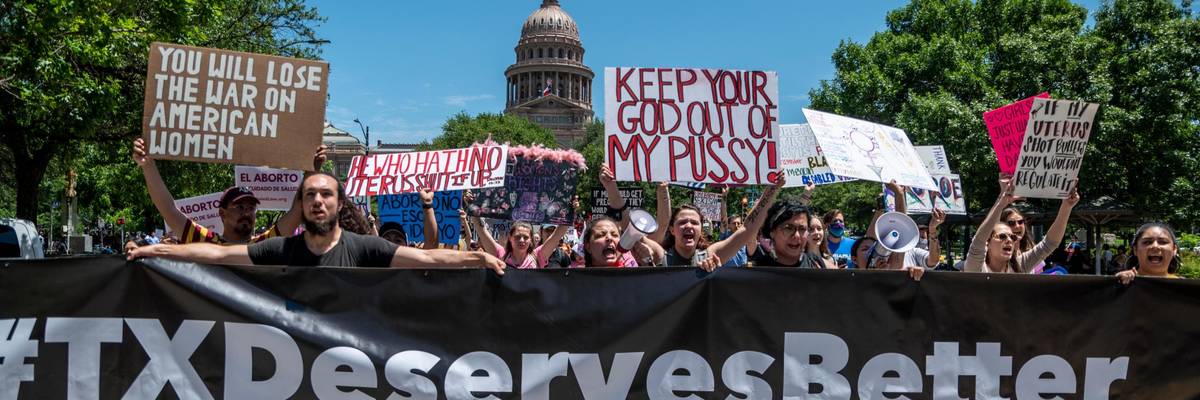
Pro-choice protesters march down Congress Avenue outside the Texas State Capitol in Austin on May 29, 2021. (Photo: Sergio Flores/Getty Images)
With concerns mounting about the future of Roe v. Wade and this year's "unprecedented" GOP attacks on reproductive rights, healthcare providers in Texas filed suit Tuesday over a new state law that would ban ending a pregnancy as early as six weeks and allow anti-choice "vigilantes" to sue anyone who "aids or abets" an abortion.
"The state has put a bounty on the head of any person or entity who so much as gives a patient money for an abortion after six weeks of pregnancy, before most people know they are pregnant."
--Nancy Northup, CRR
Senate Bill 8 was signed by Republican Gov. Greg Abbott in May, just days after it was finalized by state lawmakers. Providers, led by Whole Woman's Health, have joined with abortion funds, support networks, doctors, clinic staff, and clergy members in an effort to prevent (pdf) the law from taking effect in September.
"When it comes to abortion access, we are living in two different America," said Amy Hagstrom Miller, president and CEO of Whole Woman's Health and Whole Woman's Health Alliance. "With every barrier that has been enacted over the last 30 years in Texas, it's nearly impossible for pregnant people to access the quality abortion care they need."
"The right to abortion is affirmed on paper, but that right does not exist for those who cannot afford to navigate barriers like forced 24-hour waiting periods, no Medicaid coverage, and hours of travel to a clinic," she added. "S.B. 8 will be the biggest barrier yet."
Defendants in the suit include every state court trial judge and county clerk; the Texas medical, nursing, and pharmacy boards; Texas Attorney General Ken Paxton; and Mark Lee Dickson, director of the anti-choice Right to Life of East Texas, who has already threatened to target providers under the looming law and encouraged others to do the same.
The plaintiffs are represented by the Center for Reproductive Rights (CRR), Planned Parenthood Federation of America (PPFA), the Lawyering Project, the ACLU, the ACLU of Texas, and Morrison & Foerster LLP. The legal experts emphasized that the new law is just the latest in a long record of "unlawful and extremist tactics" by anti-choice policymakers in the state.
"Texas has long led the country in passing extremist laws intended to chip away at Texans' right to safe, accessible abortion care," said Adriana Pinon, policy counsel and senior staff attorney at the ACLU of Texas. "Now the state is trying to prevent people from getting abortions, full stop."
Pinon specifically highlighted that S.B. 8 "allows anti-abortion zealots to threaten people with lawsuits for simply trying to help a friend or relative who needs abortion care."
In a call with reporters on Tuesday, she described the anti-choice activists who have vowed to target providers if the law is allowed to take effect as "bounty hunters," noting that anyone successfully sued under it could be forced to pay a minimum of $10,000 in "statutory damages."
PPFA president and CEO Alexis McGill Johnson also raised alarm about that part of S.B. 8, warning in a statement that "this new law would open the floodgates to frivolous lawsuits designed to bankrupt health centers, harass providers, and isolate patients from anyone who would treat them with compassion as they seek out healthcare."
As Nancy Northup, president and CEO of CRR, put it: "If this oppressive law takes effect, it will decimate abortion access in Texas--and that's exactly what it is designed to do."
"The state has put a bounty on the head of any person or entity who so much as gives a patient money for an abortion after six weeks of pregnancy, before most people know they are pregnant," she said. "Worse, it will intimidate loved ones from providing support for fear of being sued."
"And this is happening to Texans as we are fighting another direct challenge to Roe v. Wade in the Supreme Court, out of Mississippi," Northup noted, referencing the court's May decision to hear a challenge to Mississippi's ban on nearly all abortions after 15 weeks of gestation.
Reproductive rights advocates fear that the Mississippi case or other challenges to states' abortion restrictions and bans could give the high court's six conservative justices opportunities to reverse the historic 1973 decision affirming the constitutional right to end a pregnancy.
However, that fear isn't stopping providers and advocates from fighting back against what an April policy analysis from the Guttmacher Institute described as an "all-out assault" on abortion rights.
Hagstrom Miller told reporters Tuesday that clinic staff and doctors who provide abortions in Texas are already "on edge" and "terrified," forced to navigate "the uncertainty and the surveillance and stress that this kind of law is putting on them."
Patients are also stressed and confused about their rights, she said, explaining that several people have recently asked staff whether it is legal on the days of their abortions.
"Can you imagine," she said, "what that feels like as a patient and as a staff person on the ground in Texas already?"
CRR senior counsel Marc Hearron said on the call that "yet again, after decades of hostility to abortion access and patients," the Texas Legislature has forced a lawsuit.
"We have to act," he said of S.B. 8. "We can't allow this to go into effect."
This country and this world are at a monumental crossroads. US voters have an opportunity to beat back the forces of fascism and confront the billionaires who are rigging the economy, our media system, and our democracy, making it increasingly impossible for ordinary people to get by. We’re not just talking about the election. We’re talking about what must be done once these fascist elements are vanquished from power. We need a bolder set of solutions than what either major party has so far been willing to offer and a working-class movement ready to fight like hell for it. Trump didn't emerge from nowhere. The conditions that fueled MAGA authoritarianism were created by decades of radical neoliberal economic policies and a corrupt political system dominated by corporate interests. They slashed taxes on the super-rich, promising that the benefits would trickle down. They said giveaways to the corporate titans would make life more affordable for the rest of us. It was all bullshit. And when a bitter, betrayed populace searches for someone to blame, right-wing demagogues have little trouble finding scapegoats. People know when they're being lied to, but you won't hear any of this from the corporate media. Only independent journalism—powered and funded by people who believe in building a better world—can deliver truly trustworthy daily news. If you share our vision, please contribute whatever you can to sustain our work. |
With concerns mounting about the future of Roe v. Wade and this year's "unprecedented" GOP attacks on reproductive rights, healthcare providers in Texas filed suit Tuesday over a new state law that would ban ending a pregnancy as early as six weeks and allow anti-choice "vigilantes" to sue anyone who "aids or abets" an abortion.
"The state has put a bounty on the head of any person or entity who so much as gives a patient money for an abortion after six weeks of pregnancy, before most people know they are pregnant."
--Nancy Northup, CRR
Senate Bill 8 was signed by Republican Gov. Greg Abbott in May, just days after it was finalized by state lawmakers. Providers, led by Whole Woman's Health, have joined with abortion funds, support networks, doctors, clinic staff, and clergy members in an effort to prevent (pdf) the law from taking effect in September.
"When it comes to abortion access, we are living in two different America," said Amy Hagstrom Miller, president and CEO of Whole Woman's Health and Whole Woman's Health Alliance. "With every barrier that has been enacted over the last 30 years in Texas, it's nearly impossible for pregnant people to access the quality abortion care they need."
"The right to abortion is affirmed on paper, but that right does not exist for those who cannot afford to navigate barriers like forced 24-hour waiting periods, no Medicaid coverage, and hours of travel to a clinic," she added. "S.B. 8 will be the biggest barrier yet."
Defendants in the suit include every state court trial judge and county clerk; the Texas medical, nursing, and pharmacy boards; Texas Attorney General Ken Paxton; and Mark Lee Dickson, director of the anti-choice Right to Life of East Texas, who has already threatened to target providers under the looming law and encouraged others to do the same.
The plaintiffs are represented by the Center for Reproductive Rights (CRR), Planned Parenthood Federation of America (PPFA), the Lawyering Project, the ACLU, the ACLU of Texas, and Morrison & Foerster LLP. The legal experts emphasized that the new law is just the latest in a long record of "unlawful and extremist tactics" by anti-choice policymakers in the state.
"Texas has long led the country in passing extremist laws intended to chip away at Texans' right to safe, accessible abortion care," said Adriana Pinon, policy counsel and senior staff attorney at the ACLU of Texas. "Now the state is trying to prevent people from getting abortions, full stop."
Pinon specifically highlighted that S.B. 8 "allows anti-abortion zealots to threaten people with lawsuits for simply trying to help a friend or relative who needs abortion care."
In a call with reporters on Tuesday, she described the anti-choice activists who have vowed to target providers if the law is allowed to take effect as "bounty hunters," noting that anyone successfully sued under it could be forced to pay a minimum of $10,000 in "statutory damages."
PPFA president and CEO Alexis McGill Johnson also raised alarm about that part of S.B. 8, warning in a statement that "this new law would open the floodgates to frivolous lawsuits designed to bankrupt health centers, harass providers, and isolate patients from anyone who would treat them with compassion as they seek out healthcare."
As Nancy Northup, president and CEO of CRR, put it: "If this oppressive law takes effect, it will decimate abortion access in Texas--and that's exactly what it is designed to do."
"The state has put a bounty on the head of any person or entity who so much as gives a patient money for an abortion after six weeks of pregnancy, before most people know they are pregnant," she said. "Worse, it will intimidate loved ones from providing support for fear of being sued."
"And this is happening to Texans as we are fighting another direct challenge to Roe v. Wade in the Supreme Court, out of Mississippi," Northup noted, referencing the court's May decision to hear a challenge to Mississippi's ban on nearly all abortions after 15 weeks of gestation.
Reproductive rights advocates fear that the Mississippi case or other challenges to states' abortion restrictions and bans could give the high court's six conservative justices opportunities to reverse the historic 1973 decision affirming the constitutional right to end a pregnancy.
However, that fear isn't stopping providers and advocates from fighting back against what an April policy analysis from the Guttmacher Institute described as an "all-out assault" on abortion rights.
Hagstrom Miller told reporters Tuesday that clinic staff and doctors who provide abortions in Texas are already "on edge" and "terrified," forced to navigate "the uncertainty and the surveillance and stress that this kind of law is putting on them."
Patients are also stressed and confused about their rights, she said, explaining that several people have recently asked staff whether it is legal on the days of their abortions.
"Can you imagine," she said, "what that feels like as a patient and as a staff person on the ground in Texas already?"
CRR senior counsel Marc Hearron said on the call that "yet again, after decades of hostility to abortion access and patients," the Texas Legislature has forced a lawsuit.
"We have to act," he said of S.B. 8. "We can't allow this to go into effect."