

SUBSCRIBE TO OUR FREE NEWSLETTER
Daily news & progressive opinion—funded by the people, not the corporations—delivered straight to your inbox.
5
#000000
#FFFFFF
To donate by check, phone, or other method, see our More Ways to Give page.
Daily news & progressive opinion—funded by the people, not the corporations—delivered straight to your inbox.
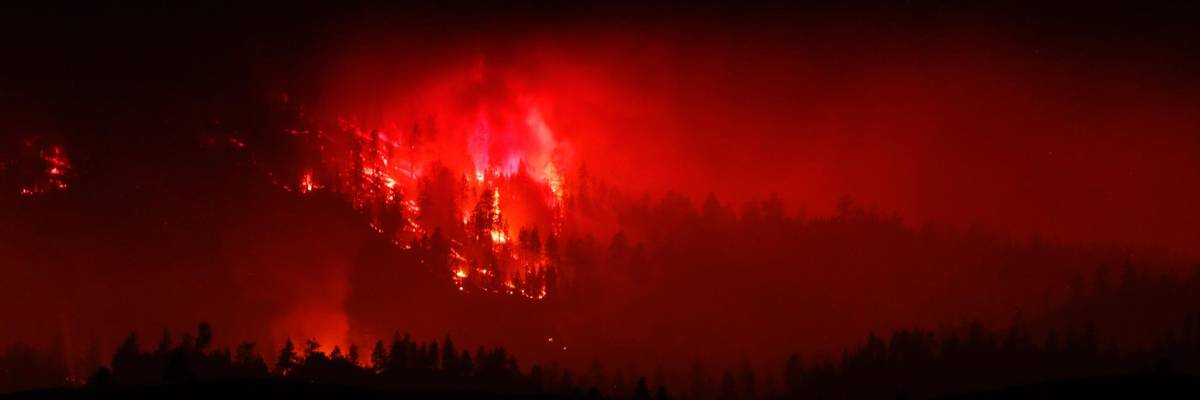
Trees burning as the Beckwourth Complex Fire approaches Highway 395 in California. (Photo: Ty ONeil/SOPA Images/LightRocket via Getty Images)
With hundreds of thousands of acres burning across swaths of the U.S. West that have already endured record-breaking heat this summer--and mounting concerns about the GOP and centrist Democrats watering down federal infrastructure legislation--the climate movement on Monday reiterated demands for ambitious government action and investment.
"This 'unprecedented' weather must serve as a wake-up call for our politicians."
--Ellen Sciales, Sunrise Movement
Progressives that called President Joe Biden's initial physical and human infrastructure proposal, the American Jobs and Families Plans, inadequate have ramped up their criticism in the wake of a bipartisan deal Democrats want to pass alongside a reconciliation bill, a flooded New York City subway system, a collapsed condo in Florida, a pipeline-related fire in the Gulf of Mexico, and a firenado in California.
"Buildings are collapsing into the sea. Infrastructure is melting. Hundreds are dying from extreme heat. Millions are without power. The ocean is literally on fire. The climate crisis is here," said Ellen Sciales, communications director of the youth-led Sunrise Movement, in a statement Monday.
"And yet, some Democratic politicians like Joe Biden are still pushing for a compromise on climate under the guise of 'bipartisanship'--though it's actually just doing the bidding of Exxon lobbyists," she added, pointing to an expose that provided insight on the company's lobbying efforts targeting key senators who are working on the infrastructure package.
Sciales highlighted that the movement's demands aren't just focused on infrastructure legislation; activists also want the president to use his executive power to deliver on his broad campaign promises to combat the climate emergency.
"Communities in every corner of this country, especially low-income communities and communities of color, are currently bracing for or suffering from the climate crisis. It is clear we need bold action now," she said. "And despite these deadly climate disasters and videos of the Gulf of Mexico literally on fire after a pipeline leak, Biden is still refusing to stop Line 3, which will further endanger our air, our water and lock us into more fossil fuel development."
The Sunrise leader declared that "this 'unprecedented' weather must serve as a wake-up call for our politicians. The time for incrementalism is over. We need to call the 'bipartisan' infrastructure plan what it is: the ExxonMobil Plan."
"Politicians must stop entertaining a weak, fossil fuel-backed plan," Sciales said, "and instead seize on this historic opportunity to avert the climate crisis by investing in a mass mobilization of our society and economy, rebuilding the infrastructure we lost to the crisis and protecting the lives of millions of Americans."
"If Biden and Democrats do not pass and sign trillions of dollars in climate investments including a massive Civilian Climate Corps through a Democratic reconciliation bill," she warned, "it will be a death sentence for our generation."
Rep. Alexandria Ocasio-Cortez (D-N.Y.) said Monday on Democracy Now! that progressive lawmakers are "united" in opposing "bipartisan legislation without a reconciliation bill, and one that takes bold and large action on climate" by cutting down planet-heating emissions, helping frontline communities, and creating jobs.
Ocasio-Cortez is leading the congressional fight for a Civilian Climate Corps (CCC) with fellow Green New Deal champion Sen. Ed Markey (D-Mass.)--an effort Senate Majority Leader Chuck Schumer (D-N.Y.) notably endorsed last week, pledging to work with Sunrise activists.
The chair of the Congressional Progressive Caucus, Rep. Pramila Japayal (D-Wash.), has also affirmed her position in recent days, tweeting that "it's time to go big, bold, and fast on an infrastructure package that not only fixes our roads, bridges, and transit systems--but also invests in the care economy, climate action, and working families."
Jayapal, whose state is among those suffering from wildfires and record heat, pointed out Monday that the triple-digit temperatures in another western state--California--endanger a significant portion of the United States' food supply, and repeated her call for climate action.
Axios reported Monday that "wildfires were burning across more than 768,000 acres of land in 12 western U.S. states, and over 500,000 acres in Canada on Sunday amid another searing heatwave."
The Bootleg Fire in southern Oregon--which nearly doubled in size from Saturday to Sunday--has now been burning for six days straight, scorching over 150,000 acres.
According to the New York Times:
Charles Smith, a meteorologist with the National Weather Service in Medford, Oregon, said the fire was especially worrying because Oregon's fire season had only just begun.
"There's concern because of how early this is starting, and how far it has grown within a relatively short amount of time," he said.
The Oregon fire has put pressure on the power grid that connects to neighboring California, leading Golden State officials to urge residents and businesses to conserve electricity on Monday.
In the Mojave Desert, California's Death Valley recorded temperatures of a potentially record-setting 130degF on Friday and 129.4degF degrees on Saturday, according to the National Weather Service's preliminary figures.
Experts continue to emphasize humanity's impact on climate, and how that affects wildfires.
"The exceptional fire weather this year and in recent years does not represent random bad luck," Jacob Bendix, a Syracuse University professor who specializes in wildfire distribution, told the Los Angeles Times. "It is among the results of our adding carbon to the atmosphere--results that were predictable, and indeed that have been predicted for decades."
Craig Clements, a professor of meteorology and director of the Wildfire Interdisciplinary Research Center at San Jose State, echoed that message.
" Climate change is real, it's bad, and it's really affecting our fire weather and our fire danger," he told the newspaper. "Its fingerprints are all over this stuff."
Dear Common Dreams reader, It’s been nearly 30 years since I co-founded Common Dreams with my late wife, Lina Newhouser. We had the radical notion that journalism should serve the public good, not corporate profits. It was clear to us from the outset what it would take to build such a project. No paid advertisements. No corporate sponsors. No millionaire publisher telling us what to think or do. Many people said we wouldn't last a year, but we proved those doubters wrong. Together with a tremendous team of journalists and dedicated staff, we built an independent media outlet free from the constraints of profits and corporate control. Our mission has always been simple: To inform. To inspire. To ignite change for the common good. Building Common Dreams was not easy. Our survival was never guaranteed. When you take on the most powerful forces—Wall Street greed, fossil fuel industry destruction, Big Tech lobbyists, and uber-rich oligarchs who have spent billions upon billions rigging the economy and democracy in their favor—the only bulwark you have is supporters who believe in your work. But here’s the urgent message from me today. It's never been this bad out there. And it's never been this hard to keep us going. At the very moment Common Dreams is most needed, the threats we face are intensifying. We need your support now more than ever. We don't accept corporate advertising and never will. We don't have a paywall because we don't think people should be blocked from critical news based on their ability to pay. Everything we do is funded by the donations of readers like you. When everyone does the little they can afford, we are strong. But if that support retreats or dries up, so do we. Will you donate now to make sure Common Dreams not only survives but thrives? —Craig Brown, Co-founder |
With hundreds of thousands of acres burning across swaths of the U.S. West that have already endured record-breaking heat this summer--and mounting concerns about the GOP and centrist Democrats watering down federal infrastructure legislation--the climate movement on Monday reiterated demands for ambitious government action and investment.
"This 'unprecedented' weather must serve as a wake-up call for our politicians."
--Ellen Sciales, Sunrise Movement
Progressives that called President Joe Biden's initial physical and human infrastructure proposal, the American Jobs and Families Plans, inadequate have ramped up their criticism in the wake of a bipartisan deal Democrats want to pass alongside a reconciliation bill, a flooded New York City subway system, a collapsed condo in Florida, a pipeline-related fire in the Gulf of Mexico, and a firenado in California.
"Buildings are collapsing into the sea. Infrastructure is melting. Hundreds are dying from extreme heat. Millions are without power. The ocean is literally on fire. The climate crisis is here," said Ellen Sciales, communications director of the youth-led Sunrise Movement, in a statement Monday.
"And yet, some Democratic politicians like Joe Biden are still pushing for a compromise on climate under the guise of 'bipartisanship'--though it's actually just doing the bidding of Exxon lobbyists," she added, pointing to an expose that provided insight on the company's lobbying efforts targeting key senators who are working on the infrastructure package.
Sciales highlighted that the movement's demands aren't just focused on infrastructure legislation; activists also want the president to use his executive power to deliver on his broad campaign promises to combat the climate emergency.
"Communities in every corner of this country, especially low-income communities and communities of color, are currently bracing for or suffering from the climate crisis. It is clear we need bold action now," she said. "And despite these deadly climate disasters and videos of the Gulf of Mexico literally on fire after a pipeline leak, Biden is still refusing to stop Line 3, which will further endanger our air, our water and lock us into more fossil fuel development."
The Sunrise leader declared that "this 'unprecedented' weather must serve as a wake-up call for our politicians. The time for incrementalism is over. We need to call the 'bipartisan' infrastructure plan what it is: the ExxonMobil Plan."
"Politicians must stop entertaining a weak, fossil fuel-backed plan," Sciales said, "and instead seize on this historic opportunity to avert the climate crisis by investing in a mass mobilization of our society and economy, rebuilding the infrastructure we lost to the crisis and protecting the lives of millions of Americans."
"If Biden and Democrats do not pass and sign trillions of dollars in climate investments including a massive Civilian Climate Corps through a Democratic reconciliation bill," she warned, "it will be a death sentence for our generation."
Rep. Alexandria Ocasio-Cortez (D-N.Y.) said Monday on Democracy Now! that progressive lawmakers are "united" in opposing "bipartisan legislation without a reconciliation bill, and one that takes bold and large action on climate" by cutting down planet-heating emissions, helping frontline communities, and creating jobs.
Ocasio-Cortez is leading the congressional fight for a Civilian Climate Corps (CCC) with fellow Green New Deal champion Sen. Ed Markey (D-Mass.)--an effort Senate Majority Leader Chuck Schumer (D-N.Y.) notably endorsed last week, pledging to work with Sunrise activists.
The chair of the Congressional Progressive Caucus, Rep. Pramila Japayal (D-Wash.), has also affirmed her position in recent days, tweeting that "it's time to go big, bold, and fast on an infrastructure package that not only fixes our roads, bridges, and transit systems--but also invests in the care economy, climate action, and working families."
Jayapal, whose state is among those suffering from wildfires and record heat, pointed out Monday that the triple-digit temperatures in another western state--California--endanger a significant portion of the United States' food supply, and repeated her call for climate action.
Axios reported Monday that "wildfires were burning across more than 768,000 acres of land in 12 western U.S. states, and over 500,000 acres in Canada on Sunday amid another searing heatwave."
The Bootleg Fire in southern Oregon--which nearly doubled in size from Saturday to Sunday--has now been burning for six days straight, scorching over 150,000 acres.
According to the New York Times:
Charles Smith, a meteorologist with the National Weather Service in Medford, Oregon, said the fire was especially worrying because Oregon's fire season had only just begun.
"There's concern because of how early this is starting, and how far it has grown within a relatively short amount of time," he said.
The Oregon fire has put pressure on the power grid that connects to neighboring California, leading Golden State officials to urge residents and businesses to conserve electricity on Monday.
In the Mojave Desert, California's Death Valley recorded temperatures of a potentially record-setting 130degF on Friday and 129.4degF degrees on Saturday, according to the National Weather Service's preliminary figures.
Experts continue to emphasize humanity's impact on climate, and how that affects wildfires.
"The exceptional fire weather this year and in recent years does not represent random bad luck," Jacob Bendix, a Syracuse University professor who specializes in wildfire distribution, told the Los Angeles Times. "It is among the results of our adding carbon to the atmosphere--results that were predictable, and indeed that have been predicted for decades."
Craig Clements, a professor of meteorology and director of the Wildfire Interdisciplinary Research Center at San Jose State, echoed that message.
" Climate change is real, it's bad, and it's really affecting our fire weather and our fire danger," he told the newspaper. "Its fingerprints are all over this stuff."
With hundreds of thousands of acres burning across swaths of the U.S. West that have already endured record-breaking heat this summer--and mounting concerns about the GOP and centrist Democrats watering down federal infrastructure legislation--the climate movement on Monday reiterated demands for ambitious government action and investment.
"This 'unprecedented' weather must serve as a wake-up call for our politicians."
--Ellen Sciales, Sunrise Movement
Progressives that called President Joe Biden's initial physical and human infrastructure proposal, the American Jobs and Families Plans, inadequate have ramped up their criticism in the wake of a bipartisan deal Democrats want to pass alongside a reconciliation bill, a flooded New York City subway system, a collapsed condo in Florida, a pipeline-related fire in the Gulf of Mexico, and a firenado in California.
"Buildings are collapsing into the sea. Infrastructure is melting. Hundreds are dying from extreme heat. Millions are without power. The ocean is literally on fire. The climate crisis is here," said Ellen Sciales, communications director of the youth-led Sunrise Movement, in a statement Monday.
"And yet, some Democratic politicians like Joe Biden are still pushing for a compromise on climate under the guise of 'bipartisanship'--though it's actually just doing the bidding of Exxon lobbyists," she added, pointing to an expose that provided insight on the company's lobbying efforts targeting key senators who are working on the infrastructure package.
Sciales highlighted that the movement's demands aren't just focused on infrastructure legislation; activists also want the president to use his executive power to deliver on his broad campaign promises to combat the climate emergency.
"Communities in every corner of this country, especially low-income communities and communities of color, are currently bracing for or suffering from the climate crisis. It is clear we need bold action now," she said. "And despite these deadly climate disasters and videos of the Gulf of Mexico literally on fire after a pipeline leak, Biden is still refusing to stop Line 3, which will further endanger our air, our water and lock us into more fossil fuel development."
The Sunrise leader declared that "this 'unprecedented' weather must serve as a wake-up call for our politicians. The time for incrementalism is over. We need to call the 'bipartisan' infrastructure plan what it is: the ExxonMobil Plan."
"Politicians must stop entertaining a weak, fossil fuel-backed plan," Sciales said, "and instead seize on this historic opportunity to avert the climate crisis by investing in a mass mobilization of our society and economy, rebuilding the infrastructure we lost to the crisis and protecting the lives of millions of Americans."
"If Biden and Democrats do not pass and sign trillions of dollars in climate investments including a massive Civilian Climate Corps through a Democratic reconciliation bill," she warned, "it will be a death sentence for our generation."
Rep. Alexandria Ocasio-Cortez (D-N.Y.) said Monday on Democracy Now! that progressive lawmakers are "united" in opposing "bipartisan legislation without a reconciliation bill, and one that takes bold and large action on climate" by cutting down planet-heating emissions, helping frontline communities, and creating jobs.
Ocasio-Cortez is leading the congressional fight for a Civilian Climate Corps (CCC) with fellow Green New Deal champion Sen. Ed Markey (D-Mass.)--an effort Senate Majority Leader Chuck Schumer (D-N.Y.) notably endorsed last week, pledging to work with Sunrise activists.
The chair of the Congressional Progressive Caucus, Rep. Pramila Japayal (D-Wash.), has also affirmed her position in recent days, tweeting that "it's time to go big, bold, and fast on an infrastructure package that not only fixes our roads, bridges, and transit systems--but also invests in the care economy, climate action, and working families."
Jayapal, whose state is among those suffering from wildfires and record heat, pointed out Monday that the triple-digit temperatures in another western state--California--endanger a significant portion of the United States' food supply, and repeated her call for climate action.
Axios reported Monday that "wildfires were burning across more than 768,000 acres of land in 12 western U.S. states, and over 500,000 acres in Canada on Sunday amid another searing heatwave."
The Bootleg Fire in southern Oregon--which nearly doubled in size from Saturday to Sunday--has now been burning for six days straight, scorching over 150,000 acres.
According to the New York Times:
Charles Smith, a meteorologist with the National Weather Service in Medford, Oregon, said the fire was especially worrying because Oregon's fire season had only just begun.
"There's concern because of how early this is starting, and how far it has grown within a relatively short amount of time," he said.
The Oregon fire has put pressure on the power grid that connects to neighboring California, leading Golden State officials to urge residents and businesses to conserve electricity on Monday.
In the Mojave Desert, California's Death Valley recorded temperatures of a potentially record-setting 130degF on Friday and 129.4degF degrees on Saturday, according to the National Weather Service's preliminary figures.
Experts continue to emphasize humanity's impact on climate, and how that affects wildfires.
"The exceptional fire weather this year and in recent years does not represent random bad luck," Jacob Bendix, a Syracuse University professor who specializes in wildfire distribution, told the Los Angeles Times. "It is among the results of our adding carbon to the atmosphere--results that were predictable, and indeed that have been predicted for decades."
Craig Clements, a professor of meteorology and director of the Wildfire Interdisciplinary Research Center at San Jose State, echoed that message.
" Climate change is real, it's bad, and it's really affecting our fire weather and our fire danger," he told the newspaper. "Its fingerprints are all over this stuff."

