SUBSCRIBE TO OUR FREE NEWSLETTER
Daily news & progressive opinion—funded by the people, not the corporations—delivered straight to your inbox.
5
#000000
#FFFFFF
To donate by check, phone, or other method, see our More Ways to Give page.
Daily news & progressive opinion—funded by the people, not the corporations—delivered straight to your inbox.
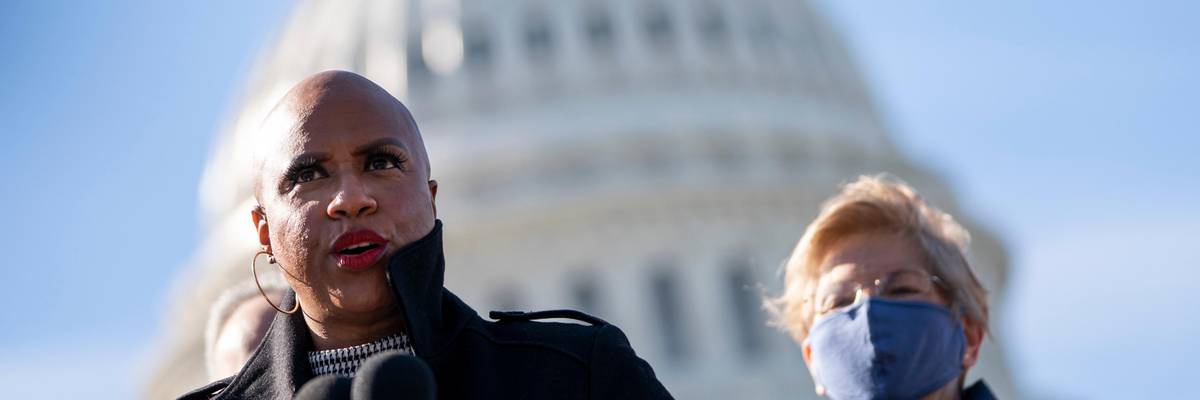
Rep. Ayanna Pressley (D-Mass.) speaks as Sen. Elizabeth Warren (D-Mass.) looks on during a press conference on student debt outside the U.S. Capitol on February 4, 2021 in Washington, D.C. (Photo: Drew Angerer/Getty Images)
More than 60 lawmakers from the House and Senate on Wednesday demanded that President Joe Biden immediately extend a soon-to-expire pause on federal student loan payments and interest accumulation--while also working toward cancellation of the debt that is saddling tens of millions of people across the United States.
"President Biden can and must cancel student debt with the stroke of a pen. We urgently call on him to act," Rep. Ayanna Pressley (D-Mass.) said in a statement. "In the interim, extending this payment pause will provide a crucial additional layer of relief for millions of borrowers. We can't turn our backs on these families as we work toward an equitable economic recovery."
"We can't turn our backs on these families as we work toward an equitable economic recovery."
--Rep. Ayanna Pressley
In a letter (pdf) to Biden spearheaded by Pressley, Sen. Elizabeth Warren (D-Mass.), and Senate Majority Leader Chuck Schumer (D-N.Y.), 63 members of Congress note that "the suspension of payments and interest during the pandemic has provided essential relief to borrowers and their families during this economic and public health crisis."
According to a recent estimate by the Education Department, the pause on interest accumulation alone has saved borrowers around $4.8 billion a month.
Former President Donald Trump first implemented the student loan payment and interest pause in March 2020 as the coronavirus spread rapidly across the U.S., sparking a nationwide public health crisis and ravaging the economy. Trump subsequently extended the moratorium through the end of January 2021 and Biden--on his first day in office--extended it again through September 30.
With the pause now set to expire in less than 100 days, borrowers are getting worried that the White House is going to leave them out to dry.
"At any moment this could come to an end, and then what are you going to do?" Richelle Brooks, a 33-year-old educator in Long Beach, California, told the American Prospect last week. "The psychological turmoil of a moratorium without any explanation as to what comes next is twisted."
In their letter on Wednesday, the lawmakers warned that "restarting payments... will present a significant challenge for borrowers, loan servicers, and the Department of Education (ED), and we urge you not to let the payment pause lapse when borrowers are still depending on this financial relief."
"We urge you to act quickly to extend the current pause on payments and interest so that borrowers are not penalized and student debt payments do not drag down the pace of our economic recovery," the lawmakers wrote. "Specifically, we ask that you extend the pause by at least six months--until March 31, 2022--or until the economy reaches pre-pandemic employment levels, whichever is longer."
Sen. Elizabeth Warren (D-Mass.), who has called on Biden to use his executive authority to forgive at least $50,000 in student loan debt per borrower, said in a statement Wednesday that "President Biden should cancel student debt, but in the meantime he should extend the payment pause so that borrowers aren't hurt." Canceling $50,000 in student loan debt per person would fully wipe out the debt burden of 84% of borrowers.
In early April, the White House announced that Biden had directed the Department of Education to prepare a memo on the president's legal authority to unilaterally cancel student loan debt, but nearly three months have passed and the memo has yet to be completed.
Increasingly frustrated by the president's inaction on the issue, a union of debtors earlier this month released a draft executive order that would cancel every penny of the roughly $1.8 trillion in federal student loan debt currently held by more than 40 million people in the U.S.
"Our communities need help now, and canceling student debt is something the Biden administration can do today, without going through our dysfunctional Congress and seeking ever-elusive bipartisan support," Braxton Brewington, a spokesperson for the Debt Collective, wrote in an op-ed for Teen Vogue. "Eliminating student debt would be an enormous bottom-up stimulus to our economy, creating millions of new jobs, accelerating home buying, and delivering additional pandemic relief to communities still recovering from the hardship of Covid-19."
Dear Common Dreams reader, It’s been nearly 30 years since I co-founded Common Dreams with my late wife, Lina Newhouser. We had the radical notion that journalism should serve the public good, not corporate profits. It was clear to us from the outset what it would take to build such a project. No paid advertisements. No corporate sponsors. No millionaire publisher telling us what to think or do. Many people said we wouldn't last a year, but we proved those doubters wrong. Together with a tremendous team of journalists and dedicated staff, we built an independent media outlet free from the constraints of profits and corporate control. Our mission has always been simple: To inform. To inspire. To ignite change for the common good. Building Common Dreams was not easy. Our survival was never guaranteed. When you take on the most powerful forces—Wall Street greed, fossil fuel industry destruction, Big Tech lobbyists, and uber-rich oligarchs who have spent billions upon billions rigging the economy and democracy in their favor—the only bulwark you have is supporters who believe in your work. But here’s the urgent message from me today. It's never been this bad out there. And it's never been this hard to keep us going. At the very moment Common Dreams is most needed, the threats we face are intensifying. We need your support now more than ever. We don't accept corporate advertising and never will. We don't have a paywall because we don't think people should be blocked from critical news based on their ability to pay. Everything we do is funded by the donations of readers like you. When everyone does the little they can afford, we are strong. But if that support retreats or dries up, so do we. Will you donate now to make sure Common Dreams not only survives but thrives? —Craig Brown, Co-founder |
More than 60 lawmakers from the House and Senate on Wednesday demanded that President Joe Biden immediately extend a soon-to-expire pause on federal student loan payments and interest accumulation--while also working toward cancellation of the debt that is saddling tens of millions of people across the United States.
"President Biden can and must cancel student debt with the stroke of a pen. We urgently call on him to act," Rep. Ayanna Pressley (D-Mass.) said in a statement. "In the interim, extending this payment pause will provide a crucial additional layer of relief for millions of borrowers. We can't turn our backs on these families as we work toward an equitable economic recovery."
"We can't turn our backs on these families as we work toward an equitable economic recovery."
--Rep. Ayanna Pressley
In a letter (pdf) to Biden spearheaded by Pressley, Sen. Elizabeth Warren (D-Mass.), and Senate Majority Leader Chuck Schumer (D-N.Y.), 63 members of Congress note that "the suspension of payments and interest during the pandemic has provided essential relief to borrowers and their families during this economic and public health crisis."
According to a recent estimate by the Education Department, the pause on interest accumulation alone has saved borrowers around $4.8 billion a month.
Former President Donald Trump first implemented the student loan payment and interest pause in March 2020 as the coronavirus spread rapidly across the U.S., sparking a nationwide public health crisis and ravaging the economy. Trump subsequently extended the moratorium through the end of January 2021 and Biden--on his first day in office--extended it again through September 30.
With the pause now set to expire in less than 100 days, borrowers are getting worried that the White House is going to leave them out to dry.
"At any moment this could come to an end, and then what are you going to do?" Richelle Brooks, a 33-year-old educator in Long Beach, California, told the American Prospect last week. "The psychological turmoil of a moratorium without any explanation as to what comes next is twisted."
In their letter on Wednesday, the lawmakers warned that "restarting payments... will present a significant challenge for borrowers, loan servicers, and the Department of Education (ED), and we urge you not to let the payment pause lapse when borrowers are still depending on this financial relief."
"We urge you to act quickly to extend the current pause on payments and interest so that borrowers are not penalized and student debt payments do not drag down the pace of our economic recovery," the lawmakers wrote. "Specifically, we ask that you extend the pause by at least six months--until March 31, 2022--or until the economy reaches pre-pandemic employment levels, whichever is longer."
Sen. Elizabeth Warren (D-Mass.), who has called on Biden to use his executive authority to forgive at least $50,000 in student loan debt per borrower, said in a statement Wednesday that "President Biden should cancel student debt, but in the meantime he should extend the payment pause so that borrowers aren't hurt." Canceling $50,000 in student loan debt per person would fully wipe out the debt burden of 84% of borrowers.
In early April, the White House announced that Biden had directed the Department of Education to prepare a memo on the president's legal authority to unilaterally cancel student loan debt, but nearly three months have passed and the memo has yet to be completed.
Increasingly frustrated by the president's inaction on the issue, a union of debtors earlier this month released a draft executive order that would cancel every penny of the roughly $1.8 trillion in federal student loan debt currently held by more than 40 million people in the U.S.
"Our communities need help now, and canceling student debt is something the Biden administration can do today, without going through our dysfunctional Congress and seeking ever-elusive bipartisan support," Braxton Brewington, a spokesperson for the Debt Collective, wrote in an op-ed for Teen Vogue. "Eliminating student debt would be an enormous bottom-up stimulus to our economy, creating millions of new jobs, accelerating home buying, and delivering additional pandemic relief to communities still recovering from the hardship of Covid-19."
More than 60 lawmakers from the House and Senate on Wednesday demanded that President Joe Biden immediately extend a soon-to-expire pause on federal student loan payments and interest accumulation--while also working toward cancellation of the debt that is saddling tens of millions of people across the United States.
"President Biden can and must cancel student debt with the stroke of a pen. We urgently call on him to act," Rep. Ayanna Pressley (D-Mass.) said in a statement. "In the interim, extending this payment pause will provide a crucial additional layer of relief for millions of borrowers. We can't turn our backs on these families as we work toward an equitable economic recovery."
"We can't turn our backs on these families as we work toward an equitable economic recovery."
--Rep. Ayanna Pressley
In a letter (pdf) to Biden spearheaded by Pressley, Sen. Elizabeth Warren (D-Mass.), and Senate Majority Leader Chuck Schumer (D-N.Y.), 63 members of Congress note that "the suspension of payments and interest during the pandemic has provided essential relief to borrowers and their families during this economic and public health crisis."
According to a recent estimate by the Education Department, the pause on interest accumulation alone has saved borrowers around $4.8 billion a month.
Former President Donald Trump first implemented the student loan payment and interest pause in March 2020 as the coronavirus spread rapidly across the U.S., sparking a nationwide public health crisis and ravaging the economy. Trump subsequently extended the moratorium through the end of January 2021 and Biden--on his first day in office--extended it again through September 30.
With the pause now set to expire in less than 100 days, borrowers are getting worried that the White House is going to leave them out to dry.
"At any moment this could come to an end, and then what are you going to do?" Richelle Brooks, a 33-year-old educator in Long Beach, California, told the American Prospect last week. "The psychological turmoil of a moratorium without any explanation as to what comes next is twisted."
In their letter on Wednesday, the lawmakers warned that "restarting payments... will present a significant challenge for borrowers, loan servicers, and the Department of Education (ED), and we urge you not to let the payment pause lapse when borrowers are still depending on this financial relief."
"We urge you to act quickly to extend the current pause on payments and interest so that borrowers are not penalized and student debt payments do not drag down the pace of our economic recovery," the lawmakers wrote. "Specifically, we ask that you extend the pause by at least six months--until March 31, 2022--or until the economy reaches pre-pandemic employment levels, whichever is longer."
Sen. Elizabeth Warren (D-Mass.), who has called on Biden to use his executive authority to forgive at least $50,000 in student loan debt per borrower, said in a statement Wednesday that "President Biden should cancel student debt, but in the meantime he should extend the payment pause so that borrowers aren't hurt." Canceling $50,000 in student loan debt per person would fully wipe out the debt burden of 84% of borrowers.
In early April, the White House announced that Biden had directed the Department of Education to prepare a memo on the president's legal authority to unilaterally cancel student loan debt, but nearly three months have passed and the memo has yet to be completed.
Increasingly frustrated by the president's inaction on the issue, a union of debtors earlier this month released a draft executive order that would cancel every penny of the roughly $1.8 trillion in federal student loan debt currently held by more than 40 million people in the U.S.
"Our communities need help now, and canceling student debt is something the Biden administration can do today, without going through our dysfunctional Congress and seeking ever-elusive bipartisan support," Braxton Brewington, a spokesperson for the Debt Collective, wrote in an op-ed for Teen Vogue. "Eliminating student debt would be an enormous bottom-up stimulus to our economy, creating millions of new jobs, accelerating home buying, and delivering additional pandemic relief to communities still recovering from the hardship of Covid-19."