
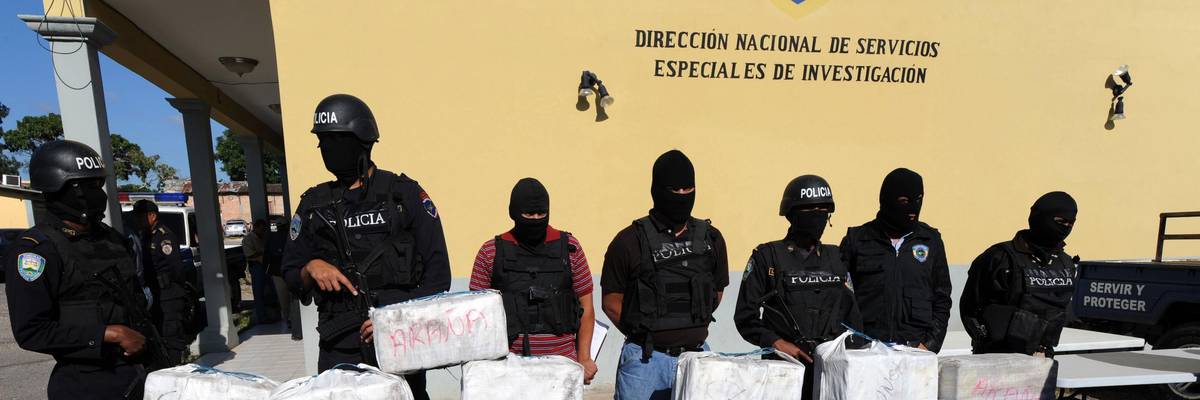
Police officers from the anti-drug squad in Tegucigalpa on October 7, 2010 look after a load of 500 kilos of cocaine seized from traffickers during a joint operation by the Honduran Police, the Army, and the U.S. Drug Enforcement Administration (DEA), in Brus Laguna, Mosquitia, Honduras. (Photo: Orlando Sierra/AFP via Getty Images)
Poll Shows 83% of Americans Believe So-Called 'War on Drugs' an Abject Failure
The findings come just ahead of the 50th's anniversary of President Richard Nixon's drug war declaration.
New polling released Wednesday reveals that an overwhelming majority of Americans think the so-called "war on drugs" is a total failure, underscoring broad support for a new approach that puts public health over criminalization and a militarized response to the illegal narcotics trade that has lasted for decades.
The findings released by the American Civil Liberties Union (ACLU) and Drug Policy Alliance (DPA) showed that 83% of Americans say the "war on drugs" has failed. That assessment is felt similarly across party lines; 83% of Democrats expressed that view, as did 85% of Independents and 82% of Republicans. Nearly two-thirds of respondents (65%) said it's time to end the war on drugs.
"It's time to adopt a new approach that treats substance use as a public health issue rather than a criminal justice one."--Udi Ofer, ACLU
The poll also found that 66% of voters support getting rid of "criminal penalties for drug possession and reinvesting drug enforcement resources into treatment and addiction services."
Similar percentages were seen in support for eliminating mandatory minimum sentences for drug crimes (64%) and for commuting or reducing the sentences of people incarcerated for drugs (61%).
A further finding was that 63% think drug use should be addressed as a public health issue compared to just 33% say it should be addressed as a criminal justice issue.
The polling came just ahead of the 50th anniversary of President Richard Nixon's "war on drugs" declaration. On June 17, 1971, Nixon called drug abuse "public enemy number one" and said it must be met with an "all-out offensive." Opponents of the approach say it's spurred decades of widespread harms to people and communities both in the U.S. and worldwide.
As a senator, Joe Biden promoted the war on drugs but in his 2020 presidential campaign sounded a different note, calling instead for a public health approach to substance abuse. In January, just ahead of his inauguration, a coalition of more than 200 drug policy, healthcare, and other community-based organizations called on Biden to end the war on drugs, telling the then-incoming administration that "the time for urgent, bold change is now."
"We deserve to live in a world where the health and safety of our communities is paramount." --Kassandra Frederique, DPA
Udi Ofer, director of the ACLU's Justice Division, urged the president to make good on his campaign pledge in a statement pointing to the drug war's fueling of the incarceration crisis.
"On this 50th anniversary of the drug war, President Biden must make good on his campaign promises and take steps to begin dismantling the system of over-policing and mass incarceration that is endemic to the war on drugs," Ofer said. "Today, drug possession continues to be the number one arrest in the United States, with more than 1.35 million arrests per year. Every 25 seconds, a person is arrested for possessing drugs for personal use, with Black people disproportionately targeted by this over-policing."
"It's time to adopt a new approach that treats substance use as a public health issue rather than a criminal justice one," Ofer continued.
Biden, he said, can "make headway in ending this harmful and racist war by commuting the sentences of people incarcerated in federal prison for drugs."
According to DPA executive director Kassandra Frederique, the new poll shows "a different reality--one where we treat people who use drugs with dignity and respect, and one where drugs are no longer an excuse for law enforcement to surveil, harass, assault, and even kill Black, Latinx, and Indigenous people--is 100% possible."
With the "devastation" of the drug war plain to see, Frederique said "it should come as no surprise that Americans are ready for a drastically different approach."
"We deserve to live in a world where the health and safety of our communities is paramount," she said, "and that means eliminating all the ways in which we are criminalized and building an alternative response to get the support and help we need."
We are at a crossroads
This country and this world are at a monumental crossroads. In a few short weeks, US voters will have an opportunity to beat back the forces of fascism and confront the billionaires who are rigging the economy, our media system, and our democracy, making it increasingly impossible for ordinary people to get by. We’re not just talking about the election. We’re talking about what must be done once these fascist elements are vanquished from power. We need a bolder set of solutions than what either major party has so far been willing to offer and a working-class movement ready to fight like hell for it. Trump didn't emerge from nowhere. The conditions that fueled MAGA authoritarianism were created by decades of radical neoliberal economic policies and a corrupt political system dominated by corporate interests. They slashed taxes on the super-rich, promising that the benefits would trickle down. They said giveaways to the corporate titans would make life more affordable for the rest of us. It was all bullshit. And when a bitter, betrayed populace searches for someone to blame, right-wing demagogues have little trouble finding scapegoats. People know when they're being lied to, but you won't hear any of this from the corporate media. Only independent journalism—powered and funded by people who believe in building a better world—can deliver truly trustworthy daily news. Our Fall Campaign is underway, and we need your help. To power our newsroom through the rest of the year, we need to raise $125,000 by midnight on October 31. So if you share our vision, please contribute whatever you can to sustain our work. |
New polling released Wednesday reveals that an overwhelming majority of Americans think the so-called "war on drugs" is a total failure, underscoring broad support for a new approach that puts public health over criminalization and a militarized response to the illegal narcotics trade that has lasted for decades.
The findings released by the American Civil Liberties Union (ACLU) and Drug Policy Alliance (DPA) showed that 83% of Americans say the "war on drugs" has failed. That assessment is felt similarly across party lines; 83% of Democrats expressed that view, as did 85% of Independents and 82% of Republicans. Nearly two-thirds of respondents (65%) said it's time to end the war on drugs.
"It's time to adopt a new approach that treats substance use as a public health issue rather than a criminal justice one."--Udi Ofer, ACLU
The poll also found that 66% of voters support getting rid of "criminal penalties for drug possession and reinvesting drug enforcement resources into treatment and addiction services."
Similar percentages were seen in support for eliminating mandatory minimum sentences for drug crimes (64%) and for commuting or reducing the sentences of people incarcerated for drugs (61%).
A further finding was that 63% think drug use should be addressed as a public health issue compared to just 33% say it should be addressed as a criminal justice issue.
The polling came just ahead of the 50th anniversary of President Richard Nixon's "war on drugs" declaration. On June 17, 1971, Nixon called drug abuse "public enemy number one" and said it must be met with an "all-out offensive." Opponents of the approach say it's spurred decades of widespread harms to people and communities both in the U.S. and worldwide.
As a senator, Joe Biden promoted the war on drugs but in his 2020 presidential campaign sounded a different note, calling instead for a public health approach to substance abuse. In January, just ahead of his inauguration, a coalition of more than 200 drug policy, healthcare, and other community-based organizations called on Biden to end the war on drugs, telling the then-incoming administration that "the time for urgent, bold change is now."
"We deserve to live in a world where the health and safety of our communities is paramount." --Kassandra Frederique, DPA
Udi Ofer, director of the ACLU's Justice Division, urged the president to make good on his campaign pledge in a statement pointing to the drug war's fueling of the incarceration crisis.
"On this 50th anniversary of the drug war, President Biden must make good on his campaign promises and take steps to begin dismantling the system of over-policing and mass incarceration that is endemic to the war on drugs," Ofer said. "Today, drug possession continues to be the number one arrest in the United States, with more than 1.35 million arrests per year. Every 25 seconds, a person is arrested for possessing drugs for personal use, with Black people disproportionately targeted by this over-policing."
"It's time to adopt a new approach that treats substance use as a public health issue rather than a criminal justice one," Ofer continued.
Biden, he said, can "make headway in ending this harmful and racist war by commuting the sentences of people incarcerated in federal prison for drugs."
According to DPA executive director Kassandra Frederique, the new poll shows "a different reality--one where we treat people who use drugs with dignity and respect, and one where drugs are no longer an excuse for law enforcement to surveil, harass, assault, and even kill Black, Latinx, and Indigenous people--is 100% possible."
With the "devastation" of the drug war plain to see, Frederique said "it should come as no surprise that Americans are ready for a drastically different approach."
"We deserve to live in a world where the health and safety of our communities is paramount," she said, "and that means eliminating all the ways in which we are criminalized and building an alternative response to get the support and help we need."
New polling released Wednesday reveals that an overwhelming majority of Americans think the so-called "war on drugs" is a total failure, underscoring broad support for a new approach that puts public health over criminalization and a militarized response to the illegal narcotics trade that has lasted for decades.
The findings released by the American Civil Liberties Union (ACLU) and Drug Policy Alliance (DPA) showed that 83% of Americans say the "war on drugs" has failed. That assessment is felt similarly across party lines; 83% of Democrats expressed that view, as did 85% of Independents and 82% of Republicans. Nearly two-thirds of respondents (65%) said it's time to end the war on drugs.
"It's time to adopt a new approach that treats substance use as a public health issue rather than a criminal justice one."--Udi Ofer, ACLU
The poll also found that 66% of voters support getting rid of "criminal penalties for drug possession and reinvesting drug enforcement resources into treatment and addiction services."
Similar percentages were seen in support for eliminating mandatory minimum sentences for drug crimes (64%) and for commuting or reducing the sentences of people incarcerated for drugs (61%).
A further finding was that 63% think drug use should be addressed as a public health issue compared to just 33% say it should be addressed as a criminal justice issue.
The polling came just ahead of the 50th anniversary of President Richard Nixon's "war on drugs" declaration. On June 17, 1971, Nixon called drug abuse "public enemy number one" and said it must be met with an "all-out offensive." Opponents of the approach say it's spurred decades of widespread harms to people and communities both in the U.S. and worldwide.
As a senator, Joe Biden promoted the war on drugs but in his 2020 presidential campaign sounded a different note, calling instead for a public health approach to substance abuse. In January, just ahead of his inauguration, a coalition of more than 200 drug policy, healthcare, and other community-based organizations called on Biden to end the war on drugs, telling the then-incoming administration that "the time for urgent, bold change is now."
"We deserve to live in a world where the health and safety of our communities is paramount." --Kassandra Frederique, DPA
Udi Ofer, director of the ACLU's Justice Division, urged the president to make good on his campaign pledge in a statement pointing to the drug war's fueling of the incarceration crisis.
"On this 50th anniversary of the drug war, President Biden must make good on his campaign promises and take steps to begin dismantling the system of over-policing and mass incarceration that is endemic to the war on drugs," Ofer said. "Today, drug possession continues to be the number one arrest in the United States, with more than 1.35 million arrests per year. Every 25 seconds, a person is arrested for possessing drugs for personal use, with Black people disproportionately targeted by this over-policing."
"It's time to adopt a new approach that treats substance use as a public health issue rather than a criminal justice one," Ofer continued.
Biden, he said, can "make headway in ending this harmful and racist war by commuting the sentences of people incarcerated in federal prison for drugs."
According to DPA executive director Kassandra Frederique, the new poll shows "a different reality--one where we treat people who use drugs with dignity and respect, and one where drugs are no longer an excuse for law enforcement to surveil, harass, assault, and even kill Black, Latinx, and Indigenous people--is 100% possible."
With the "devastation" of the drug war plain to see, Frederique said "it should come as no surprise that Americans are ready for a drastically different approach."
"We deserve to live in a world where the health and safety of our communities is paramount," she said, "and that means eliminating all the ways in which we are criminalized and building an alternative response to get the support and help we need."