SUBSCRIBE TO OUR FREE NEWSLETTER
Daily news & progressive opinion—funded by the people, not the corporations—delivered straight to your inbox.
5
#000000
#FFFFFF
To donate by check, phone, or other method, see our More Ways to Give page.
Daily news & progressive opinion—funded by the people, not the corporations—delivered straight to your inbox.
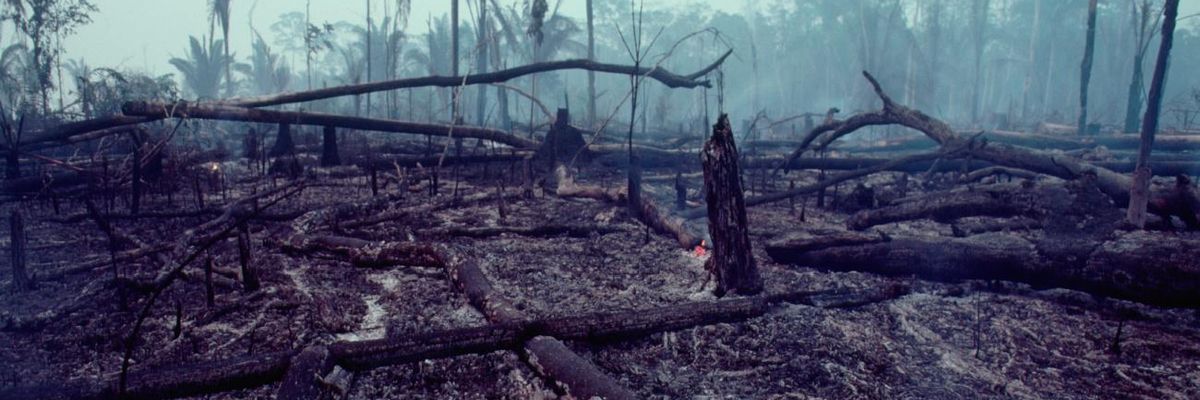
Charred remains of trees lie the Brazilian rainforest between Ariquemes and Porto Velho, Brazil. (Photo: Stephanie Maze/Getty Images)
More than a year into the pandemic that's still raging across much of the world, an independent task force of scientists said government leaders are doing far too little to stop future pandemics at their source by ending the exploitation and destruction of nature.
The task force was convened by Harvard Global Health Institute (HGHI) and the Harvard T.H. Chan School of Public Health Center for Climate Health and the Global Environment (Harvard Chan C-CHANGE)--the academic affiliates of the Coalition for Preventing Pandemics at the Source (PPS).
By the end of the summer, scientists from all over the world plan to present the coalition with an action plan to stop pandemics "at the point of spillover of pathogens from animals to humans, well before they can become global pandemics, epidemics, or even localized outbreaks."
" Covid-19 was a warning shot from nature to our species," tweeted Dr. Aaron Bernstein of Harvard Chan C-CHANGE, who is leading the task force. "We need greater investment in science and actions to stop viruses from spilling into humans in the first place."
Covid-19 is only the latest disease scientists believe originated with animals, along with SARS, MERS, Ebola, and others. About 75% of new infectious diseases are of zoonotic origin, according to the World Health Organization (WHO).
"The current narrative is heavily weighted towards health system preparedness, containment, and vaccinations. This presumes the best we can do is prevent a disease from spreading once it emerges... The costs of actions [to prevent spillovers] are a fraction of the cost of managing a pandemic once it emerges." --Dr. Aaron Bernstein, Harvard Chan C-CHANGE
Ahead of the scientific task force's report, PPS has identified parts of the world where viral spillover from animals to humans is most likely to happen, including West and Central Africa and South Asia.
A Global Action Fund for Pandemic Prevention would fuel on-the-ground prevention efforts, financing the development of "cutting-edge behavior change approaches, diagnostic platforms, incentives programs, technologies, and data solutions" aimed at pushing communities around the world to end the exploitation of wildlife.
Protection measures would include ending deforestation, shutting down wildlife trade industries, better protecting farm animals from infection, and introducing rapid disease detection in animal markets like the one where Covid-19 is believed to have originated.
According to researchers at Princeton University and Duke University, the annual cost of such measures to prevent another pandemic at the source would be $26.6 billion--about 2% of what the pandemic has cost the global community so far.
The task force is convening about a month after an independent panel presented the WHO with a report on preventing another pandemic, garnering criticism for focusing heavily on how to stop community transmission of diseases rather than preventing spillover to begin with.
"The current narrative is heavily weighted towards health system preparedness, containment, and vaccinations," Bernstein told The Guardian. "This presumes the best we can do is prevent a disease from spreading once it emerges. We've learned that our salvation comes cheap. The costs of actions [to prevent spillovers] are a fraction of the cost of managing a pandemic once it emerges."
The work of the task force will inform the High-Level Panel on Prevention at the Source, which was assembled in May to advise WHO. The panel aims to adopt a "one health" approach to public health, aimed at improving the wellbeing of the whole global community and the planet by recognizing the connections between humans, animals, and nature.
"We need to focus on what science tells us, not what our existing organizations are equipped to do," Bernstein said. "The reason we have the challenge we do is because there is no WHO equivalent for planetary health."
In large part, Bernstein noted, the focus on preventing the spread of immune diseases from person-to-person is likely motivated by the drive for profits in the public health sector.
"To be perfectly blunt, there's a lot of money to be made on making better drugs, vaccines, and diagnostics," he said. "But you can't sell forest conservation for profit."
The task force aims to make clear to the WHO and policymakers around the world that "this pandemic is not something that is happening to us; rather, it is something we helped create by not properly considering the relationship between nature and our own health."
"We can choose to transform this moment into an opportunity to learn from our recent tragic mistakes, and recognize humanity's dependence on the natural systems that support us," PPS said. "We can choose to invest in prevention."
Dear Common Dreams reader, It’s been nearly 30 years since I co-founded Common Dreams with my late wife, Lina Newhouser. We had the radical notion that journalism should serve the public good, not corporate profits. It was clear to us from the outset what it would take to build such a project. No paid advertisements. No corporate sponsors. No millionaire publisher telling us what to think or do. Many people said we wouldn't last a year, but we proved those doubters wrong. Together with a tremendous team of journalists and dedicated staff, we built an independent media outlet free from the constraints of profits and corporate control. Our mission has always been simple: To inform. To inspire. To ignite change for the common good. Building Common Dreams was not easy. Our survival was never guaranteed. When you take on the most powerful forces—Wall Street greed, fossil fuel industry destruction, Big Tech lobbyists, and uber-rich oligarchs who have spent billions upon billions rigging the economy and democracy in their favor—the only bulwark you have is supporters who believe in your work. But here’s the urgent message from me today. It's never been this bad out there. And it's never been this hard to keep us going. At the very moment Common Dreams is most needed, the threats we face are intensifying. We need your support now more than ever. We don't accept corporate advertising and never will. We don't have a paywall because we don't think people should be blocked from critical news based on their ability to pay. Everything we do is funded by the donations of readers like you. When everyone does the little they can afford, we are strong. But if that support retreats or dries up, so do we. Will you donate now to make sure Common Dreams not only survives but thrives? —Craig Brown, Co-founder |
More than a year into the pandemic that's still raging across much of the world, an independent task force of scientists said government leaders are doing far too little to stop future pandemics at their source by ending the exploitation and destruction of nature.
The task force was convened by Harvard Global Health Institute (HGHI) and the Harvard T.H. Chan School of Public Health Center for Climate Health and the Global Environment (Harvard Chan C-CHANGE)--the academic affiliates of the Coalition for Preventing Pandemics at the Source (PPS).
By the end of the summer, scientists from all over the world plan to present the coalition with an action plan to stop pandemics "at the point of spillover of pathogens from animals to humans, well before they can become global pandemics, epidemics, or even localized outbreaks."
" Covid-19 was a warning shot from nature to our species," tweeted Dr. Aaron Bernstein of Harvard Chan C-CHANGE, who is leading the task force. "We need greater investment in science and actions to stop viruses from spilling into humans in the first place."
Covid-19 is only the latest disease scientists believe originated with animals, along with SARS, MERS, Ebola, and others. About 75% of new infectious diseases are of zoonotic origin, according to the World Health Organization (WHO).
"The current narrative is heavily weighted towards health system preparedness, containment, and vaccinations. This presumes the best we can do is prevent a disease from spreading once it emerges... The costs of actions [to prevent spillovers] are a fraction of the cost of managing a pandemic once it emerges." --Dr. Aaron Bernstein, Harvard Chan C-CHANGE
Ahead of the scientific task force's report, PPS has identified parts of the world where viral spillover from animals to humans is most likely to happen, including West and Central Africa and South Asia.
A Global Action Fund for Pandemic Prevention would fuel on-the-ground prevention efforts, financing the development of "cutting-edge behavior change approaches, diagnostic platforms, incentives programs, technologies, and data solutions" aimed at pushing communities around the world to end the exploitation of wildlife.
Protection measures would include ending deforestation, shutting down wildlife trade industries, better protecting farm animals from infection, and introducing rapid disease detection in animal markets like the one where Covid-19 is believed to have originated.
According to researchers at Princeton University and Duke University, the annual cost of such measures to prevent another pandemic at the source would be $26.6 billion--about 2% of what the pandemic has cost the global community so far.
The task force is convening about a month after an independent panel presented the WHO with a report on preventing another pandemic, garnering criticism for focusing heavily on how to stop community transmission of diseases rather than preventing spillover to begin with.
"The current narrative is heavily weighted towards health system preparedness, containment, and vaccinations," Bernstein told The Guardian. "This presumes the best we can do is prevent a disease from spreading once it emerges. We've learned that our salvation comes cheap. The costs of actions [to prevent spillovers] are a fraction of the cost of managing a pandemic once it emerges."
The work of the task force will inform the High-Level Panel on Prevention at the Source, which was assembled in May to advise WHO. The panel aims to adopt a "one health" approach to public health, aimed at improving the wellbeing of the whole global community and the planet by recognizing the connections between humans, animals, and nature.
"We need to focus on what science tells us, not what our existing organizations are equipped to do," Bernstein said. "The reason we have the challenge we do is because there is no WHO equivalent for planetary health."
In large part, Bernstein noted, the focus on preventing the spread of immune diseases from person-to-person is likely motivated by the drive for profits in the public health sector.
"To be perfectly blunt, there's a lot of money to be made on making better drugs, vaccines, and diagnostics," he said. "But you can't sell forest conservation for profit."
The task force aims to make clear to the WHO and policymakers around the world that "this pandemic is not something that is happening to us; rather, it is something we helped create by not properly considering the relationship between nature and our own health."
"We can choose to transform this moment into an opportunity to learn from our recent tragic mistakes, and recognize humanity's dependence on the natural systems that support us," PPS said. "We can choose to invest in prevention."
More than a year into the pandemic that's still raging across much of the world, an independent task force of scientists said government leaders are doing far too little to stop future pandemics at their source by ending the exploitation and destruction of nature.
The task force was convened by Harvard Global Health Institute (HGHI) and the Harvard T.H. Chan School of Public Health Center for Climate Health and the Global Environment (Harvard Chan C-CHANGE)--the academic affiliates of the Coalition for Preventing Pandemics at the Source (PPS).
By the end of the summer, scientists from all over the world plan to present the coalition with an action plan to stop pandemics "at the point of spillover of pathogens from animals to humans, well before they can become global pandemics, epidemics, or even localized outbreaks."
" Covid-19 was a warning shot from nature to our species," tweeted Dr. Aaron Bernstein of Harvard Chan C-CHANGE, who is leading the task force. "We need greater investment in science and actions to stop viruses from spilling into humans in the first place."
Covid-19 is only the latest disease scientists believe originated with animals, along with SARS, MERS, Ebola, and others. About 75% of new infectious diseases are of zoonotic origin, according to the World Health Organization (WHO).
"The current narrative is heavily weighted towards health system preparedness, containment, and vaccinations. This presumes the best we can do is prevent a disease from spreading once it emerges... The costs of actions [to prevent spillovers] are a fraction of the cost of managing a pandemic once it emerges." --Dr. Aaron Bernstein, Harvard Chan C-CHANGE
Ahead of the scientific task force's report, PPS has identified parts of the world where viral spillover from animals to humans is most likely to happen, including West and Central Africa and South Asia.
A Global Action Fund for Pandemic Prevention would fuel on-the-ground prevention efforts, financing the development of "cutting-edge behavior change approaches, diagnostic platforms, incentives programs, technologies, and data solutions" aimed at pushing communities around the world to end the exploitation of wildlife.
Protection measures would include ending deforestation, shutting down wildlife trade industries, better protecting farm animals from infection, and introducing rapid disease detection in animal markets like the one where Covid-19 is believed to have originated.
According to researchers at Princeton University and Duke University, the annual cost of such measures to prevent another pandemic at the source would be $26.6 billion--about 2% of what the pandemic has cost the global community so far.
The task force is convening about a month after an independent panel presented the WHO with a report on preventing another pandemic, garnering criticism for focusing heavily on how to stop community transmission of diseases rather than preventing spillover to begin with.
"The current narrative is heavily weighted towards health system preparedness, containment, and vaccinations," Bernstein told The Guardian. "This presumes the best we can do is prevent a disease from spreading once it emerges. We've learned that our salvation comes cheap. The costs of actions [to prevent spillovers] are a fraction of the cost of managing a pandemic once it emerges."
The work of the task force will inform the High-Level Panel on Prevention at the Source, which was assembled in May to advise WHO. The panel aims to adopt a "one health" approach to public health, aimed at improving the wellbeing of the whole global community and the planet by recognizing the connections between humans, animals, and nature.
"We need to focus on what science tells us, not what our existing organizations are equipped to do," Bernstein said. "The reason we have the challenge we do is because there is no WHO equivalent for planetary health."
In large part, Bernstein noted, the focus on preventing the spread of immune diseases from person-to-person is likely motivated by the drive for profits in the public health sector.
"To be perfectly blunt, there's a lot of money to be made on making better drugs, vaccines, and diagnostics," he said. "But you can't sell forest conservation for profit."
The task force aims to make clear to the WHO and policymakers around the world that "this pandemic is not something that is happening to us; rather, it is something we helped create by not properly considering the relationship between nature and our own health."
"We can choose to transform this moment into an opportunity to learn from our recent tragic mistakes, and recognize humanity's dependence on the natural systems that support us," PPS said. "We can choose to invest in prevention."