SUBSCRIBE TO OUR FREE NEWSLETTER
Daily news & progressive opinion—funded by the people, not the corporations—delivered straight to your inbox.
5
#000000
#FFFFFF
To donate by check, phone, or other method, see our More Ways to Give page.
Daily news & progressive opinion—funded by the people, not the corporations—delivered straight to your inbox.
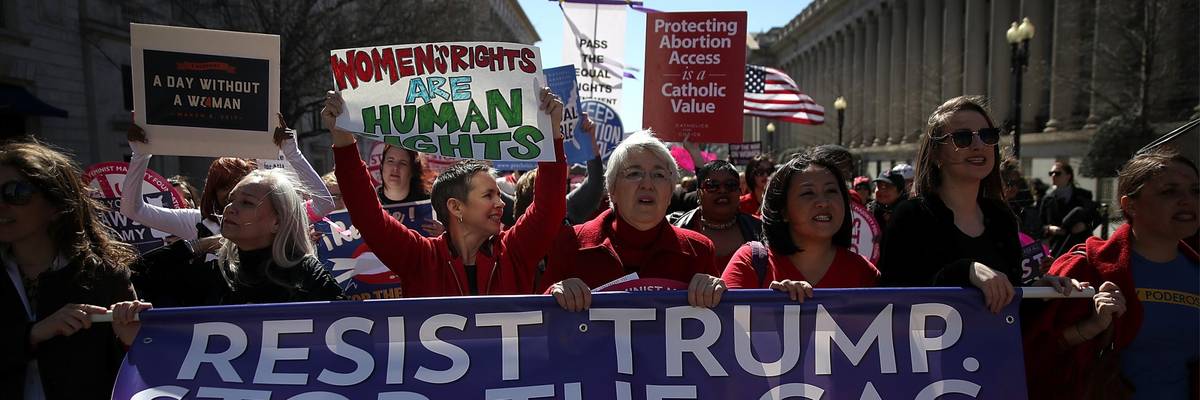
In this pre-pandemic photo, participants in a March 8, 2017 International Women's Day march in Washington, D.C. hold a sign demanding an end to the anti-choice Mexico City Policy, also known as the global gag rule, which had been revived by then-President Donald Trump in January 2017. (Photo: Justin Sullivan/Getty Images)
Former U.S. President Donald Trump's aggressively anti-choice global gag rule may be a thing of the past for now, but it is still causing "immense harm" to women around the world and should be permanently revoked.
"The Trump administration is gone but the harm from this policy continues to impact access to healthcare, particularly for the most marginalized women and girls around the world."
--Shannon Kowalski, IWHC
So says a report published Wednesday by the International Women's Health Coalition (IWHC), which documented the policy's harmful effects on women in four countries.
The IWHC report (pdf), entitled Care Denied: Year Three Impact of Trump's Global Gag Rule, studied the effects of the global gag rule--which blocks foreign organizations that provide information, referrals, or services for abortion, or advocate for decriminalization or expanding access, from receiving U.S. funding--on women in Kenya, Nepal, Nigeria, and South Africa.
Formally known as the Mexico City Policy, the global gag rule first went into effect during the administration of then-President Ronald Reagan in 1985. Every Democratic president since then has revoked the policy, while all Republican presidents--most recently Donald Trump in 2017--have reinstated it. Trump, who expanded the policy to cover all U.S. international healthcare aid, sought to further broaden it in 2020. President Joe Biden rescinded the policy in January.
Reseach has shown that the global gag rule has had the opposite effect of what its proponent intended--it has been linked to increased pregnancies and abortions in countries that accept U.S. aid.
The new IWHC report found that although the global gag rule has been revoked, it "continues to exacerbate existing barriers to healthcare access," with "services including comprehensive abortion care, contraceptive services, and HIV/AIDS testing and treatment" becoming less accessible, according to an executive summary.
That's because it takes months or even years following the lifting of the policy for organizations to draft and deliver funding proposals to U.S. aid agencies, and groups know that all their hard work may have been in vain due to the possibility of a future Republican administration reinstating the global gag rule.
The report's summary says the Mexico City Policy "continues to be harmful to the health and well-being of women and marginalized groups such as young people, people living in rural areas, and poor communities," and "creates funding gaps" while continuing "to fragment health services and halt critical health programs."
Additionally, the global gag rule is "shrinking civil society spaces, silencing voices, and creating distrust amongst collaborators and partners. Partnerships and coalitions are becoming fractured due to the policy, thereby limiting civil society's ability to work effectively and hold their governments accountable."
"The policy continues to embolden regressive actors and is creating new opportunities for such players to expand their influence," the summary states. "It has also been providing an excuse to hinder progress on sexual and reproductive health for individuals who do not support comprehensive sexual and reproductive health and rights within their professional capacities."
"Governments of countries receiving large amounts of U.S. global health funds have remained largely silent regarding the consequences of the policy on the health of their own people and have failed to take significant steps to mitigate its effects," it adds.
IWHC recommends the following steps to mitigate the ongoing impact of the global gag rule:
"The research is clear that the global gag rule is a deadly policy and will have far-reaching implications on global healthcare for years to come," said IWHC advocacy and policy director Shannon Kowalski in a statement introducing the report. "The Trump administration is gone but the harm from this policy continues to impact access to healthcare, particularly for the most marginalized women and girls around the world. And the threat of future harm is still very much a concern."
"We are encouraged by the Biden administration's action so far to remove this policy," Kowalski added. "Now, it is time for U.S. policymakers to pass the Global HER Act and end the global gag rule for good. Women's health and lives are at stake."
Dear Common Dreams reader, It’s been nearly 30 years since I co-founded Common Dreams with my late wife, Lina Newhouser. We had the radical notion that journalism should serve the public good, not corporate profits. It was clear to us from the outset what it would take to build such a project. No paid advertisements. No corporate sponsors. No millionaire publisher telling us what to think or do. Many people said we wouldn't last a year, but we proved those doubters wrong. Together with a tremendous team of journalists and dedicated staff, we built an independent media outlet free from the constraints of profits and corporate control. Our mission has always been simple: To inform. To inspire. To ignite change for the common good. Building Common Dreams was not easy. Our survival was never guaranteed. When you take on the most powerful forces—Wall Street greed, fossil fuel industry destruction, Big Tech lobbyists, and uber-rich oligarchs who have spent billions upon billions rigging the economy and democracy in their favor—the only bulwark you have is supporters who believe in your work. But here’s the urgent message from me today. It's never been this bad out there. And it's never been this hard to keep us going. At the very moment Common Dreams is most needed, the threats we face are intensifying. We need your support now more than ever. We don't accept corporate advertising and never will. We don't have a paywall because we don't think people should be blocked from critical news based on their ability to pay. Everything we do is funded by the donations of readers like you. When everyone does the little they can afford, we are strong. But if that support retreats or dries up, so do we. Will you donate now to make sure Common Dreams not only survives but thrives? —Craig Brown, Co-founder |
Former U.S. President Donald Trump's aggressively anti-choice global gag rule may be a thing of the past for now, but it is still causing "immense harm" to women around the world and should be permanently revoked.
"The Trump administration is gone but the harm from this policy continues to impact access to healthcare, particularly for the most marginalized women and girls around the world."
--Shannon Kowalski, IWHC
So says a report published Wednesday by the International Women's Health Coalition (IWHC), which documented the policy's harmful effects on women in four countries.
The IWHC report (pdf), entitled Care Denied: Year Three Impact of Trump's Global Gag Rule, studied the effects of the global gag rule--which blocks foreign organizations that provide information, referrals, or services for abortion, or advocate for decriminalization or expanding access, from receiving U.S. funding--on women in Kenya, Nepal, Nigeria, and South Africa.
Formally known as the Mexico City Policy, the global gag rule first went into effect during the administration of then-President Ronald Reagan in 1985. Every Democratic president since then has revoked the policy, while all Republican presidents--most recently Donald Trump in 2017--have reinstated it. Trump, who expanded the policy to cover all U.S. international healthcare aid, sought to further broaden it in 2020. President Joe Biden rescinded the policy in January.
Reseach has shown that the global gag rule has had the opposite effect of what its proponent intended--it has been linked to increased pregnancies and abortions in countries that accept U.S. aid.
The new IWHC report found that although the global gag rule has been revoked, it "continues to exacerbate existing barriers to healthcare access," with "services including comprehensive abortion care, contraceptive services, and HIV/AIDS testing and treatment" becoming less accessible, according to an executive summary.
That's because it takes months or even years following the lifting of the policy for organizations to draft and deliver funding proposals to U.S. aid agencies, and groups know that all their hard work may have been in vain due to the possibility of a future Republican administration reinstating the global gag rule.
The report's summary says the Mexico City Policy "continues to be harmful to the health and well-being of women and marginalized groups such as young people, people living in rural areas, and poor communities," and "creates funding gaps" while continuing "to fragment health services and halt critical health programs."
Additionally, the global gag rule is "shrinking civil society spaces, silencing voices, and creating distrust amongst collaborators and partners. Partnerships and coalitions are becoming fractured due to the policy, thereby limiting civil society's ability to work effectively and hold their governments accountable."
"The policy continues to embolden regressive actors and is creating new opportunities for such players to expand their influence," the summary states. "It has also been providing an excuse to hinder progress on sexual and reproductive health for individuals who do not support comprehensive sexual and reproductive health and rights within their professional capacities."
"Governments of countries receiving large amounts of U.S. global health funds have remained largely silent regarding the consequences of the policy on the health of their own people and have failed to take significant steps to mitigate its effects," it adds.
IWHC recommends the following steps to mitigate the ongoing impact of the global gag rule:
"The research is clear that the global gag rule is a deadly policy and will have far-reaching implications on global healthcare for years to come," said IWHC advocacy and policy director Shannon Kowalski in a statement introducing the report. "The Trump administration is gone but the harm from this policy continues to impact access to healthcare, particularly for the most marginalized women and girls around the world. And the threat of future harm is still very much a concern."
"We are encouraged by the Biden administration's action so far to remove this policy," Kowalski added. "Now, it is time for U.S. policymakers to pass the Global HER Act and end the global gag rule for good. Women's health and lives are at stake."
Former U.S. President Donald Trump's aggressively anti-choice global gag rule may be a thing of the past for now, but it is still causing "immense harm" to women around the world and should be permanently revoked.
"The Trump administration is gone but the harm from this policy continues to impact access to healthcare, particularly for the most marginalized women and girls around the world."
--Shannon Kowalski, IWHC
So says a report published Wednesday by the International Women's Health Coalition (IWHC), which documented the policy's harmful effects on women in four countries.
The IWHC report (pdf), entitled Care Denied: Year Three Impact of Trump's Global Gag Rule, studied the effects of the global gag rule--which blocks foreign organizations that provide information, referrals, or services for abortion, or advocate for decriminalization or expanding access, from receiving U.S. funding--on women in Kenya, Nepal, Nigeria, and South Africa.
Formally known as the Mexico City Policy, the global gag rule first went into effect during the administration of then-President Ronald Reagan in 1985. Every Democratic president since then has revoked the policy, while all Republican presidents--most recently Donald Trump in 2017--have reinstated it. Trump, who expanded the policy to cover all U.S. international healthcare aid, sought to further broaden it in 2020. President Joe Biden rescinded the policy in January.
Reseach has shown that the global gag rule has had the opposite effect of what its proponent intended--it has been linked to increased pregnancies and abortions in countries that accept U.S. aid.
The new IWHC report found that although the global gag rule has been revoked, it "continues to exacerbate existing barriers to healthcare access," with "services including comprehensive abortion care, contraceptive services, and HIV/AIDS testing and treatment" becoming less accessible, according to an executive summary.
That's because it takes months or even years following the lifting of the policy for organizations to draft and deliver funding proposals to U.S. aid agencies, and groups know that all their hard work may have been in vain due to the possibility of a future Republican administration reinstating the global gag rule.
The report's summary says the Mexico City Policy "continues to be harmful to the health and well-being of women and marginalized groups such as young people, people living in rural areas, and poor communities," and "creates funding gaps" while continuing "to fragment health services and halt critical health programs."
Additionally, the global gag rule is "shrinking civil society spaces, silencing voices, and creating distrust amongst collaborators and partners. Partnerships and coalitions are becoming fractured due to the policy, thereby limiting civil society's ability to work effectively and hold their governments accountable."
"The policy continues to embolden regressive actors and is creating new opportunities for such players to expand their influence," the summary states. "It has also been providing an excuse to hinder progress on sexual and reproductive health for individuals who do not support comprehensive sexual and reproductive health and rights within their professional capacities."
"Governments of countries receiving large amounts of U.S. global health funds have remained largely silent regarding the consequences of the policy on the health of their own people and have failed to take significant steps to mitigate its effects," it adds.
IWHC recommends the following steps to mitigate the ongoing impact of the global gag rule:
"The research is clear that the global gag rule is a deadly policy and will have far-reaching implications on global healthcare for years to come," said IWHC advocacy and policy director Shannon Kowalski in a statement introducing the report. "The Trump administration is gone but the harm from this policy continues to impact access to healthcare, particularly for the most marginalized women and girls around the world. And the threat of future harm is still very much a concern."
"We are encouraged by the Biden administration's action so far to remove this policy," Kowalski added. "Now, it is time for U.S. policymakers to pass the Global HER Act and end the global gag rule for good. Women's health and lives are at stake."