SUBSCRIBE TO OUR FREE NEWSLETTER
Daily news & progressive opinion—funded by the people, not the corporations—delivered straight to your inbox.
5
#000000
#FFFFFF
To donate by check, phone, or other method, see our More Ways to Give page.
Daily news & progressive opinion—funded by the people, not the corporations—delivered straight to your inbox.
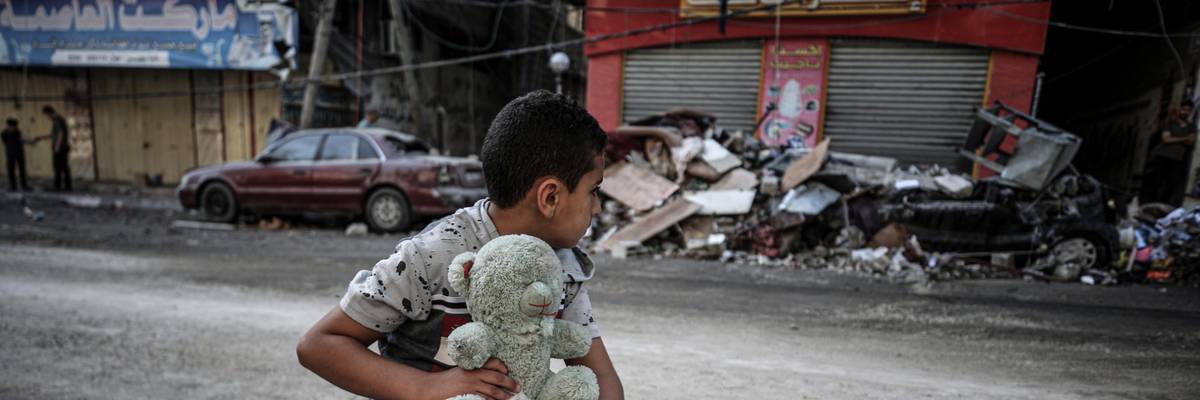
A boy with his teddy bear sits on the ruins of buildings destroyed by Israeli airstrikes in the Sheikh Ridvan neighborhood in Gaza City on May 19, 2021. (Photo: Ali Jadallah/Anadolu Agency via Getty Images)
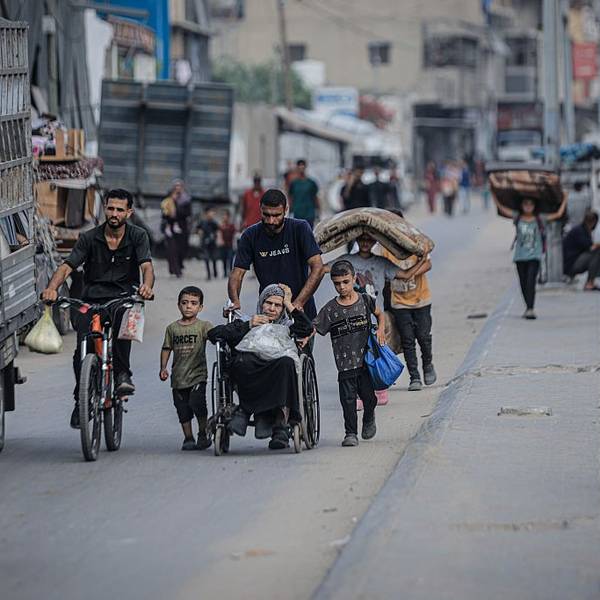
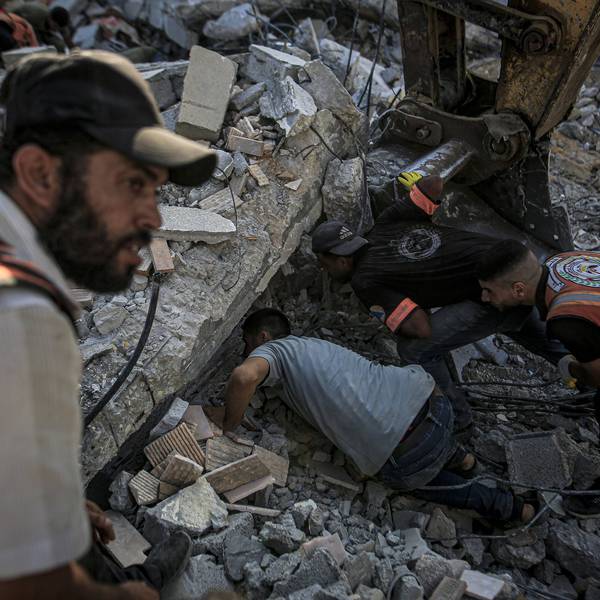
Israel's ongoing bombardment of the Gaza Strip--carried out with the diplomatic and military support of the U.S. government--has displaced nearly 60,000 people living in the occupied territory and "caused immense suffering" since it began last week, the United Nations reported Tuesday.
Over 220 Palestinians have been killed and roughly 6,040 more wounded since Israel launched its latest assault on Palestinians living in the occupied West Bank and Gaza.
"There is no safe place in Gaza, where two million people have been forcibly isolated from the rest of the world, for over 13 years," U.N. Under-Secretary-General for Humanitarian Affairs and Emergency Relief Coordinator Mark Lowcock said Tuesday. "High-frequency Israeli bombardments... have displaced over 58,000 Palestinians, many of whom are seeking refuge in U.N. Relief and Works Agency schools across Gaza."
"I am concerned about the transmission of Covid-19 between vulnerable people huddled in crowded shelters and the inability of the healthcare system to cope," said Lowcock.
Earlier this week, as Common Dreams reported, Israeli airstrikes severely damaged Gaza's lone coronavirus testing lab as well as the offices of the Palestinian Ministry of Health and killed two senior doctors--further straining the besieged territory's healthcare system that was already reeling from Israel's nearly 14-year blockade.
"I abhor the violence that has killed and injured scores of children and other civilians and caused extensive damage to homes and vital infrastructure," Lowcock said. "Damage to vital infrastructure and insufficient fuel supplies have affected water, sanitation, and hygiene services for hundreds of thousands of people. Electrical power shortages, and the damage to the Gaza Ministry of Health Central Laboratory, hinder healthcare provision at dozens of centers throughout Gaza."
Israel's destruction of civilian infrastructure was also noted by Kenneth Roth, executive director of Human Rights Watch, which issued a landmark report last month accusing Israel of the crime of apartheid.
The U.N. World Food Programme also warned Tuesday that Israel's onslaught has caused the number of Gazans suffering from hunger to spike by an estimated 160,000.
According to Lowcock, "two critical issues must be addressed" in order to respond effectively to the unfolding humanitarian catastrophe.
First, he said, "we need adequate funding to enable a speedy response." The U.N. official urged donors to "accelerate their contributions" to the Occupied Palestinian Territory Humanitarian Fund "without delay." According to Lowcock, U.N. Humanitarian Coordinator Lynn Hastings hopes to raise $14 million to meet immediate needs, after which U.N. Secretary-General Antonio Guterres is expected to request additional funding.
Second, Lowcock added, "access is paramount. Without this, the humanitarian community is unable to respond to the extent needed."
"The crossings with Gaza need to be opened and to remain as such for the entrance of essential and humanitarian supplies, including fuel for basic services and supplies to curb the spread of Covid-19," the U.N. official stressed. "Opening the crossings will also ensure the exit of patients who need life-saving treatment and the entry of special surgical emergency teams to tend to the wounded."
"I call on all parties to the hostilities to agree to a humanitarian pause to allow for emergency humanitarian relief distribution and for civilians to purchase food and water, seek medical care, and attend to other emergency needs," Lowcock added.
Right-wing Israeli Prime Minister Benjamin Netanyahu, for his part, reportedly told news media on Wednesday: "We're not standing with a stopwatch. We want to achieve the goals of the operation. Previous operations lasted a long time so it is not possible to set a timeframe."
Dear Common Dreams reader, It’s been nearly 30 years since I co-founded Common Dreams with my late wife, Lina Newhouser. We had the radical notion that journalism should serve the public good, not corporate profits. It was clear to us from the outset what it would take to build such a project. No paid advertisements. No corporate sponsors. No millionaire publisher telling us what to think or do. Many people said we wouldn't last a year, but we proved those doubters wrong. Together with a tremendous team of journalists and dedicated staff, we built an independent media outlet free from the constraints of profits and corporate control. Our mission has always been simple: To inform. To inspire. To ignite change for the common good. Building Common Dreams was not easy. Our survival was never guaranteed. When you take on the most powerful forces—Wall Street greed, fossil fuel industry destruction, Big Tech lobbyists, and uber-rich oligarchs who have spent billions upon billions rigging the economy and democracy in their favor—the only bulwark you have is supporters who believe in your work. But here’s the urgent message from me today. It's never been this bad out there. And it's never been this hard to keep us going. At the very moment Common Dreams is most needed, the threats we face are intensifying. We need your support now more than ever. We don't accept corporate advertising and never will. We don't have a paywall because we don't think people should be blocked from critical news based on their ability to pay. Everything we do is funded by the donations of readers like you. When everyone does the little they can afford, we are strong. But if that support retreats or dries up, so do we. Will you donate now to make sure Common Dreams not only survives but thrives? —Craig Brown, Co-founder |
Israel's ongoing bombardment of the Gaza Strip--carried out with the diplomatic and military support of the U.S. government--has displaced nearly 60,000 people living in the occupied territory and "caused immense suffering" since it began last week, the United Nations reported Tuesday.
Over 220 Palestinians have been killed and roughly 6,040 more wounded since Israel launched its latest assault on Palestinians living in the occupied West Bank and Gaza.
"There is no safe place in Gaza, where two million people have been forcibly isolated from the rest of the world, for over 13 years," U.N. Under-Secretary-General for Humanitarian Affairs and Emergency Relief Coordinator Mark Lowcock said Tuesday. "High-frequency Israeli bombardments... have displaced over 58,000 Palestinians, many of whom are seeking refuge in U.N. Relief and Works Agency schools across Gaza."
"I am concerned about the transmission of Covid-19 between vulnerable people huddled in crowded shelters and the inability of the healthcare system to cope," said Lowcock.
Earlier this week, as Common Dreams reported, Israeli airstrikes severely damaged Gaza's lone coronavirus testing lab as well as the offices of the Palestinian Ministry of Health and killed two senior doctors--further straining the besieged territory's healthcare system that was already reeling from Israel's nearly 14-year blockade.
"I abhor the violence that has killed and injured scores of children and other civilians and caused extensive damage to homes and vital infrastructure," Lowcock said. "Damage to vital infrastructure and insufficient fuel supplies have affected water, sanitation, and hygiene services for hundreds of thousands of people. Electrical power shortages, and the damage to the Gaza Ministry of Health Central Laboratory, hinder healthcare provision at dozens of centers throughout Gaza."
Israel's destruction of civilian infrastructure was also noted by Kenneth Roth, executive director of Human Rights Watch, which issued a landmark report last month accusing Israel of the crime of apartheid.
The U.N. World Food Programme also warned Tuesday that Israel's onslaught has caused the number of Gazans suffering from hunger to spike by an estimated 160,000.
According to Lowcock, "two critical issues must be addressed" in order to respond effectively to the unfolding humanitarian catastrophe.
First, he said, "we need adequate funding to enable a speedy response." The U.N. official urged donors to "accelerate their contributions" to the Occupied Palestinian Territory Humanitarian Fund "without delay." According to Lowcock, U.N. Humanitarian Coordinator Lynn Hastings hopes to raise $14 million to meet immediate needs, after which U.N. Secretary-General Antonio Guterres is expected to request additional funding.
Second, Lowcock added, "access is paramount. Without this, the humanitarian community is unable to respond to the extent needed."
"The crossings with Gaza need to be opened and to remain as such for the entrance of essential and humanitarian supplies, including fuel for basic services and supplies to curb the spread of Covid-19," the U.N. official stressed. "Opening the crossings will also ensure the exit of patients who need life-saving treatment and the entry of special surgical emergency teams to tend to the wounded."
"I call on all parties to the hostilities to agree to a humanitarian pause to allow for emergency humanitarian relief distribution and for civilians to purchase food and water, seek medical care, and attend to other emergency needs," Lowcock added.
Right-wing Israeli Prime Minister Benjamin Netanyahu, for his part, reportedly told news media on Wednesday: "We're not standing with a stopwatch. We want to achieve the goals of the operation. Previous operations lasted a long time so it is not possible to set a timeframe."
Israel's ongoing bombardment of the Gaza Strip--carried out with the diplomatic and military support of the U.S. government--has displaced nearly 60,000 people living in the occupied territory and "caused immense suffering" since it began last week, the United Nations reported Tuesday.
Over 220 Palestinians have been killed and roughly 6,040 more wounded since Israel launched its latest assault on Palestinians living in the occupied West Bank and Gaza.
"There is no safe place in Gaza, where two million people have been forcibly isolated from the rest of the world, for over 13 years," U.N. Under-Secretary-General for Humanitarian Affairs and Emergency Relief Coordinator Mark Lowcock said Tuesday. "High-frequency Israeli bombardments... have displaced over 58,000 Palestinians, many of whom are seeking refuge in U.N. Relief and Works Agency schools across Gaza."
"I am concerned about the transmission of Covid-19 between vulnerable people huddled in crowded shelters and the inability of the healthcare system to cope," said Lowcock.
Earlier this week, as Common Dreams reported, Israeli airstrikes severely damaged Gaza's lone coronavirus testing lab as well as the offices of the Palestinian Ministry of Health and killed two senior doctors--further straining the besieged territory's healthcare system that was already reeling from Israel's nearly 14-year blockade.
"I abhor the violence that has killed and injured scores of children and other civilians and caused extensive damage to homes and vital infrastructure," Lowcock said. "Damage to vital infrastructure and insufficient fuel supplies have affected water, sanitation, and hygiene services for hundreds of thousands of people. Electrical power shortages, and the damage to the Gaza Ministry of Health Central Laboratory, hinder healthcare provision at dozens of centers throughout Gaza."
Israel's destruction of civilian infrastructure was also noted by Kenneth Roth, executive director of Human Rights Watch, which issued a landmark report last month accusing Israel of the crime of apartheid.
The U.N. World Food Programme also warned Tuesday that Israel's onslaught has caused the number of Gazans suffering from hunger to spike by an estimated 160,000.
According to Lowcock, "two critical issues must be addressed" in order to respond effectively to the unfolding humanitarian catastrophe.
First, he said, "we need adequate funding to enable a speedy response." The U.N. official urged donors to "accelerate their contributions" to the Occupied Palestinian Territory Humanitarian Fund "without delay." According to Lowcock, U.N. Humanitarian Coordinator Lynn Hastings hopes to raise $14 million to meet immediate needs, after which U.N. Secretary-General Antonio Guterres is expected to request additional funding.
Second, Lowcock added, "access is paramount. Without this, the humanitarian community is unable to respond to the extent needed."
"The crossings with Gaza need to be opened and to remain as such for the entrance of essential and humanitarian supplies, including fuel for basic services and supplies to curb the spread of Covid-19," the U.N. official stressed. "Opening the crossings will also ensure the exit of patients who need life-saving treatment and the entry of special surgical emergency teams to tend to the wounded."
"I call on all parties to the hostilities to agree to a humanitarian pause to allow for emergency humanitarian relief distribution and for civilians to purchase food and water, seek medical care, and attend to other emergency needs," Lowcock added.
Right-wing Israeli Prime Minister Benjamin Netanyahu, for his part, reportedly told news media on Wednesday: "We're not standing with a stopwatch. We want to achieve the goals of the operation. Previous operations lasted a long time so it is not possible to set a timeframe."