

SUBSCRIBE TO OUR FREE NEWSLETTER
Daily news & progressive opinion—funded by the people, not the corporations—delivered straight to your inbox.
5
#000000
#FFFFFF
To donate by check, phone, or other method, see our More Ways to Give page.
Daily news & progressive opinion—funded by the people, not the corporations—delivered straight to your inbox.
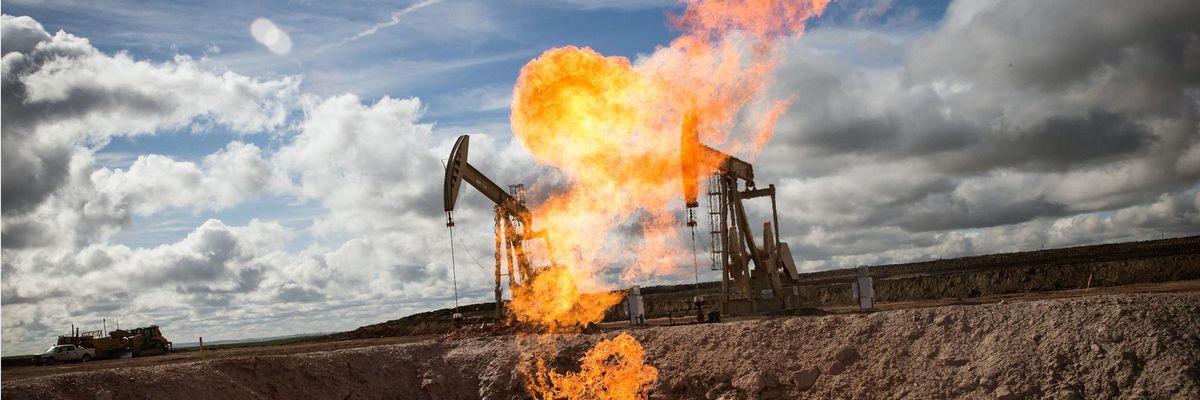
A gas flare is seen at an oil well site on July 26, 2013 outside Williston, North Dakota. Gas flares are created when excess flammable gases are released by pressure release valves during the drilling for oil and natural gas. (Photo: Andrew Burton/Getty Images)
The critical importance of reducing global methane emissions, including those generated by the fossil fuel industry, is more significant than previously understood, according to a report published Thursday by the United Nations Environment Program.
"We need international cooperation to urgently reduce methane emissions as much as possible this decade."
--Inger Andersen, UNEP
The new global methane assessment (pdf) concludes that slashing a pollutant that is 84 to 87 times more potent than carbon dioxide over a 20-year period is a crucial step needed to tackle the climate emergency.
According to the report, cutting methane emissions dramatically is relatively inexpensive and could be accomplished by repairing leaking fossil fuel pipelines, preventing natural gas venting during drilling, capturing gas emitted by landfills, and reducing animal agriculture.
"Reducing human-caused methane emissions is one of the most cost-effective strategies to rapidly reduce the rate of warming and contribute significantly to global efforts to limit temperature rise to 1.5degC," an executive summary of the report states, referring to the more ambitious goal of the Paris climate agreement.
"Available targeted methane measures, together with additional measures that contribute to priority development goals, can simultaneously reduce human-caused methane emissions by as much as 45%, or 180 million tonnes a year (Mt/yr), by 2030," the summary continues. "This will avoid nearly 0.3degC of global warming by the 2040s and complement all long-term climate change mitigation efforts."
"It would also, each year, prevent 255,000 premature deaths, 775 000 asthma-related hospital visits, 73 billion hours of lost labor from extreme heat, and 26 million tonnes of crop losses globally," it adds.
In a statement announcing the new report, UNEP Executive Director Inger Andersen said that "cutting methane is the strongest lever we have to slow climate change over the next 25 years and complements necessary efforts to reduce carbon dioxide."
As Common Dreams reported last month, a study published by the U.S. National Oceanic and Atmospheric Administration revealed that both carbon and methane emissions rose in 2020 to levels unseen on Earth for more than three million years, despite the temporary reduction in global emissions due to the coronavirus pandemic.
"The benefits to society, economies, and the environment are numerous and far outweigh the cost," Andersen said Thursday. "We need international cooperation to urgently reduce methane emissions as much as possible this decade."
"It is absolutely critical that we tackle methane and that we tackle it expeditiously," she stressed.
Environmental groups weighed in on the new report, with Center for Biological Diversity population and sustainability director Stephanie Feldstein noting the impact of animal agriculture on methane emissions.
"Methane from meat and dairy production has been ignored for far too long even though it's a leading source of climate pollution," Feldstein said in a statement. "Americans eat three times the global average of meat. We can't lower methane emissions with unproven half-measures that cater to the ag industry. We have to reduce meat consumption and production if we're going to effectively address agricultural methane."
Dear Common Dreams reader, It’s been nearly 30 years since I co-founded Common Dreams with my late wife, Lina Newhouser. We had the radical notion that journalism should serve the public good, not corporate profits. It was clear to us from the outset what it would take to build such a project. No paid advertisements. No corporate sponsors. No millionaire publisher telling us what to think or do. Many people said we wouldn't last a year, but we proved those doubters wrong. Together with a tremendous team of journalists and dedicated staff, we built an independent media outlet free from the constraints of profits and corporate control. Our mission has always been simple: To inform. To inspire. To ignite change for the common good. Building Common Dreams was not easy. Our survival was never guaranteed. When you take on the most powerful forces—Wall Street greed, fossil fuel industry destruction, Big Tech lobbyists, and uber-rich oligarchs who have spent billions upon billions rigging the economy and democracy in their favor—the only bulwark you have is supporters who believe in your work. But here’s the urgent message from me today. It's never been this bad out there. And it's never been this hard to keep us going. At the very moment Common Dreams is most needed, the threats we face are intensifying. We need your support now more than ever. We don't accept corporate advertising and never will. We don't have a paywall because we don't think people should be blocked from critical news based on their ability to pay. Everything we do is funded by the donations of readers like you. When everyone does the little they can afford, we are strong. But if that support retreats or dries up, so do we. Will you donate now to make sure Common Dreams not only survives but thrives? —Craig Brown, Co-founder |
The critical importance of reducing global methane emissions, including those generated by the fossil fuel industry, is more significant than previously understood, according to a report published Thursday by the United Nations Environment Program.
"We need international cooperation to urgently reduce methane emissions as much as possible this decade."
--Inger Andersen, UNEP
The new global methane assessment (pdf) concludes that slashing a pollutant that is 84 to 87 times more potent than carbon dioxide over a 20-year period is a crucial step needed to tackle the climate emergency.
According to the report, cutting methane emissions dramatically is relatively inexpensive and could be accomplished by repairing leaking fossil fuel pipelines, preventing natural gas venting during drilling, capturing gas emitted by landfills, and reducing animal agriculture.
"Reducing human-caused methane emissions is one of the most cost-effective strategies to rapidly reduce the rate of warming and contribute significantly to global efforts to limit temperature rise to 1.5degC," an executive summary of the report states, referring to the more ambitious goal of the Paris climate agreement.
"Available targeted methane measures, together with additional measures that contribute to priority development goals, can simultaneously reduce human-caused methane emissions by as much as 45%, or 180 million tonnes a year (Mt/yr), by 2030," the summary continues. "This will avoid nearly 0.3degC of global warming by the 2040s and complement all long-term climate change mitigation efforts."
"It would also, each year, prevent 255,000 premature deaths, 775 000 asthma-related hospital visits, 73 billion hours of lost labor from extreme heat, and 26 million tonnes of crop losses globally," it adds.
In a statement announcing the new report, UNEP Executive Director Inger Andersen said that "cutting methane is the strongest lever we have to slow climate change over the next 25 years and complements necessary efforts to reduce carbon dioxide."
As Common Dreams reported last month, a study published by the U.S. National Oceanic and Atmospheric Administration revealed that both carbon and methane emissions rose in 2020 to levels unseen on Earth for more than three million years, despite the temporary reduction in global emissions due to the coronavirus pandemic.
"The benefits to society, economies, and the environment are numerous and far outweigh the cost," Andersen said Thursday. "We need international cooperation to urgently reduce methane emissions as much as possible this decade."
"It is absolutely critical that we tackle methane and that we tackle it expeditiously," she stressed.
Environmental groups weighed in on the new report, with Center for Biological Diversity population and sustainability director Stephanie Feldstein noting the impact of animal agriculture on methane emissions.
"Methane from meat and dairy production has been ignored for far too long even though it's a leading source of climate pollution," Feldstein said in a statement. "Americans eat three times the global average of meat. We can't lower methane emissions with unproven half-measures that cater to the ag industry. We have to reduce meat consumption and production if we're going to effectively address agricultural methane."
The critical importance of reducing global methane emissions, including those generated by the fossil fuel industry, is more significant than previously understood, according to a report published Thursday by the United Nations Environment Program.
"We need international cooperation to urgently reduce methane emissions as much as possible this decade."
--Inger Andersen, UNEP
The new global methane assessment (pdf) concludes that slashing a pollutant that is 84 to 87 times more potent than carbon dioxide over a 20-year period is a crucial step needed to tackle the climate emergency.
According to the report, cutting methane emissions dramatically is relatively inexpensive and could be accomplished by repairing leaking fossil fuel pipelines, preventing natural gas venting during drilling, capturing gas emitted by landfills, and reducing animal agriculture.
"Reducing human-caused methane emissions is one of the most cost-effective strategies to rapidly reduce the rate of warming and contribute significantly to global efforts to limit temperature rise to 1.5degC," an executive summary of the report states, referring to the more ambitious goal of the Paris climate agreement.
"Available targeted methane measures, together with additional measures that contribute to priority development goals, can simultaneously reduce human-caused methane emissions by as much as 45%, or 180 million tonnes a year (Mt/yr), by 2030," the summary continues. "This will avoid nearly 0.3degC of global warming by the 2040s and complement all long-term climate change mitigation efforts."
"It would also, each year, prevent 255,000 premature deaths, 775 000 asthma-related hospital visits, 73 billion hours of lost labor from extreme heat, and 26 million tonnes of crop losses globally," it adds.
In a statement announcing the new report, UNEP Executive Director Inger Andersen said that "cutting methane is the strongest lever we have to slow climate change over the next 25 years and complements necessary efforts to reduce carbon dioxide."
As Common Dreams reported last month, a study published by the U.S. National Oceanic and Atmospheric Administration revealed that both carbon and methane emissions rose in 2020 to levels unseen on Earth for more than three million years, despite the temporary reduction in global emissions due to the coronavirus pandemic.
"The benefits to society, economies, and the environment are numerous and far outweigh the cost," Andersen said Thursday. "We need international cooperation to urgently reduce methane emissions as much as possible this decade."
"It is absolutely critical that we tackle methane and that we tackle it expeditiously," she stressed.
Environmental groups weighed in on the new report, with Center for Biological Diversity population and sustainability director Stephanie Feldstein noting the impact of animal agriculture on methane emissions.
"Methane from meat and dairy production has been ignored for far too long even though it's a leading source of climate pollution," Feldstein said in a statement. "Americans eat three times the global average of meat. We can't lower methane emissions with unproven half-measures that cater to the ag industry. We have to reduce meat consumption and production if we're going to effectively address agricultural methane."

