SUBSCRIBE TO OUR FREE NEWSLETTER
Daily news & progressive opinion—funded by the people, not the corporations—delivered straight to your inbox.
5
#000000
#FFFFFF
To donate by check, phone, or other method, see our More Ways to Give page.
Daily news & progressive opinion—funded by the people, not the corporations—delivered straight to your inbox.
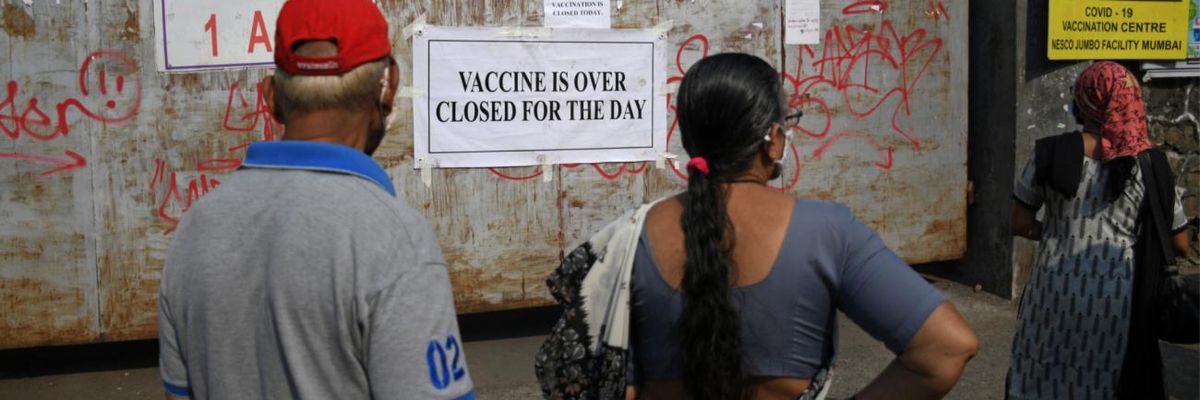
People stand near the gate of a vaccination center with a notice saying "vaccine is over, closed for the day" in Mumbai. (Photo: Ashish Vaishnav/SOPA Images/LightRocket via Getty Images)
Advocates for vaccine equity on Monday responded to the news of Moderna's pledge to make 500 million doses of its vaccine available to developing countries by calling for a truly global effort to end the coronavirus pandemic--rather than individual acts of charity by pharmaceutical companies.
The company said Monday it will supply COVAX, the coronavirus vaccine facility supported by Gavi, the Vaccine Alliance; the Coalition for Epidemic Preparedness Innovations; and the World Health Organization (WHO) with 34 million doses of its vaccine in the fourth quarter of 2021, with 466 million doses available in 2022. According to the Washington Post, Moderna is offering the doses at its "lowest tiered price."
Kate Elder, senior vaccines policy adviser for Doctors Without Borders, wrote on social media that "any additional dose commitments to COVAX is a step in the right direction" and called the pledge "good news," but expressed doubt that 34 million doses provided several months from now, when countries including India are currently facing severe outbreaks, will make the kind of difference needed to combat the pandemic.
"We need Moderna doses now, not in Q4 2021. Why the long wait?" asked Elder.
Moderna's pledge comes as India faces one of the worst Covid-19 outbreaks in the world, as well as a shortage of the vaccine developed in the country. In the nation of 1.3 billion people, just 2% of the population is fully vaccinated while less that 10% has had one dose. In the U.S., nearly a third of the population has now been fully vaccinated.
More than 401,000 new cases were reported in India on Saturday, setting a new world record, and the country has seen an average of more than 3,000 deaths per day, according to official counts--which may vastly understate the true toll.
The Serum Institute of India said Monday that the country's vaccine shortage could last for months, as the government was not prepared for the current second wave, which some experts believe is being driven by a new variant of the virus.
While Moderna's pledge offers some hope that India will have access to more vaccine doses in the future, journalist Anand Giridharadas said, the company's plan "is not a substitute for patent justice."
"We can't count on the benevolence of Big Pharma corporations" to end the global pandemic, added the advocacy group Lower Drug Prices Now, which has called on the World Trade Organization to lift patents on the vaccines made by Pfizer and Moderna, allowing for the manufacture of generic versions of the vaccines.
The WHO has warned that continuing to allow access to the bulk of vaccine doses only in wealthy countries would be a "catastrophic moral failure," as well as a failure to work effectively to end the coronavirus crisis.
"If a temporary waiver to patents cannot be issued now, during these unprecedented times, when will be the right time?" WHO Director-General Tedros Adhanom Ghebreyesus said in March. "Solidarity is the only way out."
On Sunday, White House national security adviser Jake Sullivan said that U.S. Trade Representative Katherine Tai has begun "intensive consultations" at the WTO regarding the possibility of waiving patents, amid intensifying global pressure.
The outcome of failing to embark on a global effort to end the pandemic "is not only sporadic flare-ups or confined challenges," wrote Guardian columnist Nesrine Malik on Monday, "but an entire population trapped by and condemned to live with the virus."
"What is required is something far more ambitious than vaccine donations," Malik added. "The world needs a global logistical exercise, a sort of Marshall plan that would provide financial support, expert manpower, and medical technology... As the virus recedes in the west, now is the time to apply this kind of pressure on leaders to deliver the south from its almost certain fate. By the time the real numbers of deaths and infections in poorer countries become clear, it will be far too late for many people."
Dear Common Dreams reader, It’s been nearly 30 years since I co-founded Common Dreams with my late wife, Lina Newhouser. We had the radical notion that journalism should serve the public good, not corporate profits. It was clear to us from the outset what it would take to build such a project. No paid advertisements. No corporate sponsors. No millionaire publisher telling us what to think or do. Many people said we wouldn't last a year, but we proved those doubters wrong. Together with a tremendous team of journalists and dedicated staff, we built an independent media outlet free from the constraints of profits and corporate control. Our mission has always been simple: To inform. To inspire. To ignite change for the common good. Building Common Dreams was not easy. Our survival was never guaranteed. When you take on the most powerful forces—Wall Street greed, fossil fuel industry destruction, Big Tech lobbyists, and uber-rich oligarchs who have spent billions upon billions rigging the economy and democracy in their favor—the only bulwark you have is supporters who believe in your work. But here’s the urgent message from me today. It's never been this bad out there. And it's never been this hard to keep us going. At the very moment Common Dreams is most needed, the threats we face are intensifying. We need your support now more than ever. We don't accept corporate advertising and never will. We don't have a paywall because we don't think people should be blocked from critical news based on their ability to pay. Everything we do is funded by the donations of readers like you. When everyone does the little they can afford, we are strong. But if that support retreats or dries up, so do we. Will you donate now to make sure Common Dreams not only survives but thrives? —Craig Brown, Co-founder |
Advocates for vaccine equity on Monday responded to the news of Moderna's pledge to make 500 million doses of its vaccine available to developing countries by calling for a truly global effort to end the coronavirus pandemic--rather than individual acts of charity by pharmaceutical companies.
The company said Monday it will supply COVAX, the coronavirus vaccine facility supported by Gavi, the Vaccine Alliance; the Coalition for Epidemic Preparedness Innovations; and the World Health Organization (WHO) with 34 million doses of its vaccine in the fourth quarter of 2021, with 466 million doses available in 2022. According to the Washington Post, Moderna is offering the doses at its "lowest tiered price."
Kate Elder, senior vaccines policy adviser for Doctors Without Borders, wrote on social media that "any additional dose commitments to COVAX is a step in the right direction" and called the pledge "good news," but expressed doubt that 34 million doses provided several months from now, when countries including India are currently facing severe outbreaks, will make the kind of difference needed to combat the pandemic.
"We need Moderna doses now, not in Q4 2021. Why the long wait?" asked Elder.
Moderna's pledge comes as India faces one of the worst Covid-19 outbreaks in the world, as well as a shortage of the vaccine developed in the country. In the nation of 1.3 billion people, just 2% of the population is fully vaccinated while less that 10% has had one dose. In the U.S., nearly a third of the population has now been fully vaccinated.
More than 401,000 new cases were reported in India on Saturday, setting a new world record, and the country has seen an average of more than 3,000 deaths per day, according to official counts--which may vastly understate the true toll.
The Serum Institute of India said Monday that the country's vaccine shortage could last for months, as the government was not prepared for the current second wave, which some experts believe is being driven by a new variant of the virus.
While Moderna's pledge offers some hope that India will have access to more vaccine doses in the future, journalist Anand Giridharadas said, the company's plan "is not a substitute for patent justice."
"We can't count on the benevolence of Big Pharma corporations" to end the global pandemic, added the advocacy group Lower Drug Prices Now, which has called on the World Trade Organization to lift patents on the vaccines made by Pfizer and Moderna, allowing for the manufacture of generic versions of the vaccines.
The WHO has warned that continuing to allow access to the bulk of vaccine doses only in wealthy countries would be a "catastrophic moral failure," as well as a failure to work effectively to end the coronavirus crisis.
"If a temporary waiver to patents cannot be issued now, during these unprecedented times, when will be the right time?" WHO Director-General Tedros Adhanom Ghebreyesus said in March. "Solidarity is the only way out."
On Sunday, White House national security adviser Jake Sullivan said that U.S. Trade Representative Katherine Tai has begun "intensive consultations" at the WTO regarding the possibility of waiving patents, amid intensifying global pressure.
The outcome of failing to embark on a global effort to end the pandemic "is not only sporadic flare-ups or confined challenges," wrote Guardian columnist Nesrine Malik on Monday, "but an entire population trapped by and condemned to live with the virus."
"What is required is something far more ambitious than vaccine donations," Malik added. "The world needs a global logistical exercise, a sort of Marshall plan that would provide financial support, expert manpower, and medical technology... As the virus recedes in the west, now is the time to apply this kind of pressure on leaders to deliver the south from its almost certain fate. By the time the real numbers of deaths and infections in poorer countries become clear, it will be far too late for many people."
Advocates for vaccine equity on Monday responded to the news of Moderna's pledge to make 500 million doses of its vaccine available to developing countries by calling for a truly global effort to end the coronavirus pandemic--rather than individual acts of charity by pharmaceutical companies.
The company said Monday it will supply COVAX, the coronavirus vaccine facility supported by Gavi, the Vaccine Alliance; the Coalition for Epidemic Preparedness Innovations; and the World Health Organization (WHO) with 34 million doses of its vaccine in the fourth quarter of 2021, with 466 million doses available in 2022. According to the Washington Post, Moderna is offering the doses at its "lowest tiered price."
Kate Elder, senior vaccines policy adviser for Doctors Without Borders, wrote on social media that "any additional dose commitments to COVAX is a step in the right direction" and called the pledge "good news," but expressed doubt that 34 million doses provided several months from now, when countries including India are currently facing severe outbreaks, will make the kind of difference needed to combat the pandemic.
"We need Moderna doses now, not in Q4 2021. Why the long wait?" asked Elder.
Moderna's pledge comes as India faces one of the worst Covid-19 outbreaks in the world, as well as a shortage of the vaccine developed in the country. In the nation of 1.3 billion people, just 2% of the population is fully vaccinated while less that 10% has had one dose. In the U.S., nearly a third of the population has now been fully vaccinated.
More than 401,000 new cases were reported in India on Saturday, setting a new world record, and the country has seen an average of more than 3,000 deaths per day, according to official counts--which may vastly understate the true toll.
The Serum Institute of India said Monday that the country's vaccine shortage could last for months, as the government was not prepared for the current second wave, which some experts believe is being driven by a new variant of the virus.
While Moderna's pledge offers some hope that India will have access to more vaccine doses in the future, journalist Anand Giridharadas said, the company's plan "is not a substitute for patent justice."
"We can't count on the benevolence of Big Pharma corporations" to end the global pandemic, added the advocacy group Lower Drug Prices Now, which has called on the World Trade Organization to lift patents on the vaccines made by Pfizer and Moderna, allowing for the manufacture of generic versions of the vaccines.
The WHO has warned that continuing to allow access to the bulk of vaccine doses only in wealthy countries would be a "catastrophic moral failure," as well as a failure to work effectively to end the coronavirus crisis.
"If a temporary waiver to patents cannot be issued now, during these unprecedented times, when will be the right time?" WHO Director-General Tedros Adhanom Ghebreyesus said in March. "Solidarity is the only way out."
On Sunday, White House national security adviser Jake Sullivan said that U.S. Trade Representative Katherine Tai has begun "intensive consultations" at the WTO regarding the possibility of waiving patents, amid intensifying global pressure.
The outcome of failing to embark on a global effort to end the pandemic "is not only sporadic flare-ups or confined challenges," wrote Guardian columnist Nesrine Malik on Monday, "but an entire population trapped by and condemned to live with the virus."
"What is required is something far more ambitious than vaccine donations," Malik added. "The world needs a global logistical exercise, a sort of Marshall plan that would provide financial support, expert manpower, and medical technology... As the virus recedes in the west, now is the time to apply this kind of pressure on leaders to deliver the south from its almost certain fate. By the time the real numbers of deaths and infections in poorer countries become clear, it will be far too late for many people."